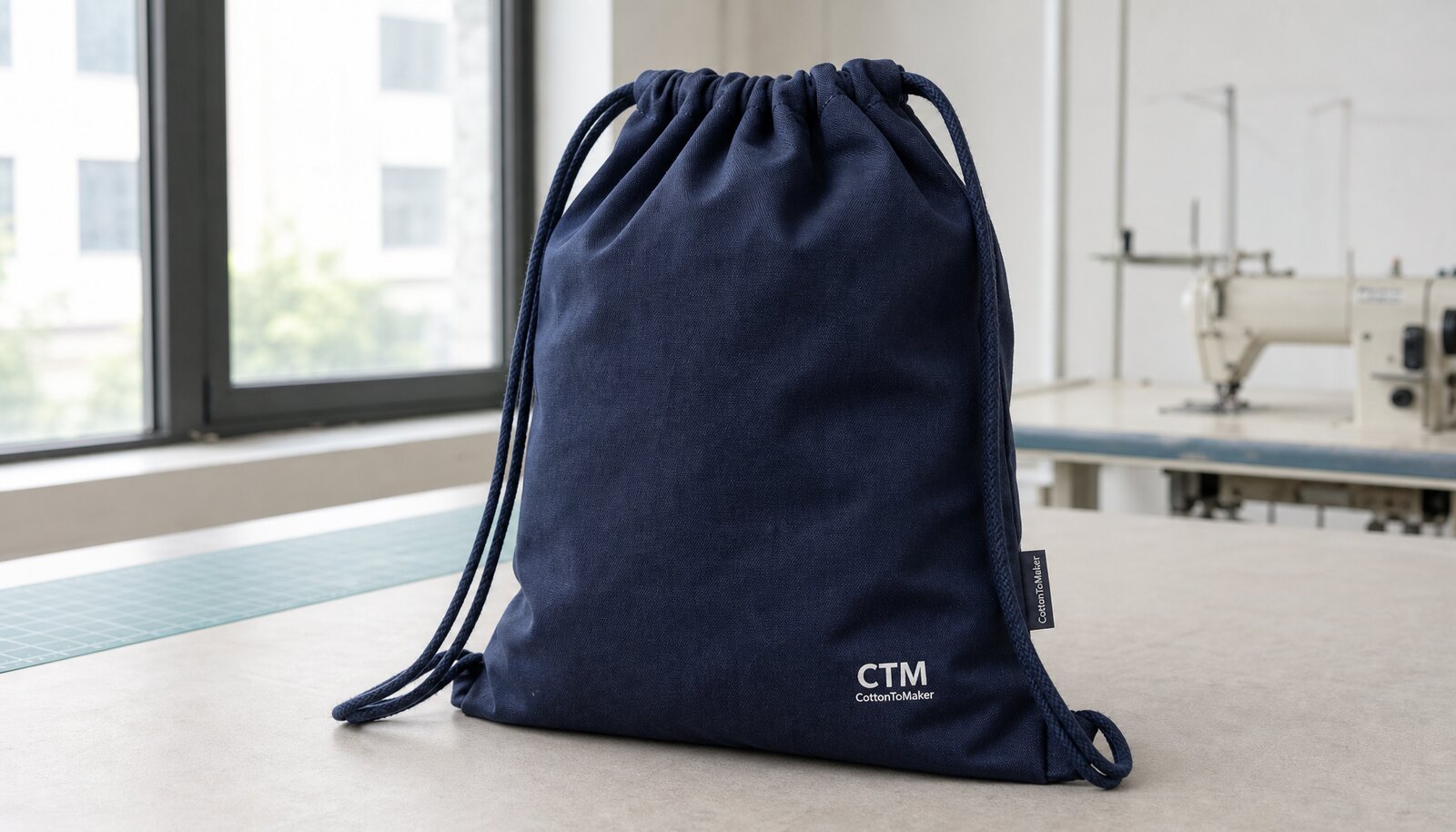
Why monogrammed drawstring backpacks fail at the quote stage
Most sourcing problems start before production. A monogrammed drawstring backpack looks simple, but the quote can be built on completely different assumptions: a thin 80 GSM cotton bag with a quick screen print, a heavier 200 GSM canvas version with tighter seams, or a polyester pack decorated by heat transfer. If the RFQ does not name the fabric, size, closure, and decoration method, suppliers will fill the gap with their cheapest interpretation.
For procurement teams, the real issue is not whether the bag is attractive in a sample photo. It is whether the quote supports the selling channel you actually need. A distributor program may need low landed cost and compact packing. A retail brand may need better hand-feel, consistent monogram placement, and a cleaner fold. A school, club, or event buyer may care more about durability and fast turnaround than premium finishing.
- Do not send only the word “monogrammed”; define initials, full name, logo lockup, or side-label branding.
- State the end use: retail, giveaway, membership pack, school, sports, travel, or gift set.
- Separate the product spec from the decoration spec so the supplier cannot blend them into one vague line item.
Choose the right base fabric before you compare prices
For a monogrammed drawstring backpack, fabric choice drives cost, print appearance, and failure rate more than most buyers expect. Cotton canvas in the 140-200 GSM range gives a more natural retail feel and supports cleaner print edges than very loose weaves. If the bag is meant to carry shoes, apparel, or event items, this range usually gives a better balance between drape and structure. Polyester options in 210D-300D are lighter and often cheaper to ship, but the hand-feel is more promotional unless the finishing is upgraded.
If you want a premium-looking monogram, avoid very flimsy cloth. Thin fabrics make the logo look cheap because the surface ripples under the screen or stitching pulls the face panel. A better spec is often a plain-woven cotton or cotton-poly blend with enough body that the front panel hangs flat. If the buyer wants a natural look but not a heavy bag, many factories can build a 160-180 GSM canvas version that still packs efficiently.
- Use 140-160 GSM for lighter gifting or event distribution where weight matters.
- Use 180-200 GSM when the bag will be reused often or sold through retail channels.
- Ask whether the fabric is prewashed or pre-shrunk if dimensional stability matters after first use.
Decide the monogram style early, because decoration changes the whole cost structure
A monogram can be done as a small one-color print, multi-color print, embroidery, woven label, or embossed patch. The cheapest route is usually a one-color screen print with a simple initial or name block. That is the most practical option when the artwork repeats across many units and the bag needs a clean front face. If the brand wants a giftable look, a small woven label or embroidery can feel more premium, but the cost and setup logic changes fast.
Embroidery is not automatically better. It adds texture, but on soft or loosely woven cloth the stitches can distort the fabric, especially if the monogram is small or uses thin strokes. Screen printing is usually the safer choice for crisp initials, especially where the monogram is bold and has limited detail. Heat transfer may look fine at first but can be less durable on rough handling unless the buyer tests rubbing, folding, and wash exposure.
- For fine script monograms, test whether the smallest stroke thickness survives the selected method.
- Keep the decorated area away from seam lines and cord tunnels.
- If the bag is sold as retail, require a rub test on the decorated area before approval.
How to compare supplier routes without comparing apples to oranges
The cheapest quote is not always the best quote, because different sourcing routes bundle different risks. A direct factory can usually control fabric, stitching, and decoration better at repeat volume. A trading company may be faster for mixed SKUs or smaller buys, but you need more visibility on where the sewing and printing actually happen. Local decorators can be useful for urgent jobs, but the base bag may be sourced elsewhere, which makes quality consistency harder to manage across reorders.
For a monogrammed drawstring backpack, the best sourcing route depends on the order profile. If you need 3,000-10,000 pcs with a stable repeat design, direct factory sourcing usually gives the best cost control and the cleanest spec lock. If you need 100-300 pcs for a launch test or regional promo, a stock-bag decorator can be the fastest route, but unit cost and custom options will usually be worse. The quote should show where the savings or markup is coming from.
- Direct factory: best for repeat volume, clearer QC ownership, and better control of fabric and cord sourcing.
- Trading company: useful for multi-category consolidation, but confirm the actual production site.
- Local decorator: good for speed, but check whether the blank bag quality matches the finish you want.
Use real MOQ logic, not just the headline minimum
MOQ on a monogrammed drawstring backpack is rarely one number. There is often a minimum by fabric color, by print method, and by packaging format. A factory may quote 500 pcs minimum for a printed cotton bag, but if you need two colors, retail folding, and barcode labels, the practical MOQ might rise because labor and setup are spread over more units. If you need embroidery, the true minimum may be lower for the bag body but higher for decoration setup efficiency.
Procurement teams should compare MOQ in the context of inventory risk. A buyer launching a new retail SKU may prefer a slightly higher MOQ if it unlocks a cleaner build and lower defect rate. A distributor testing a seasonal campaign may prefer a higher unit price on a lower MOQ if it reduces leftover stock. The important point is to get the supplier to separate base bag MOQ from decoration MOQ, because those are not the same commercial constraint.
- Ask for MOQ by color, by artwork version, and by packing method.
- Check whether plain stock bags can be decorated below the full custom MOQ.
- If you need multiple monograms, confirm whether each version carries a separate setup fee.
What a usable quote should actually include
A workable quote for a monogrammed drawstring backpack should show the base bag price, the decoration charge, packing cost, and the sample charge separately. If these are bundled into one number, it becomes impossible to tell where the supplier is competitive and where the price is padded. Buyers comparing factories should also request the exact fabric GSM, cord type, size, and carton pack-out on the same line sheet so that one supplier cannot quietly quote a lighter bag or simpler decoration.
Ask for at least two quantity breaks. A typical commercial pattern might be 500 pcs, 1,000 pcs, and 3,000 pcs, with a note on whether the print setup fee is amortized or charged once. For example, a quote might move from a higher first-tier unit price at 500 pcs to a lower unit price at 3,000 pcs because the print setup and cutting loss are spread across the order. Without that detail, the buyer cannot model landed cost or forecast reorder economics.
- Require separate lines for sample fee, tooling or setup, unit price, packing, and carton charge.
- Make the supplier state whether freight and customs are excluded.
- If the price looks unusually low, check whether the bag is quoted with a thinner fabric or a smaller print area.
Use a simple landed-cost view before you approve the art
Landed cost on this product is usually moved by four things: fabric weight, decoration method, packing format, and carton efficiency. A heavier canvas bag may cost more per unit but ship more predictably in retail bundles. A printed polyester bag may be cheaper at factory gate but can lose its advantage if you need individual polybags, hangtags, or a custom insert. The right comparison is not factory price alone; it is the cost per salable unit at your warehouse or distribution center.
A practical way to compare is to model three versions. First, the lowest-cost promo build with lighter fabric and one-color print. Second, the retail-ready build with midweight canvas, cleaner finish, and better fold. Third, the premium gift build with embroidery or woven branding. Most buyers only need one of those three. The mistake is asking one supplier to quote all of them in one vague SKU and then trying to compare them after the fact.
- Compare freight by carton volume, not only by weight.
- Include inner pack labor if your warehouse needs retail-ready units.
- Evaluate whether a slightly higher unit price reduces damage, returns, or relabeling cost.
Sample approval should test more than the logo
A pre-production sample for a monogrammed drawstring backpack should use the final fabric, final cord, final decoration method, and final packing format. A blank bag or loose artwork proof is not enough. The sample needs to show how the monogram sits on the face panel, how the cord moves through the channel, and whether the bag still closes cleanly after decoration. If the logo is embroidered, inspect the back side for stabilizer residue, pull-through, or stiff patches that could irritate users or affect folding.
The sample should also be measured and handled like a real production unit. Check the strap lengths, the cord exit points, top closure symmetry, and whether both sides of the bag match visually. A monogram on one side that looks centered in the sample room can shift once the bag is cut and sewn at scale. That is why buyers should approve with the exact artwork size and placement notes written on the sample card, not just by a visual thumbs-up in email.
- Approve the sample with written notes for print size, placement, and color tolerance.
- Pull and close the sample several times to see whether the cord channel distorts.
- If the bag is wash-sensitive, test one sample for print and fabric behavior after cleaning.
Packing and carton details affect damage rates and warehouse handling
Packing is often where a low-cost bag becomes an expensive inbound problem. A monogrammed drawstring backpack that is folded too tightly can develop permanent crease lines, and printed surfaces can rub against each other in bulk cartons. On retail programs, the buyer may want a neat fold with an individual polybag and an insert card. On distribution programs, a flat bulk pack may be more efficient, provided the product does not absorb dust or pick up scuff marks during transit.
Carton pack-out should be chosen with warehouse handling in mind. If the cartons are too full, the product can be compressed and the cords may deform. If they are too loose, freight efficiency drops and cartons crush more easily. A good quote should show carton dimensions, packed quantity, gross weight, and whether barcodes or carton marks are preprinted. That information matters when receiving teams need to count, store, and relabel product quickly.
- Use polybags when the brand needs clean retail presentation or dust protection.
- Use bulk packs when the goal is lower labor and faster fulfillment.
- Set carton labels, size marks, and SKU codes before production starts.
QC thresholds that prevent avoidable chargebacks and rework
The main defects on this product are usually measurable: off-center monograms, poor stitch tension, damaged cords, uneven bag size, print bleed, and dirty packing. A buyer does not need a long quality manual to control them. A short acceptance standard works better: define placement tolerance, stitching quality, no-open-seam requirement, and print appearance under normal light. Then require the factory to inspect the first production output against the approved sample before the rest of the run continues.
For inbound control, the best practice is to link defect types to severity. A crooked logo or a wrong color is often a critical visual defect on retail product. A loose thread or slight crease may be a minor issue if it can be trimmed or pressed. But a broken cord channel, a failed seam, or a misprinted monogram version is not a minor defect because the product may be unsaleable. Buyers should make that distinction in the PO and QC plan so the factory knows what to hold and what can be reworked.
- Define what counts as a critical, major, and minor defect before mass production.
- Require first-article approval at the beginning of the run.
- If the bag is retail-bound, reject mixed decoration tones in the same carton.
Specification comparison for buyers
| Spec decision | Recommended option | When it fits | Buyer risk to check |
|---|---|---|---|
| Body fabric | 140-200 GSM cotton canvas for a softer retail feel; 210D-300D polyester for lighter promo packs | Canvas suits lifestyle, gifting, and premium retail; polyester suits low-cost giveaways and sports events | Too-light fabric can distort under load; too-heavy fabric raises freight and print cost |
| Decoration method | 1-color screen print for most monogram runs; woven label or small embroidery only when the brand wants a tactile premium finish | Print works for simple initials, club names, and repeat orders; embroidery suits smaller logos and higher perceived value | Fine serif monograms may fill in with embroidery; screen print can crack if the ink system is wrong |
| Monogram placement | Front lower-right or centered upper front with 60-90 mm safe print width | Best when cord channels and draw closures need to stay clear of decoration | Logo too close to seams can warp during sewing or be hidden by folds |
| Closure system | Cotton cord or polyester cord with reinforced eyelets or stitched channels | Cotton cord fits natural-fiber branding; polyester cord improves abrasion resistance and consistency | Weak eyelets or thin channel stitching fail first in abrasion and load testing |
| Bag size | 34 x 42 cm to 38 x 48 cm for standard retail use | Fits shoes, apparel, event packs, and school items without making the bag bulky | Oversized bags drive up fabric consumption and print area cost; undersized bags create complaints about usable volume |
| MOQ route | 500-1,000 pcs per color/style for full custom; 100-300 pcs if using stock fabric with simple logo decoration | Small launches, seasonal programs, and distributor tests | Low MOQ can hide higher unit cost, fewer color options, and less control over trim matching |
| Sample stage | Pre-production sample with actual fabric, cord, print, and packing carton | When the order must match retail presentation or a strict brand standard | Paper approval alone misses print tone, shrink, stitching, and packing errors |
| Packing method | Bulk packed with size-typed inner polybag or flat bundle pack; retail folding only when shelf presentation matters | Distribution, e-commerce prep, and club resale programs | Overpacking raises freight; underpacking causes creases, ink transfer, and carton damage |
| Supplier route | Direct factory for repeat volume; trading company or local decorator for very small, urgent, or mixed-item orders | When you need either best cost control or speed/convenience | Middleman quotes may hide decoration subcontracting, slower sample control, or limited factory visibility |
Buyer checklist before sampling
- Confirm final bag size, gusset, handle drop, and usable loading weight.
- Specify fabric type, GSM/oz weight, color tolerance, and shrinkage expectations.
- Send vector artwork and define logo size, print position, and Pantone references.
- Ask for sample photos plus one physical pre-production sample before bulk approval.
- Agree carton packing, barcode or hangtag needs, and shipment marks before production.
- Record inspection checkpoints for stitching, print adhesion, stains, and quantity count.
Factory quote questions to send
- What exact fabric is quoted, including GSM, yarn count or denier, and whether it is pre-shrunk, coated, or dyed after weaving?
- Is the monogram price based on screen print, embroidery, woven label, or heat transfer, and what setup charge applies?
- What is the minimum order quantity by color and by decoration method?
- What are the sample lead time, bulk lead time, and the production start trigger after sample approval?
- How many pcs per export carton, what carton size and gross weight are used, and are carton marks or barcode labels included?
- What inspection standard do you use for print alignment, stitch quality, cord strength, and dimensional tolerance?
- Can you quote separate prices for plain bags, decorated bags, retail folding, and individual polybag packing?
- Which parts of the order are made in-house and which are subcontracted?
Quality-control points to confirm
- Bag dimensions stay within a practical tolerance of about +/- 1 cm on width and height unless the buyer specifies a tighter retail fit.
- Print placement remains centered or positioned to artwork tolerance, with no major skew, smudge, pinholes, or color bleed on the monogram.
- Seams at the side and bottom hold under normal pull without skipped stitches, seam pop, or loose thread bundles.
- Cord channels or eyelets are reinforced and the cords slide smoothly without cutting into the fabric edge.
- Fabric weight matches the approved sample or written spec; check for flimsy hand-feel, visible weave gaps, or uneven coating.
- Cartons survive stacking and transit with no crushed corners, mixed sizes, or missing quantity labels.
- If the bag is sold for retail, the fold and polybag presentation are consistent across cartons, with no ink transfer between units.