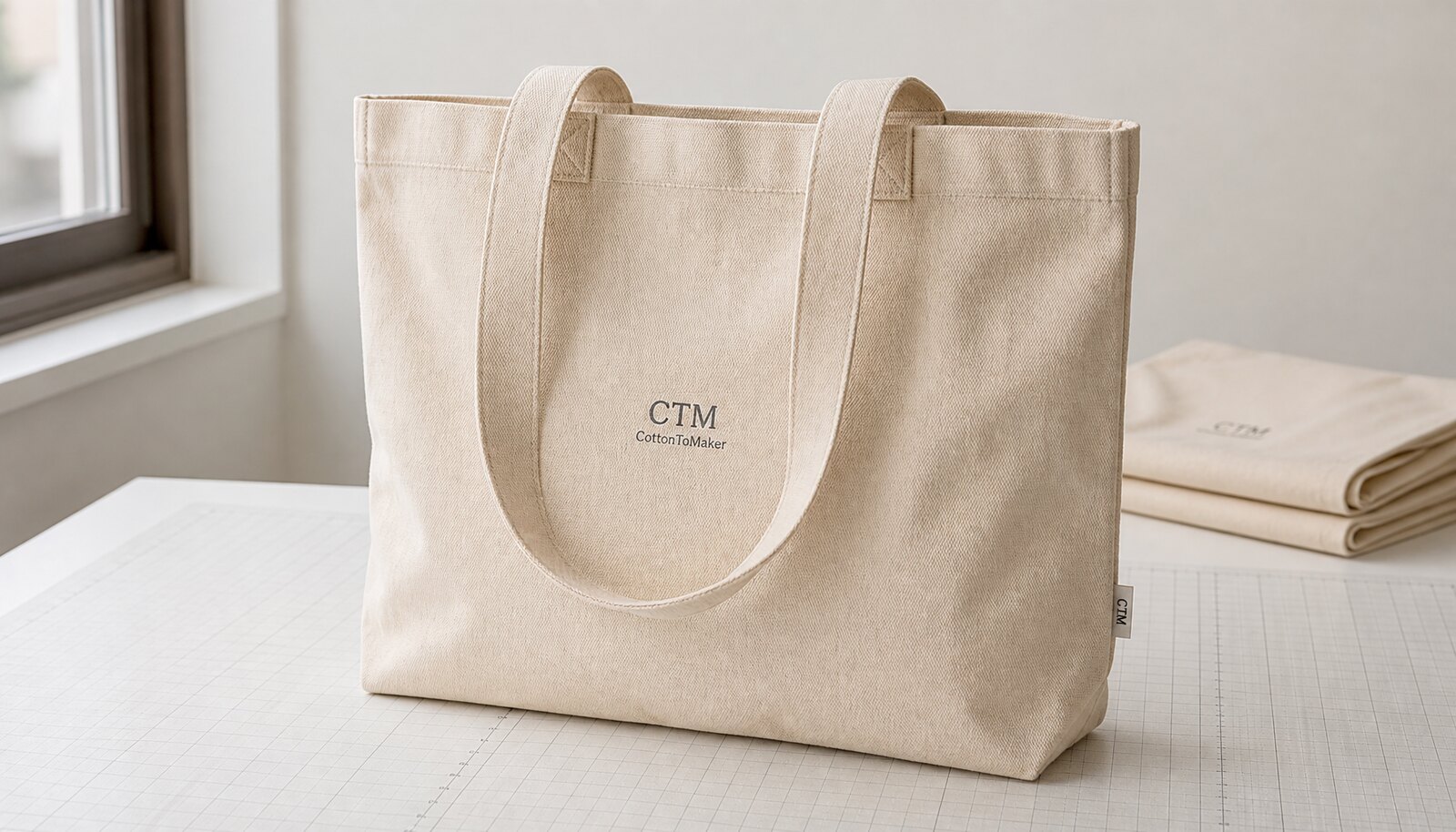
What a Monogram Canvas Tote Bag Buyer Is Really Buying
A monogram canvas tote bag is not just a blank tote with a logo on it. Buyers are really buying a combination of base fabric, construction quality, decoration method, and presentation. If any one of those pieces is weak, the bag can still look acceptable in a photo but fail in store, in shipping, or after a short period of customer use. That is why procurement teams should treat the monogram as part of the production spec, not as a last-step add-on.
The buying problem is usually consistency. One supplier quotes the tote body from a standard stock pattern, another quotes a softer canvas, and a third prices the decoration separately without clarifying placement or stitch count. If you are comparing quotes across factories, you need to normalize the spec first so you are not comparing a 10 oz canvas bag with a 14 oz bag, or a flat printed monogram with a dense embroidered one.
- Define the bag as a finished product, not a decoration task.
- Lock size, fabric weight, handle structure, and monogram method before price comparison.
- Separate blank bag cost from decoration cost so supplier quotes stay readable.
Build the Base Bag First: Fabric Weight, Shape, and Stitching
For most retail and promotional programs, canvas between 12 oz and 16 oz is the most practical range. In gsm terms, that usually means roughly 340 to 450 gsm depending on the mill and finish. Lighter fabric can work for event giveaways or low-load retail use, but it tends to collapse, wrinkle more, and expose decoration distortion sooner. Heavier canvas gives a more premium hand feel and better shelf shape, but it also raises fabric cost, sewing time, and freight weight.
The structure matters as much as the weight. A flat tote with no gusset is cheaper and often easier to decorate cleanly, but it has less usable capacity and less retail presence. A gusseted tote carries better, sits better on a shelf, and usually feels more substantial in the hand. If the tote is meant for store resale or branded merchandising, reinforce the handle attachment points and use a balanced seam allowance so the bag does not twist under load.
- 12 oz to 14 oz works for many promotional and entry retail programs.
- 14 oz to 16 oz is safer for premium retail, grocery-style carry, and heavier inserts.
- Use bar-tacks or reinforced stitching at stress points, especially where handles meet the body.
Choose the Monogram Method That Fits the Margin and the Brand
Embroidery is the default option when the brand wants texture and a more finished appearance. It costs more than printing, and it adds process time, but it usually reads as more premium on canvas. The tradeoff is technical: dense stitching can pucker thin fabric, so the factory needs the right stabilizer backing and a controlled stitch density. If the logo is small, embroidery can look crisp; if the logo is large or has fine detail, the result can become heavy and distorted.
Screen printing is usually the most efficient route for larger runs and simple monograms. It gives good value when the artwork is bold and the brand accepts a flatter look. Woven or sewn patches are useful when the buyer wants tactile branding without flooding the bag with ink. They can also help if the base canvas is textured and a clean print edge is difficult to hold. Heat transfer should be treated carefully on canvas because it can feel less durable unless the supplier uses a tested transfer system and confirms rub resistance.
- Use embroidery for premium positioning and stronger visual depth.
- Use screen print for simple monograms, larger volumes, and lower decoration cost.
- Use a woven or sewn patch when the brand wants a refined mark with less risk of ink bleed.
MOQ Logic: Why the Decoration Choice Changes the Price Curve
A monogram canvas tote bag rarely prices linearly. The base bag may have a reasonable unit cost, but the decoration setup charge, sample charge, and labor time change the economics fast. Embroidery often has a higher setup burden than print because the factory must digitize the artwork and sometimes create multiple machine programs for different sizes or placements. Screen printing is usually more economical at volume, but setup can still be significant if the design uses multiple colors or if the supplier needs new screens and registration tests.
This is where MOQ logic matters. A low MOQ on paper may still be expensive in practice if the decoration process is labor heavy or if the supplier is carrying excess fabric color inventory for a custom shade. Buyers should ask whether MOQ applies to the blank tote, the decorated tote, or the full order across colors and sizes. A factory that offers a low print MOQ may still require a higher MOQ for embroidery or for special packing because the line setup is different.
- Ask for MOQ by size, color, and decoration method separately.
- Expect setup charges for embroidery digitizing, screen making, or patch tooling.
- Do not compare a low MOQ quote against a quote that includes only blank bags.
How to Compare Supplier Quotes Without Getting Misled
The cleanest way to compare suppliers is to break the quote into the same cost buckets: blank bag, decoration, packaging, carton, and freight terms if available. If one supplier includes a cotton label and another excludes it, the lower headline price is not a real comparison. You also need to know whether the quote covers one production method or multiple methods with different costs. A monogrammed tote with embroidery on the front and a woven side label should not be priced against a single-print quote without adjustment.
Supplier route matters too. A factory direct quote often gives better control over the sewing and decoration sequence, which is useful when the monogram must align tightly with the bag panel. A trading company can help when you need options quickly or when the product is part of a broader bag program, but the buyer should press for factory identity, actual process ownership, and who handles final inspection. A decoration specialist paired with a bag factory can work well for premium monograms, yet it adds handoff risk if quality responsibility is not clearly assigned.
- Normalize all quotes to the same bag size, fabric weight, and decoration area.
- Ask whether the quote includes testing, tooling, packing, and export carton costs.
- Clarify who owns defects if the bag maker and decorator are different companies.
Sample Approval: What to Lock Before You Release Production
The first sample should answer more than visual questions. It should show whether the bag stands properly, whether the monogram lands in the correct position, and whether the fabric weight works with the chosen decoration method. If the bag is meant for a retail shelf, check whether it holds its shape when packed with a small insert or sample load. If the product is for promotional distribution, confirm that the decoration can survive folding, transport, and repeated handling without edge damage.
Use the sample stage to set approval criteria in writing. For example, decide how far the monogram may shift from center, what color variation is acceptable against the approved artwork, and whether thread tails, loose fibers, or small print specks are rejectable. A good sample process also includes one or two uncut or unpressed reference pieces from the production line, because the hand-finished sample often looks cleaner than the real bulk output.
- Approve placement using measured distances from seams and top edges.
- Inspect the sample under both normal light and closer retail viewing distance.
- Keep a signed sample or sealed reference piece tied to the PO.
QC Thresholds That Prevent the Most Common Returns
The most common return drivers on decorated canvas totes are not dramatic failures. They are crooked monograms, weak handles, inconsistent colors, and bags that arrive crushed or marked in the carton. Buyers should set tolerances that a factory can actually hit in bulk. For example, define an acceptable placement window for the monogram, a minimum number of bar-tacks or reinforcement stitches, and a clear rule for loose threads or skipped embroidery stitches.
If the tote will carry retail goods, include a simple functional test in your QC plan. Load the bag with a realistic weight and check whether the handles cut into the seam or whether the top opening distorts badly. For printed bags, rub resistance matters more than many buyers expect, especially if the bag will be stacked tightly or handled by distribution staff. For embroidered bags, the back side of the stitch field should be checked for scratching, stiffness, or excess backing material that may irritate the end user.
- Reject visible crooked placement that is obvious at normal retail viewing distance.
- Reject ink bleed, broken stitches, loose thread clusters, or lifting patch corners.
- Check a loaded carry sample before mass approval, not only an empty bag photo.
Packing, Cartons, and Presentation: The Hidden Cost Layer
Packing is where many tote bag programs lose money quietly. A monogram canvas tote bag can be technically correct and still arrive unacceptable if the packing adds wrinkles, scuffs, or moisture marks. Buyers need to define whether the bag ships folded, inserted with tissue, polybagged, or bulk packed. For retail, a cleaner pack may justify the added labor because it reduces store handling and improves shelf appearance. For wholesale or distribution use, bulk packing may be fine if the buyer can absorb some handling marks.
Labeling also deserves attention. If the product is private label, confirm whether the woven side label, care label, hangtag, or barcode must be sewn in at the factory or attached later at the distribution center. The carton mark should state style number, color, size, quantity, and packing method in a format your warehouse can scan or read quickly. If the supplier cannot give a straightforward pack structure, expect receiving delays and avoidable count discrepancies.
- Specify folding method and polybag use in the PO.
- Confirm carton count per master carton and the gross weight target.
- Use clear style and color labeling for warehouse receiving.
Lead Time and Landed Cost: Where Schedules Slip
Lead time on a monogram tote is usually longer than on a blank bag because the order has at least two phases: base bag production and decoration plus finishing. If the supplier is sourcing canvas from a mill, allowing extra time for dye lot confirmation or fabric reservation is sensible. If the monogram method needs digitizing, screen preparation, or patch approval, build that time into the front end rather than treating it as a small pre-production task. Many late shipments happen because the buyer approves the bag body but ignores the decoration proof until the end.
For landed cost, focus on the whole path, not just the ex-factory price. Freight weight rises with heavier canvas. Embroidery increases labor time. Better packing adds carton volume. A low-price quote can become expensive if it ships in oversized cartons or if the supplier needs to rerun decoration because the approved artwork was not specified clearly enough. Buyers should compare landed cost on the same basis: same fabric weight, same decoration method, same packing, same port terms, and same inspection standard.
- Separate base production time from decoration and final packing time.
- Include freight volume and carton efficiency in landed-cost comparisons.
- Treat artwork approval as a schedule gate, not an informal step.
An RFQ Structure That Gets Useful Answers Fast
A good RFQ for a monogram canvas tote bag is short, specific, and measurable. It should state the finished size, canvas weight, handle length, decoration method, artwork size, placement tolerance, packing method, quantity, and target ship date. If the buyer also wants packaging or labeling, those requirements should be listed separately from the bag spec so the supplier cannot assume a simplified packout. The goal is not to make the RFQ long. The goal is to make every quote directly comparable.
The best RFQs also ask for production proof, not just price. Request fabric details, factory decoration capability, sample lead time, and a photo or scan of a previous equivalent process if available. When the supplier answers with vague language like standard canvas, normal monogram, or export packing, push for measurable values. That extra discipline usually prevents the exact type of problem that turns a simple tote order into a rework discussion.
- State exact artwork dimensions and placement in millimeters or inches.
- Include required carton pack count and preferred delivery terms.
- Ask for a full price breakdown instead of one lump sum.
Specification comparison for buyers
| Spec decision | Recommended option | When it fits | Buyer risk to check |
|---|---|---|---|
| Sourcing route | Factory direct with in-house decoration | Repeat orders, tighter price control, fewer handoffs | Confirm whether printing, embroidery, and sewing happen in one facility or are outsourced |
| Sourcing route | Trading company with multiple factory options | Fast quotation round when design is not final | Watch for margin stacking, vague spec sheets, and inconsistent factory allocation |
| Sourcing route | Decoration specialist plus bag maker | Premium monogram finish or complex thread work | Check who owns final QC if the bag maker and decorator split responsibility |
| Decoration method | Embroidery | Premium retail feel, logo needs texture and depth | Verify stitch density, thread count, and fabric backing to avoid puckering |
| Decoration method | Screen print | Large runs, simple monogram, lower unit cost | Check ink opacity, cure quality, and wash/rub resistance |
| Decoration method | Woven or sewn patch | Brand wants a tactile, upscale mark without heavy ink coverage | Confirm patch edge finish and attachment method so it does not lift in transit |
| Fabric weight | 12 oz to 16 oz canvas | Mainstream retail and promotional orders with acceptable structure | Make sure weight is stated in gsm and not only in oz; ask for finished fabric width and shrink allowance |
| Bag construction | Gusset with reinforced stress points | Retail use, heavier carry, better shelf shape | Inspect handle bar-tack count, seam allowance, and bottom seam strength |
| Packing route | Bulk packed with clear carton marks | Wholesale or distribution orders where rework risk is low | Define polybag use, carton count, and moisture control to avoid stains and crush marks |
Buyer checklist before sampling
- Confirm finished bag size, canvas weight in gsm, handle length, and seam allowance before quoting.
- State the monogram method, decoration size, thread or ink color, and exact placement from seams.
- Request a pre-production sample or virtual strike-off for color, placement, and logo scale approval.
- Ask for carton pack count, polybag requirement, and label format in the quote, not after PO.
- Require the supplier to state lead time separately for blank bags, decoration, and packing.
- Get a cost split for base bag, decoration, packaging, and any setup or plate charges.
- Inspect stitching, monogram alignment, fabric shrinkage, and color transfer on the first sample set.
- Confirm the supplier's tolerance for measurement, print registration, and acceptable defect rate.
Factory quote questions to send
- What is the finished fabric weight in gsm, and is that before or after washing and finishing?
- Is the monogram done by embroidery, screen print, woven patch, heat transfer, or sewn label?
- What is the setup charge, and does it change with logo size, number of thread colors, or print screens?
- What is the MOQ for the exact color, size, and monogram method we want?
- What are the sample costs, sample lead time, and what will be included in the first sample?
- Can you state the exact placement tolerance for the monogram and the handle or seam reinforcement details?
- What packaging options are available, and what is the carton pack count and outer carton size?
- What is the production lead time after sample approval, and what parts of the order can run in parallel?
- Which defects will you reject during final inspection, and what is your standard AQL target?
- Please provide a unit-price breakdown for blank bag, decoration, packing, and export carton costs.
Quality-control points to confirm
- Canvas weight matches the approved spec within a tight tolerance, with no visible thin spots, skew, or weak weave lines.
- Monogram placement sits within the agreed distance from top edge, side seam, and centerline, with no crooked alignment.
- Embroidery, print, or patch finish is clean at the edges, without skipped stitches, ink bleed, loose threads, or lifting corners.
- Handles are symmetrical, bar tacks are secure, and the bag passes a loaded carry test without seam opening.
- Color on the bag body and decoration is consistent across production lots, with no obvious shade shift between panels.
- Cartons are dry, clean, correctly labeled, and packed to prevent crush damage, staining, or moisture exposure.
- Finished size, gusset depth, and handle length stay within the approved measurement tolerance after sewing and pressing.