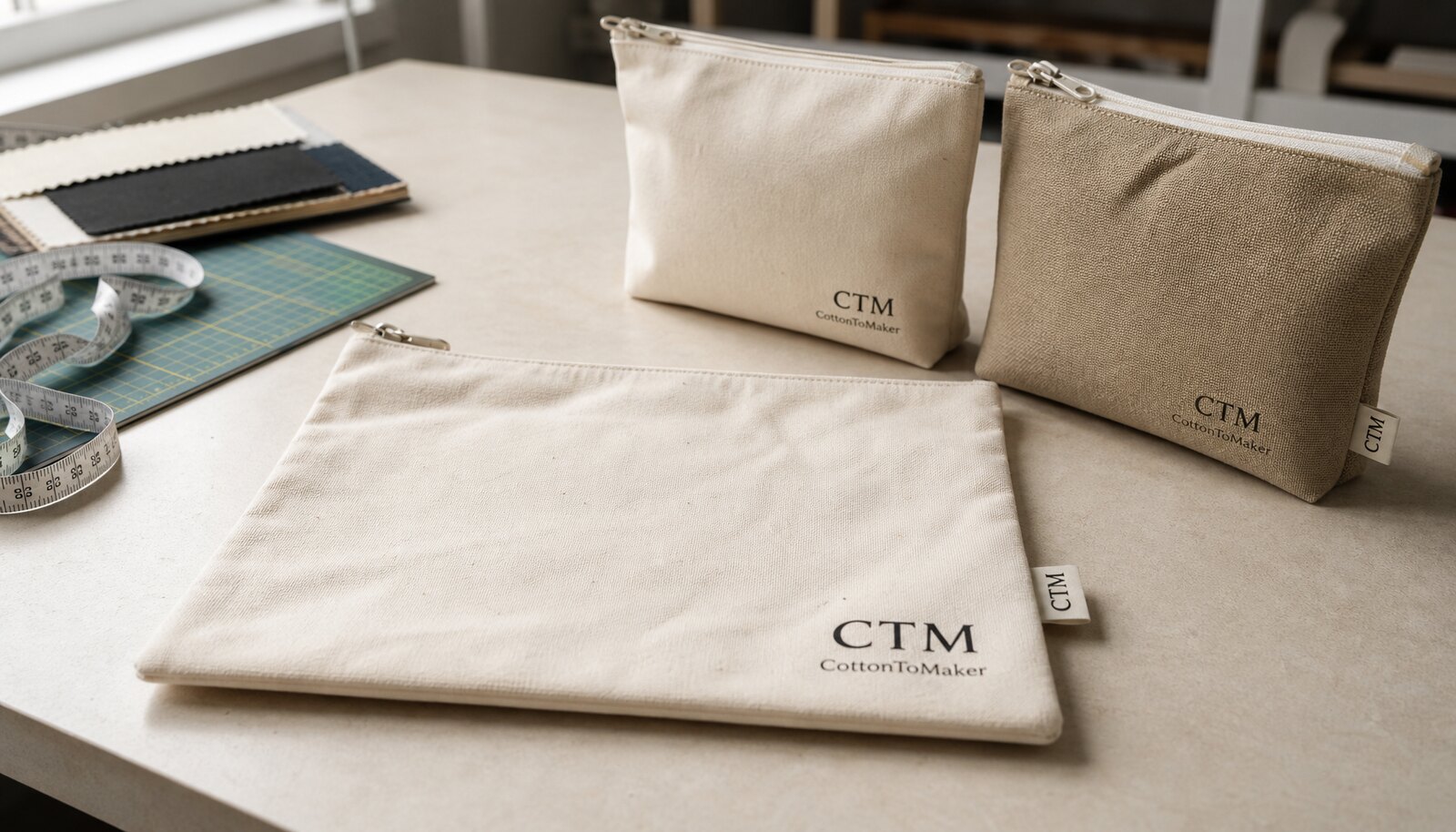
1. Why zipper pouch quotes vary so much
A logo zipper pouch quote is not driven by one number. Factories price the fabric, the zipper, the logo method, the sewing time, the packing method, and the risk they take on rework. Buyers often send the same phrase - "custom logo zipper pouch" - and get quotes that differ by a lot because each factory is assuming a different material weight, decoration method, and finish level. If you do not define those points, the quote is only a rough guess, not a usable procurement number.
The most common reason for quote gaps is that one buyer is asking for a promo pouch and another is asking for a retail-ready item. A 6 oz cotton twill pouch with one-color screen print and bulk packing is a different job from a 12 oz canvas pouch with a woven label, color-matched zipper, and individual polybag. When you understand the cost drivers, you can read the quote faster and ask better follow-up questions instead of comparing unrelated prices.
- Material weight changes both fabric cost and sewing behavior.
- Logo method changes setup time, machine time, and reject risk.
- Packing format affects labor, carton count, and shipping volume.
- MOQ usually follows trim setup and artwork change cost, not just fabric consumption.
2. Lock the product definition before you request pricing
Start with a usable product definition, not a loose idea. State the pouch size in finished dimensions, and if the pouch will hold pens, cosmetics, cables, cards, or samples, say so. A factory needs to know whether the pouch is slim, padded, gusseted, or flat because that changes pattern making, stitch length, seam allowance, and zipper length. If your team only gives a generic size like "about 20 cm," the supplier may quote a pouch that is technically close but commercially wrong.
You should also define the exterior, lining, closure, and branding position in the first RFQ round. If the pouch needs a lining, spell out whether it is plain cotton, recycled polyester, or no lining at all. If the zipper is visible from the front, that may change the look and cost. For logos, do not say only "print logo"; give the artwork size, number of colors, and placement from the top edge or side seam. The goal is to remove interpretation before the quote is written.
- Give finished size and usable inner size if both matter.
- State whether the pouch is flat, gusseted, or padded.
- Confirm lining material, zipper length, and puller style.
- Provide a simple tech sketch if the shape is not standard.
3. Pick the right fabric weight and construction
For zipper pouches, fabric weight is one of the fastest ways to control both cost and quality perception. A 200-280 gsm cotton twill or 6-8 oz canvas works for giveaways, internal kits, and large promo programs where the pouch mainly carries light items. A 340-420 gsm or 10-12 oz canvas usually feels more structured, prints more cleanly, and holds its shape better on shelf. If the pouch will be reused often, the heavier build usually pays back in fewer complaints and a better brand impression.
Construction details matter as much as weight. Ask whether the pouch uses single-needle or double-needle stitching, whether the seam allowance is consistent, and whether the corners are reinforced. If the zipper is sewn too close to a soft body fabric, you may see waviness or puckering. If the bag is meant to stay upright, a factory may suggest a firmer canvas or an extra layer inside. Those options add cost, but they also reduce shape problems and rework.
- 6-8 oz or 200-280 gsm: lowest-cost, light-duty use.
- 10-12 oz or 340-420 gsm: stronger structure and better retail feel.
- Double stitching is usually safer on corners and zipper ends.
- Ask for a sewn sample if your pouch needs a firm, upright shape.
4. Match the logo method to the artwork and volume
The logo method should follow the artwork, not the other way around. Screen printing is usually the most practical choice for simple logos with one to three spot colors, especially when the logo sits on a flat cotton surface. It gives a clean look and predictable cost, but it needs good cure control and a stable print area. If the art has fine detail, gradients, or many colors, a woven label, sewn patch, or embroidery patch may be the better answer because the factory can keep the mark readable at small scale.
For procurement, the real question is not which decoration is "best" but which one survives the use case. A retail buyer may want a woven label for a more finished feel, while a distributor may prefer print because the setup is simpler and the artwork is easy to repeat. If you are comparing quotes, make sure all suppliers are pricing the same logo method, same placement, same size, and same number of colors. A quote that looks cheaper may simply be excluding the decoration step you expected.
- Screen print: best for simple logos and cleaner unit economics.
- Woven label or sewn patch: better for small detail and premium feel.
- Embroidery: useful on thicker fabrics, but can distort very fine art.
- Always confirm logo size, placement, and Pantone targets in writing.
5. Build MOQ and lead-time logic into the RFQ
MOQ is usually tied to trim setup, color change, and production efficiency. If your pouch uses one fabric color, one zipper color, and one logo version, the MOQ can often stay lower than a program with multiple colorways or multiple placements. Factories need to cut fabric, set the print screen or label, source the zipper tape, and line up sewing lines. Every change adds setup time. That is why the real MOQ question should be asked per design, per color, and per artwork version.
Lead time should also be broken into stages. Sampling may take a few days to a few weeks depending on artwork and trim availability. Production lead time starts after sample approval, but it can stretch if a supplier still needs to buy zipper tape, woven labels, or custom pullers. When you write the RFQ, ask the factory to separate sample lead time, material purchase lead time, and bulk sewing lead time. That helps your team plan launch dates without guessing where the time is spent.
- Ask MOQ per design, not just one total MOQ.
- Ask whether mixed colors can share the same production run.
- Confirm whether sample approval is the lead-time starting point.
- Ask which components are stock and which are made to order.
6. Read the factory quote line by line
A useful factory quote should show more than a total unit price. It should tell you what fabric weight is being priced, what zipper type is included, what logo method is included, how the pouch is packed, and what the MOQ assumption is. If the quote only says "custom pouch" with a price, you still do not know whether the supplier priced a 6 oz promo item or a 12 oz retail pouch. Always compare like for like before you compare numbers.
Watch for hidden gaps in the quote. Some factories leave out sample fees, artwork setup, zipper color changes, carton labels, or individual polybags. Others quote bulk sewing but not the trim upgrade you asked for. If you see a price that is clearly lower, check whether the supplier removed lining, used a thinner fabric, changed the decoration method, or assumed a larger order than you actually plan to place. The job of the buyer is to expose those assumptions before the PO is issued.
- Check whether the quote includes sampling or only bulk production.
- Confirm the stated fabric weight, not just the fabric name.
- Verify that logo method and logo area match your request.
- Make sure packing and carton details are included or clearly excluded.
7. Use the sample stage to prevent production mistakes
The sample is where most pouch problems can be caught at low cost. Review the sample against a simple checklist: size, fabric feel, zipper smoothness, logo clarity, seam finish, and packing method. If the sample is for a retail or branded program, compare it against your brand standard, not just against the factory's idea of acceptable. A pouch can be technically usable and still fail your shelf presentation or brand consistency requirements.
Ask the factory to submit a pre-production sample before mass sewing begins if your order has new artwork, a new zipper color, or a new fabric weight. That sample should show the same construction path the bulk order will follow. If changes are needed, fix them before the factory cuts all the fabric. Once production starts, a small decision like moving the logo 1 cm or changing the zipper puller can become an expensive rework or a quote dispute.
- Check the sample under natural light and on a flat surface.
- Measure logo placement from the seam, not from the edge of the fabric roll.
- Open and close the zipper several times and look for snagging.
- Approve the sample only after the packing method is confirmed.
8. Packing and shipping details that change the quote
Packing is often treated as an afterthought, but it can change both the factory quote and the landed cost. Bulk-packed pouches cost less to pack, but retail programs usually need an individual polybag, barcode label, or insert card. The factory may also need to fold the pouch in a specific direction or use a specific carton quantity to support shelf presentation. Each of those details takes labor and carton space, so they should be included in the RFQ instead of added later.
Shipping assumptions matter too. Ask for carton size, gross weight, and carton count by order quantity. This helps your team estimate freight volume and compare quotes that may look similar at the unit level but differ in carton efficiency. If the supplier provides a heavy pouch with extra packaging, the freight cost can erase the savings from a lower factory price. For importers, a quote is only complete when the production spec and the packing spec tell the same story.
- State whether you need bulk pack, polybag, or retail-ready packing.
- Ask for carton dimensions and gross weight by carton.
- Confirm barcode location, label format, and master carton marks.
- If shelf presentation matters, define folding direction and insert needs.
9. Common mistakes that create re-quotes and claims
The biggest mistake is letting the supplier fill in missing details. If your team does not define fabric weight, logo size, zipper type, or packing, the factory will choose something workable, not necessarily something that fits your program. That leads to surprises later when the sample looks different from the expectation or the quote changes because the supplier priced a lighter spec. A cleaner RFQ protects both sides by removing the room for assumption.
Another common problem is changing too many variables after the sample is approved. Buyers sometimes approve a sample and then ask for a different zipper color, a bigger logo, thicker fabric, and retail bagging at the same time. That can affect material sourcing, sewing time, and carton volume all at once. If changes are needed, batch them carefully and ask the factory to confirm the effect on MOQ, lead time, and pricing before production restarts.
- Do not compare quotes if the fabric weight is different.
- Do not approve a sample with one zipper and expect another in bulk.
- Do not assume logo color will print the same on every fabric shade.
- Do not change packing requirements after the factory has already bought materials.
10. A practical sourcing workflow for cleaner quotes
The fastest way to get an accurate logo zipper pouch quote is to send a complete, simple RFQ package. Include a dimension sketch, fabric target, logo artwork, packing request, quantity split, and your target market use. Then ask each factory to quote the same spec sheet, not their own interpretation. Once the quotes come back, compare them line by line for fabric weight, logo method, zipper type, packing, and lead time. That is much more useful than comparing one total price against another total price.
After the first round, narrow the suppliers to the ones that answer clearly and quote the same structure. Ask for samples or pre-production confirmations only from those suppliers. If a factory cannot explain what is included, or keeps revising the number without a spec change, that is a warning sign. Buyers do not need the lowest number on paper; they need the lowest-risk quote that can actually be produced at the quality level the brand expects.
- Send one spec sheet to every supplier.
- Compare apples to apples: fabric, logo, zipper, packing, and lead time.
- Shortlist factories that quote clearly and answer technical questions directly.
- Lock the sample before the bulk PO.
Specification comparison for buyers
| Spec decision | Recommended option | When it fits | Buyer risk to check |
|---|---|---|---|
| Body fabric | 10-12 oz canvas or 340-420 gsm cotton canvas | Retail pouches, brand merch, trade-show kits, and repeat-use cosmetics or stationery bags | Check shrinkage after wash, fabric stiffness, lint level, and whether the print sits cleanly on the weave |
| Economy build | 6-8 oz cotton twill or 200-280 gsm cotton | Large promotional runs where unit cost matters more than structure | Watch for too-soft bodies, zipper puckering, and show-through on dark logo colors |
| Logo method | Screen print with 1-3 spot colors | Flat logos, simple artwork, and larger quantities with stable artwork | Confirm Pantone references, curing, print registration, and maximum print area |
| Premium branding | Woven label or sewn patch | Small logos, multi-color marks, or a more retail-ready look | Check edge fray, stitch placement, label size, and whether the artwork loses detail at small scale |
| Closure and trim | Nylon coil zipper #3 or #5 with matched puller | Daily-use pouches, travel kits, and products that need smooth opening and closing | Verify zipper color match, pull strength, smooth travel, and that the puller does not scratch the fabric |
Buyer checklist before sampling
- Confirm finished size, usable inner size, and measurement tolerance before you ask for a quote.
- State the target fabric by weight or GSM, not only by name, and say whether lining is required.
- Send vector artwork, Pantone targets, and the exact logo placement with dimensions.
- Specify zipper type, puller style, zipper color, and whether you need a matching tape.
- Tell the factory your expected order split by size, color, and artwork version.
- Ask for MOQ per design and per color, not just one total MOQ number.
- Request a pre-production sample, not only a photo, before mass production starts.
- Confirm packing format, polybag requirements, carton marks, and barcode needs.
- Ask the supplier to state lead time from sample approval, not from PO date alone.
- Define defect tolerance, replacement handling, and what happens if the bulk sample drifts from the approved sample.
Factory quote questions to send
- What exact finished size, seam allowance, and tolerance are you pricing?
- What fabric weight or GSM are you using, and can you share a swatch or spec sheet?
- Which zipper type, puller style, and zipper tape color are included in the quote?
- What logo method is included, how many colors, and what is the print or stitch area?
- Is the quoted MOQ per design, per color, or per artwork version?
- Does the quote include sampling, or is the sample fee separate from production pricing?
- What packing is included: bulk, polybag, insert card, barcode sticker, master carton, or pallet?
- What is the lead time after sample approval, and what part of that time depends on trim purchase?
- What inspection steps do you do before shipment, and can you share the AQL or internal standard?
- What changes will trigger a re-quote, such as logo size, zipper color, lining, or carton spec?
Quality-control points to confirm
- Measure finished size after pressing and compare it with the approved tolerance window.
- Check fabric weight, weave, and hand feel against the approved swatch or sample.
- Inspect logo placement, color match, edge quality, and whether ink or stitching covers cleanly.
- Open and close each zipper multiple times to confirm smooth travel, stop security, and alignment.
- Look at seam density, corner finishing, and any puckering near the zipper ends.
- Check loose threads, stains, odor, and dust inside the pouch before packing.
- Verify puller strength, zipper tape color, and whether metal parts can scratch the fabric.
- Confirm polybag count, barcode placement, carton marks, and master carton quantity.
- Pull compare the bulk sample against the approved golden sample before release.
- If the pouch is for retail, inspect fold direction, hangtag placement, and shelf-ready appearance.