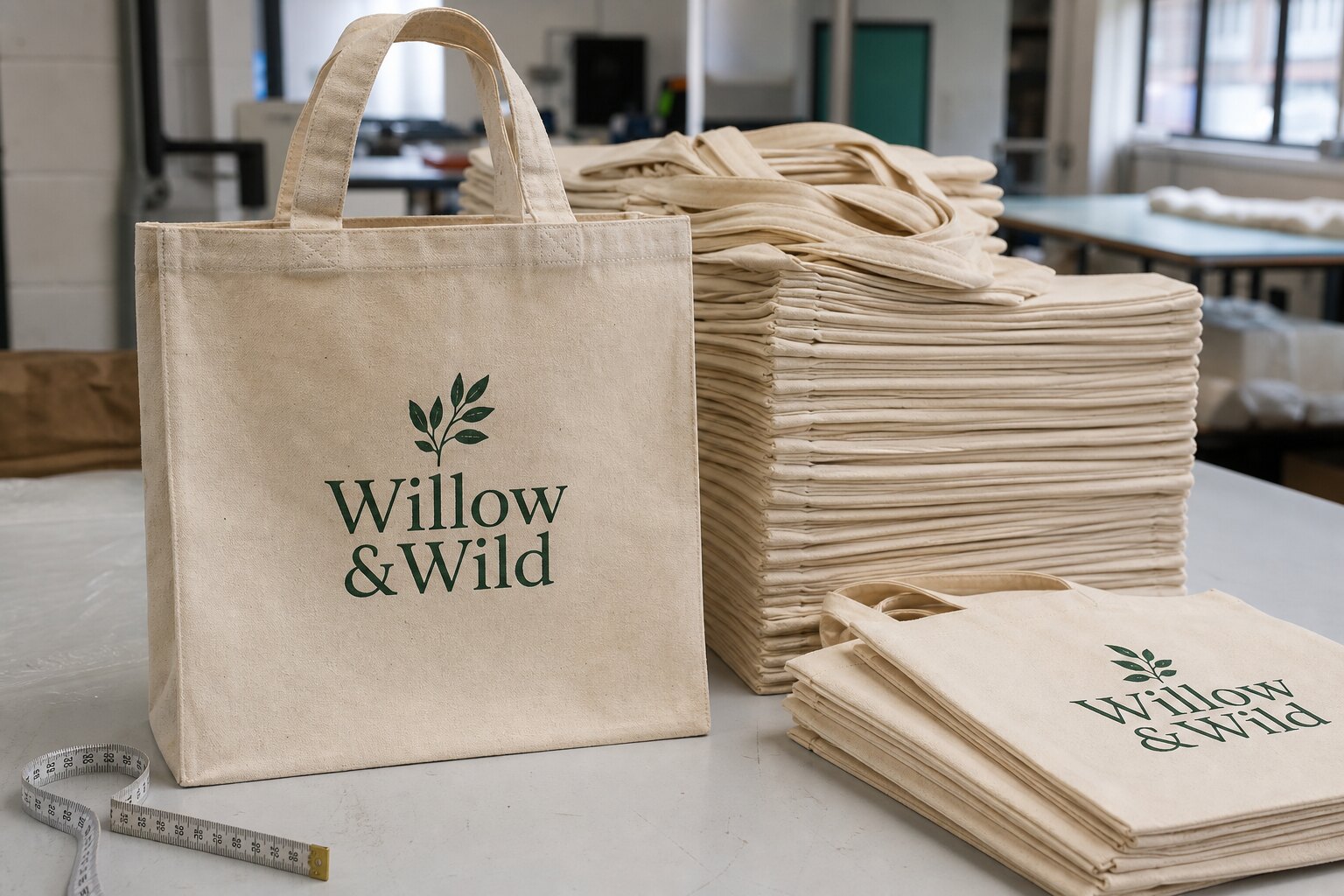
The Buying Problem: A Clean Logo Depends on the Whole Bag Specification
When procurement teams ask for logo printed organic cotton bags, many quotations only list size, fabric weight, logo color, and quantity. That is not enough for a reliable production order.
Organic cotton fabric has natural slubs, absorbency differences, and possible shrinkage after washing or finishing. These factors affect how sharp the logo looks, how flat the print area stays, and whether the finished bag matches the approved sample.
A good RFQ should connect the logo requirement with fabric construction, bag size, seam position, print method, color tolerance, and packing method. If those details are missing, the supplier may quote a cheaper version that cannot meet your brand standard.
- Main risk: approving a low-detail quote and discovering print distortion or weak fabric after mass production.
- Best use case: retail merchandise, corporate gifting, organic product packaging, trade show giveaways, and distributor stock programs.
- Key decision: specify the bag around the logo result, not only around the lowest unit price.
- Buyer outcome: fewer sample revisions, clearer supplier comparison, and more predictable landed cost.
Start With the Bag Use, Not the Logo Size
The same printed organic cotton bag can be suitable for a light cosmetic gift set or unsuitable for grocery retail. Before choosing print size, confirm the product weight, expected reuse, shelf presentation, and whether the buyer wants a soft natural handfeel or a structured retail-grade bag.
For promotional use, 5 oz to 7 oz organic cotton may be enough. For retail packaging or repeated shopping use, buyers often move to 8 oz, 10 oz, or heavier canvas construction. The heavier fabric gives better body and durability, but it may also change ink absorption and print texture.
If the logo has small text, fine lines, or a solid ink block, the print area must be flat and stable. Avoid placing detailed logos too close to side seams, bottom gussets, darts, or handle stitching.
- Light giveaway bag: lower fabric weight, simple one-color print, economical packing.
- Retail carry bag: stronger fabric, reinforced seams, controlled logo placement, better folding.
- Organic product packaging: natural fabric tone, certification support, clean print registration.
- Distributor stock item: standard size, repeatable print area, carton packing suitable for warehousing.
Product Specification Checklist for Logo Printed Organic Cotton Bags
Use this checklist when sending RFQs to factories. It helps suppliers quote the same product instead of making assumptions. It also makes it easier to compare price differences between suppliers.
For repeat orders, keep this specification as a control sheet. Small changes in fabric weight, handle length, or print placement can affect both the appearance and cost of the final bag.
- Bag style: flat tote, bottom gusset tote, side gusset tote, drawstring pouch, or zipper bag.
- Fabric: certified organic cotton, requested weight in oz or gsm, natural or dyed color, washed or unwashed finish.
- Size: width, height, gusset depth, and measurement tolerance after sewing.
- Handles: self-fabric handles, webbing handles, length, width, cross-stitch or box-stitch reinforcement.
- Logo: artwork format, print size, print position from top and side edges, Pantone color reference, and acceptable color tolerance.
- Packing: folding method, individual polybag or bulk pack, carton quantity, carton mark, and barcode or label requirement.
Comparison Table: Common Logo Methods for Organic Cotton Bags
The right logo method depends on fabric weight, artwork detail, order quantity, and brand positioning. Screen printing is common for organic cotton bags because it is cost-effective and stable for simple logos. Other methods may be better when the design needs a premium texture or lower minimum quantity.
Ask the supplier to confirm whether the chosen method has been tested on the exact fabric weight and color you plan to order. A print that works on bleached cotton may look different on natural organic cotton.
- Screen printing | Best for: solid logos, one to four colors, medium and large orders | Watch point: fine lines may fill in on coarse fabric.
- Water-based ink printing | Best for: softer handfeel and eco-positioned programs | Watch point: color may look less saturated on natural cotton.
- Heat transfer | Best for: detailed artwork and small batch personalization | Watch point: film feel may not match the natural look of organic cotton.
- Embroidery | Best for: premium small logos and heavy fabric bags | Watch point: not ideal for very large logos or thin fabric.
- Woven label stitched on bag | Best for: retail branding and repeat stock items | Watch point: less direct than a printed front logo and requires label MOQ.
Fabric Weight and Weave Affect Print Sharpness
Organic cotton bags are not all the same. A plain weave 6 oz fabric behaves differently from a 10 oz canvas. Coarser yarns and visible slubs can make the logo look more natural, but they can also reduce edge sharpness.
If your artwork includes small lettering, QR codes, thin outlines, or dense negative space, request a print test on the production fabric. Do not approve the logo based only on a digital layout.
For natural-color organic cotton, expect the base fabric tone to influence the final ink color. White ink, light beige, pastel colors, and metallic tones require extra checking.
- 5 oz to 6 oz: suitable for light promotional bags, but less structure and possible transparency.
- 7 oz to 8 oz: balanced option for many brand and event programs.
- 10 oz and above: stronger handfeel, better retail impression, higher freight weight and cost.
- Canvas weave: more durable and structured, but texture may show through large solid logo areas.
Artwork Rules That Prevent Production Delays
Most logo problems start before production. Low-resolution files, unclear Pantone colors, and missing placement dimensions force the factory to guess. That creates delays and sample revisions.
Send vector artwork whenever possible, such as AI, EPS, SVG, or editable PDF. If the logo includes small type, confirm the minimum printable line width with the supplier. For multi-color printing, ask about registration tolerance so the final result is judged realistically.
For international buyers, also confirm whether the logo contains trademarked marks, certification logos, or retail compliance symbols. The factory can print what you approve, but the buyer is usually responsible for legal use of brand marks.
- Provide vector artwork, not only JPG or PNG files.
- Specify Pantone colors or approved color references.
- Define logo size in millimeters, not only as a visual percentage.
- Mark the logo position from the top edge, side edge, and handle seam.
- Approve a physical pre-production sample before bulk production when the logo is critical.
Organic Claims and Certification Documents to Confirm
If the product is sold as organic cotton, the sourcing documents matter. Buyers should confirm what certificate or transaction document is available and whether it covers the fabric, the finished bag, or only the raw cotton supply.
Do not assume every organic cotton bag is automatically certified for retail claim use. Certification scope, logo use rules, labeling, and chain-of-custody requirements vary by program and market.
For distributor and retail orders, ask early whether certification references will appear on the bag, hangtag, packaging label, invoice, or marketing material. This affects both artwork approval and documentation.
- Confirm fabric certification type and supplier document availability.
- Check whether the certificate covers the finished product or only material sourcing.
- Ask if certification logos can legally be printed on the bag or packaging.
- Keep transaction certificates and production batch records for retail buyers.
- Separate organic cotton claims from general eco-friendly marketing language.
Sampling and Approval Points Before Bulk Production
A good sample is not just a photo. It should confirm fabric feel, logo clarity, stitching quality, size tolerance, and packing presentation. For logo printed organic cotton bags, physical approval is especially important because fabric texture and ink absorption are difficult to judge on screen.
Ask the factory to keep one signed approval sample and send one to your team. This gives both sides the same reference during inline and final inspection.
If your order includes multiple logo colors, bag sizes, or fabric colors, approve each variation. Do not assume one sample covers all combinations.
- Check actual finished size after sewing and pressing.
- Check logo size, color, edge sharpness, and placement.
- Check handle strength, seam density, and reinforcement stitching.
- Check whether the bag lies flat after printing and packing.
- Check carton packing to prevent creasing across the printed logo.