Start With the Use Case, Not the Mockup
For trade show exhibitors, logo placement on custom cotton drawstring backpacks is a procurement decision, not a design garnish. The position affects the decoration method, the printable field, the pack fold, carton count, and how the bag looks when a visitor grabs it on a crowded show floor. A logo that reads cleanly on a screen can still land too high, too low, or too close to the drawcord channel once the bag is sewn and filled.
The first spec should describe the physical target. State the finished bag size, the usable front-panel area, the logo width and height, the distance from the top channel, and the measurement references. If the brief only says centered on front, each supplier will interpret that differently and the quotes will no longer be comparable.
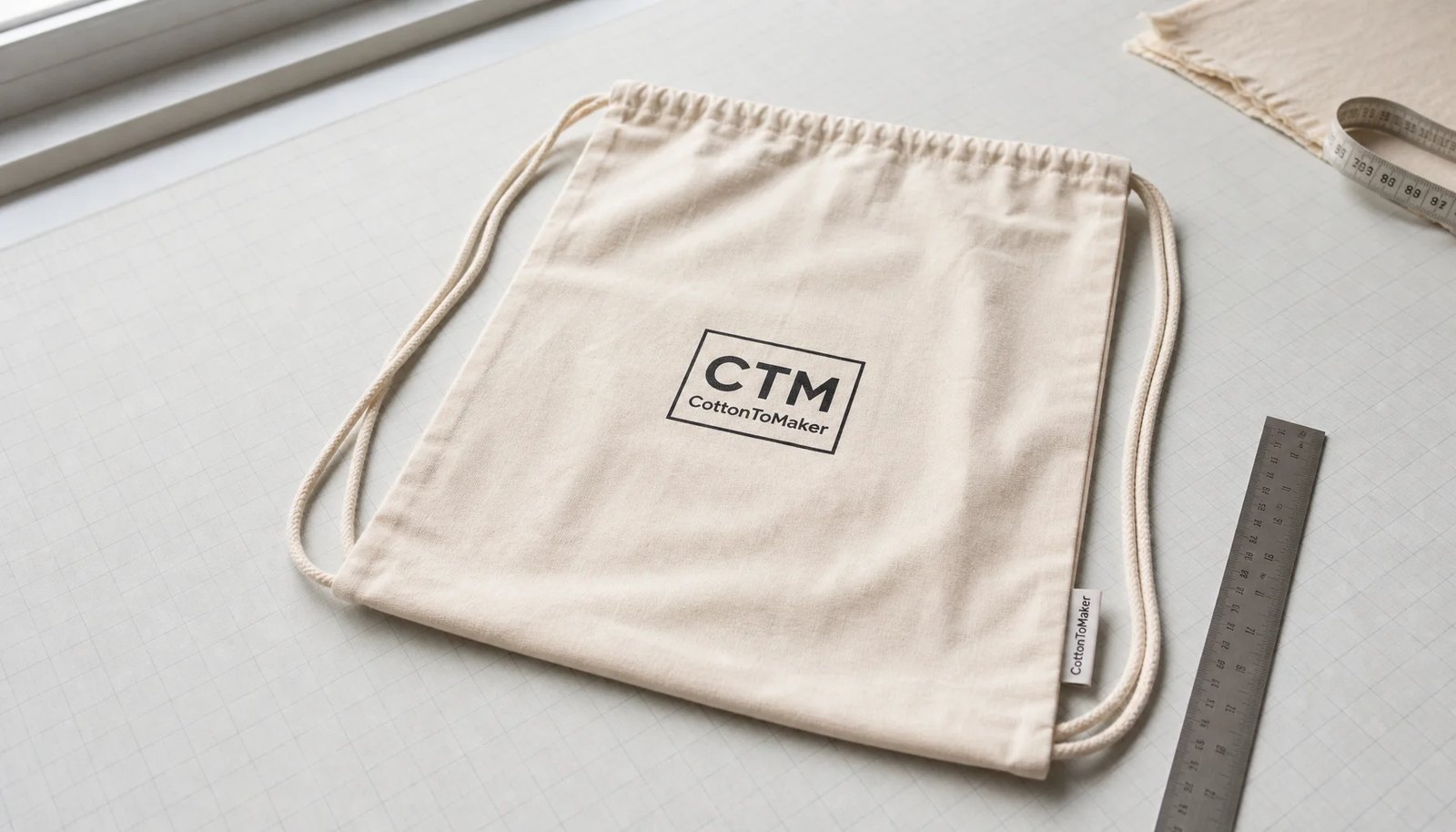
A trade show bag is handled flat, stacked in cartons, worn over one shoulder, hung on a chair, and opened quickly. The safest default is a front-center logo below the drawcord channel, with enough negative space that the mark stays visible when the bag is cinched or partly filled.
That kind of specification gives marketing a clear review point, gives procurement a way to compare quotes on the same basis, and gives QC a standard that can be checked without interpretation. It is the difference between an order that runs cleanly and one that becomes a series of approval emails after samples are already late.
- Put logo placement in the RFQ alongside bag size, fabric weight, and decoration method.
- Use seam-based measurements, not a loose visual center point.
- Keep the logo clear of the top channel, side seams, cord exits, and planned folds.
- Use one main logo zone unless there is a real sponsor or event-content requirement.
Choose the Bag Build Before You Choose the Logo
Unit price is only one line in the decision. Buyers should compare full builds: fabric weight, print surface behavior, folding behavior, freight cube, and whether the bag still looks useful after a day of handling. A cheaper bag can become more expensive if it wrinkles badly, needs extra print setup, or ships in a larger carton because the fabric has too much bulk.
For most trade show programs, 140 gsm cotton is the budget option and 160-180 gsm is the balanced option. Lighter fabric lowers material and freight cost, but the front panel shows texture and wrinkles more easily. Midweight cotton usually gives a flatter print surface, better hand feel, and less risk that the logo looks thin on natural cotton. Heavier builds above 200 gsm should be reserved for premium kits or bags that actually need the extra body.
Decoration route changes the build choice as much as GSM does. Screen printing fits stable vector artwork and repeat orders. Heat transfer or digital transfer handles more colors and late sponsor updates. Embroidery, woven labels, and patches can lift perceived value, but each adds another step and more chances for puckering, stiffness, or misalignment on a soft cotton bag.
The right spec is the one that fits the event. If the bag is a broad giveaway, cost and repeatability win. If it is part of a premium conference kit, hand feel matters more. If the artwork is complex, the decoration route drives the build, not the other way around.
- Use 140 gsm when the bag is a light giveaway and freight pressure is high.
- Use 160-180 gsm for the most balanced trade show specification.
- Move above 200 gsm only when the contents or brand position justify it.
- Treat labels, patches, and embroidery as separate approval items, not minor add-ons.
- Approve cotton color and print opacity on the actual base fabric, not just on a rendering.
Define the Printable Field on the Sewn Bag
A drawstring backpack is simple only before it is sewn. Once the top channel is formed, the side seams are closed, and the cords are threaded, the flat print field is smaller than the finished size suggests. That is why a measured line drawing or sample beats a digital mockup on a perfect rectangle.
The buyer should define the usable front panel in millimeters and ask the supplier to show the no-print areas. Those zones include the top channel, seam allowances, side seam bulk, bottom reinforcements, and any cord exits or eyelets. If the artwork reaches too close to those boundaries, the logo can look off-center or distort when the bag is filled and cinched.
Keep the logo size separate from the decoration field. A 150 mm wordmark may still need a larger artwork zone if it includes a date line, sponsor strip, or QR code. The more fine detail you add, the more cotton texture and seam proximity matter. Thin fonts and tiny code modules need room because the bag is not a coated poster board.
For trade show buyers, the best approval artifact is a measured line drawing or actual-fabric strike-off with offsets marked from stable references. It should be simple enough for QC to use on the line and clear enough that a reorder can follow it without design interpretation.
- Ask for a flat drawing with no-print zones shown clearly.
- Measure the logo from side seams and the top channel seam line.
- Keep small text and QR codes away from seams and folds.
- Separate artwork size from total decoration field.
- Approve the field on the actual bag material, not only on screen.
Match Decoration Method to Artwork and Timing
One-color screen printing is still the cleanest choice for many custom cotton drawstring backpacks. It suits simple logos, predictable repeat orders, and a front panel that needs a bold mark at a reasonable cost. On cotton, the key checks are even coverage, readable detail, and controlled opacity. If the design is stable and the quantity is meaningful, screen print usually gives the best cost-to-impact ratio.
Two-color screen print can still be efficient when the brand system is simple, but registration needs to be explicit. Cotton is less forgiving than a coated surface, so tight reverses, narrow gaps, and thin outlines can fail if the art is too crowded. If the sponsor lockup is complicated, simplify the artwork before screens are made or accept a higher risk of visible shift.
Transfers solve a different problem. Heat transfer or digital transfer is better for complex artwork, gradients, many colors, or late sponsor changes. The buyer should still inspect the parts that matter on cotton: edge lift, shine, stiffness, and how the print behaves after the bag is folded and compressed. A clean first-day look is not enough if the decoration marks the cloth after packing.
Embroidery, woven labels, and patches belong in the same choice set because they affect the bag differently. Embroidery adds texture and value but can pucker lightweight cotton. Woven labels are neat but less visible than a front print. Patches can look strong, but they need secure stitching and enough space so the bag still folds and cinches properly.
- Use screen print for simple vector logos and repeatable programs.
- Use transfers for multi-color artwork, gradients, or late sponsor changes.
- Keep embroidery compact and pair it with a firmer cotton base.
- Treat woven labels and patches as separate approval items with their own size and placement rules.
- Ask the supplier to simplify thin type or tight outlines before decoration starts.
Write the RFQ Around Real Cost Drivers
The RFQ should force every supplier to quote the same backpack, not a similar one. Include finished size, printable area, cotton weight, fabric color, cord specification, logo size, color count, placement offsets, decoration method, packing method, and shipping term. Without that definition, the quote is a guess and procurement ends up comparing mismatched products.
Price tiers matter because they expose how setup cost is absorbed. Ask for 500, 1,000, 3,000, and 5,000 pieces, or whatever breakpoints match your event calendar. That gives the team a real view of the cost curve and shows whether consolidation across several shows is worth it. It also reveals when a quote only looks attractive at one narrow quantity.
MOQ should be stated by variant, not as a single number. Bag color, GSM, cord color, print version, label style, and packing configuration can each carry their own minimum. If the order includes regional sponsor versions or split destinations, the practical MOQ may be higher than the headline MOQ. The same is true for urgent orders that need local finishing or relabeling.
Separate the product cost from the extras. Setup fees, screen charges, sample charges, packing upgrades, carton labels, and freight basis all belong on the quote. A lower unit price does not help if sample work is hidden or cartons are not labeled for the venue. The best quote is the one procurement can turn into a landed-cost comparison without guessing.
- Show bag cost, decoration cost, setup fee, sample fee, packing fee, carton cost, and freight term separately.
- Quote at multiple quantities to see the real price curve.
- Define MOQ by variant, not only by total order volume.
- Require carton dimensions and gross weight before landed cost is calculated.
- Make the PO match the approved sample so inspection has a written standard.
Approve Samples Against the Way Bags Will Be Used
A digital proof only proves that the art fits on a flat rectangle. It does not prove how the logo looks on cotton, how the print reacts to texture, or how the bag behaves when filled and folded. For final approval, ask for a sewn sample or an actual-fabric strike-off on the same cotton base that will be used in bulk production.
The sample review should follow the real use path. Check the logo flat against the measured drawing, then cinch the bag closed, fill it with typical trade show contents, and look at it again from a normal viewing distance. If the mark drifts into the top channel, looks crowded near the seam, or disappears when the bag is cinched, the placement needs to move before bulk starts.
Folding is part of the sample, not an afterthought. Many exhibitor bags are packed under pressure, and the fold line can cross the logo or make transfers stick together. If the planned pack method harms the artwork, change the fold direction or shift the placement. That is faster and cheaper than trying to recover mispacked goods near the event date.
A sample approval note should be detailed enough to survive turnover inside the company. Record the approved bag size, cotton color, GSM, cord spec, decoration method, logo dimensions, placement offsets, label position, fold method, and accepted limitations such as natural cotton speck variation. Keep one sealed reference sample or a signed photo set for production and reorder use.
- Review a sewn sample or actual-fabric strike-off on the real cotton base.
- Check the bag flat, cinched, filled, folded, and reopened.
- Reject any layout that fails once the bag is packed or pulled shut.
- Record the approval in dimensions and offsets, not only in words.
- Keep one sealed reference sample for production and reorders.
Set Defect Thresholds and QC Rules the Factory Can Follow
Quality control should be written as a measurable checklist, not a general promise to do the work carefully. For custom cotton drawstring backpacks, the inspection points are placement, print quality, fabric color, GSM, seam quality, cord function, label position, packing count, and carton marks. If those items are not written into the order, the factory may inspect to a different standard than the buyer expects.
Placement tolerance needs a number and a reference point. A practical starting point for many sewn cotton bag orders is +/-5 mm from the approved position, but the buyer should still state the exact method used to measure it. Side seam, bottom seam, and top channel seam line are better references than the loose top edge, which can shift as the channel is formed.
Print quality should be checked against the approved sample, not a mental image of the artwork. Look for opacity, edge sharpness, smearing, pinholes, heavy buildup, and visible distortion near seams or folds. On natural cotton, some weave texture will show through. That is acceptable only if the sample already showed the same effect and the brand approved it.
Function matters as much as appearance. The cord should slide smoothly, the bag should cinch without snagging, and the logo should remain readable when the bag is closed. If the decoration crosses into a stress area and cracks under normal use, the bag fails even if the flat photo looked fine. QC should catch that before shipment, not after venue delivery.
- Write placement tolerance in millimeters with named reference points.
- Check ink opacity, edge quality, and color against the approved sample.
- Inspect stitching at the top channel, side seams, bottom corners, and reinforcement points.
- Verify cord movement after decoration and after the bag is cinched shut.
- Set a zero-tolerance rule for critical defects and a capped major-defect rate for decorated bags.
Plan Packing, Cartons, and Pallets Before Production Starts
Packing is part of the product because it changes how the bag looks when the customer receives it. A good print can be creased by a bad fold, and a clean bag can arrive wrinkled if the carton is packed too tightly. For trade show orders, the packing method should be approved with the same seriousness as logo placement.
Bulk packing is efficient, but the fold direction should protect the artwork. If the logo needs to face outward for quick distribution, say so. If the print area should avoid a hard crease, mark that in the packing instruction. Transfers deserve special attention because pressure and stacked cartons can create sticking or surface marks if the bags are packed too tightly.
Individual polybags, inner bundles, or kit-ready packing each solve a different problem. Polybags make counting and kitting easier but add cost and waste. Inner bundles are a good middle ground for many exhibitor programs. Kit-ready packing works when bags are being inserted into a larger welcome pack or shipped to a fulfillment center. The best option is the one that fits the downstream handling path, not the one with the lowest packing line item.
Carton marks must be complete before the production run ends. Confirm pieces per carton, carton dimensions, gross weight, net weight, carton sequence, PO number, SKU or item name, destination code, and any venue or warehouse label format. If the order ships to a 3PL, trade show dock, or mixed-SKU warehouse, also confirm pallet height, pallet pattern, and whether the receiving site has manual-handling weight limits.
- Approve the fold method before bulk packing starts.
- Choose bulk pack, inner bundle, or individual polybag based on the event handling path.
- Confirm carton dimensions, gross weight, net weight, and carton sequence early.
- Add venue, warehouse, or fulfillment labels while the cartons are being packed.
- Treat packing instructions as part of the PO, not a side note.
Manage Lead Time, Supplier Capability, and Reorders
Lead time risk is usually not about the sewing itself. It comes from late artwork, sample loops, unclear approval ownership, and suppliers who split the work across multiple factories without saying so. A good schedule works backward from the show date, then adds time for artwork lock, sample approval, production, packing, freight, and receiving. If the order has a tight sponsor deadline, the buffer should be visible in the plan, not assumed.
Ask which steps are in-house and which are subcontracted. Sewing, printing, embroidery, label attachment, and packing do not always live in the same facility. If the supplier cannot name the factory doing each step, the buyer should treat the quote as higher risk. Final QC ownership should also be explicit. If a print defect appears, there should be no dispute over who replaces it.
A local-decoration or blank-stock model can work when the event is close or the artwork may still change. It is faster, but it also creates split accountability. The buyer should name the party responsible for final sign-off, as well as the fallback if the shipment arrives with the wrong logo or the wrong bag shade. That is especially important for multi-show programs where a small defect can repeat across several venues.
For reorders, keep the approved sample, the measured placement sheet, the carton spec, and the packing instruction together in one file. If the factory changes cord supplier, cotton lot, or print method on a reorder, ask for a fresh sample or at least a photo of the changed component. Reorders fail when teams assume the first order's details will automatically carry forward.
- Work backward from the show date and include artwork, sample, production, packing, freight, and receiving time.
- Confirm which steps are in-house and which are subcontracted.
- Make final QC ownership and replacement responsibility explicit.
- Use blank-stock or local decoration only when speed matters more than exact control.
- Keep the approved sample, placement sheet, and carton spec together for reorder use.
Specification comparison for buyers
| Option | Best fit | What you gain | What you give up / check |
|---|---|---|---|
| 140 gsm natural cotton + 1-color screen print | High-volume giveaways with light inserts and short handout cycles | Lowest landed cost, compact folding, and simple repeat orders | More visible weave, easier wrinkling, and a higher chance the print reads differently on each lot; approve on the actual cotton color |
| 160-180 gsm cotton + 1-2 color screen print | Mainstream trade show use when the bag needs to feel substantial without becoming bulky | Better front-panel stability, cleaner print support, and stronger perceived value | Higher fabric cost and freight weight; check carton cube, seam consistency, and whether the bag still packs efficiently |
| 200 gsm+ cotton + embroidery or a small patch | Premium event kits or bags expected to carry heavier contents | More body, more tactile value, and a finish that can feel more elevated | More bulk in cartons, higher MOQ risk, and a greater chance of puckering or stiff folds; confirm the bag still cinches cleanly |
| 140-160 gsm cotton + heat transfer | Complex artwork, gradients, sponsor updates, or late design changes | Flexible color handling and easier artwork changes than screen printing | Check edge lift, shine, crease behavior, and whether the transfer survives folding and carton pressure |
| Blank stock bag + local decoration | Urgent programs that cannot wait for full cut-and-sew production | Faster turnaround and a shorter supply chain | Less control over cotton shade, GSM, and fit; assign one party to own final QC and replacement responsibility |
| Cotton bag + woven side label | Lower-key branding where the bag should feel less promotional | Good repeatability and less dependence on ink opacity | Much lower visibility than a front print; confirm label size, orientation, and stitch placement before approval |
Buyer checklist before sampling
- State finished bag size, usable front-panel width and height, fabric GSM, cotton color, cord material, cord diameter, cord color, top channel depth, seam construction, bottom reinforcement, and any label or patch location before the supplier prices the order.
- Mark the logo on a measured flat photo or line drawing with millimeter offsets from the side seams, bottom seam, and top channel seam line. Do not approve a visual mockup without dimensions.
- Separate logo size from total decoration area. A wordmark, date line, sponsor strip, and QR code can change the quote even when the main logo width stays the same.
- Give the factory vector artwork when possible, plus Pantone or spot-color references, minimum line weights, and instructions for small text, reversed text, and QR code simplification.
- Define acceptable placement tolerance in writing. A practical starting point for sewn cotton bag orders is +/-5 mm from the approved sample unless the supplier proves a tighter process.
- Ask whether the logo is printed before sewing or after sewing. That choice changes placement tolerance, seam interaction, sample timing, and sometimes unit price.
- Approve a preproduction sample or actual-fabric strike-off using the same cotton color, GSM, cord, print method, packing fold, and label style whenever timing allows.
- Review the sample flat, cinched, filled with typical trade show material, worn over one shoulder, folded for packing, and reopened after pressure.
- Lock MOQ by variant, including bag color, fabric weight, print color count, cord color, label type, and packing method. One headline MOQ can hide several smaller minimums.
- Ask for tiered pricing at 500, 1,000, 3,000, and 5,000 pieces with blank bag cost, decoration cost, setup fee, sample fee, packing fee, carton specs, and freight basis shown separately.
Factory quote questions to send
- What finished bag size, printable area, seam map, top channel depth, and reinforcement method are included in this quote?
- What cotton GSM are you quoting, and what changes if we move from 140 gsm to 160 gsm or 180 gsm? Please show the impact on unit price, print clarity, gross weight, and carton cube.
- Is the fabric natural cotton, bleached cotton, dyed cotton, or a recycled blend, and what shade variation should we expect between lots?
- What cord material, diameter, color, and end finish are included, and do the bottom corners use bartacks, tabs, eyelets, or another reinforcement method?
- Is the logo screen printed, heat transferred, digitally transferred, embroidered, woven, or patched, and which steps are done in-house versus subcontracted?
- What is the MOQ for the exact bag size, fabric color, fabric GSM, cord color, print color count, label type, packing method, and destination split we need?
- Please quote 500, 1,000, 3,000, and 5,000 pieces with blank bag cost, decoration cost, setup fee, sample charge, packing upgrade, carton cost, and shipping term listed separately.
- What logo size and placement do you recommend for our artwork, and what minimum clearance do you require from the top channel, side seams, bottom seam, cord exits, and fold lines?
- How will logo position be measured in production, and what placement tolerance can you hold against the approved sample?
- What is your in-house scope versus subcontracted scope for sewing, printing, embroidery, packing, and final inspection, and who owns replacement if a defect appears after handoff?
Quality-control points to confirm
- Wrong SKU, wrong bag size, missing cords, open seams, missing labels, or wrong carton labels are critical defects. Set zero tolerance for those items before production starts.
- Logo placement matches the approved drawing within the agreed tolerance, usually around +/-5 mm unless a tighter standard is confirmed in writing.
- Measurements are taken from fixed reference points such as the side seam, bottom seam, and top channel seam line, not from a loose cord or a visual center guess.
- Ink coverage is even compared with the approved sample, with no obvious pinholes, smearing, fuzzy edges, heavy buildup, or fabric show-through beyond the signed standard.
- Print color matches the approved strike-off or Pantone target within the agreed practical tolerance for cotton, recognizing that natural cotton base color affects the final look.
- For two-color prints, registration is acceptable and readable. If the design includes thin outlines, reversed text, or tiny gaps, the supplier should simplify the art before screens are made.
- A practical starting point for decorated bags is zero critical defects and a capped major-defect rate such as 1 major per 100 pieces, then adjust to your event risk and the supplier's process capability.
- No print should cross a seam, eyelet, reinforcement tab, cord channel, or planned hard fold line unless the approved artwork intentionally allows it.
- Cord movement stays smooth after decoration, and the logo does not crack, distort, or disappear when the bag is cinched shut.
- Stitching around the top channel, side seams, bottom corners, cord exits, labels, and patches is even, with no skipped stitches, loose threads, or open seams.