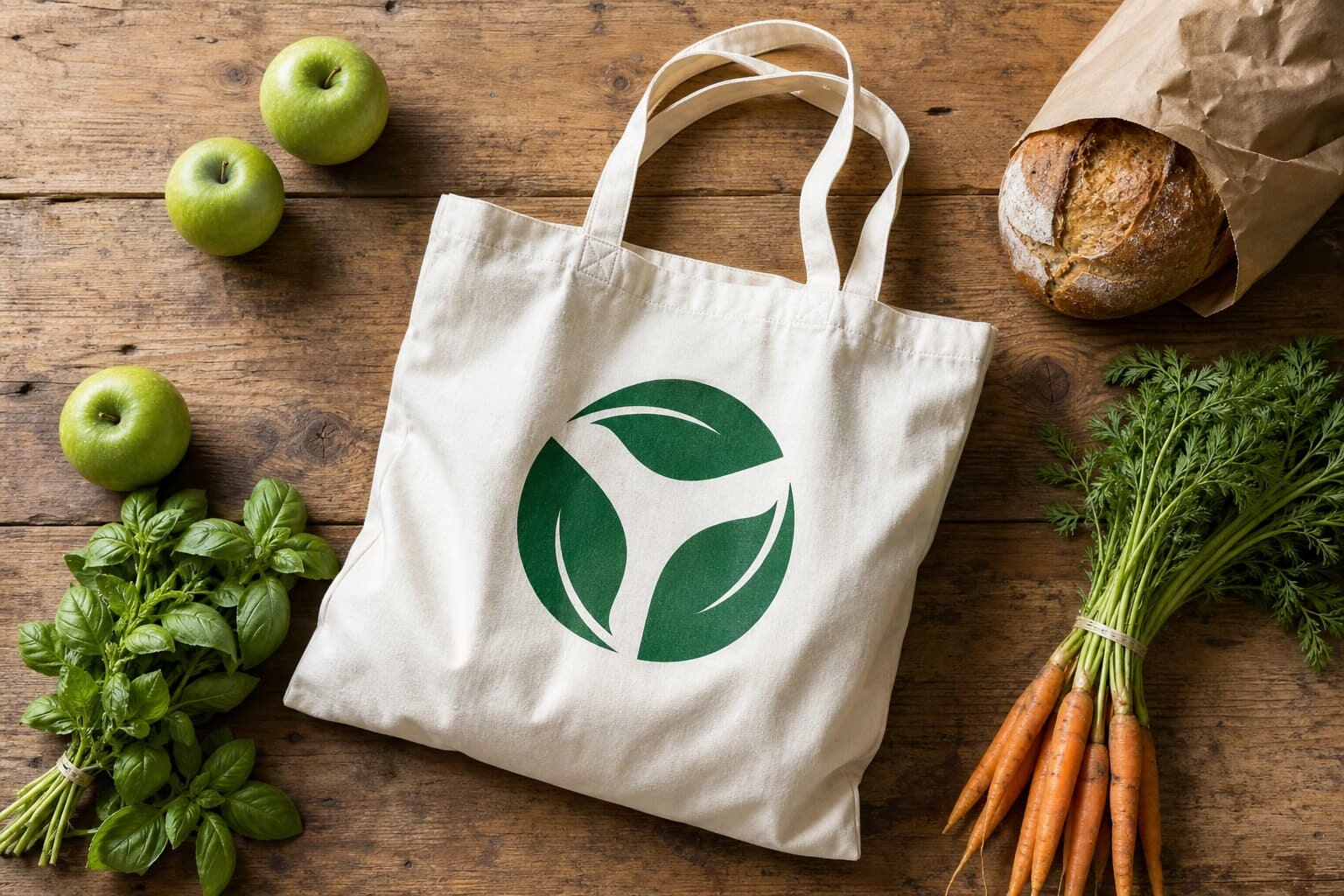
Why logo print quotes on organic cotton totes often do not match
The main buying problem is not finding a factory that can print a logo on an organic cotton tote bag. It is getting three or four quotes that are based on the same bag, the same fabric, and the same print process. Many RFQs say only "organic cotton tote with logo" and attach artwork. One factory prices 220 GSM plain weave with a one-color screen print, another assumes 310 GSM canvas with a larger print area, and a third includes a pre-production sample and interleaving in the carton. The unit prices look far apart, but the offers are not comparable.
Organic cotton adds another layer because different mills and converters use different fabric routes, shrinkage levels, and base shades. A logo that looks sharp on a tightly woven 300 GSM canvas may look softer and more absorbent on a lighter 180-220 GSM body fabric. If you do not lock the fabric and print assumptions first, your lowest quote can become the costliest order after resampling, print correction, or claim handling. A good print guide reduces that gap before you ask for pricing.
- Do not compare quotes until fabric GSM, weave, bag size, print size, and packing basis are aligned.
- Treat print method and fabric construction as one decision, because canvas texture changes print appearance.
- Ask factories to break out setup charges and variable unit costs instead of sending one blended number.
Start with the bag body before discussing the logo
For logo work, the fabric is not a background detail. It is the print surface. On organic cotton totes, common options range from roughly 140-180 GSM for lightweight promotional bags, 180-260 GSM for everyday giveaway totes, and 280-340 GSM for retail-grade canvas bags with better structure. Once you move into 350 GSM and above, the bag feels more substantial, but sewing, folding, and print penetration all change. If the buyer's priority is a clean front logo that stays flat in stores, 280-340 GSM is usually the safer starting point than chasing the lowest GSM.
Also define weave and finishing. A loose plain weave can fuzz and absorb ink more than a denser canvas. Pre-washed or pre-shrunk fabric can improve stability, but it may soften the print edge slightly compared with untreated fabric. Natural organic cotton shades vary from lot to lot, so if your logo color depends on a bright base, specify whether the fabric must be natural, dyed, enzyme washed, or bleached, and whether optical whiteners are allowed. That decision affects both compliance and visual consistency.
- Include fabric composition, GSM target, and GSM tolerance in the RFQ.
- State whether the tote is plain weave or canvas and whether pre-shrunk finishing is required.
- For shoulder totes, specify handle width and handle attachment method along with body fabric.
Choose the print method by artwork detail, quantity, and fabric texture
For most organic cotton tote logos, screen printing remains the practical bulk option. It works well for one-color or two-color branding, medium to large front panels, and stable replenishment programs. The reason buyers like it is not only cost. A well-made screen print can deliver better wash durability and a more controlled hand feel than cheaper shortcuts. But it depends on the artwork and fabric. Fine lines, reverse text, and very small legal copy can soften or fill in on textured canvas, especially on heavier slubbed or washed fabric.
Digital printing and heat transfer can help for multi-color artwork, photo detail, or low-volume sampling, but they need tighter review on colorfastness, edge cleanliness, and long-term abrasion. Pigment digital print may look attractive on approval, then fade faster than expected on bags used daily. Heat transfer can solve detail problems, but it may introduce a film-like hand on soft organic cotton. The correct question is not which method is newer. It is which method matches your logo file, expected order volume, target hand feel, and use case.
- Screen print: strongest option for simple logos, larger runs, and lower variable cost after setup.
- Digital print: useful for complex artwork or sampling, but check rubbing, wash reaction, and color repeatability.
- Heat transfer: useful for small detailed marks or limited runs, but confirm hand feel and edge durability.
- Ask the factory for minimum line thickness and minimum text height by print method on your chosen fabric.
Define logo size, placement, and print tolerance like a production spec
A surprising number of print claims start with vague placement instructions. "Center logo on front" is not enough when tote widths vary by a centimeter, seam allowances move, or handle stitching overlaps the intended print zone. Buyers should give the exact logo width and height, the distance from the top hem to the top of the print, and whether the bag should be measured laid flat before or after pressing. If the tote has a gusset, specify whether the design is centered on the front panel only or wraps visually across the body.
Placement tolerance matters just as much as artwork size. On basic tote bags, a realistic bulk tolerance may be around plus or minus 0.5-1.0 cm depending on bag size and print method. If your market is premium retail and the logo sits close to the top seam or side seam, you may want tighter control, but that can reduce line speed and increase rejection. Define what is critical. A centered logo on a natural cotton tote can often tolerate slight shade variation better than obvious left-right misalignment.
- Provide artwork in vector format and state final print size in centimeters.
- Mark the printable area on a line drawing of the bag, not only on a lifestyle image.
- Set approval criteria for position tolerance, skew, edge sharpness, and legibility of small text.
Build an RFQ that forces comparable factory offers
A usable tote bag RFQ should read more like a technical sheet than a purchase request. Start with one exact bag construction: finished size, gusset, handle length, handle width, stitching method, fabric GSM, color, print location, print method requested, and packing basis. Then ask the factory to quote controlled alternatives separately, for example the same bag in 220 GSM, 280 GSM, and 340 GSM, or screen print versus transfer. This format shows which variable is moving the cost instead of letting every supplier redesign the bag to win on headline price.
Quote data should also separate fixed and variable elements. You want to know whether the MOQ is driven by screen setup, dye lot, stock fabric availability, or sewing efficiency. If the print is one solid black CTM logo on a natural tote, setup may be minor and material may drive the cost. If the design needs two colors, exact Pantone match, and a large print area, print setup and slower throughput may matter more. Without that breakdown, buyers often negotiate the wrong part of the offer.
- Request unit price by quantity break such as 500, 1000, 3000, and 5000 pieces.
- Ask for a separate line for sample charge, screen charge, and packing upgrade if any.
- Require the factory to state what is included: polybag, carton marks, barcode labels, interleaf, and inspection standard.
- If you need certification support, ask whether the quote includes transaction documents or only material declaration.
Understand MOQ logic before pushing for a lower minimum
Buyers often hear one MOQ number and treat it as fixed. In reality, tote bag MOQ is usually a stack of several minimums. The fabric mill may have a minimum for custom dyed organic cotton. The printer may have a minimum that makes screen setup worthwhile. The sewing line may run small orders, but only if all trim and packing details are simple. If you ask which MOQ actually controls the order, you can often redesign intelligently instead of just requesting a lower minimum and getting a weak answer.
For example, a natural organic cotton tote with stock fabric and one-color front print may have a practical lower MOQ than a dyed tote with front-and-back prints and custom inner labels. If the order is below the printer's efficient run size, unit cost rises because setup and cleaning are spread over fewer bags. If the factory combines your order with another program using the same natural fabric, they may accept a lower quantity. The point is to ask for MOQ by component, not only total MOQ.
- Stock natural fabric usually reduces MOQ pressure compared with custom dyed shades.
- One-color, one-side print programs are easier to place at lower quantities than multi-position prints.
- Ask whether mixed SKU quantities can share one fabric lot or one print setup.
- If quantity is tight, prioritize keeping fabric and print simple rather than reducing bag quality blindly.
Use a real pre-production sample to catch print and sewing issues early
A digital mockup is useful for artwork alignment, but it is not a production sample. Before bulk approval, ask for a pre-production sample made on the same or equivalent bulk fabric with the actual print method, actual handle construction, and intended packing if rub risk is a concern. This sample is where buyers should judge the interaction between the logo and the cloth: edge clarity, ink coverage, hand feel, base shade influence, and whether the print sits square once the bag is sewn and pressed.
Do not approve only the front appearance. Check the inside of the bag for strike-through, check the handle area for distortion if the logo sits high, and test whether fresh prints transfer when stacked. If the tote may be washed by end users, ask for one simple wash observation on the sample, even if no formal wash standard is in the contract. Many quality problems are not dramatic failures. They are small mismatches between sample expectations and bulk realities that were never written down.
- Approve against a signed sample or numbered photo set with measurable dimensions.
- Check print size, position, Pantone target, fabric hand feel, and seam appearance together.
- Ask how many days sample approval adds to ex-factory lead time and whether screens are remade after sample changes.
Packing can protect or damage a good print
Packing details matter more on printed organic cotton totes than many buyers expect. If bags are folded and compressed before the ink fully cures, offsetting or blocking can appear after transit, especially in humid weather or when dark solid logos are stacked face-to-face. Some factories quote standard flat packing with no interleaf because it is faster and cheaper. That may be fine for light logos on rough canvas, but not always for larger coverage prints or smoother finishes.
From a logistics point of view, the right carton plan also affects warehouse handling and freight efficiency. A very heavy canvas tote packed too tightly can produce oversized carton weights that retailers reject. On the other hand, low piece counts per carton can raise freight cost unnecessarily. Buyers should specify inner pack quantity, master carton target, maximum carton gross weight, and whether printed faces need tissue or alternating direction. If you sell to retail chains, also confirm carton markings, barcode label location, and assortment rules before bulk starts.
- Ask how long printed bags rest before folding and packing.
- Set a maximum carton gross weight suitable for your downstream warehouse or retail customer.
- Use interleaf or alternating print direction when large dark prints are prone to rub or transfer.
- Confirm whether each bag is packed loose, in individual polybag, or in bundle packs by SKU.
Lead time depends on approvals, not only sewing capacity
Procurement teams sometimes ask only for total lead time, but a print-driven tote order should be reviewed as a sequence. Fabric booking or knitting is one stage, cutting and sewing another, print screen preparation another, and sample approval can stop all of them if artwork or color is still moving. A factory may say 30 days, but that usually assumes clean artwork, no color revisions, and no change after the pre-production sample. If your internal brand team is slow to approve Pantone or layout, the real lead time becomes much longer.
A practical timeline asks the factory to break out sample days, material days, bulk production days, and packing days. Also ask what milestones trigger delay. For example, if you approve the sample but later move the logo 2 cm upward, the factory may need to remake screens or redo pressing templates. That is not just an art file change. It affects schedule and waste. Good buyers freeze the spec before the factory commits line time.
- Request milestone lead times: artwork check, sample, material booking, print setup, sewing, final packing.
- Ask which changes after sample approval will restart print preparation.
- If the order is seasonal, build time for carton inspection and booking handoff, not only factory finish date.
Set acceptance criteria for print quality and workmanship
Final inspection goes more smoothly when the buyer defines defects in language that the factory and inspector can use. For logo printed organic cotton totes, critical checks usually include logo position, skew, missing print, shade mismatch beyond approved tolerance, unreadable text, excessive pinholes, smudging, and print transfer. Sewing checks should include open seams, broken stitches, loose threads beyond your standard, uneven handle attachment, and obvious panel distortion that makes the logo appear off-center even if the print itself is technically straight.
It also helps to separate cosmetic defects from functional failures. A tiny natural slub in organic cotton may be acceptable if it does not affect the logo or use performance, while a weak handle bartack is not. If your market is premium retail, define what face side appearance standard applies when the bag is viewed at normal selling distance. If your market is promotional distribution, durability and consistency may matter more than perfect surface uniformity. Write the standard to match the sales channel.
- State acceptable print position tolerance and maximum skew in measurable terms.
- Define whether minor natural fiber specks are acceptable on undyed organic cotton.
- Add handle strength and seam integrity checks so print approval does not overshadow functional quality.
- Use your normal AQL, but add product-specific print criteria in the inspection notes.
Specification comparison for buyers
| Spec decision | Recommended option | When it fits | Buyer risk to check |
|---|---|---|---|
| Fabric weight for daily retail tote | 280-340 GSM organic cotton canvas | Best for branded retail bags that need body and cleaner print presentation | Factories may quote lighter 180-220 GSM to reduce price unless GSM tolerance is written |
| Print method for simple 1-2 color logo | Water-based screen print | Large runs, bold logos, solid fills, low unit print cost after setup | Color variance between sample and bulk if Pantone target and underbase rules are not approved |
| Print method for fine lines or small text | High-mesh screen print or heat transfer for limited detail zones | When logo has thin strokes, small legal text, or registration-sensitive artwork | Very small text can fill in on textured canvas; require minimum line thickness and legibility standard |
| Bag color for sharp black logo | Natural fabric with pre-shrunk wash-stable finish | Most common importer program and easiest color control | Natural cotton shade can vary by lot; define acceptable base tone if logo contrast matters |
| Handle construction for grocery or trade-show use | Cross-stitched self-fabric handles, 60-70 cm length | Shoulder carry with stronger load performance on medium to heavy canvas | Short handles or weak box stitch can fail even when print is acceptable |
| Packing for printed face protection | Flat pack with tissue or interleaf every 10-20 pcs if fresh print rub risk exists | Dark prints, large ink coverage, or humid transit seasons | Print offset or scuffing if bags are compressed too early after curing |
Buyer checklist before sampling
- State fabric composition clearly: 100% organic cotton, woven canvas, target GSM, color, and whether recycled blend is not allowed.
- Specify finished bag size with tolerance, gusset if any, handle width and total handle length, and stitching requirement at handle joints.
- Attach artwork in vector format and list logo dimensions in centimeters, front or back placement, and print orientation from top seam.
- Name the print method requested or invite alternatives, but require the factory to quote each option separately instead of mixing methods in one line.
- Define print colors by Pantone reference and say whether slight shade drift is acceptable on natural cotton fabric.
- Ask whether fabric is pre-shrunk, washed, or untreated, and request expected shrinkage after printing and after one wash if the end market may launder the bag.
- Request MOQ by fabric color, by print color count, and by size so you know what is driving the minimum, not just the headline MOQ.
- Require pre-production sample approval with actual bulk-like fabric and actual print method, not a digital mockup or paper strike-off only.
- Confirm inner pack quantity, master carton count, carton size, carton gross weight, and whether printed panels need interleaving.
- Add acceptance criteria for print position tolerance, color tolerance, print adhesion, odor, needle detection if needed, and workmanship defects.
Factory quote questions to send
- What fabric GSM are you pricing, and what is the allowed production tolerance in percent?
- Is the quoted fabric certified organic at yarn, fabric, or finished bag level, and what document can you provide with shipment if requested?
- Which print method is included in the quote, and how many colors, screens, or transfer setups does that price assume?
- What maximum printable area are you quoting on this bag size without seam interference or handle obstruction?
- Does the quote include color matching to Pantone, and is there any surcharge for white underbase, flash curing, or large coverage prints?
- What is the MOQ driver: greige fabric stock, dyed fabric lot, screen setup, or sewing line efficiency?
- Can you quote the same bag in 220 GSM, 280 GSM, and 340 GSM so we can compare material effect separately from print cost?
- Will you provide a pre-production sample on the same fabric and with the same ink system as bulk, and how many days does that add?
- How long do bags need to rest after printing before packing to avoid set-off or blocking inside cartons?
- What carton quantity and carton dimensions are based on your quote, and how much do they change if we request lower carton weight?
Quality-control points to confirm
- Verify bulk fabric GSM from random roll or cut panel checks before cutting, not only from supplier paperwork.
- Check logo position from top edge and side seam on first-off pieces and again during inline sewing because panel shifting changes centering.
- Confirm print color against approved standard under consistent light, especially on natural cotton where base tone changes visual shade.
- Rub test cured print on dark solid areas to detect under-cured ink or powdery surface before mass packing.
- Measure handle length pair-to-pair and load-bearing stitching density because buyers often focus on print and miss carrying performance.
- Inspect for print strike-through, seam distortion through printed area, pinholes in solid fills, ghosting near folds, and ink marks on inside panels.
- Open packed cartons during final inspection to check whether stacked bags are blocking or transferring ink after compression.
- Review carton markings, SKU labels, and assortment ratio against packing list because mixed logos or mixed colorways create rework risk at destination.