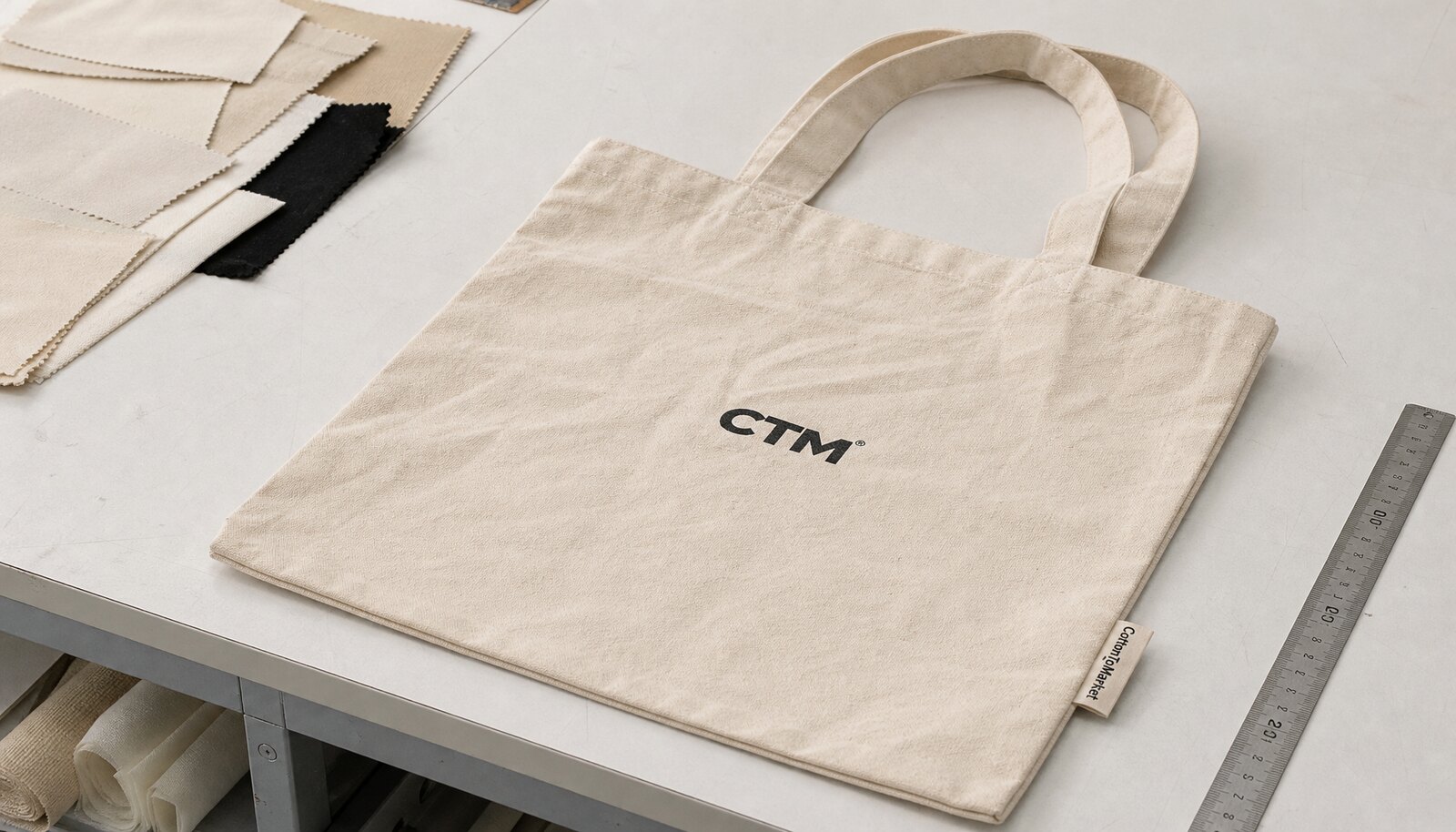
Why logo proofs fail on organic cotton bags
Organic cotton is not a neutral printing surface. The fabric can be raw, bleached, enzyme washed, or dyed, and each version behaves differently under ink. A logo proof that looks clean on one lot may print softer, duller, or slightly wider on another lot because the weave, absorbency, and GSM change how the ink sits in the fibers. Buyers often discover this only after the sample is signed and the bulk run is already scheduled.
The bigger problem is that many RFQs do not define enough production detail. If the request only says logo print included, the factory has to guess the bag size, print area, fabric weight, and packing method. That guesswork creates quote gaps. One supplier may include a full strike-off and proper curing, while another may quote a bare-bones print that looks fine on a screen but fails in bulk. The buyer then compares unit price instead of comparing the actual production plan.
- A weak proof process usually causes wrong print size, wrong placement, and wrong ink density.
- Loose RFQs also hide fabric changes that affect color, hand-feel, and shrink behavior.
- A good logo proof is a production control tool, not a marketing visual.
Fix the bag spec before you ask for artwork approval
Start with the bag, not the logo. State the finished size, handle length, gusset depth, seam allowance, and target GSM before you ask the supplier to price printing. For light promotional totes, 110-130 gsm can work, but the print and structure will feel less substantial. For retail or reuse-oriented bags, 140-180 gsm is a more common range because the fabric holds shape better and gives the logo a cleaner surface. If the bag is lined or uses a gusset, the logo placement must be measured against the real fold lines, not the flat artwork file.
Also define the cotton condition. Natural unbleached cotton gives a warmer, more textured look, but it can mute pale ink colors. Bleached cotton improves contrast but may change shrink and hand-feel. If the buyer wants the logo centered on a front panel, the factory should know where the visual center sits after sewing, not just the cut panel size. That is how procurement avoids a bag that looks balanced on paper but off-center in hand.
- Include finished size, target GSM, handle length, gusset depth, and seam allowance.
- State whether the cotton is raw, bleached, or dyed.
- Confirm whether the logo may cross a seam, fold, or stitched edge.
- Specify the use case: event giveaway, retail shelf, or repeat resale.
What the proof must show line by line
A useful proof should read like a production sheet. It needs the actual print size in millimeters, the exact placement from the top edge and side seam, the number of colors, and the ink reference. If the logo includes small text, fine lines, or a thin outline, the proof should also note the minimum line width that the factory can hold without filling in. This is especially important on organic cotton because the weave can swallow detail faster than buyers expect.
Ask for a proof that mirrors the bulk plan as closely as possible. If the bulk bag will be 140 gsm natural cotton with one-color black screen print, do not sign off a digital render on a whitened sample. The purpose of the proof is not to look attractive. It is to prove that the print survives the real fabric, real curing, and real sewing tolerances. A pretty picture does not protect a purchase order.
- Artwork file format and version should be listed on the proof.
- Print size and placement should be measured, not described loosely.
- Ink color should be tied to a standard or approved sample.
- The proof should name the fabric weight and finish used.
- Every approval should carry a date and revision number.
Choose the print method before comparing quotes
Screen print is still the default for most logo organic cotton bag orders because it is readable, repeatable, and cost-efficient at volume. One or two spot colors usually work best. Water-based inks are common when the brand wants a softer hand and a more natural finish, but they demand better control over fabric shade and curing. Heat transfer and digital methods can be useful for low quantities or more complex graphics, yet they often change the hand-feel and can raise the cost per piece in ways the buyer does not see at first glance.
The right method depends on three things: logo complexity, order quantity, and acceptable finish. A simple one-color logo on a 5,000-piece order should not be priced the same way as a gradient-rich mark on a 300-piece test order. If the buyer expects monthly reorders, setup cost matters more than the first quote alone. If the artwork has small type or fine lines, the supplier should tell you upfront whether the chosen method can hold the detail cleanly on the selected GSM.
- Use screen print for simple logos, cleaner repeatability, and larger volumes.
- Use water-based inks when hand-feel matters and the design allows for it.
- Use digital or transfer methods only when the logo complexity justifies the extra cost.
- Do not compare quotes unless the print method is the same across suppliers.
Read the quote as a production document, not a unit price
A quote for printed organic cotton bags should break down the bag body, print setup, sampling, packing, and any special handling. That breakdown tells procurement whether two suppliers are truly offering the same thing. One factory may include a strike-off, thread trimming, and carton marks. Another may leave those out and appear cheaper until the hidden extras are added. Ask for the quote data in a format that lets you compare line by line, not just bottom line to bottom line.
MOQ logic matters as much as the unit price. A factory may quote 1,000 pieces at one level, 3,000 at a lower level, and 5,000 at a better level because screens, cutting, printing, and packing labor are spread over more units. If the supplier only gives a single number, ask what happens at the next breakpoint. That is often where the real commercial value sits. You may find that a slightly larger order materially lowers print setup cost per bag, which can change your sourcing plan.
- Ask for fabric GSM, finish, and construction in the quote line.
- Separate setup fees from recurring print cost.
- Request sample fee, re-sample fee, and artwork revision fee if any.
- Ask for MOQ tiers and the price at each tier.
- Confirm whether packing, carton marks, and moisture protection are included.
- Ask if the quoted lead time includes fabric booking and curing time.
Approve the strike-off with measurable acceptance rules
A strike-off should be judged with a ruler and a clear standard, not with a general impression. Check logo width and height, placement from the edges, ink opacity, and edge sharpness. On organic cotton, small fiber irregularities can be normal, but bleeding into the weave or a visibly warped logo is not. If the factory sends only a photo, ask for the physical sample. Color, texture, and print depth are all easier to miss on a screen than in hand.
Before bulk starts, define the acceptance limits that matter for your channel. Some buyers allow a 5 mm placement tolerance and a slight natural-fiber texture variation. Others need tighter alignment because the bags will be sold in retail packaging. The key is to decide the pass or fail rule before the production slot opens. Once the machine is running, every late change costs time and money. A clear sign-off sheet protects both sides because it removes ambiguity from the order.
- Check print width, height, and placement against a ruler.
- Confirm the logo sits flat after curing and does not crack when folded.
- Allow only the texture variation you can sell to your customer.
- Reject any sample with bleeding, ghosting, or weak opacity.
- Write down the approved version before the bulk run begins.
Packing can damage a good print if you ignore it
A good print can still arrive damaged if the folding and packing plan is wrong. Organic cotton bags should be folded so the print area does not crease sharply through the center of the logo. If the front panel carries the mark, ask the factory how the bag will sit in the carton and whether each piece needs an individual polybag. For long ocean transit, moisture protection may matter as much as the print itself because cotton can hold odor, pick up humidity marks, or rub against adjacent pieces.
Retail buyers and distributors should also look at carton count and carton size as part of the proof checklist. Too many bags per carton can crush the logo and make warehouse receiving slow. Too few bags per carton raise freight cost and waste cube space. The best packing spec supports the customer's next step, whether that is shelf display, distribution-center counting, or direct resale. Packing is not a last-minute add-on. It is part of the product's final quality.
- Specify fold method and keep the print area away from hard crease lines.
- Confirm whether an individual polybag is needed.
- State carton quantity, carton dimensions, and master carton marks.
- Add moisture protection if the route is long or humid.
- Ask for a pack-out photo before shipment if the order is sensitive.
Plan the lead time around fabric, proof, and sewing
Organic cotton bag lead time usually depends on three queues: fabric availability, print approval, and sewing capacity. If the bag requires a specific GSM or a specific cotton finish, fabric booking can become the longest step. Once the proof is approved, the factory still has to cut, print, cure or dry, trim threads, inspect, fold, and pack. Buyers who only ask for a final ship date often miss the fact that sample approval and material booking are the real schedule drivers.
A better RFQ asks for time by stage. Request a sample lead time, a bulk lead time after approval, and a clear start point for the clock. Does it begin when the artwork is confirmed, when the deposit lands, or when the fabric is in house? Ask that question before you compare vendors. For example, many factories need about 5-10 working days for a strike-off and 20-35 working days for bulk, but the actual timing depends on order size, print method, and fabric status. That stage-by-stage view makes planning more reliable and helps procurement protect the launch date.
- Ask when the lead-time clock starts.
- Separate sample lead time from bulk production lead time.
- Confirm whether artwork revisions restart the queue.
- Check whether fabric booking is already in hand or still needs sourcing.
- Plan buffer time if the bags must move by sea instead of by air.
The mistakes buyers repeat and how to stop them
The most common mistake is approving a mockup instead of a production proof. The second is changing the logo after the strike-off and expecting the same price and schedule. The third is ignoring fabric weight. On organic cotton, the same artwork can look premium on 180 gsm and weak on 120 gsm because the fabric body changes the visual balance of the logo. Buyers should treat GSM as part of branding, not just a cost line.
Another frequent failure is split approval. Marketing likes one version, procurement signs another, and the factory prints a third. That is how disputes start. Use one version-controlled approval sheet with the bag spec, artwork, placement, color reference, packing, and tolerance limits in the same file. Everyone signs the same sheet, and the factory builds to one target. That single discipline prevents most of the avoidable errors that make a logo print proof checklist useful in the first place.
- Do not approve a render when you need a physical strike-off.
- Do not change artwork after approval without revising price and lead time.
- Do not ignore GSM, because it changes print appearance and bag structure.
- Do not let different teams sign different versions of the same order.
Specification comparison for buyers
| Spec decision | Recommended option | When it fits | Buyer risk to check |
|---|---|---|---|
| Artwork proof format | Vector mockup with exact print size and placement | First-round quote comparison and artwork sign-off | Proof missing scale, bleed, or margin to seam |
| Print method | 1-2 color screen print | Simple logo, higher volumes, and stable reorders | Fine text, gradients, or tight registration may fail |
| Proof sample | Strike-off on the same GSM fabric | Color-sensitive branding on natural cotton | Approval made on the wrong fabric finish or shade |
| Packing spec | Bulk pack with carton mark and moisture bag | Warehouse or retail receiving needs clean counts | Print rub, creases, or short-shipped cartons |
Buyer checklist before sampling
- Confirm finished bag size, handle length, seam allowance, and target GSM before asking for logo pricing.
- State whether the organic cotton is raw, bleached, or dyed, because shade affects print contrast.
- Send vector artwork and set minimum line thickness so the factory does not guess on small text.
- Specify print location, actual print size, and whether the logo appears on one side or both sides.
- Ask for a strike-off on the same fabric weight and finish that will be used in bulk.
- Request the print method, ink type, and curing method in the quote, not only the unit price.
- Ask for MOQ tiers so you can see where setup cost and labor start to drop.
- Confirm folding method, individual packaging, carton quantity, carton marks, and moisture protection.
- Approve a written tolerance for placement, color shift, and fabric texture before bulk starts.
- Separate sample lead time, bulk lead time, and freight timing so the schedule is realistic.
Factory quote questions to send
- What GSM, weave, and fabric finish are you quoting for this bag?
- Is the price based on raw natural cotton, bleached cotton, or dyed organic cotton?
- What print method do you recommend for this logo, and how many colors are included?
- What are the setup costs for screens, plates, or digital files, and what does each one cover?
- Will the strike-off be made on the same fabric and with the same process as bulk production?
- What MOQ tiers do you quote, and how does the unit price change at each tier?
- What folding, polybag, carton quantity, and carton marking spec are included in the quote?
- What is the sample lead time, bulk lead time, and the point at which the schedule starts?
Quality-control points to confirm
- Check fabric GSM against the approved spec and confirm no substitution without written approval.
- Measure finished bag size, handle length, and gusset depth against the signed sample.
- Verify logo position from top edge and side seam before bulk printing starts.
- Inspect print sharpness, opacity, and registration under daylight and indoor light.
- Look for ink bleed, cracking, ghosting, or strike-through on the reverse side of the fabric.
- Confirm thread trimming, seam strength, and handle attachment around stress points.
- Check folding method, carton count, carton marks, and barcode readability at pack-out.
- Review moisture protection, odor, and crease condition after carton compression.