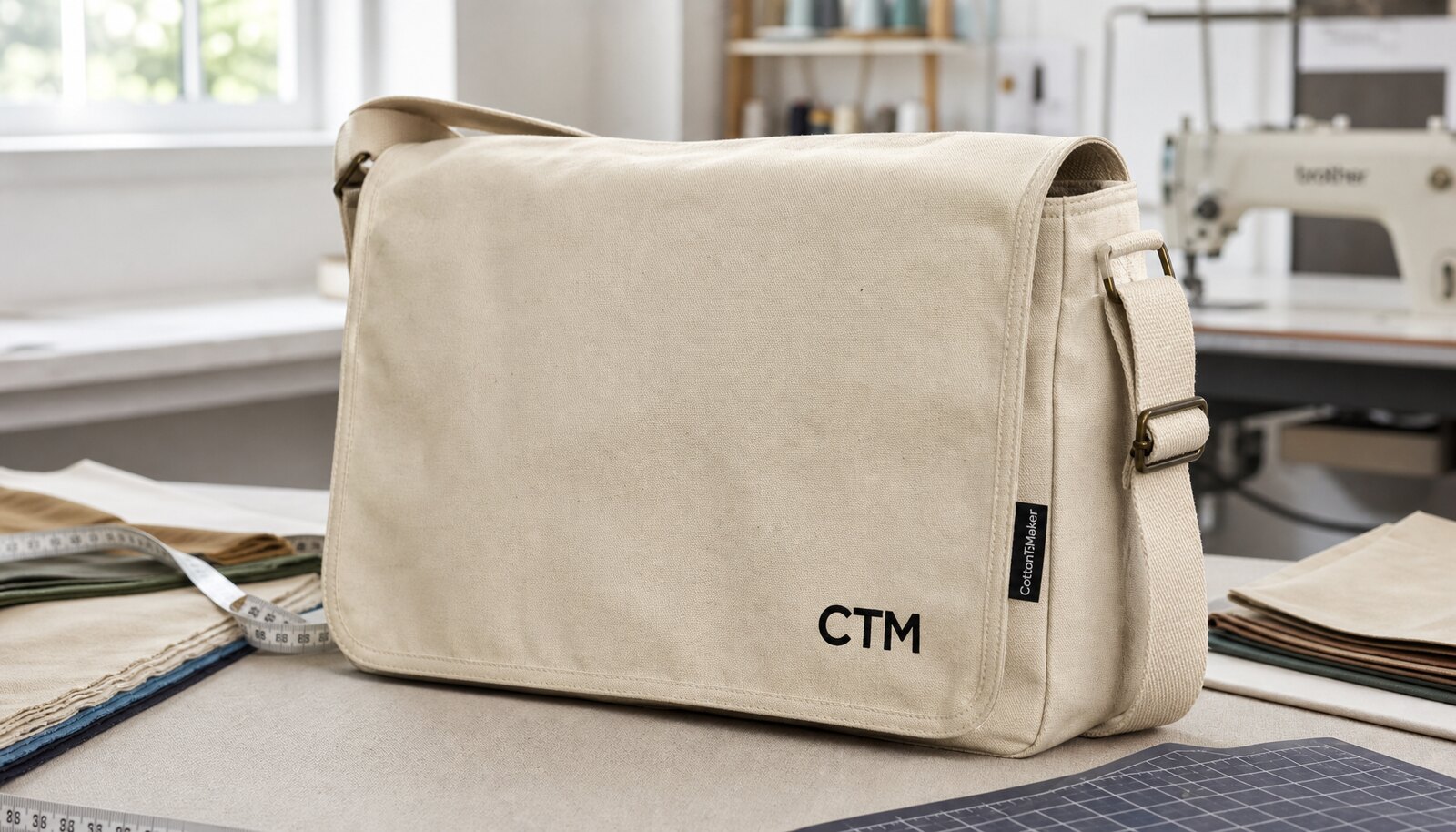
The Buying Problem: Quotes Look Similar, Bags Do Not
A logo messenger bag supplier may quote the same basic description as another factory: cotton canvas messenger bag, front flap, shoulder strap, logo print. On paper the quotes look comparable. In production, the difference can be fabric density, strap strength, logo durability, hardware grade, sewing accuracy, and packing method.
The main procurement risk is not only paying too much. It is approving a low-detail quote that allows the supplier to choose cheaper fabric, thinner webbing, unstable print ink, weak magnets, or rough packing. A messenger bag has more structure than a tote bag, so small changes in material and sewing can affect how the flap hangs, how the strap carries weight, and how the logo looks after folding.
- Do not compare suppliers by unit price until fabric weight, size, logo method, hardware, and packing are aligned.
- Avoid RFQs that only say canvas messenger bag with logo; this leaves too many production decisions open.
- Request photos of previous bulk goods, but base approval on a physical sample made to your specification.
- Ask the supplier to identify which parts of the quote are fixed and which may change after sampling.
Lock the Bag Construction Before Discussing Logo Cost
A messenger bag is a cut-and-sew product with several cost drivers hidden inside the construction. The supplier needs to know whether the bag is a simple document carrier, a retail-style shoulder bag, or a padded laptop-style bag. Each version changes fabric consumption, sewing time, hardware needs, and inspection risk.
For B2B orders, the most practical starting point is to define the finished size, gusset, flap type, strap type, closure, and internal organization. If you leave the inside details open, factories may quote a plain compartment while your team expects a zipper pocket or padded sleeve.
- Common finished size range: about 34-40 cm wide, 26-32 cm high, with 7-12 cm gusset depending on capacity.
- Front flap: short flap reduces fabric cost; full flap improves logo visibility and content coverage.
- Strap: 3.2-3.8 cm cotton webbing is common; wider straps improve comfort but increase cost.
- Closures: magnetic snap, hook-and-loop, buckle, zipper top, or no closure should be specified clearly.
- Interior: plain compartment, zipper pocket, open pocket, laptop sleeve, lining, or pen slots should be listed in the RFQ.
Choose Canvas GSM Based on Use, Not Guesswork
Canvas weight is one of the biggest reasons supplier quotes vary. Many buyers request 12oz canvas without confirming GSM, weave density, or whether the fabric is natural, bleached, dyed, or washed. One factory's 12oz canvas can feel tighter and stronger than another supplier's looser weave.
For logo messenger bags, 10oz canvas can work for light promotional use, but 12oz is usually a safer commercial balance. If the bag is expected to carry laptops, catalogues, drink bottles, or retail goods, consider 14oz or add reinforcement at stress points instead of simply increasing GSM everywhere.
- 10oz canvas, about 300-340 GSM: suitable for low-weight promotional distribution and large quantity campaigns.
- 12oz canvas, about 380-410 GSM: practical default for brand merchandise, retail programs, and distributor stock.
- 14oz-16oz canvas, about 450-540 GSM: stronger hand feel, better structure, higher sewing and freight cost.
- Natural cotton canvas may show seed flecks and shade variation; dyed canvas needs color approval and colorfastness checks.
- If the bag has lining, the outer fabric can sometimes be slightly lighter without losing perceived structure.
Match the Logo Method to Artwork and Bag Position
The most common logo method for canvas messenger bags is screen printing. It is efficient for solid-color logos and larger front flap branding. However, the flap bends during use, so ink flexibility and curing matter. A large print over a fold line can crack or look uneven if the artwork is not positioned correctly.
For retail-style bags, a woven label, cotton label, embroidery, or PU leather patch can look more permanent than a large print. These methods are useful when the buyer wants a quieter brand effect or when the logo has small text that may not print sharply on coarse canvas.
- Screen print: best for 1-3 solid colors, bold logos, and repeat promotional orders.
- Heat transfer: useful for detailed artwork but must be tested for adhesion on canvas texture.
- Embroidery: durable and premium, but small text can distort and dense stitching can pucker canvas.
- Woven label: good for retail branding, side labels, and subtle logo placement.
- Patch: suitable for premium collections, but confirm patch material, stitch style, and edge finishing.
Understand MOQ Logic Before Pushing for a Lower Quantity
MOQ is not only a factory preference. It is affected by fabric sourcing, dyeing, logo setup, cutting efficiency, sewing line changeover, packing material, and inspection cost. A supplier may accept a lower bag MOQ if stock fabric and standard hardware are used, but custom dyed canvas, custom webbing, special labels, or printed retail packaging often have separate minimums.
When comparing suppliers, ask them to break down the MOQ by component. This helps you see whether the minimum is driven by fabric, logo, accessories, or the sewing line. It also gives you options: use stock natural canvas for a trial run, then switch to custom dyed canvas after sell-through is proven.
- Stock natural canvas usually supports lower MOQs than custom dyed canvas.
- Custom woven labels and leather patches may have their own MOQ even if the bag MOQ is lower.
- Pantone dyed fabric often requires additional material lead time and higher minimum yardage.
- Small trial orders may carry higher unit cost because cutting, setup, and inspection are spread over fewer pieces.
- If you need mixed colors, confirm whether the MOQ is per style, per color, per logo, or per shipment.
Sample Approval Should Simulate Bulk Production
A good sample is not just for appearance. It should prove that the selected fabric, logo process, hardware, sewing construction, and packing can be repeated in bulk. If a supplier makes a hand-finished sample using substitute fabric or temporary hardware, it may look acceptable but fail to predict production quality.
Ask for a pre-production sample after final artwork and materials are confirmed. Measure it, fill it, hang it with weight, rub the logo, inspect seam strength, and check how it folds into the planned packing. For messenger bags, the way the flap sits after packing is especially important.
- Confirm sample fabric weight, color, weave, and finish match bulk material.
- Check logo size, placement, color, edge sharpness, ink hand feel, and rub resistance.
- Load the bag with realistic contents to test strap comfort and stress points.
- Open and close magnetic snaps, buckles, hook-and-loop, and zippers repeatedly.
- Approve size tolerance, not only the target size, because canvas cutting and sewing can vary.
Quote Data Buyers Should Request in One Sheet
A professional quote for a logo messenger bag should make assumptions visible. If the quote only includes a unit price and delivery time, procurement teams cannot compare suppliers accurately or protect the purchase order from later changes.
Ask the factory to quote against the same data sheet. This reduces misunderstandings and helps your team identify which supplier has actually understood the product. It also prevents the common problem of receiving a low quote that excludes logo setup, sample cost, custom label cost, carton marking, or special packing.
- Finished size, fabric weight, fabric color, lining, pocket structure, strap specification, and hardware details.
- Logo method, logo size, print colors, artwork position, setup charge, and sample charge if applicable.
- MOQ by style, color, logo, packing type, and shipment.
- Sample lead time, sample revision time, bulk material lead time, sewing lead time, and packing time.
- Individual packing, carton quantity, carton size, gross weight, shipping marks, and barcode requirements.
- Payment terms, inspection timing, defect handling, and validity period of the quote.
Packing and Lead Time Can Change the Real Cost
Messenger bags are bulkier than flat totes because of flaps, straps, hardware, gussets, and possible padding. Packing method affects carton size, freight cost, crease marks, logo transfer, and warehouse receiving efficiency. A low unit price can become less attractive if the bags are packed inefficiently or arrive with pressure marks.
Lead time should also be broken into stages. Sampling, artwork approval, material sourcing, cutting, printing, sewing, inspection, and packing do not happen at the same time. If the logo is printed before sewing, any print defect can waste cut panels. If the logo is applied after sewing, the supplier must confirm the printing position can be controlled on the finished bag.
- Folded packing saves carton volume but can create flap creases on heavy canvas.
- Flat packing protects shape but increases carton size and freight cost.
- Dark prints and metal hardware should be separated from light natural canvas to avoid marking.
- Paper belly bands may fit retail programs, while polybags may be needed for warehouse protection.
- Ask for carton drop resistance, moisture protection, and carton labeling details for import receiving.
Specification comparison for buyers
| Spec decision | Recommended option | When it fits | Buyer risk to check |
|---|---|---|---|
| Canvas fabric weight | 12oz cotton canvas, about 380-410 GSM | Most retail, event, and brand merchandise messenger bags needing good structure without becoming too heavy | Ask whether GSM is before or after washing; low-density fabric can look thin even if quoted as 12oz |
| Budget fabric option | 10oz cotton canvas, about 300-340 GSM | Large promotional runs where the bag carries documents, light apparel, or trade show material | Flap may wrinkle more easily; check whether reinforcement is needed at strap and bottom stress points |
| Premium fabric option | 14oz-16oz canvas, about 450-540 GSM | Retail programs, laptop-style bags, and higher perceived value gift sets | Higher fabric weight increases carton weight, needle marks, sewing time, and freight cost |
| Logo branding | Screen print for 1-3 solid colors | Clear flat logos, campaign artwork, university marks, and distributor branding | Confirm ink coverage, curing, rub resistance, and whether the print crosses seam or flap fold areas |
| Premium logo branding | Woven label, PU leather patch, or embroidery | Retail-style programs where the logo should look less promotional | Check label colorfastness, patch placement tolerance, and needle holes on dense canvas |
| Closure detail | Magnetic snap or hook-and-loop under flap | Daily-use messenger bags where contents need basic security | Magnets may affect packing thickness; hook-and-loop can catch lint and reduce perceived value |
| Packing method | One bag in a recycled polybag or paper belly band, then export carton | Distributor inventory, retail DC delivery, or brand warehouse receiving | Unprotected metal parts and dark prints can mark natural canvas during long sea shipment |
Buyer checklist before sampling
- Define the exact bag size as width x height x gusset, and state whether measurements are for the finished bag or cut panels.
- Specify canvas weight in oz and estimated GSM, plus whether the fabric is natural, dyed, washed, or bleached.
- Confirm strap material, strap width, adjustable range, hardware material, and whether the strap is removable or fixed.
- Provide logo artwork in vector format and state logo size, print color references, position from edges, and acceptable placement tolerance.
- Decide whether the bag needs inner lining, zipper pocket, laptop sleeve, pen slots, or only a plain main compartment.
- Ask for a pre-production sample using bulk fabric, bulk logo method, bulk hardware, and intended packing method.
- Confirm carton quantity, carton dimensions, gross weight, individual packing, barcode label needs, and any retail hangtag or insert.
- Require the supplier to separate tooling, sample, logo screen, packing, and freight-related charges from the unit price.
Factory quote questions to send
- What fabric weight are you quoting, in both oz and approximate GSM, and is the fabric stock fabric or custom dyed?
- What is the MOQ for the bag body, and is there a separate MOQ for custom dyed canvas, custom webbing, woven labels, patches, or printed packing?
- Which logo method do you recommend for this artwork, and what logo size, color limit, and placement tolerance are included in the quote?
- Can the sample be made with the same fabric, thread color, hardware, lining, logo process, and packing as bulk production?
- What are the estimated lead times for artwork approval, sampling, sample revision, material preparation, bulk sewing, inspection, and packing?
- Are metal parts zinc alloy, iron, brass, or plastic, and can you confirm color, finish, corrosion resistance, and replacement policy for defective hardware?
- How many pieces per export carton, what is the estimated carton size and gross weight, and will bags be folded or shipped flat?
- What inspection standard do you use for fabric defects, print defects, sewing defects, stains, loose threads, size tolerance, and packing errors?
Quality-control points to confirm
- Check finished size tolerance on width, height, gusset, flap length, and strap length before approving the sample.
- Review fabric density, shade, odor, slubs, stains, and shrinkage risk, especially for natural and dyed cotton canvas.
- Test logo adhesion by rubbing, bending the flap, and checking whether ink cracks on folded or high-stress areas.
- Inspect stress points at strap joints, side seams, bottom corners, D-rings, buckles, and magnetic snaps.
- Confirm the flap sits straight, the bag stands correctly when filled, and the front panel does not twist after sewing.
- Check needle marks, skipped stitches, loose threads, seam allowance, bartack strength, and thread color consistency.
- Verify individual packing prevents logo transfer, canvas creasing, hardware scratches, moisture damage, and carton compression.
- Confirm production labels, carton marks, barcode stickers, inner quantity, and shipping marks match the purchase order.