The Main Buying Problem: Jute Texture Changes the Print Result
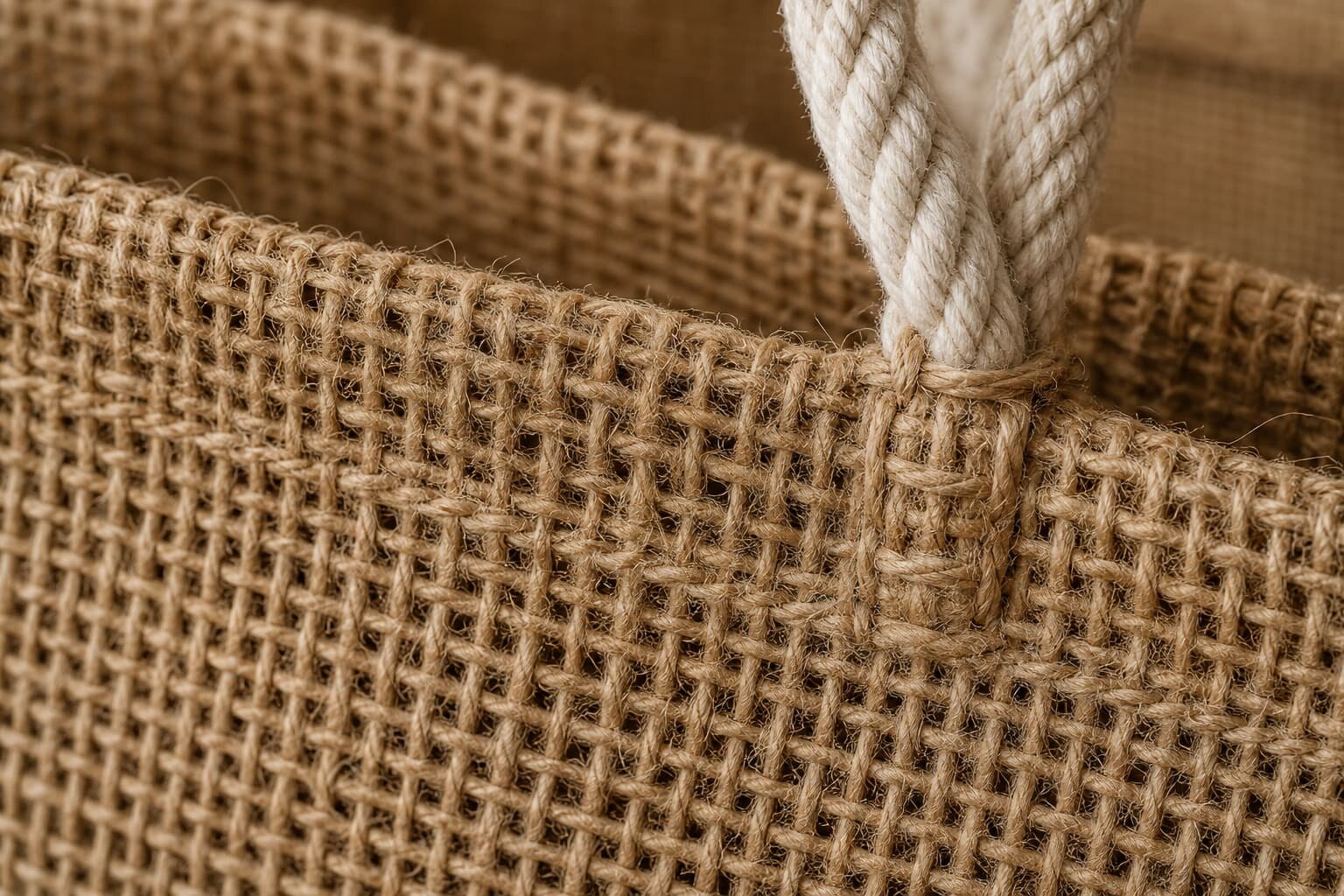
A logo jute bag printing project is not the same as printing on cotton canvas. Jute has a coarse weave, raised yarns, natural color variation, and small gaps between fibers. These features are exactly why buyers choose jute for a rustic retail or gift-packaging look, but they also make fine logo details harder to reproduce. If the RFQ only says custom printed jute tote bag with logo, different suppliers may quote very different constructions and print standards.
For procurement teams, the main risk is not only unit price. The larger risk is approving a quote that looks competitive but is based on thinner fabric, a simplified print, loose placement tolerance, or packing that creases the logo. A useful supplier quote should tell you what will happen in production: fabric weight, lamination, print method, logo size limit, handle reinforcement, sample process, lead time, and carton data.
- Use jute when the buyer accepts natural fiber variation rather than a perfectly smooth print surface.
- Avoid very small text, thin outlines, QR codes, and detailed gradients on direct jute printing.
- Request a print strike-off or pre-production sample before approving bulk printing.
- Compare quotes only after construction, print method, and packing assumptions are aligned.
Choose the Right Jute Fabric Weight Before Asking for Price
Jute bag prices move quickly with fabric weight. Many factories describe jute by ounce weight, while buyers often ask in GSM. A practical retail tote usually sits around 13 oz to 15 oz jute, roughly 370-425 GSM depending on yarn and weave. Lighter jute can work for low-cost giveaways, but it may wrinkle more easily, feel less structured, and create weaker seams under load. Heavier jute improves body and perceived value, but it increases material cost, carton weight, and shipping volume.
The RFQ should not use only words like thick, strong, eco, or premium. These terms cannot be audited. Ask the supplier to state the fabric weight included in the quote and the expected tolerance. Also confirm whether the bag is made from natural jute, dyed jute, laminated jute, or jute blended with cotton. A small construction change can make one supplier look cheaper while the real reason is a lower grade material.
- Light promotional use: around 10 oz to 12 oz jute may be acceptable for short events and low carrying weight.
- Standard retail tote: around 13 oz to 15 oz jute is a common practical range for brand programs.
- Heavier reusable shopping bag: 15 oz plus, or laminated jute, may be suitable when structure matters.
- Ask whether GSM is measured before lamination, after lamination, or as an approximate fabric reference.
Direct Screen Printing vs Patch Label: Match the Logo to the Surface
Direct screen printing is usually the most practical method for logo jute bags when the artwork is bold, solid, and not too small. It works well for one-color logos, simple retail marks, event names, and large block graphics. The factory should control ink viscosity and squeegee pressure so the ink sits on the raised jute surface without flooding into the weave. Because the base material is tan or dyed, light ink colors may need extra opacity or a heavier ink deposit.
If the logo has small text, thin lines, multiple colors, or strict brand sharpness requirements, a cotton patch, canvas panel, woven label, or leather-style tag may be safer. The logo is printed or woven on a smoother component and then stitched onto the jute bag. This adds material and labor cost, but it gives a cleaner logo edge and a more controlled brand appearance. For premium retail packaging, the patch method often reduces complaints even if the unit price is higher.
- Use direct screen print for bold logos, large marks, and budget-sensitive bulk orders.
- Use a cotton or canvas patch for small lettering, multi-color graphics, or tighter brand standards.
- Use woven labels for small permanent branding, side labels, or merchandise-style finishing.
- Avoid heat transfer films on rough jute unless the supplier has tested adhesion and wash or rub behavior.
Logo Artwork Rules That Prevent Rejected Samples
Artwork problems cause many avoidable sampling delays. A factory can print only what is technically possible on the chosen surface. Vector files are preferred because the supplier can separate colors, adjust screen output, and maintain clean edges. For direct printing on jute, the logo should be simplified before sampling. Thin lines, small trademark symbols, tiny legal text, and low-contrast colors often look weaker on real jute than on a digital proof.
Placement needs the same level of detail as the artwork. State the logo width and height, distance from the top edge, and whether the measurement is from the top seam, bag opening, or top of the printed area. If the bag has a gusset, confirm whether the print is centered on the front panel only or aligned with the overall flat width. For two-sided printing, identify whether both sides use the same artwork and whether handle stitching may affect the print area.
- Send AI, EPS, PDF, or SVG artwork instead of a low-resolution PNG copied from a website.
- State Pantone references, but allow realistic tolerance because natural jute affects visual color.
- Confirm minimum printable line width and minimum text height before sample production.
- Mark print placement in millimeters or inches, not only with a screenshot.
- Ask for an artwork proof and a physical sample; a digital proof cannot show jute texture.
Bag Construction Details That Change the Quote
Two suppliers can quote the same printed jute bag size and still be pricing different products. Construction details such as gusset depth, handle length, handle width, top hem, lamination, lining, binding, and reinforcement stitching all affect cost. A small gusset increase may require more fabric and change the cutting plan. Longer handles may need more cotton webbing and stronger attachment. A lined jute bag may look cleaner inside but uses additional fabric and labor.
For reusable shopping and retail bags, handle construction deserves close attention. Cotton webbing handles are comfortable and can be dyed or matched more easily than jute handles. Jute handles create a consistent natural look but may feel rougher in hand. The handle should be secured with cross-stitch, box stitch, or reinforced stitching appropriate for the carrying weight. If the bag will carry bottles, groceries, catalogs, or boxed products, do not approve the quote until load expectations are written into the specification.
- State finished size as width x height x gusset, such as 35 x 40 x 15 cm.
- State handle length or handle drop; shoulder carry and hand carry are different constructions.
- Specify cotton webbing width, jute handle width, or rope handle diameter where relevant.
- Ask whether the top opening has a folded hem, binding, zipper, button, or no closure.
- Confirm whether lamination or lining is included, because both change feel and print behavior.
MOQ Logic: Why the Cheapest Quote May Not Be the Best One
MOQ for logo jute bag printing is not only a factory policy. It depends on fabric availability, dye lot, cutting efficiency, print setup, color count, handle type, and packing requirements. A supplier may accept a low order quantity if the jute fabric is in stock and the logo is one-color direct print. The same supplier may request a higher MOQ for dyed jute, special GSM, uncommon handle color, multi-color patch labels, or separate artwork versions.
When comparing quotes, ask what is driving the MOQ. A low MOQ can be useful for a test order, but it may include higher unit cost, limited material choices, or manual printing that is harder to scale. A higher MOQ may be better if it gives consistent fabric, efficient screen setup, and stable production planning. Buyers should also separate MOQ per style from MOQ per artwork. If a distributor needs three logo versions on the same bag construction, the price logic may be different from three different bag sizes.
- Clarify MOQ per bag size, per print design, per colorway, and per shipment.
- Ask whether multiple SKUs can share the same base material and handle to reduce setup waste.
- Check whether sample charges can be refunded or credited after bulk order confirmation.
- Confirm whether screen setup is charged per print color and per artwork size.
- Do not compare a one-color direct print quote against a stitched patch quote as if they are the same product.
Sample Approval Should Test Production, Not Just Appearance
A good sample approval process checks whether the factory can reproduce the agreed product in bulk. For logo jute bags, the sample should use the same fabric weight, same lamination or lining, same handle material, same print method, and same packing direction as the final order. If a supplier sends a similar reference sample only to show workmanship, it can help with evaluation, but it should not replace a pre-production sample made to your artwork and specification.
Procurement teams should define sample acceptance criteria before the sample is made. Otherwise, disputes become subjective. For example, a logo that is 5 mm off center may or may not matter depending on the bag size and brand standard. Ink coverage on rough jute will not look like printing on white paper, so the buyer should judge whether the logo is clean enough, legible enough, and consistent with the approved strike-off. Keep one approved sample sealed for comparison during inspection.
- Check finished bag size and gusset after the bag is opened, not only when flat.
- Check print size, position, and angle against the artwork approval sheet.
- Rub the printed area lightly to see whether loose ink or fiber transfer is excessive.
- Inspect inside seams, top hem, handle stitching, and any lining or lamination edge.
- Pack and unpack the sample once to see whether the logo creases or transfers.
Packing and Freight Data Affect the Real Landed Cost
Jute bags are bulky compared with flat paper goods, and packing method can change freight cost. Flat packing usually reduces volume, but over-compression may create hard creases across the printed area. Bundle packing can help distribution, but it may increase carton size. Inner polybags protect against dust and moisture, while plastic-free packing may be preferred for sustainability programs. The buyer needs to decide which requirement is more important before the quote is finalized.
A supplier quote should include pieces per carton, carton size, gross weight, net weight, and estimated CBM. These details allow importers and distributors to compare freight cost, warehouse handling, and retail allocation. If carton data is missing, the lowest unit price may not produce the lowest landed cost. Also confirm carton marks, barcode labels, master carton strength, and whether the bag must be folded with the logo inside or outside.
- Flat pack for lower shipping volume when the logo can tolerate gentle folding.
- Avoid sharp folding directly through thick ink or patch edges.
- Use inner polybags, kraft bands, or paper wrap based on buyer policy and moisture risk.
- Limit carton gross weight so warehouse teams can handle cartons safely.
- Request carton data before booking freight, not after goods are finished.
Lead Time Planning: Separate Artwork, Sampling, Bulk, and Packing
Lead time becomes unreliable when buyers treat the whole project as one number. A realistic logo jute bag schedule has separate stages: artwork checking, material confirmation, sample production, sample approval, bulk fabric preparation, printing, sewing, final inspection, packing, and export handover. Delays usually come from unclear artwork, changed logo size, late sample comments, or a last-minute packing change.
Ask the supplier to quote lead time after artwork approval and after sample approval, not from the first email. For repeat orders, lead time can be shorter if fabric, screens, and packing are unchanged. For new orders with dyed jute, special handles, or patch labels, more time may be needed. If the bags are for a fixed event or retail launch, build in approval time and inspection time rather than relying on the factory's best-case production estimate.
- Artwork check: confirm file quality, Pantone colors, print size, and placement.
- Sample stage: allow time for physical sample making, courier transit, and buyer comments.
- Bulk stage: include fabric preparation, printing, drying, sewing, trimming, and packing.
- Inspection stage: reserve time for rework if carton labels, print defects, or quantity issues appear.
- Shipping handover: confirm documents, carton marks, and loading date before the deadline becomes critical.
How to Compare Supplier Quotes Without Missing Hidden Differences
The best way to compare logo jute bag printing suppliers is to make a side-by-side quote sheet with the same specification fields. Do not compare only the unit price. Include jute GSM, lamination, bag size, gusset, handle material, print method, print area, number of print colors, sample cost, screen charge, packing, carton data, payment term, and lead time. If one quote is much lower, ask which specification is different before assuming the supplier is more competitive.
A factory that asks detailed questions is not necessarily making the process harder. It may be protecting the buyer from production mistakes. Strong suppliers will point out risky artwork, unrealistic color expectations, weak handle construction, or packing that may damage the logo. For importers and brand buyers, the goal is not to buy the cheapest sample; it is to lock a repeatable specification that purchasing, quality control, and the factory can all follow.
- Separate unit price from setup charges, sample charges, packing charges, and local logistics charges.
- Check whether the supplier quoted final approved artwork or assumed a simplified one-color print.
- Ask for photos of similar jute print results, but verify with your own sample before bulk.
- Keep the approved specification, artwork proof, sample photos, and carton data in one purchase file.
- Use the same inspection criteria for every supplier under consideration.
Specification comparison for buyers
| Spec decision | Recommended option | When it fits | Buyer risk to check |
|---|---|---|---|
| Jute fabric weight | 13 oz to 15 oz jute, roughly 370-425 GSM depending on weave | Retail shopping bags, gift packaging, supermarket promotions, brand merchandise | Thin jute can sag at seams and show uneven ink coverage; ask for actual GSM tolerance and sample swatch |
| Logo print method | Screen printing with opaque ink and controlled pressure | One to three solid colors, bold brand marks, medium to large logos | Fine lines may fill in because jute has an open weave; confirm minimum line width before artwork approval |
| Premium logo finish | Cotton patch label, woven label, or printed canvas panel stitched onto jute | Small detailed logos, luxury packaging, resale bags, wine or boutique retail use | Patch size and stitching cost must be quoted separately; check color matching between patch and jute body |
| Lamination choice | Unlaminated for natural texture; inner laminated jute when structure and moisture resistance matter | Unlaminated for eco-style gift bags; laminated for grocery, retail, and heavier items | Lamination can change hand feel and print behavior; request print sample on the final construction |
| Handle construction | Cotton webbing or jute handles with cross-stitch reinforcement | Cotton handles for comfort and better color options; jute handles for a fully rustic look | Handle attachment is often the first failure point; specify handle length, width, and load test expectation |
| MOQ structure | MOQ by bag size, fabric stock, print color count, and handle type | Best for buyers comparing several SKUs or colorways in one program | A low MOQ may hide higher setup charges, limited material choices, or combined production with other orders |
| Packing method | Flat packed in export cartons with inner polybag or kraft band by buyer requirement | Flat packing for lower freight volume; bundle packing for retail distribution | Over-compression can crease printed areas; define carton weight and whether logo faces inward or outward |
Buyer checklist before sampling
- Confirm final bag size as width x height x gusset, and state whether measurements are taken flat or opened.
- Specify jute fabric weight or acceptable GSM range instead of using vague terms such as thick, premium, or heavy duty.
- Send vector artwork with Pantone references, print size, exact placement, and whether the print is one side or both sides.
- Decide whether the logo should be printed directly on jute, printed on a cotton patch, woven as a label, or embossed on a leather-style tag.
- Confirm handle material, handle length, handle width, attachment method, and any required load test.
- Ask whether the quoted price includes screen setup, sampling, inner packing, export cartons, carton marks, and local port charges.
- Approve a physical pre-production sample made in final jute, final print method, final handle, and final packing style.
- Define acceptable print tolerance for position, color shade, registration, and ink coverage before mass production starts.
- Request carton dimensions, carton gross weight, pieces per carton, and estimated CBM for freight comparison.
- Ask the supplier to separate sample lead time, bulk production lead time, and shipping preparation time in the quotation.
Factory quote questions to send
- What jute GSM or ounce weight is included in this quote, and what tolerance should we expect in bulk?
- Is the bag unlaminated, laminated inside, laminated outside, or made with a cotton lining?
- Which print method are you quoting for our logo, and what is the minimum line thickness you recommend on jute?
- Does the unit price include screen charges, artwork adjustment, and one pre-production sample, or are these separate?
- What MOQ applies to this exact size, fabric weight, handle type, and print color count?
- Can you quote alternative prices for direct screen print versus printed cotton patch if our logo has small text?
- What is the standard packing, pieces per carton, carton size, gross weight, and estimated CBM?
- What sample checks do you perform before bulk printing, and can we receive photos of the print strike-off and first finished bag?
- What is the lead time after artwork approval, after sample approval, and after deposit or purchase order release?
- Which parts of the specification may change the price after quote approval, such as handle length, gusset size, or ink coverage?
Quality-control points to confirm
- Check fabric weight with a cut swatch or supplier GSM report and compare the hand feel with the approved sample.
- Measure finished bag width, height, gusset, handle length, and handle drop against the approved tolerance.
- Inspect print position from top edge, side seam, and bottom fold because jute panels can shift during sewing.
- Review logo edges, ink coverage, registration, and color shade under consistent light before approving bulk printing.
- Pull test handles and inspect reinforcement stitching, especially where cotton webbing or jute tape enters the top seam.
- Check loose fibers, broken yarns, oil marks, uneven lamination, and strong odor before packing.
- Confirm each carton uses the approved packing direction so printed panels are not rubbed or sharply folded.
- Verify carton marks, barcode labels if required, quantity per carton, and gross weight before shipment.