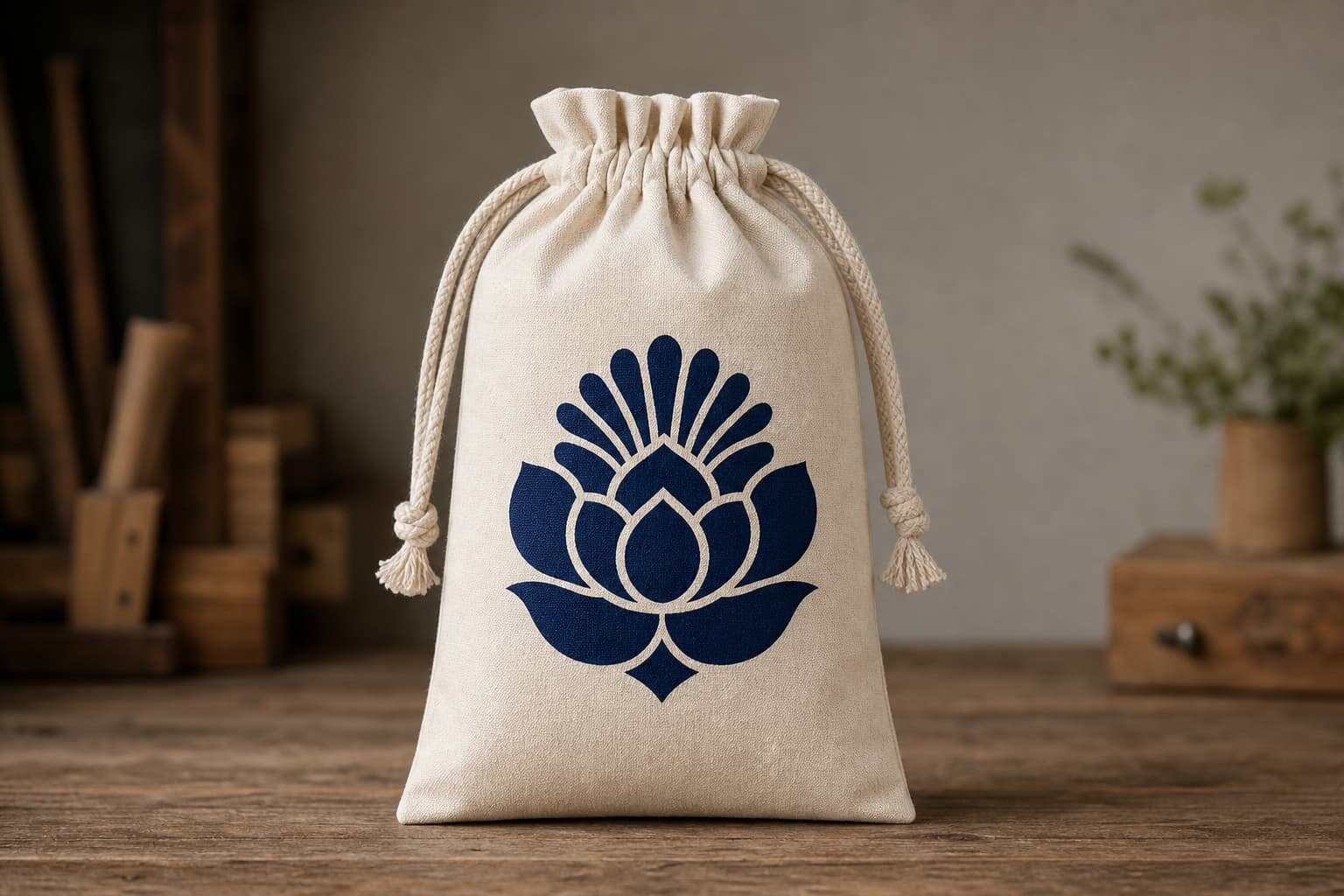
Why the Print Proof Decides the Bulk Result
For a logo drawstring pouch order, the print proof is not a decoration formality. It is the point where artwork, fabric, sewing, closure, packing, and lead time all meet. If the proof is vague, the factory will still produce something, but the result may not match your retail packaging, gift set, or distributor specification. Procurement teams should treat the proof as a production control document, not just a photo for brand approval.
The most common mistake is approving a clean logo image without confirming how it behaves on the actual pouch. Drawstring pouches are soft goods. They shrink, wrinkle, gather at the top, and do not stay perfectly square like a paper box. A logo that looks centered on a PDF can sit too high after sewing, distort when the cord is pulled, or lose detail on a coarse cotton weave. A proper proof checklist reduces these risks before fabric is cut for the full order.
- Use the proof to approve the exact fabric, not only the logo.
- Check print position against seams, not against a blank artwork board.
- Ask the supplier to show the pouch flat, filled, and closed when logo visibility matters.
- Do not release bulk production until sample, artwork, and packing instructions match the purchase order.
Start with the Real Pouch Use
Before checking Pantone color or logo size, confirm what the pouch must do. A jewelry pouch, candle pouch, coffee pouch, shoe dust bag, amenity pouch, and promotional giveaway pouch do not need the same fabric weight or print process. If the supplier does not understand the product inside, they may quote the cheapest fabric and leave you with a pouch that looks thin, pulls badly, or cannot support the brand price point.
A useful RFQ gives the factory a short use case. State the product weight, whether the pouch is retail-facing, whether it will be reused, whether it must protect the item from scratches, and whether the customer will wash or handle it repeatedly. This helps the merchandiser recommend a sensible GSM, cord type, and print method instead of guessing. It also makes competing quotes easier to compare because each supplier is solving the same packaging problem.
- For jewelry or cosmetics, ask about soft hand feel, lint level, and print sharpness on small logos.
- For candles, ceramics, or heavier accessories, confirm seam strength and whether 180 GSM or heavier fabric is needed.
- For shoe or apparel dust bags, check drawcord length, fabric opacity, and carton volume.
- For food-related outer packaging, clarify whether direct food contact is required because that changes material and testing discussions.
- For retail gift packaging, request one filled sample photo so the logo placement can be judged realistically.
Lock Fabric Weight Before Approving Print Color
Fabric weight affects nearly every print proof decision. A 120 GSM cotton pouch can be soft and economical, but it may show more weave texture and less ink coverage. A 200 GSM cotton or canvas pouch gives a more substantial retail feel, but it costs more, packs heavier, and may require stronger cord or a wider channel. If quotes only say cotton pouch without GSM, the prices are not comparable.
Natural cotton color also varies. Unbleached cotton, off-white cotton, dyed cotton, canvas, muslin, and recycled cotton can all change how the same ink color looks. White ink on natural cotton may look warmer; black ink on coarse weave may not have a sharp edge; small gray text can become weak. For color-critical orders, approve the print on the same fabric lot or at least the same fabric specification that will be used in production.
- Common lightweight pouch range: 100-140 GSM for simple gift or amenity packaging.
- Common midweight range: 150-180 GSM for better opacity and reusable promotional packaging.
- Common premium range: 200-240 GSM cotton canvas for retail packaging and heavier contents.
- Ask whether the GSM tolerance is controlled, for example plus or minus 5 percent or supplier standard.
- Request fabric swatches when choosing between natural, bleached, dyed, or recycled cotton appearances.
Choose the Print Method for the Artwork, Not the Catalog
The best print method depends on the logo, fabric, order quantity, and expected handling. Screen printing is usually efficient for simple one-color or two-color logos and gives a clean solid result when the artwork is not too fine. Heat transfer can handle more colors and gradients, but the hand feel is different and the edge may be more visible. Digital printing can work for complex graphics, but the result depends heavily on fabric surface and pretreatment.
Procurement teams should not accept a quote that says logo printing included without method details. The proof should state screen print, heat transfer, digital print, embroidery, woven label, sewn label, or another decoration method. Each method has different setup costs, MOQ logic, lead time, and risk. A low unit price can become expensive if the method requires high setup charges, extra sampling, or rejects due to poor artwork compatibility.
- Screen print: best for solid logos, larger MOQs, strong brand colors, and cost control.
- Heat transfer: useful for gradients, small detailed graphics, and smaller trial orders, but check feel and cracking risk.
- Digital print: suitable for full-color artwork where fabric and color tolerance are approved in advance.
- Embroidery: premium but not ideal for very small pouches, fine text, or thin fabric.
- Woven or sewn label: good when the pouch fabric cannot hold a sharp print or when a subtle brand detail is preferred.
Check Artwork Files Like a Production Engineer
A print proof should begin with usable artwork. Vector files such as AI, EPS, or editable PDF are preferred for screen printing and clean logo reproduction. If a buyer sends only a low-resolution JPG or PNG, the supplier may redraw the logo, and small differences can pass unnoticed until the bulk pouches arrive. Text should be converted to outlines, and brand colors should be defined by Pantone, CMYK, or a signed physical standard depending on the print method.
Minimum line width matters more on drawstring pouches than on smooth paper. Coarse cotton and canvas absorb ink and soften edges. Tiny registered trademark marks, thin serif letters, small QR codes, and negative-space icons can close up or disappear. Before paying for a sample, ask the factory to flag artwork elements that are below their safe print limit on the chosen fabric.
- Send vector artwork when possible, with final logo size stated in millimeters.
- Confirm whether the artwork includes bleed, safe area, and converted text outlines.
- State the number of print colors and provide Pantone references for each solid color.
- Ask the factory to confirm minimum printable line width and minimum readable text height.
- For QR codes or barcodes, request a scan test on the physical printed pouch before approval.
Measure Logo Placement on a Soft, Gathered Product
Logo position is where many pouch proofs fail. A drawstring pouch has a top channel, side seams, bottom seam, and fabric movement. If the logo is placed too high, the drawstring gather can wrinkle through it. If it is placed too low, it may disappear when the pouch sits on a shelf or is folded into a carton. Visual centering on an empty flat pouch is not enough for retail packaging approval.
Use measurable placement instructions. For example, specify that the logo is centered horizontally and positioned 45 mm below the lower stitch line of the drawstring channel, or 60 mm above the bottom seam, depending on pouch size. For small pouches, even a 5 mm shift can look obvious. For larger dust bags, a wider tolerance may be acceptable, but it should still be written before bulk production starts.
- Measure from the finished pouch edge or seam, not from fabric cut panels.
- Keep the logo below the drawstring channel and outside the main wrinkle area.
- Approve the logo size in width and height, not by percentage only.
- For double-sided print, confirm whether front and back placement must match exactly.
- Ask for proof photos with a ruler beside the pouch if approving remotely.
Review the Physical Sample, Not Only the Photo Proof
A photo proof is useful for fast communication, but it cannot confirm everything a buyer needs. Camera exposure can hide poor ink coverage, fabric defects, or color shifts. A physical pre-production sample lets you check hand feel, opacity, print adhesion, odor, cord smoothness, seam strength, and actual size. For a first order, new supplier, new fabric, or new print method, the physical sample is the safest approval point.
When the sample arrives, do not only check whether the logo looks nice. Put the actual product inside if possible. Pull the drawstring several times. Rub the print with a dry white cloth. Fold the pouch the way it will be packed. Check if the logo cracks, sticks, transfers, wrinkles badly, or becomes hidden. A sample that fails these simple checks will usually not improve during mass production unless you change the specification.
- Measure at least three points: width, height, and drawstring channel position.
- Compare fabric color and GSM against the approved swatch or previous order sample.
- Check print opacity under normal retail lighting, not only under bright factory light.
- Test opening and closing action to see whether cord thickness suits the channel.
- Photograph and sign the approved sample reference before releasing bulk production.
Understand MOQ Logic Behind the Quote
MOQ is not only one number for the pouch. It can come from fabric purchasing, dyeing, print setup, sewing line efficiency, cord color, label production, and packing material. A supplier may accept 500 pieces for a natural cotton pouch with one-color screen print, but require a higher MOQ for custom dyed fabric, special cord color, embroidery, or a woven label. If the quote does not separate these limits, the buyer may misunderstand what can be changed later.
For quote comparison, ask the factory to show pricing at several quantities using the same specification. For example, 500, 1000, 3000, and 5000 pieces. This helps you see whether the cost drop comes from print setup dilution, fabric purchasing, or labor efficiency. It also helps distributors quote their own customers with realistic price breaks instead of promising a low price that only works at a much higher quantity.
- Natural stock fabric usually supports lower MOQ than custom dyed fabric.
- One-color screen print usually has simpler setup than multi-color registration.
- Custom cord, metal tips, special labels, and individual polybags can raise MOQ or cost.
- Small pouches can be labor-sensitive because handling time does not fall as much as material cost.
- Ask whether sample cost, screen charge, artwork adjustment, and packing cost are included or separate.
Prevent Packing and Shipping Problems Early
Packing decisions should be checked during proof approval, not after bulk production. Drawstring pouches can be packed flat, folded, nested, bundled, or individually bagged. Each method affects carton quantity, crease marks, barcode application, warehouse receiving, and final presentation. A premium retail pouch can be damaged by tight folding if the logo sits on the fold line, while a low-cost giveaway pouch may not need individual packaging at all.
Procurement teams should request a packing photo and carton data before shipment. This is especially important for importers and distributors who must book freight, calculate landed cost, or ship to multiple retail DCs. Carton weight can increase quickly when moving from 120 GSM to 220 GSM fabric. Without carton dimensions and gross weight, a quote can look competitive but create higher freight and storage costs.
- Confirm whether each pouch is loose, bundled, or individually packed.
- State inner quantity and carton quantity, especially for mixed colors or mixed sizes.
- Avoid folding directly across the logo unless crease marks are acceptable.
- Request carton marks, SKU labels, country of origin labels, and barcode placement if required.
- Ask for estimated carton size, gross weight, and net weight with the formal quote.
Write Approval Criteria into the Purchase Order
A clear purchase order should repeat the approved proof details. Do not rely on a long email chain where artwork, fabric, and packing changes are scattered across multiple messages. The PO should state the finished size, fabric material and GSM, color, print method, logo size, logo placement, cord spec, packing method, tolerance, sample approval date, and required inspection standard. This gives the factory a production target and gives your QC team a document to inspect against.
Lead time should also be tied to approval. Many delays happen because buyers count from inquiry date, while factories count from deposit, final artwork, and sample approval. If the supplier needs to buy fabric, prepare screens, make a pre-production sample, and wait for buyer confirmation, those days must be included. A practical schedule separates sample lead time, bulk production lead time, inspection time, and shipping handover.
- State that bulk production must match the signed pre-production sample.
- List size and print tolerances, such as plus or minus 5 mm where appropriate.
- Include fabric GSM and color standard in the PO, not only in the email.
- Confirm lead time starts after deposit, final artwork, and proof approval are complete.
- Require pre-shipment photos or inspection for fabric, print, sewing, packing, and carton marks.
Specification comparison for buyers
| Spec decision | Recommended option | When it fits | Buyer risk to check |
|---|---|---|---|
| Fabric weight for small gift pouch | 120-140 GSM cotton or muslin | Lightweight jewelry, cosmetics, tea, hotel amenity, or giveaway packaging | Logo may show through if the weave is open; confirm print opacity and seam strength on the actual fabric |
| Fabric weight for reusable retail pouch | 180-220 GSM cotton or canvas | Premium product packaging, accessories, shoes, candles, or repeat-use brand packaging | Heavier fabric changes drawstring feel and carton weight; ask for packed carton dimensions before approving |
| Print method for simple 1-2 color logo | Screen print with Pantone matching | Solid logos, text marks, icons, and cost-sensitive bulk orders | Fine lines can fill in on coarse fabric; check minimum line width and ink edge sharpness |
| Print method for gradient or multi-color artwork | Heat transfer or digital print, depending on fabric | Full-color artwork, small MOQ promotions, photographic graphics, or complex illustrations | Transfers can feel rubbery and may crack if over-cured; request wash or rub test results for intended use |
| Logo position on gathered pouch | Keep print inside a flat safe zone below cord channel | Most drawstring pouches where the top gathers after closing | Artwork too close to the channel will wrinkle when cinched; approve proof with pouch both flat and closed |
| Closure choice | Cotton cord for natural look, polyester cord for color consistency | Cotton cord suits eco-style packaging; polyester suits bright branded colors | Cord color, diameter, and shrinkage may vary by supplier; confirm cord spec and knot finish |
| Proof approval format | Physical pre-production sample for first order; photo proof only for exact reorder | New logo, new fabric, new supplier, or retail-visible packaging | Photo lighting hides ink density and fabric defects; do not approve color-critical jobs by photo only |
Buyer checklist before sampling
- Confirm pouch size as finished outside dimensions, not fabric cut size, and state tolerance such as plus or minus 5 mm for small pouches.
- Approve fabric type, color, GSM, weave, and shrinkage expectation before checking logo color.
- Check whether the logo is printed on one side or two sides, and whether both sides need the same registration tolerance.
- Verify artwork file type, Pantone references, minimum line width, negative space, and whether text has been converted to outlines.
- Measure the logo position from left edge, right edge, bottom seam, and drawstring channel, not by visual centering only.
- Review the proof with the pouch flat and with the drawstring closed, especially for logos placed near the upper third.
- Ask for a physical sample when fabric, ink, cord, or size has changed from a previous order.
- Check print hand feel, opacity, rub resistance, edge sharpness, and whether ink bleeds through to the back layer.
- Confirm stitch density, seam allowance, cord channel width, cord length, knot type, and whether loose threads are trimmed.
- Approve unit packing, inner bag quantity, carton quantity, carton marks, barcode labels, and whether pouches are packed flat or folded.
Factory quote questions to send
- Which fabric will you quote for this pouch: cotton, canvas, muslin, polyester, velvet, jute, or another material, and what is the GSM or ounce weight?
- Is the quoted size the finished pouch size after sewing, and what production tolerance will you accept?
- Which print method are you using for the logo, and why is it suitable for this fabric and order quantity?
- Does the unit price include one-side printing only, or both sides? How many print colors are included?
- What artwork format do you need for production, and can you check minimum line thickness before sampling?
- What is the MOQ for this fabric color, this pouch size, and this print method separately?
- Will you provide a physical pre-production sample, and is the sample charge refundable after bulk order confirmation?
- What sample lead time and bulk lead time apply after artwork approval, and what could extend the schedule?
- How will the pouches be packed, and what are the estimated carton quantity, carton size, gross weight, and net weight?
- Can you provide photos of the approved sample, bulk print during production, final packing, and carton marks before shipment?
Quality-control points to confirm
- Finished size checked flat with pouch empty, including width, height below drawstring channel, and channel height.
- Fabric GSM checked against approved swatch and purchase order, especially when natural cotton color varies between lots.
- Logo color compared under neutral light against Pantone target or approved sample, not only against a phone photo.
- Print position measured from fixed seams and bottom edge with a ruler, with tolerance written in the QC sheet.
- Print adhesion checked by dry rub and light scratch test suitable for the product use, before full carton packing.
- Drawstring function tested by opening and closing pouches repeatedly to confirm smooth pulling and no seam tearing.
- Seams checked for skipped stitches, broken threads, crooked channel stitching, fraying corners, and open side seams.
- Bulk pieces compared with the signed pre-production sample for fabric hand feel, cord color, print size, and packing method.
- Carton labels, inner quantities, and mixed SKU separation verified before loading to avoid warehouse receiving problems.