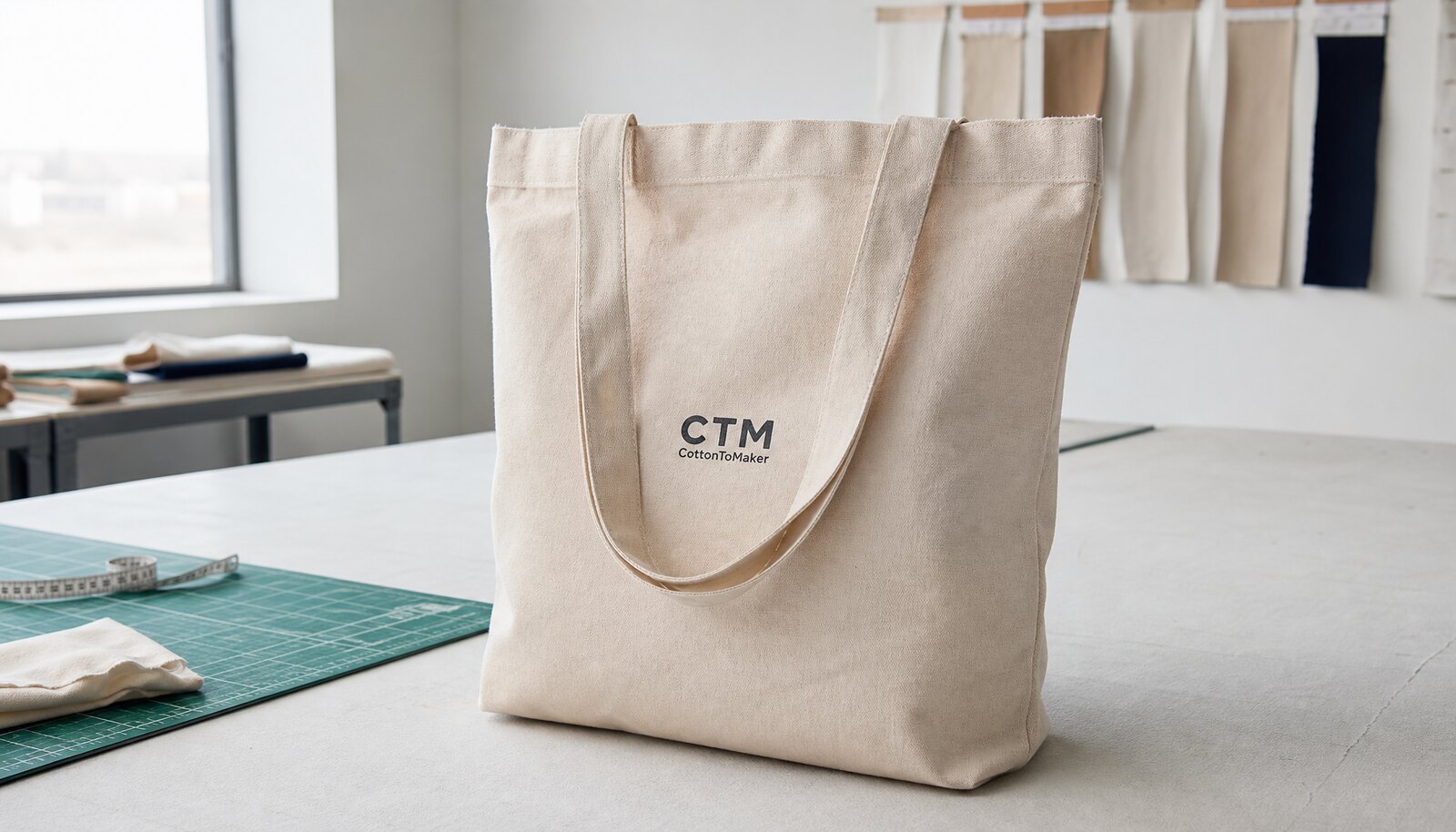
Define Durability by the Tote's Real Use
Print durability on a canvas tote is not a single lab number. For procurement teams, it means the logo still looks acceptable after the bag is folded, stacked, shipped, unpacked, handled by store staff, carried by end users, and stored again. A logo can look sharp in a sample photo and still fail commercially if it cracks along the carton fold, transfers onto the next bag, or loses color when rubbed by a coat sleeve.
Start the project by writing the use case in plain language. A one-day event giveaway has a different durability requirement from a reusable retail tote sold at checkout. A staff welcome kit may need the logo to stay presentable for office commuting, while a grocery tote may face heavier abrasion, damp handling, and repeated folding. The use case tells the supplier whether the order needs a standard print, a more robust ink system, a heavier canvas, or a different branding method such as embroidery or a woven label.
The strongest brief also defines what failure looks like. Do not stop at "good quality print." State whether cracking, peeling, edge lift, heavy color transfer, tackiness, visible fading, or logo distortion will be rejected. This language gives the factory a target and gives your inspection team a defensible standard when bulk goods arrive.
- Separate promotional, retail, staff, and repeated-use programs before choosing the print method.
- Define unacceptable failure modes: cracking, peeling, powdering, blocking, rubbing off, bleeding, or skewed placement.
- Treat fold lines and packed contact points as durability risks, not only cosmetic details.
- Use the signed sample as the commercial standard, but support it with measurable checks.
Choose Canvas Weight, Weave, and Finish Before Decoration
The print sits on the fabric, so the canvas specification must come before the logo method. For many logo canvas tote bag programs, 12 oz to 16 oz canvas, roughly 340 to 450 GSM, gives the most useful balance of structure, print hold, and buyer-perceived value. Lighter canvas can be suitable for cost-sensitive promotions, but open weave and soft body can make fine artwork look broken after folding. Heavier canvas feels more substantial, but it raises material cost, carton weight, sewing difficulty, and freight exposure.
Weight is only part of the decision. A tight plain weave usually gives cleaner print edges than a loose or heavily slubbed fabric. A fuzzy surface can trap ink irregularly. A washed finish may improve hand feel but can change shrinkage, surface absorbency, and logo sharpness. A bleached or dyed canvas can also change ink opacity, especially for white, cream, yellow, or pale brand colors. Ask the factory to describe the actual cloth, not only say "cotton canvas."
If the tote will be sold or used as a premium carrier, request both weight and hand-feel references. Buyers sometimes over-specify GSM and then discover the bag feels stiff, bulky, or expensive to ship. The right canvas is the one that supports the logo, handles the intended load, and matches the retail or brand positioning without creating unnecessary cost.
- Use 10 oz canvas mainly for lightweight promotional programs where price and freight matter most.
- Use 12 oz canvas as a practical middle ground for many retail and promotional orders.
- Use 14 oz canvas when the tote needs better structure and stronger logo presence.
- Use 16 oz canvas for premium programs only when the added cost, weight, and stiffness are acceptable.
- Ask for GSM, oz weight, weave description, finish, shrinkage expectation, and fabric color standard.
Match the Print Method to the Artwork
Screen print remains the most common choice for volume canvas tote orders because it handles solid logos, simple icons, and one- to three-color artwork efficiently. When ink deposit, mesh selection, pressure, and curing are controlled, screen print gives a durable result at a sensible unit cost. The risk appears when the design has fine lines, small reversed text, heavy coverage, or colors that need strong opacity on dark canvas.
Water-based ink can give a softer hand feel and is often preferred for natural canvas programs where a less plastic surface is wanted. High-opacity or plastisol-style systems may be used when the logo must stand out on dark fabric. Neither choice is automatically better. The buyer should ask what the factory can cure consistently on the selected canvas and how the printed surface behaves after rubbing, folding, and packing.
DTF and heat transfer are useful when the logo has many colors, gradients, or short-run variation. They can reduce setup barriers, but the logo may feel more like a film on top of the textile. For tote bags that are folded through the design or stored in warm conditions, edge lift, gloss marks, and film cracking need attention. Embroidery, woven labels, or patches can be more durable for small marks, but they change the look and may not replace a large front graphic.
- Use screen print for bold artwork, stable repeat orders, and stronger unit economics at volume.
- Use water-based ink when soft hand feel matters and the logo does not require extreme opacity.
- Use high-opacity ink or an underbase when printing light colors on dark canvas.
- Use DTF or transfer when color complexity matters more than textile-like hand feel.
- Use embroidery or woven labels when abrasion resistance and premium detailing matter more than print area.
Control Artwork, Placement, and Safe Zones
Many print problems start before production because the artwork is designed for a flat digital mockup rather than a stitched textile product. A tote panel is interrupted by seams, hems, handle bases, gussets, and fold lines. If the logo is too close to those areas, the print may distort during sewing or crack where the bag is folded for packing. The artwork proof should show the logo on the finished bag dimensions, not only as a floating file.
Ask the factory for minimum line thickness, minimum readable text height, maximum print area, and recommended safe distance from seams. A textured canvas will not hold tiny legal copy the same way coated paper does. Reversed text, thin outlines, and delicate gradients often need simplification. If brand rules allow it, a slightly bolder mark usually performs better on canvas than a detailed version forced into a rough weave.
Placement tolerance should also be written into the approval. For many bulk tote programs, plus or minus 5 mm may be commercially reasonable, but some centered retail graphics need tighter control. The tolerance must reflect how the bag is cut, sewn, and printed. If the logo sits near a pocket, handle base, or gusset, ask the factory how they position each piece during printing and how they prevent skew.
- Approve artwork at the final print size, not only as a logo file.
- State print location from fixed points such as top hem, side seam, or bottom panel line.
- Keep artwork away from heavy folds, seams, handle bases, and gusset corners whenever possible.
- Confirm minimum line thickness and text height before approving detailed artwork.
- Record placement tolerance and orientation requirements in the signed sample file.
Build an RFQ That Prevents Substitution
A quote is only useful if every supplier is pricing the same product. "Canvas tote with logo" can mean different fabric weights, different sewing quality, different print chemistry, different packing, and different durability risk. A procurement-ready RFQ should lock the finished size, gusset, handle length, fabric GSM, fabric color, decoration method, logo dimensions, logo location, color count, packing method, carton target, incoterm, and lead-time requirement.
Avoid repeating generic quote language. Instead, ask each supplier to show the cost drivers. The quote should separate the blank bag, decoration, setup, extra color charges, underbase, digitizing, special packing, sample fee, inspection fee, and freight or incoterm basis. When these items are hidden, the cheapest supplier may only be cheaper because they excluded curing time, interleaf packing, heavier canvas, or a second print pass.
For multi-design programs, ask whether the same bag body can be used across several logos. This helps you understand whether MOQ is driven by the sewn tote, the fabric color, the print setup, or the artwork variation. It also makes repeat orders easier because screens, digitizing files, and packing instructions can be reused when appropriate.
- Include finished measurements, fabric spec, decoration spec, packing standard, quantity, and incoterm in one RFQ.
- Ask suppliers to quote the same direct print route and one alternate branding route if durability is uncertain.
- Separate setup charges from unit price so reorder economics are clear.
- Require the supplier to state assumptions, exclusions, and MOQ drivers in writing.
- Do not compare quotes until fabric weight, print method, packing, and lead time are aligned.
Use Samples as a Controlled Durability Test
A pre-production sample should not be a beauty sample made under different conditions. It should use the final fabric, final decoration method, final logo size, final placement, and intended packing fold. If the supplier sends a print on uncut fabric, a different canvas weight, or a hand-carried sample with no packing pressure, treat it as a reference only. It does not prove the bulk order will survive production and transit.
The signed sample should be reviewed like a production control document. Photograph it flat and folded, record the logo measurement and placement, note the ink or decoration method, and keep the approved artwork proof with it. If the sample passes with a small tolerance or a known compromise, write that down. Otherwise, the bulk inspection team may reject something the buyer silently accepted, or accept something the buyer expected to be corrected.
Simple buyer-side tests catch many common failures before bulk begins. Fold and unfold the sample along the actual packing crease 10 times. Rub the printed area with a clean white cotton cloth for 20 back-and-forth strokes under firm hand pressure. Stack the printed face against fabric or interleaf for a settling period and check whether it sticks or transfers. These checks are not a replacement for a lab, but they give procurement teams practical evidence before approving production.
- Approve only a pre-production sample made with final fabric, final decoration, and final packing direction.
- Keep one signed physical sample with the buyer and one with the factory if possible.
- Record sample tolerances for placement, size, color density, hand feel, and visible defects.
- Run fold, dry rub, edge adhesion, and blocking checks before bulk approval.
- Reject samples that pass visually but fail after basic handling.
Set Measurable QC Acceptance Criteria
Visual inspection is necessary, but it is not enough for a print durability guide. Bulk QC should include specific acceptance language that inspectors can apply consistently. For appearance, the print should match the signed sample for color density, logo size, placement, registration, and hand feel. For defects, define what is not acceptable: bleeding, pinholes, misregistration, missing ink, excessive underbase show-through, edge lift, cracking, tackiness, scorched transfer marks, or obvious fabric distortion.
For practical handling checks, use a repeatable method. A dry rub check can be 20 back-and-forth strokes with a clean white cotton cloth under firm hand pressure. The result should show no heavy transfer and no visible breakdown of the logo. A fold check can be 10 fold/unfold cycles at the actual carton fold or the most likely use crease. The result should show no obvious cracking, peeling, or permanent white break line. For transfers, pay extra attention to corners and edges because failures often begin there.
Curing confirmation should also be part of QC. Ask the factory to record the curing temperature and time for screen print, or heat press temperature, pressure, and dwell time for transfers. The exact setting depends on materials and factory equipment, so the buyer does not need to invent a universal number. The important point is that the process is controlled, recorded, and repeatable. Bulk goods should not be packed while prints are tacky, warm, or still vulnerable to blocking.
- Use the signed sample as the visual standard and measurable checks as the durability standard.
- Set common tolerances such as plus or minus 5 mm placement unless the project requires tighter control.
- Require dry rub, fold, transfer-edge, and blocking checks for relevant decoration methods.
- Ask for curing or heat-press records instead of relying only on finished-goods photos.
- Make packing condition part of final inspection, not a warehouse afterthought.
Treat Packing and Transit as Part of the Print Spec
A strong print can still be damaged by poor packing. If totes are folded through a heavy logo, packed before full cure, compressed into tight cartons, or stacked face-to-face without protection, the buyer may see blocking, gloss marks, ink offset, scuffing, or pressure shine. These defects often appear after shipment, not during the first sample review, which makes packing a real durability variable.
Specify the fold direction and whether the printed face is inside, outside, or protected by interleaf. For many prints, folding away from the logo is safer. For large front graphics, interleaf paper, tissue, or controlled bundle packing may be needed. Polybags can help presentation but may trap humidity or add cost, so they should be chosen for a reason rather than added automatically.
Carton design matters too. Ask for carton quantity, carton dimensions, maximum gross weight, and how long goods rest after printing before packing. A very dense carton may reduce freight cost but increase print damage risk during hot container transit or warehouse storage. If the program has a long distribution chain, packing should be tested and photographed during sample approval.
- Confirm fold direction during sample approval, not after production starts.
- Use interleaf or protective packing for heavy ink coverage, dark prints, transfers, or long transit.
- Limit carton compression by controlling pieces per carton and gross weight.
- Allow curing, cooling, and resting time before packing printed bags.
- Inspect cartons for blocking, offset, shine marks, and scuffed logo surfaces before shipment.
Read Supplier Quotes for Durability Risk
When quotes differ sharply, the missing detail is often where durability risk is hiding. One supplier may quote 12 oz tight-weave canvas with cured screen print and interleaf packing. Another may quote a lighter bag, a transfer print, and high-compression cartons. Both may call the item a logo canvas tote bag, but they are not the same commercial product.
Look beyond the first unit price. Check whether the quote includes underbase printing, extra screens, Pantone matching, sample revisions, packing materials, carton strength, inspection, and rework. Ask whether repeat orders reuse screens or digitizing files and whether reorder pricing changes after setup. If the order has multiple artwork versions, clarify whether MOQ applies per logo, per colorway, per print location, or per total quantity.
Also review lead time for hidden pressure. A quote that promises a very short schedule may be assuming no sampling changes, no curing buffer, no inspection delay, and immediate booking. For print durability, rushing the final steps can create more claims than a slightly longer controlled production plan. A credible supplier should be able to name the sequence from artwork approval through packed cartons.
- Compare landed specification, not only headline unit price.
- Identify whether cost savings come from lighter fabric, simpler packing, cheaper print method, or reduced QC.
- Ask MOQ questions by body color, decoration method, artwork version, and print location.
- Check whether lead time includes sampling, screen setup, curing, packing, inspection, and booking.
- Treat vague quotes as a risk signal, especially when the order depends on logo performance.
Make the Final Buying Decision
The best buying path is not always the strongest possible decoration. It is the decoration that fits the use case, budget, artwork, and claims risk. A simple one-color logo on 12 oz natural canvas may be the right answer for a high-volume event. A store tote that customers reuse may justify 14 oz canvas, stronger opacity control, and better packing. A premium retail bag may be better with embroidery, a woven label, or a mixed branding approach rather than forcing a large fragile print onto textured fabric.
Before placing the order, compare two or three controlled routes instead of asking for endless open-ended quotes. For example, request a standard screen print option, a higher-opacity or underbase screen print option, and an alternate branding option such as embroidery or a woven label. Review them against sample performance, total cost, MOQ, lead time, and packing risk. This gives procurement a reasoned decision rather than a price-only selection.
For repeat programs, keep the approved specifications organized. Store the artwork, signed sample photos, fabric details, decoration method, curing notes, packing instructions, and inspection checklist in one file. The first order then becomes the quality reference for the next order, and the supplier has less room to substitute materials or change the process without approval. That discipline is what turns a logo canvas tote bag print durability guide into a reliable sourcing standard.
- Choose the spec that matches expected use life, not the one that only looks best in a sample photo.
- Request a direct print route and an alternate branding route when artwork or durability risk is high.
- Use sample tests, not assumptions, to decide between similar print methods.
- Keep fabric, artwork, decoration, QC, and packing records together for repeat orders.
- Approve bulk only when the supplier can explain and control the full process from canvas to packed carton.
Specification comparison for buyers
| Branding method or spec choice | Best fit | Durability profile | Cost and MOQ impact | Buyer acceptance checks |
|---|---|---|---|---|
| Screen print, 1-3 solid colors | Retail totes, promotional repeat orders, simple logos, bold text | Strong when ink deposit and curing are controlled; risk is cracking, powdering, or poor opacity on rough canvas | Setup cost per screen; economical at volume and repeat runs | Confirm ink type, curing temperature/time, rub result, fold result, and signed sample color density |
| Water-based screen print | Natural or light canvas where a softer hand feel is wanted | Good fabric feel; may look less opaque on dark fabric unless formulated correctly | Often similar setup to screen print; may need tighter curing control | Check opacity after cure, dry rub transfer, and whether print remains even over slub yarns |
| Plastisol-style or high-opacity screen print | Dark canvas, bold logos, higher visual coverage | Good opacity when cured correctly; can feel heavier and may crack if ink layer is too thick | May add cost for underbase or extra pass | Ask for underbase details, cure confirmation, fold test on the actual packing crease, and blocking check |
| DTF or heat transfer | Short runs, many colors, gradients, small design changes | Useful for complex art; risk is edge lift, shine, film feel, or peeling after repeated folding | Lower setup barrier for complex art; unit cost may stay higher at volume | Inspect transfer edge adhesion, hand feel, heat press mark, fold recovery, and rub transfer |
| Embroidery | Small premium logo, abrasion-heavy use, thicker canvas | Very durable thread surface; not ideal for large filled artwork or tiny lettering | Digitizing and stitch count affect cost; MOQ may be flexible but unit cost rises with density | Check stitch density, backing, puckering, thread color match, and whether canvas distorts around the logo |
| Woven label or patch | Premium branding, side labels, small front marks, long-wear programs | Brand mark itself is durable; attachment stitching becomes the control point | Label MOQ and attachment labor can affect cost; good for repeat programs | Check label color, edge finish, stitch strength, placement tolerance, and abrasion at corners |
| 12 oz canvas, about 340 GSM | General retail or better promotional totes | Balanced body and print hold; can work well with simple artwork | Lower material and freight cost than heavier canvas | Check weave tightness, shrinkage, print opacity, and fold behavior through the logo |
| 14-16 oz canvas, about 400-450 GSM | Premium retail totes, repeated-use carriers, heavier loading | Better structure and print presence; heavier texture can still challenge fine details | Higher material, sewing, carton, and freight cost | Check needle damage, seam tension near print, carton compression marks, and buyer-approved hand feel |
| Interleaf or low-compression packing | Dark prints, heavy ink coverage, long transit, warehouse storage | Protects against ink blocking, shine, scuffing, and print transfer between bags | Adds material, labor, and carton volume | Confirm bags are fully cured before packing, fold direction avoids the logo, and carton weight is controlled |
Buyer checklist before sampling
- Define the tote use case first: event giveaway, store carrier, employee kit, retail resale item, or repeated-use grocery tote.
- Lock the bag body before comparing decoration prices: finished size, gusset, handle length, canvas weight in oz and GSM, color, weave, and finish.
- State the logo size, exact panel, print distance from seams, color count, Pantone or approved color reference, and whether tiny text must remain readable.
- Ask the supplier to recommend a decoration method and explain the durability tradeoff, not only quote the cheapest printable option.
- Require a pre-production sample made with final canvas, final ink or thread, final artwork size, final placement, and intended packing fold.
- Agree measurable sample tolerances: logo placement tolerance, print size tolerance, color tolerance, acceptable hand feel, and visible defect limits.
- Run buyer-side checks before approval: 20 dry rub strokes with white cotton cloth, 10 fold/unfold cycles at the packing crease, and a blocking check after stacked contact.
- Confirm curing or heat-press parameters are recorded by production, including temperature, dwell time, pressure where relevant, and cooling time before packing.
- Specify final packing: fold direction, print-in or print-out, interleaf or no interleaf, bundle count, carton size, maximum gross weight, and moisture protection.
- Keep the signed sample, approved artwork proof, packing photo, and QC checklist together so bulk inspection is judged against the same reference.
Factory quote questions to send
- What exact canvas are you quoting: oz weight, GSM, weave, yarn count if available, color, finish, and whether the fabric is washed, pre-shrunk, or coated?
- Which decoration method do you recommend for this logo and why: screen print, water-based ink, high-opacity ink, DTF, heat transfer, embroidery, woven label, or another route?
- What ink, thread, transfer film, adhesive, underbase, or backing will be used, and what curing, heat-press, or finishing parameters control durability?
- What are your minimum line thickness, minimum text height, maximum print area, and recommended safe distance from seams, hems, handles, and fold lines?
- Will the bag be printed before sewing or after sewing, and what process controls keep logo placement within the approved tolerance?
- Please separate bag body cost, decoration cost, setup or screen charges, digitizing or plate charges, extra color fees, sample fees, packing charges, and inspection charges.
- What MOQ applies by bag color, logo design, decoration method, color count, print location, and repeat order using the same screens or digitizing file?
- Can you provide a pre-production sample on final fabric with final placement and packing, plus a photo or note confirming the actual production method?
- What practical durability checks do you run in-house before shipment, including rub, fold, adhesion, blocking, wash or wet handling expectation, and visual inspection?
- What are the carton quantity, fold method, interleaf use, carton size, gross weight, and minimum curing or cooling time before goods are packed?
Quality-control points to confirm
- Approved sample is signed with final fabric, final logo size, final decoration method, final placement, and final packing fold clearly recorded.
- Logo placement stays within the agreed tolerance, commonly plus or minus 5 mm unless the artwork or seam position requires a tighter standard.
- Print size and orientation match the approved artwork; the logo is level, centered as specified, and clear of seams, hems, handle bases, and fold pressure points.
- Print color and density match the signed sample under consistent light; no obvious underbase show-through, patchy coverage, pinholes, bleeding, or misregistration are visible at normal inspection distance.
- Dry rub check: after 20 back-and-forth strokes with a clean white cotton cloth under firm hand pressure, there is no heavy color transfer, powdering, or visible loss of logo definition.
- Fold check: after 10 fold/unfold cycles on the actual packing crease or most likely use crease, the logo shows no obvious cracking, peeling, or permanent white break line.
- Adhesion check for transfers: logo edges remain flat after handling and folding, with no lifting corners, bubbling, film separation, or heat press scorch marks.
- Curing or heat-press confirmation is documented by the factory, including temperature, time, pressure if relevant, and minimum cooling or resting time before packing.
- Blocking check: printed surfaces do not stick, gloss, offset, or transfer after being stacked face-to-face or packed in the approved fold for a reasonable settling period.
- Sewing near the logo does not pucker, pull, distort, or skew the print; handle reinforcement and seams do not create tension lines across the decoration.