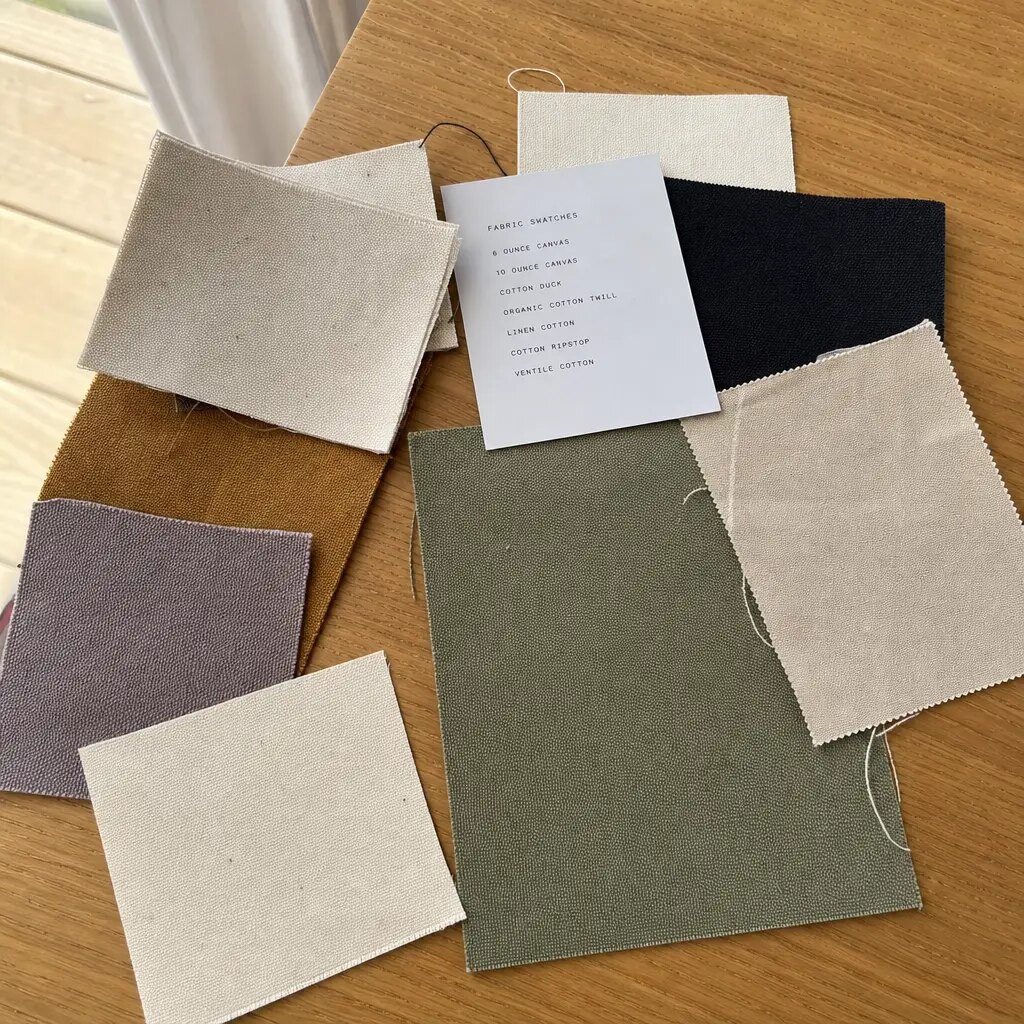
1. Start with the real lead-time driver, not the quoted calendar
For wholesale canvas grocery totes, the quoted production window is only useful after the order details are frozen. A supplier may say 25 to 40 days, but that number often assumes available fabric, approved artwork, standard construction, no label delay, and a simple packing method. Procurement teams should read the quote as a chain of dependent tasks: fabric confirmation, sample approval, material booking, cutting, sewing, print setup, finishing, inspection, packing, and shipment handoff. If one link is still undecided, the date is still provisional.
Eco apparel brands often treat a canvas grocery tote as a simple accessory, but the production path can become custom very quickly. A change from 8 oz to 12 oz canvas affects fabric sourcing and sewing speed. A shift from one-color screen print to an oversized multi-color artwork changes setup and QC. A custom woven side label can hold packing if the label supplier runs late. Even carton marks can become a bottleneck when the receiving warehouse requires exact wording, barcodes, or routing labels.
The practical move is to ask the factory to split the timeline by stage before you place the PO. This does not need to be a long technical schedule. It can be a simple line-by-line timing table that shows what happens before bulk production and what happens after approval. The goal is to identify the critical path: the step that determines the earliest possible ship date. For many tote orders, that critical path is not sewing. It is fabric availability, print approval, or packaging confirmation.
- Separate sample lead time from bulk lead time so late approvals do not quietly compress production.
- Ask which step controls the ship date: fabric, print, labels, sewing capacity, QC, packing, or freight handoff.
- Treat any unapproved artwork, fabric shade, label, or carton mark as a schedule risk, even if the unit price is already quoted.
- Use one dated spec sheet as the reference for all quote updates so the supplier is not pricing one version and producing another.
2. Define the tote specification in procurement language
A strong RFQ for canvas grocery totes should describe the bag in measurable terms, not general retail language. Instead of saying "heavy canvas tote with long handles," specify fabric weight, finished dimensions, handle width, handle drop, print location, label position, and packing method. This level of detail helps suppliers quote the same product and prevents false comparisons between a lighter promotional bag and a sturdier grocery tote.
For grocery use, many buyers start with 10 oz to 12 oz cotton canvas because it gives the tote enough body while keeping production practical. Lighter canvas can work for giveaways or light retail use, but it may not satisfy a brand that wants a reusable shopping bag. Heavier canvas can feel premium, but it increases material cost, may require slower sewing, and can affect carton volume. The best choice depends on how the tote will be used: checkout add-on, apparel purchase bag, grocery companion, event merchandise, or loyalty gift.
Procurement teams should also define whether the tote is flat, gusseted, or boxed. A flat tote is usually faster and more economical. A bottom gusset improves capacity but adds pattern and sewing steps. Side gussets or structured bottoms create a more retail-oriented shape but can raise cost and inspection complexity. Handle choice matters as well. Cotton webbing handles are often more consistent and faster than self-fabric handles, while self-fabric handles may be chosen for a fully matched look.
- Include finished size, not only pattern size, because shrinkage, seam allowance, and pressing can change the final measurement.
- Specify handle drop based on use: hand carry, shoulder carry, or mixed grocery and apparel use.
- State whether the tote must stand, fold flat, stack cleanly, or fit an existing retail display or carton system.
- Attach a photo reference only as support; the written spec should control production decisions.
3. Choose materials with lead time and quality control in mind
Fabric is one of the biggest lead-time variables in wholesale canvas grocery tote programs. Stock natural canvas is usually the fastest route because the factory can confirm availability quickly and move into sampling or cutting. Greige fabric may also be fast if it is already available and the final color is natural or lightly finished. Custom dyed canvas adds more control over brand color, but it also adds lab dips, shade approvals, dyeing time, shrinkage checks, and the risk of color variation between lots.
Eco apparel brands may also ask for organic cotton, recycled cotton, or blended canvas. These options can support brand positioning, but they must be quoted with documentation requirements and actual availability in mind. If the buyer needs certification, transaction documents, or fiber claims on hangtags, the supplier must confirm what can be supported before production begins. Do not assume that a supplier can switch from conventional cotton to certified material on the same lead time. Material claims create sourcing and paperwork steps that should be planned before the PO.
Canvas quality should be checked before cutting, not only after finished bags are packed. The factory should confirm fabric weight, width, shade, hand feel, visible defects, and whether the fabric behaves well under the chosen print method. A canvas with an uneven weave can make screen print coverage look patchy. A fabric with too much shrinkage can change finished dimensions after pressing or washing. These are not cosmetic details; they affect acceptance, carton count, and reorder consistency.
- Ask whether the quoted fabric is already in the factory, reserved with a mill, or assumed to be available.
- Request fabric weight tolerance and fabric width because both influence consumption, cutting efficiency, and MOQ.
- For custom colors, require lab dip approval and clarify whether bulk shade tolerance will be visual, Pantone-based, or sample-based.
- For sustainability claims, confirm what documentation the supplier can provide before approving artwork or hangtags.
4. Match print method to artwork, not just price
Brand artwork is another common source of lead-time drift. A one-color logo on one panel is usually straightforward. A two-color screen print is still manageable if registration is not too tight. But gradients, fine lines, small text, large solid blocks, edge-to-edge art, and multiple print placements create more setup work and more inspection risk. If the tote is meant to support an eco apparel brand's retail presentation, the print has to look intentional across the whole run, not only on the sample photographed for approval.
Screen printing is often the most stable option for simple canvas grocery totes because it is familiar, scalable, and easy to inspect. Transfer methods can be useful for certain artworks, especially when color complexity is high, but they are not automatically faster once setup, adhesion, curing, texture, and durability are considered. Embroidery can feel premium but may be slower and less practical for large grocery totes, especially if the artwork is dense or if placement is near seams. The right print method should be chosen after reviewing artwork and use case.
Procurement buyers should request a print strike-off or a production sample when artwork is new. The strike-off should show ink color, opacity, edge sharpness, cure quality, and how the print sits on the actual canvas. If the order uses natural canvas, ink color can appear different than it does on a white digital proof. If the fabric has slubs or uneven texture, small type may lose clarity. These details are much cheaper to correct before bulk printing starts.
- Provide vector artwork at production scale and identify the exact print area on the tote panel.
- Ask the factory to flag fine lines, gradients, small type, heavy coverage, or artwork close to seams before sampling.
- Define print placement tolerance in measurable terms, such as distance from top edge, side seam, or center line.
- Confirm whether print approval is based on physical strike-off, photo approval, or sealed sample comparison.
5. Compare supplier routes before comparing unit prices
A low unit price does not protect a launch date if the supplier cannot control the production route. For wholesale canvas grocery totes, buyers usually compare direct factories, trading companies, print-led suppliers, and promotional product vendors. Each route can work, but each has a different risk profile. A direct factory may provide better control over cutting, sewing, and QC. A trading company may be useful when the order includes multiple bag styles or accessories. A print-led supplier may move quickly on branding but depend on outside sewing capacity.
The key question is ownership. Who is responsible if the fabric arrives late, the print fails, the label is wrong, or the carton count does not match? If the supplier manages several subcontracted steps, the buyer needs a clear contact and a clear escalation path. Otherwise, status updates can become vague right when the calendar is tight. Buyers should ask which processes are in-house and which are outsourced, not to disqualify a supplier, but to understand where schedule risk sits.
Supplier comparison should include response quality, not only price. A strong supplier will ask clarifying questions about fabric, print, packing, and approval timing. A weak quote may look fast because it assumes the simplest possible version of every open point. When two suppliers quote different lead times for the same project, check whether they are actually quoting the same bag. Differences in canvas weight, handle construction, print method, label inclusion, and carton requirements can make one quote appear cheaper or faster than it really is.
- Ask for the actual maker's capabilities when working through a trading company or distributor.
- Confirm who owns final inspection and who authorizes rework if defects are found.
- Compare quotes using the same spec sheet, artwork file, packing instructions, and approval path.
- Watch for quotes that exclude labels, screen setup, carton marks, or sample freight because those omissions can distort both cost and timing.
6. Read the quote as a schedule document
A useful quote for canvas grocery totes should show more than unit price. It should identify what is included, what is excluded, which assumptions were used, and when the lead time begins. Some suppliers quote from deposit date. Others quote from sample approval. Some only start counting after fabric is booked, artwork is approved, and labels are received. Procurement teams should make this explicit so internal launch calendars are not built on the wrong starting point.
MOQ also needs a practical explanation. Minimums may be driven by fabric roll length, canvas width, cutting efficiency, print setup, label minimums, carton quantities, or factory line planning. If the buyer requests a very small first order, the supplier may quote it, but the unit price, setup cost, and schedule priority can change. A pilot run can be useful, but it should not be mistaken for the economics of a repeat wholesale program.
The quote should also separate one-time costs from repeat costs. Screen charges, sample fees, label setup, custom carton printing, and artwork revisions may not repeat every order. Fabric, sewing, printing, inspection, and packing costs will. This distinction helps eco apparel brands plan replenishment pricing and avoid surprise increases after the first launch. A quote that is clear at the first order becomes the baseline for a reorder program.
- Confirm whether lead time starts after deposit, sample approval, artwork approval, fabric booking, or all of the above.
- Request separate line items for screen charges, sample fees, labels, hangtags, barcode labels, and special packing.
- Ask whether the supplier can reserve fabric for the full quantity before the buyer completes internal approval.
- Require the quote revision date and spec version so old pricing is not confused with the approved production file.
7. Build the sample stage around bulk-production risk
Sampling should answer the questions that would be expensive to fix in bulk. On a canvas grocery tote, that usually means fabric weight, finished dimensions, handle drop, reinforcement, print placement, print color, label location, and how the bag folds into its carton. A sample that only shows general appearance is not enough for a first-time wholesale order. The buyer needs a production-grade reference that the factory can match during bulk manufacturing.
There are several sample types, and they should not be treated as interchangeable. A proto sample checks shape and construction. A print strike-off checks artwork and ink behavior on the selected fabric. A pre-production sample should use the actual fabric, actual print method, actual labels, and intended construction. A sealed approval sample, sometimes called a golden sample, becomes the reference for inspection and dispute resolution. If the buyer approves a sample made with substitute fabric or temporary labels, that should be documented clearly.
Approval discipline matters. If marketing approves artwork, product approves construction, and operations approves packing, the procurement owner should collect all approvals into one final production release. Factories lose time when they receive partial approvals and then get late corrections from another stakeholder. The cleaner approach is to set an approval deadline, identify the decision-maker, and state what happens if a revision is requested after bulk materials are booked.
- Approve each SKU separately when size, fabric color, print color, handle length, or label placement differs.
- Keep one sealed sample with the buyer and one with the factory if the order is high value or repeatable.
- Do not approve bulk cutting until fabric route, artwork, labels, and packing are aligned with the sample.
- Record whether sample approval was physical, photo-based, or conditional; conditional approvals should list the exact corrections.
8. Set measurable QC standards before production starts
Vague QC language creates late-stage conflict. Phrases like "good stitching," "clean print," or "premium finish" are not enough when a factory is producing thousands of canvas grocery totes. Buyers should define measurable standards wherever possible: finished dimension tolerance, handle drop tolerance, print placement tolerance, stitch density, reinforcement method, acceptable shade variation, and carton count. These standards do not need to be overly complex, but they should be clear enough for line supervisors and inspectors to use.
The most important QC points for grocery totes are fabric integrity, handle strength, seam quality, print quality, and packing accuracy. Handle attachment deserves special attention because grocery use creates load stress. A tote that looks fine on a table may fail when packed with heavier items if the handle reinforcement is weak or inconsistent. Print cure also matters. Ink that looks acceptable immediately after printing may crack, transfer, or rub if curing is rushed or if packing starts too soon.
In-process QC is more useful than only inspecting at the end. A first finished piece check can confirm size, handle placement, and stitching before the line continues. A print start check can catch color, registration, or placement issues before hundreds of bags are printed. A pre-packing check can prevent carton errors and label mistakes. Final inspection is still important, but it should confirm a controlled process rather than discover preventable problems after the schedule is already under pressure.
- Define tolerances for finished size, handle drop, print position, label placement, and carton quantity before issuing the PO.
- Ask for photos of first finished pieces and first printed pieces before the factory continues at full speed.
- Require defect categories such as critical, major, and minor if the order is large enough for formal inspection.
- Confirm whether reworked goods will be reinspected and whether rework affects the ship date.
9. Plan packing, warehousing, and freight before the bags are finished
Packing is often treated as an end-of-line task, but it can control the final ship date. Wholesale canvas grocery totes may need flat packing, bundle packing, individual polybags, belly bands, hangtags, barcode labels, inner cartons, master cartons, or pallet instructions. Each requirement affects labor, carton size, receiving accuracy, and sometimes sustainability goals. If the buyer wants reduced plastic packaging, that should be specified early so the factory does not default to individual polybags.
Flat packing is usually efficient for canvas totes, but the fold must protect the logo panel and keep carton counts consistent. If handles are folded randomly, bags can arrive distorted or difficult to merchandise. If cartons are overfilled, seams and prints may crease. If cartons are underfilled, freight cost rises. For buyers shipping into a third-party warehouse, a small carton mark mistake can delay receiving even when the product itself is correct.
Procurement teams should connect the supplier with warehouse requirements before bulk packing starts. This includes SKU labels, carton numbering, PO number placement, destination codes, gross and net weight, carton dimensions, and any routing labels. If the order is going into retail distribution, the buyer may also need carton drop expectations or pallet configuration. These details are not glamorous, but they are often the difference between a shipment that moves smoothly and one that sits while teams reconcile paperwork.
- Confirm fold method, units per bundle, units per carton, and whether individual packaging is required or avoided.
- Approve carton marks and barcode labels before production finishes, not during the final packing week.
- Request packed carton dimensions and weights for freight planning before the final invoice is prepared.
- Make sure sustainability packaging preferences are operational, clear, and compatible with warehouse intake rules.
10. Build a launch calendar with buffers where they actually help
A good lead time plan is not simply the longest possible calendar. It is a calendar that protects the steps most likely to slip. For wholesale canvas grocery totes for eco apparel brands, the common risk zones are fabric confirmation, sample revision, artwork approval, label availability, print setup, final inspection, and packing documentation. Adding a buffer to sewing days alone does not solve a late lab dip or an unapproved barcode file. The buffer should sit around decisions and handoffs.
For a standard stock-fabric tote with simple screen print, buyers may be able to work within a 25 to 40 day bulk window after production sample approval and deposit. For custom dyed canvas, special labels, organic or recycled material documentation, multiple print placements, or strict warehouse packing, the schedule should be longer. The safest planning approach is to create two dates: the factory-ready date, when all approvals are complete, and the required ship date. The space between those dates is the true production window.
Replenishment planning is where disciplined documentation pays off. If the first order has a clean spec sheet, sealed sample, print file, packing file, and QC notes, the second order should move faster and with fewer questions. If approvals live only in scattered messages, the reorder becomes a new sourcing project. Eco apparel brands that expect ongoing tote demand should treat the first order as the foundation of a repeat program, not just a one-time purchase.
- Place buffer around sample approval, artwork approval, fabric booking, and packing files because those are common decision delays.
- Create a factory-ready milestone and do not start the production clock until the supplier has everything needed to proceed.
- For first orders, allow time for at least one correction round unless the spec is entirely standard and already proven.
- For repeat orders, reuse the same spec version, sample reference, QC notes, and carton plan to reduce interpretation risk.
Specification comparison for buyers
| Spec decision | Recommended option | When it fits | Buyer risk to check |
|---|---|---|---|
| Fabric weight | 10 oz to 12 oz cotton canvas for grocery-oriented totes | Eco apparel brands that need a reusable tote with structure, acceptable carrying strength, and a retail-ready hand feel | Very light canvas can look acceptable in a sample but stretch, wrinkle, or fail after carton packing and real grocery loads |
| Fabric route | Stock natural or off-white canvas when schedule is tight; custom dyed only when color is critical | Launches, pop-ups, employee kits, retail add-ons, and replenishment programs where timing matters | Custom dyeing adds lab dip approval, shade variation risk, shrinkage checks, and extra booking time |
| Bag construction | Flat tote with reinforced handle stitching, boxed handle attachment, or bar-tack reinforcement | Most grocery tote programs where durability matters but the buyer still needs controlled cost and repeatable production | Weak reinforcement usually appears late, after sewing has started, and can require rework or rejection |
| Handle specification | Cotton webbing handles with defined width, length, and handle drop | Orders that need faster production and consistent comfort in hand or over shoulder | Changing from webbing to self-fabric handles adds cutting, folding, pressing, and sewing time |
| Print method | 1 to 2 color screen print for stable schedule and predictable QC | Repeat artwork, brand marks, simple slogans, and clean logo placements | Fine text, gradients, heavy ink coverage, oversized art, or tight registration can slow setup and increase rejects |
| Labeling | One consistent woven label, printed neck-style label, or hangtag specification | Eco apparel brands that need brand identification without overcomplicating the tote | Late label artwork, label supplier delays, or unclear placement can hold finished goods even after bags are sewn |
| Sourcing route | Direct factory with visible cutting, sewing, print coordination, packing, and QC ownership | Buyers who need clearer accountability, repeat programs, and better status updates | Suppliers that outsource several steps may quote aggressively but slip at printing, labeling, or final packing |
| Sample path | Proto sample if needed, then pre-production sample, then sealed approval sample for bulk reference | New fabric weight, new artwork, new handle construction, custom packing, or first-time supplier orders | Skipping a production-grade approval sample creates disputes over size, handle drop, print placement, and shade |
| MOQ logic | MOQ tied to fabric consumption, print setup, label minimums, and carton efficiency | Buyers comparing realistic pricing instead of a token trial quantity | A very low MOQ can hide setup fees, inefficient packing, higher repeat pricing, or slower factory priority |
Buyer checklist before sampling
- Confirm final tote size, gusset or no-gusset construction, canvas weight, fabric color target, seam allowance, handle width, handle length, handle drop, and reinforcement method before requesting final pricing.
- State whether the order uses stock canvas, greige canvas, custom dyed canvas, organic cotton, recycled cotton blend, or a required natural shade range; ask how that choice affects sample and bulk lead time.
- Provide artwork at production scale with print location, ink colors, Pantone references if applicable, maximum print area, fine-line details, and whether the print must align to seams or panels.
- Define the sample path in writing: proto sample, print strike-off, pre-production sample, sealed golden sample, approval deadline, and who on the buyer side has authority to approve.
- Confirm whether bulk production may begin after photo approval, physical sample approval, or both; physical approval is slower but reduces disputes for first orders.
- Specify packing format, fold method, units per bundle, units per carton, barcode label placement, inner label needs, carton mark wording, and any warehouse routing requirements.
- Ask the supplier to separate sample lead time, fabric booking time, label lead time, printing setup, sewing time, final QC, packing, and dispatch handoff instead of quoting one vague production window.
- Request written QC checkpoints for fabric weight, shade, visible defects, finished dimensions, handle pull strength, stitch density, print placement, print cure, carton count, and moisture control.
- Confirm inspection timing: when in-process photos will be sent, when final inspection can occur, who pays for reinspection if rework is required, and whether goods can ship before the report is accepted.
- Freeze the final spec sheet, artwork file version, sample reference, packing file, and quote version before issuing the PO; store them together for repeat orders.
Factory quote questions to send
- What is the total lead time after deposit and production sample approval, and how many days are assigned to fabric booking, cutting, printing, sewing, finishing, QC, packing, and shipment handoff?
- Is the canvas in stock, greige, custom woven, custom dyed, organic, recycled, or made to order, and how does each option change MOQ, shade control, shrinkage testing, and lead time?
- What is the MOQ for this exact tote size, fabric weight, handle type, print method, label method, and packing format, and which input is driving that MOQ?
- Which costs are included in the quoted unit price: sample fee, screen charges, ink matching, woven labels, hangtags, polybags if used, barcode labels, carton marks, inner cartons, export cartons, and final inspection support?
- What tolerances do you apply for finished width, height, gusset depth, handle length, handle drop, fabric weight, print placement, print registration, and carton quantity?
- Will the bulk order use the same fabric and print process as the approved sample, and can you reserve or identify the fabric lot before bulk cutting starts?
- Which production steps are done in-house and which are outsourced, including weaving or fabric sourcing, dyeing, cutting, sewing, screen printing, label application, and packing?
- Can you provide in-process QC photos or a short report at fabric arrival, first finished piece, mid-line sewing, printing, and pre-packing stages?
- What happens if the first production pieces do not match the sealed sample: do you pause, rework, remake, or continue pending buyer review?
- What is the latest date for artwork approval, label approval, carton mark approval, and sample approval if we need goods ready by our target ship date?
Quality-control points to confirm
- Fabric weight is checked against the approved target range, with no visible thin spots, holes, oil marks, severe slubs, uneven weave, or shade differences that would affect print appearance or perceived quality.
- Fabric lot, color tone, and hand feel are compared with the approved sample before cutting; any substitute fabric is rejected unless the buyer approves it in writing.
- Finished tote dimensions stay within the agreed tolerance after sewing, pressing, and packing, especially width, height, gusset depth, seam alignment, and top opening shape.
- Handle width, handle length, and handle drop match the spec sheet; handle attachment is reinforced consistently on both sides with box stitch, bar tack, or approved reinforcement method.
- Stitch density, thread color, seam allowance, edge finishing, and top hem construction match the sealed sample; loose threads and skipped stitches are trimmed or repaired before packing.
- Print placement, color density, opacity, registration, and curing match the approved strike-off or sealed sample, with no bleeding, cracking, skewing, ghosting, or ink transfer during packing.
- Labels, hangtags, barcodes, and carton marks match the latest approved artwork and placement files; outdated label versions are removed from the production area before packing begins.
- Carton count is exact, fold method is consistent, bags are not compressed in a way that permanently distorts the logo panel, and packing does not trap moisture inside the carton.
- Random handle pull checks, seam stress checks, print rub checks, and carton drop or compression expectations are documented according to the buyer's risk level and order size.
- Any rework, replacement, shortage, or concession is recorded separately so the buyer can decide whether to accept, reinspect, or hold shipment.