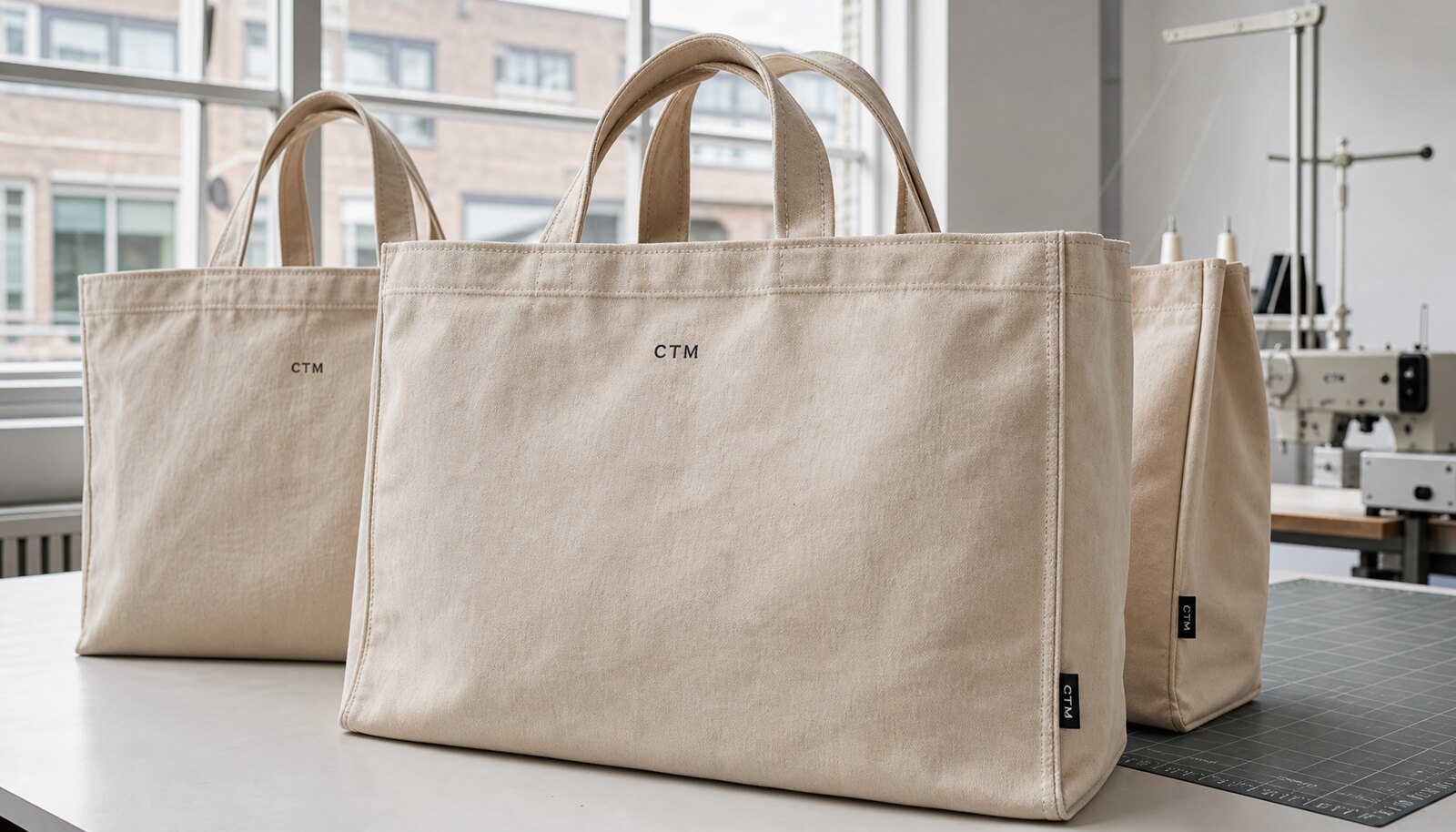
What large canvas tote bags for retail need to do
Large canvas tote bags for retail are not just soft goods. They are merchandise, packaging, and an end-user carry item at the same time. That means the bag has to look clean on shelf, survive repeated use, and still land inside the margin model after printing, packing, and inbound handling are included. A tote that works for a bookstore may be too soft for a grocery add-on, while a museum-shop bag may be overbuilt for a low-priced gift line.
The first sourcing mistake is treating every large canvas tote as interchangeable. Procurement teams need a use case before they need a supplier. Define whether the bag is for book carry, lifestyle merchandising, event retail, premium gifting, or checkout impulse sales. Then define the failure that matters most: sagging base, crooked print, weak handles, dirty packing, or poor shelf appearance. That decision should shape the spec, not follow it.
If the bag is part of a recurring retail line, ask for the target shelf price, expected reorder rhythm, and whether the product will be sold folded, hung, or stacked. Those details affect the entire quote. A supplier cannot price a tote accurately if they do not know whether it has to meet a high visual standard at store opening or only a functional standard in bulk distribution.
- Define the use case before you ask for price.
- Treat the bag as a retail product, not a generic blank tote.
- Write down what would trigger a customer complaint or a receiving rejection.
Fabric and finish: start with the right body, not the thickest canvas
There is no universal best fabric weight for large canvas tote bags for retail. Many buying teams start somewhere between 8 oz and 16 oz, but the right target depends on the retail price, the amount of structure the bag needs, and how the customer will use it. Lighter canvas is easier to fold, cheaper to ship, and usually better for promotional price points. Heavier canvas feels more substantial, but it also increases fabric cost, sewing time, and freight weight.
Instead of asking only for oz, ask the supplier to specify GSM or oz, weave type, finish, and whether the canvas is raw, natural, bleached, dyed, washed, or garment-finished. Washed canvas can look premium, but it often changes shrink behavior and can introduce shade variation if the production lot is not controlled. For retail programs, the sample should use the same batch quality and finish as bulk, not just a similar swatch.
For a simple rule of thumb, lighter merch tote programs usually favor a softer body, while premium retail or heavier carry programs need more body and better seam control. If the bag must stand up on shelf, consider whether the stiffness should come from the canvas itself, a boxed base, or a liner. Each choice affects price and lead time differently, so the buyer should ask for the tradeoff explicitly rather than accept the factory's default.
- Ask for actual GSM or oz, not just the word canvas.
- Confirm whether the fabric is pre-shrunk, washed, or raw.
- Match fabric choice to the bag's retail job, not to a generic weight rule.
Construction details that affect resale and returns
Most tote returns are not caused by the logo. They come from construction issues that show up after the customer uses the bag. Handle anchoring, seam allowance, gusset depth, and reinforcement all matter more than they look on a sample photo. A large canvas tote with weak handle roots may pass a visual inspection and still fail after a few real loads. For retail buyers, that is a margin problem, not just a quality problem.
Handle construction should be specified in enough detail that two suppliers cannot interpret it differently. State the handle width, material type, attachment method, bartack pattern, and desired handle drop. If the bag is meant to carry over the shoulder, the handle drop must be long enough to be usable without causing the bag to swing into the body. If it is meant for hand carry only, a shorter drop may be acceptable and can reduce fabric usage.
Body shape also matters. A gusset gives the bag more capacity, but it increases cutting complexity and can expose alignment issues if the factory is not well controlled. A boxed bottom can improve shelf presence, yet it adds sewing and inspection work. Lining and closures should be added only when they support the price point or the retail use case. Otherwise they create avoidable cost and more ways for the factory to miss the spec.
- Specify handle width, drop, and reinforcement method in the RFQ.
- Use gussets or boxed bottoms only when the retail job needs them.
- Set numeric tolerances for body size and print position before sample approval.
Branding, print, and labels: the retail-facing details that buyers see first
The print method should be chosen from artwork complexity, order volume, and durability needs, not from habit. Screen printing is usually the right answer for simple logos and one to three solid colors because it gives sharp edges and stable repeatability. Transfer or digital print is better when the art has gradients, fine detail, or shorter runs. Embroidery can work for a premium look, but it adds cost, can distort lighter canvas, and is not the best fit for every retail tote program.
Ask the supplier what ink system, curing process, and test method they use. A tote that looks fine on a workbench can still smear, crack, or bleed after rubbing or folding if the print process is not matched to the fabric. For brand-critical colors, the buyer should approve Pantone targets in advance and ask for a color reference that the factory will use during the run. If registration matters, set a placement tolerance in millimeters, not a vague wording like centered.
Retail labeling deserves the same discipline as the print. Many private-label programs need sewn-in fiber content, country-of-origin, and care labeling, plus swing tags or barcode stickers. If the tote will be sold in a specific market, label text should be approved before bulk. That avoids late-stage warehouse rejection and prevents the supplier from treating label copy as a shop-floor assumption rather than a contract item.
- Use screen print for simple, repeatable art.
- Approve Pantone targets and print placement before mass production.
- Lock label copy and barcode format before the factory starts bulk packing.
How to compare quotes without rewarding omissions
A tote quote is only useful if every supplier is quoting the same spec. The common mistake is comparing a low ex-factory price that excludes packing, labels, setup, or a second print color against a higher price that includes the full production scope. For large canvas tote bags for retail, procurement should normalize every bid to the same fabric weight, construction, print method, and packing format before drawing conclusions.
The cleanest quote is line-item based. Ask the supplier to separate body price, handle construction, print setup, labels, packing, and any special trim or tooling. If the supplier cannot or will not separate those items, it becomes much harder to see where the money is going or what changes the price in a reorder. That matters when your team needs to explain why one bid is cheaper but riskier.
Supplier route should also be treated as a sourcing variable, not a moral preference. A direct factory is often the best choice when the spec is stable, repeat orders are likely, and the team needs visibility into fabric, sewing, and QC ownership. A trader or converter can be the better choice when the order combines several SKUs, needs consolidation across different inputs, or requires more managed communication. The key question is not who is cheaper on day one, but who can hold the agreed spec without surprises.
- Normalize all quotes to the same spec before comparison.
- Demand a line-item quote with setup and packing separated.
- Ask who actually owns production, QC, and subcontracting.
Compliance, labeling, and destination-market constraints
Retail tote sourcing gets much easier when compliance is addressed early. If the bags are sold under a private label or shipped across borders, the buyer should confirm what label content the destination market requires and whether any printed or sewn components need testing. In the US, for example, fiber content and country-of-origin labeling are common requirements for many textile goods, while the retailer may also require a care label or an internal SKU label. In the EU or UK, language, traceability, and retailer-specific labeling rules often matter just as much as the product itself.
The tote may also contain features that trigger extra scrutiny. Coated surfaces, dyed trims, metal hardware, zipper pulls, printed inks, or decorative patches can bring in restricted-substance questions that are specific to the target market and the retailer's compliance manual. The buyer should not assume those tests are required in every case, but they should ask the supplier what documents they can provide and which parts of the bill of materials are most likely to need review.
Packaging rules are part of compliance too. Some retailers require recycled-content packaging, some require individual polybags only under specific conditions, and some require suffocation warnings or barcode placement in a fixed location. If the tote is sold through a distribution center, the carton marks and SKU labels should align with the retailer's master data. Those details are not administrative fluff; they are the difference between a clean receiving process and a delayed intake.
- Approve label copy before bulk if the tote is private label or cross-border.
- Check whether trims, inks, or hardware need destination-market test support.
- Write packaging rules into the PO, including barcode and warning-label requirements.
Sampling: the shortest path to a clean bulk order
A tote program should move through samples in a controlled sequence. Start with a white sample if you need to confirm size, construction, and seam layout before paying for artwork setup. Then review a salesman sample or pre-production sample that uses the final fabric, print, trim, and packing method. The most important control point is the sealed reference sample. Once it is approved, both sides can use it to settle questions about bulk variation without relying on memory or email screenshots.
The sample review should focus on retail-visible issues. Check whether the bag stands as intended, whether the handle drops match the use case, whether the print is centered relative to seam lines, and whether the folding method allows clean carton packing. If the sample already shows loose threads, crooked stitches, or a weak handle anchor, bulk production will not fix that. The right action is to revise the spec or reject the sample before the factory cuts production fabric.
A good sample approval note is more than a yes or no. It should state the approved fabric, color reference, print method, dimensions, label copy, packing method, and any open exceptions. If the supplier and buyer are not looking at the same written version of the sample, bulk control becomes subjective. For retail programs, subjectivity is expensive.
- Use a white sample, then a pre-production sample, then a sealed reference sample.
- Approve the sample in writing with the exact spec version attached.
- Do not use photos alone as bulk authorization.
QC that procurement can actually enforce
Quality control for large canvas tote bags for retail should be written as a contract standard, not as a general instruction to inspect carefully. Start by defining the defect classes: critical, major, and minor. A common retail starting point is 0 critical defects with AQL 2.5 major and 4.0 minor, but launch programs may need tighter thresholds. The point is not to copy a number blindly, but to make sure the factory knows what the lot will be judged against.
Physical tests are where many tote specs become real. A practical benchmark for everyday retail bags is a static pull target around 10 kg to 15 kg per handle, with no seam opening, bartack failure, or visible deformation beyond the agreed limit. Dimensional checks should use the approved tolerance, such as plus or minus 1 cm on body measurements and plus or minus 0.5 cm on handle drop. For print, the buyer can set a placement window of plus or minus 5 mm and a color reference that is checked under neutral light.
Do not stop at the tote itself. The packing lot should be inspected for the right inner count, correct carton mark, barcode readability, fold direction, and label placement. If the order is going to a retailer with strict receiving rules, carton dimensions and gross weight should also be checked against the inbound specification. A bag that passes sewing inspection but fails at receiving still costs the buyer money.
- Write AQL targets and defect definitions into the PO or quality appendix.
- Include a handle pull or static load benchmark, not just a visual check.
- Inspect packing, labels, and carton marks with the same rigor as the bag body.
Packing, palletization, and freight handling
Packing decisions have a direct effect on retail presentation and inbound labor. Large canvas tote bags can be packed in bulk to reduce cost, or individually polybagged when the retailer requires protection, scan-ready handling, or a cleaner shelf appearance. The right format depends on how the bags move through the supply chain. A direct-to-store program may need stronger pack control than a warehouse-to-warehouse transfer, while e-commerce fulfillment may need a different fold and carton logic than a standard retail DC.
Ask the supplier to state the fold direction, inner pack count, master carton count, carton dimensions, gross weight, and pallet pattern. Those numbers affect freight cost and warehouse handling, and they should be checked against the retailer's receiving rules if the buyer has them. If the bags are shipped long distance or stored in humid conditions, packaging should protect the fabric from creasing, soil, and moisture exposure. The buyer should not discover corner crush or print transfer when the first pallets arrive.
If the retailer has sustainability rules, confirm them early. Some programs want recycled-content packaging or have restrictions on single-use plastic. Others still require individual polybags because they protect a retail presentation standard. The key is to get that rule in writing before the factory packs bulk, because repacking after the fact is one of the fastest ways to lose margin.
- Lock fold method, inner pack count, and carton count before production.
- Confirm pallet pattern, max stack, and carton dimensions for the distribution center.
- Write any sustainable packaging requirement into the PO, not just the email thread.
Release checklist: when the PO is actually ready
A purchase order for large canvas tote bags for retail should only go out after the spec is stable. That means the buyer has locked the finished size, fabric weight, handle length, print proof, label copy, packing method, AQL target, and required delivery date. If any of those items are still open, the quote is still moving and the buyer is exposing the program to hidden cost changes later. In practice, that is where a lot of tote programs lose time.
The final sourcing decision should also reflect the business model. A price-sensitive launch may justify a simpler construction and fewer decoration steps. A premium retail line may justify a heavier fabric, better handle reinforcement, or a more controlled finishing process because the shelf price can absorb it. What should not happen is choosing a supplier because the sample looked good while ignoring whether that supplier can hold the same result at reorder volume.
The most reliable supplier is not the one that gives the lowest first number. It is the one that can repeat the agreed spec, show the right documents, pass the agreed QC plan, and pack the product in a way the retailer can receive without friction. That is the standard procurement teams should use when buying canvas tote bags for retail.
- Release the PO only after the spec, sample, labels, and packing rules are frozen.
- Choose the construction level that matches the retail price point.
- Prioritize repeatability and receiving performance over a low first quote.
Specification comparison for buyers
| Spec decision | Recommended option | When it fits | Buyer risk to check |
|---|---|---|---|
| Fabric weight | Start with 8 oz to 10 oz for lightweight merch, 10 oz to 12 oz for general retail, and 12 oz to 16 oz when structure or repeated carry matters | Use the lower end for price-led promo retail and the higher end when the bag must stand up better, carry books or groceries, or support premium shelf pricing | Do not compare quotes on fabric label alone. Ask for actual GSM or oz, expected shrink after wash or heat, and whether the fabric holds print cleanly without showing through |
| Handle construction | Self-fabric or webbing handles with bartacks at both ends and a clear static load target | Use when the bag is expected to be carried repeatedly and the retailer will not accept early seam failures or handle stretch | Ask the supplier to state the test target in writing. Many buyers use an everyday benchmark around 10 kg to 15 kg static pull per handle, depending on the use case |
| Dimensions and tolerance | Define the finished body size, base depth, and handle drop by end use, then lock tolerances before sampling | Best for chain retail, reorder programs, and any bag that has to pack consistently across cartons and stores | Set practical tolerances such as body size within plus or minus 1 cm, handle drop within plus or minus 0.5 cm, and logo placement within plus or minus 5 mm |
| Print method | Screen print for 1 to 3 solid colors, transfer or digital for complex art, embroidery only when the premium price point supports it | Use the method that matches artwork complexity, order volume, and the brand's durability expectations | Check cure, rub resistance, and registration. Fine art can fill in or crack on heavy canvas if the method and ink system are not matched correctly |
| Lining and closure | Unlined open top for value-led retail; lined, snap, or zipper only when the selling price and use case justify the extra work | Fits impulse retail, gift shops, bookstores, and lifestyle assortments where easy access matters | Every added component creates more sewing steps, more inspection points, and more chances for trim mismatch or packing delay |
| Labels and compliance | Sewn-in fiber, country-of-origin, and care labels plus barcode and market-specific warnings where required | Needed for retail receiving, private label programs, and cross-border shipments | Label copy should be approved before bulk production. Missing or incorrect copy can block warehouse intake or create customs issues |
| Packing method | Individual polybag only if the retailer requires it, otherwise bulk pack by SKU and color with clear carton marks | Use when store presentation, dust control, or warehouse receiving rules need more protection | Confirm polybag rules, suffocation warnings, carton counts, and fold direction. Packing errors create avoidable rework at receiving |
| Supplier route | Direct factory for stable repeat programs; trader or converter when the order mixes SKUs, languages, or subcontracted processes | Choose based on program complexity, not ideology | Ask who actually makes the bag, who buys the fabric, and who owns final QC. A low price means little if source control is unclear |
| Inspection standard | AQL 2.5 major and 4.0 minor is a common starting point for retail tote programs, with 0 critical defects | Use for production lots that need repeatability and a traceable approval chain | If the factory will not agree to defect definitions, sample size, and reference sample control, the quote is not fully comparable |
Buyer checklist before sampling
- Define the retail use case first: bookstore, museum shop, gift line, grocery add-on, or premium merch, because the right tote spec changes with the use case.
- Lock the finished size, base depth, handle length, handle drop, and acceptable tolerance before asking for prices.
- Specify fabric in GSM or oz and state whether you want natural, bleached, dyed, garment-washed, or piece-dyed canvas.
- Confirm the print method, artwork format, Pantone targets, and whether the factory is quoting screens, plates, or art cleanup separately.
- State whether the bag is open top, lined, gusseted, boxed bottom, snap-closure, or zipper-closure, and whether those features are optional or mandatory.
- Request a sample path in writing: white sample, salesman sample, pre-production sample, and sealed reference sample.
- Ask for line-item pricing that separates body, handles, print, labels, packing, tooling, and any special trim.
- Request MOQ by color, MOQ by design, MOQ by packing format, and whether mixed SKUs share any setup cost.
- Approve label copy and carton marks before production if the tote will be sold under a private label or shipped cross-border.
- Confirm carton count, inner pack, polybag rule, barcode label location, and pallet preference before the factory cuts bulk material.
Factory quote questions to send
- What finished size, base depth, handle length, and tolerance are included in this quote?
- What fabric weight, weave style, and finish are included, and is the canvas pre-shrunk, washed, or raw?
- Which print method is being quoted, how many colors are included, and are screens, plates, or art cleanup extra?
- What is the MOQ by color, by design, and by production run if we combine multiple SKUs?
- Are handles self-fabric or webbing, and how many bartacks or reinforcement points are included per handle end?
- Does the price include lining, zipper, snap, woven label, hang tag, and sewn-in care or origin label?
- What packing is included: bulk pack, individual polybag, barcode sticker, carton mark, and master carton count?
- What sample will you provide for approval, and will bulk production match the sealed reference sample?
- What QC standard do you follow for dimensions, stitch quality, print placement, and defect classification?
- What static load or pull test do you use for handle and seam validation, and what happens if the sample fails?
Quality-control points to confirm
- Measure body length, width, base depth, handle length, handle drop, and print placement against the approved spec on a representative sample from the lot.
- Set and document practical tolerance targets such as body dimensions within plus or minus 1 cm, handle drop within plus or minus 0.5 cm, and logo placement within plus or minus 5 mm.
- Inspect seam straightness, stitch density consistency, bartack placement, and exposed raw edge control.
- Run a static pull or load test on the handle and attachment area. Many retail buyers use a benchmark around 10 kg to 15 kg per handle for everyday tote programs, with the actual target set by product use.
- Check for skipped stitches, loose threads longer than the agreed limit, needle damage, oil marks, and panel skew.
- Review print registration, edge sharpness, ink coverage, cure quality, and rub resistance under normal retail lighting.
- Set a color match rule using a sealed standard. For brand-critical colors, a Delta E target of 2.0 or lower is a common control point; for natural canvas, buyers may allow a slightly wider tolerance if both sides agree in writing.
- Use an AQL plan with 0 critical defects, plus agreed major and minor defect counts. AQL 2.5 major and 4.0 minor is a common starting point for retail programs, but launch orders may need tighter limits.
- Verify labels, barcode placement, carton marks, inner pack count, and any destination-market warning labels before shipment.
- Compare the bulk lot against the sealed reference sample, not just against a photo or email approval.