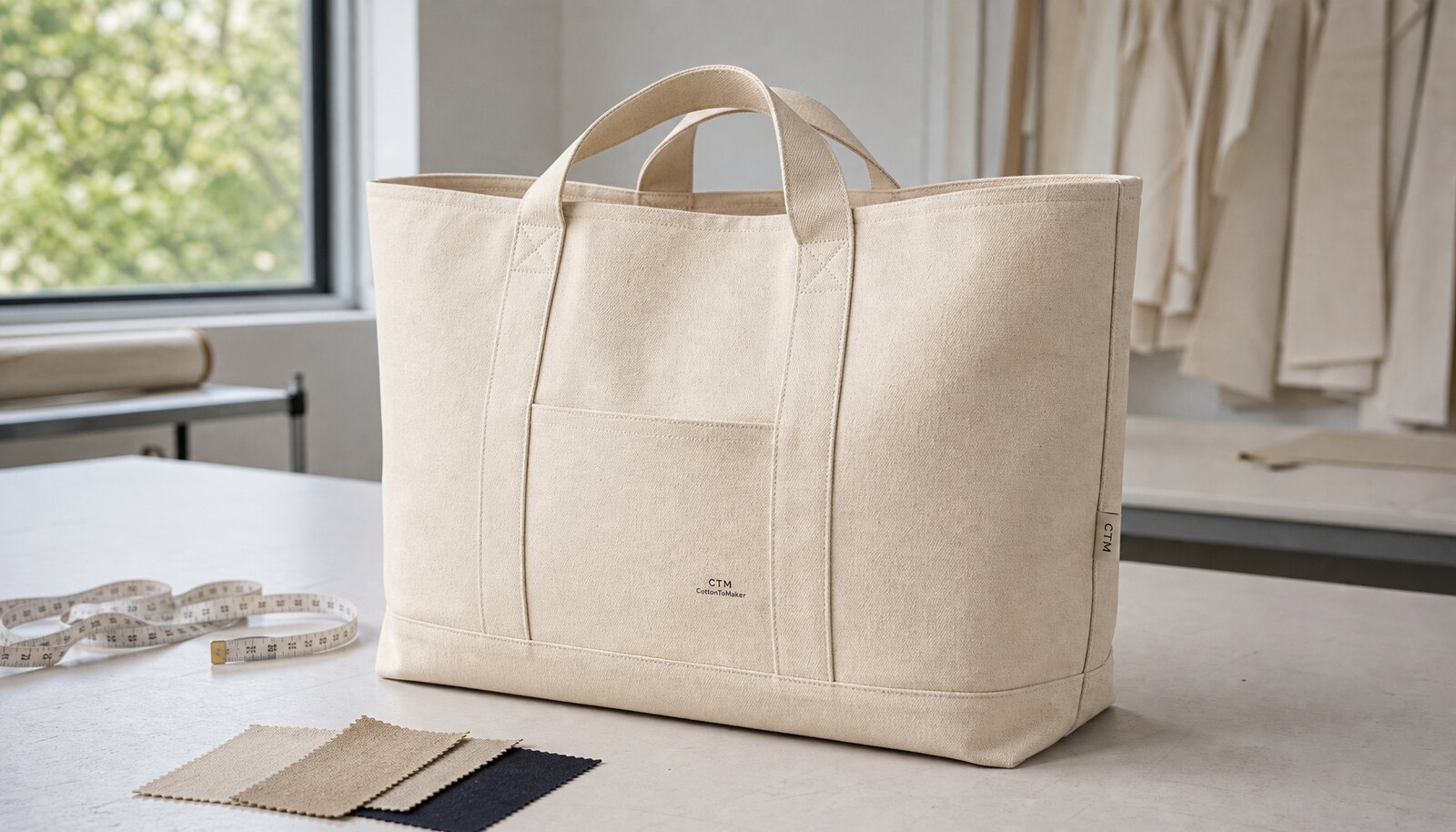
Why large canvas tote bags keep winning in corporate gift programs
Large canvas tote bags keep showing up in corporate gift programs because they solve more than one problem at once. They are useful, easy to brand, relatively efficient to ship, and flexible enough to fit different occasions without forcing a luxury gift budget. That mix matters to procurement teams. A tote can carry onboarding materials, event collateral, a bottle, a notebook, or a boxed set, and it can do that while still looking like part of the gift rather than just the carrier for it.
The commercial advantage is not that canvas is fashionable. It is that the bag can carry a message of practicality and reuse. A reusable gift tends to stay in circulation longer than a disposable pack, which gives the brand more exposure after distribution. But that only works when the tote feels durable enough to keep. If the handles twist, the seams open, or the body collapses, the bag stops being a brand asset and becomes a complaint.
From a sourcing standpoint, canvas is also adaptable. The same format can be specified as a lighter conference tote, a sturdier employee welcome bag, or a cleaner premium client gift by changing fabric weight, handle build, decoration method, and packing format. That flexibility is useful, but it also creates room for vague quotes. If the buyer only says “large canvas tote bag,” suppliers will fill in the blanks differently. Procurement gets a better result when the brief describes the fill, the usage, and the final presentation rather than only the product name.
- Define the use case first; a tote for event handouts is not the same as a tote for client gifting.
- Treat the bag as part of the gift experience, not just as packaging.
- A flexible product still needs a tight spec if you want fair supplier comparison.
Start with the end use: the same tote behaves differently in different gift scenarios
A conference tote, an employee onboarding bag, and a premium client gift bag can all look similar in a product photo and still require different specifications. For an event, the key questions are how quickly the bag can be filled, whether it can handle paper collateral and a bottle, and whether it stacks well in cartons or on a kitting table. A conference tote is often handled in volume, so opening width and packing efficiency matter more than refined finishing details.
An onboarding gift is judged differently. The bag may be opened in front of a team, set on a desk, or used as an early signal of how the company thinks about quality. In that setting, straight seams, even print placement, and a bag that stands neatly tend to matter more than shaving a small amount off the unit price. A client appreciation program sits somewhere else again: presentation matters, but so does repeat use. If the tote is meant to keep serving the recipient, construction and durability deserve more attention than they would in a one-day event giveaway.
The cleanest way to avoid mismatch is to write the actual contents into the RFQ. List the number of items, their approximate size, the heaviest item, and whether the tote will be filled at the factory or by a warehouse team later. Also state the expected life of the bag: single handout, repeated reuse, or premium ongoing use. That one paragraph will improve the quote more than a page of generic sourcing language.
- Event kits: prioritize opening width, fill speed, and carton efficiency.
- Onboarding gifts: prioritize finish quality and consistent presentation.
- Client gifts: prioritize clean stitching, stable branding, and repeat-use durability.
Fabric weight, finish, and hand feel: where quote gaps usually come from
For most large canvas tote bags for corporate gifts, 12oz to 14oz cotton canvas is the most practical range. It usually gives enough body to feel substantial without adding unnecessary weight or sewing cost. A 10oz canvas can still work when the contents are light, the bag is oversized, or the program is budget-sensitive, but buyers should understand the tradeoff: lighter canvas tends to drape more, wrinkle more, and feel less premium once loaded. If the bag will carry heavier items or needs to hold shape for presentation, moving up in weight is often worth the added cost.
The challenge is that “12oz” is not always the same across suppliers. One quote may refer to finished fabric after washing and finishing, while another may refer to a pre-process or raw basis. Those are not equivalent. A buyer should ask what basis was used, and whether the weight was measured before cutting, after washing, or as the incoming cloth. If the seller cannot answer clearly, the quote should be treated as incomplete rather than cheaper. For procurement, the question is not simply how much the tote costs, but what the delivered bag will actually feel and perform like.
Finish also changes the result. Natural canvas gives a casual, product-forward look and is often a good fit for internal campaigns or sustainability-themed messaging. Bleached canvas looks cleaner but can make shade consistency more visible. Dyed canvas can feel more deliberate and premium, but the buyer should expect tighter color control and sometimes more variation between lots. Washed or enzyme-washed canvas can be softer and more elevated, but it may also create more batch variation and slightly different shrinkage behavior. These are process decisions as much as style decisions, and they should be quoted that way.
If you need a quick filter, use this: lighter contents and short-term handout programs can often stay near 10oz-12oz; heavier contents, premium gifting, or repeat-use expectations usually fit better at 12oz-14oz; and any washed or dyed version should be approved with physical samples rather than only digital color references.
- Ask for fabric weight in GSM or ounces, and confirm whether it is finished or unfinished fabric.
- Use 12oz when you want balanced cost and structure.
- Use 14oz when the bag must carry heavier contents or present as more premium.
- Treat dyed and washed canvas as higher-control options with tighter QC requirements.
Construction details that separate a reusable gift bag from a flimsy promo bag
Construction is where a tote earns repeat use or gets pushed aside after one event. Handle attachment is usually the first failure point. Self-fabric handles can perform well if they are wide enough, folded cleanly, and anchored with reinforcement stitching at the top edge and lower stress point. The visual question is simple: does the handle look like it belongs to a reusable bag, or does it look like a strip sewn on because it was the cheapest option? Buyers should ask for a close-up photo of the handle anchor area and, if possible, a sample with the final load expected in use.
Seams and corners deserve the same attention. The bottom corners carry the load when the tote contains boxed sets, hard edges, or multiple items shifted to one side. Weak seam allowance, poor trimming, and inconsistent corner stitching can create early seam slippage even when the canvas itself is strong. If the bag must stand for kitting or look neat on a desk, the base shape also matters. A tote that looks flat and tidy when empty can distort when filled unless the pattern and seam control are right.
Open-top bags are usually easier to source and faster to pack. Closures add a different layer of complexity. A zipper, snap, or tie can improve presentation or security, but each one adds sewing operations and another QC point. Buyers should not add a closure just because it sounds more premium. If the contents do not need security and the distribution flow values speed, a well-constructed open tote may be the better commercial choice. The right construction is the one that supports use, packing, and the event or gifting process without adding avoidable risk.
- Check handle width, fold quality, and reinforcement at both anchor points.
- Inspect seam allowance consistency and the finish at corners and load-bearing areas.
- Use closures only when the gift contents or presentation really justify the extra complexity.
Branding method: choose print, embroidery, or transfer based on artwork and durability
Decoration should be chosen from the artwork outward, not from the supplier’s favorite machine inward. For most corporate gift programs, screen printing is the most practical option because it handles bold logos well, scales efficiently, and usually keeps unit cost under control. It works best when the artwork is simple, with clean edges and limited colors. The real question is not whether screen printing is common; it is whether the supplier can hold registration, ink opacity, and placement accuracy on the actual canvas you selected.
Embroidery can be useful when the logo is small and the brief calls for a tactile premium look. It is generally not the right choice for large fills, thin lettering, or complex marks because stitch build-up can distort the design and pull the fabric. Heat transfer and digital methods can be helpful when the artwork has more colors or gradients, but they should not be accepted on faith. Ask the supplier to prove durability on the chosen canvas texture. A method that looks good on a smooth promo bag may behave very differently on woven canvas.
The sample sequence should reflect that risk. Start with a blank sample to confirm size, structure, and handle feel. Then request a strike-off or print test on actual fabric. If there is custom dyeing, heavy washing, or a premium finish, a pre-production sample is worth the time because it confirms final placement and assembly. Buyers should also check where the logo sits relative to seams, pockets, and handles, since sewing can shift the visual center after the bag is assembled. Fine text and small marks are especially vulnerable; if readability matters, verify it on the real sample instead of assuming the artwork file will translate cleanly.
- Screen print: best for bold, repeatable branding and controlled cost.
- Embroidery: best for small premium marks, not for large or highly detailed logos.
- Heat transfer or digital: only if the supplier proves durability on the chosen canvas.
- Approve the logo on the real bag color and final construction, not just on a screen.
How to shortlist suppliers without relying on generic factory-versus-trader logic
The factory-versus-trading-company debate is less useful than most buyers think. A direct factory is often better when the order is repeatable, the timeline is fixed, and the buyer wants clearer accountability for sewing, decoration, and packing. But a trading partner can still be a good fit if it has real production visibility, strong communication, and documented control of the factory it is using. What matters is not the label; it is whether the seller can describe the actual production flow without hand-waving.
When shortlisting suppliers, ask questions that reveal process maturity rather than just responsiveness. Can they show photos of the actual sewing line and packing area? Can they explain how they control shade, print registration, and carton counts across a run? Can they quote the same tote in different pack formats without changing the fabric basis or the size definition? A supplier that answers quickly but vaguely may still be fine for a small promo run, but it is a weaker choice for a corporate gift project with a fixed launch date.
You should also watch for common red flags. Be cautious when a supplier avoids naming where printing happens, cannot explain how samples are approved against the final order, or refuses to disclose whether packing is subcontracted. Another warning sign is inconsistency between the spec sheet and the photos: if the images show one handle style, but the quote describes another, the supplier may be relying on generic stock information. Procurement teams do better when they shortlist on process clarity, sample control, and consistency between quote, photo evidence, and approval sample.
- Request a real production flow, not just a company profile.
- Compare the supplier’s control over sewing, print, packing, and labeling.
- Prefer vendors that can quote multiple options on the same spec basis.
- Be cautious when subcontracting is hidden or sample control is vague.
Landed cost: the number that should drive the final decision
The cheapest unit price is rarely the cheapest project. For large canvas tote bags, landed cost is shaped by fabric weight, handle construction, decoration method, setup charges, packing format, carton cube, and any extra handling required for labels or inserts. A low quote may only be low because it excludes setup, rush handling, or the presentation format the buyer actually wants. That is why procurement should compare full delivered cost, not the first number in the email.
The fixed-cost side usually includes sampling, screen setup, artwork handling, and color matching. The variable-cost side includes fabric consumption, sewing time, reinforcement, decoration, and packing. Size affects cost as well: a larger tote uses more cloth, often needs a wider hem or longer handle, and may require a bigger carton. If the order is being packed individually for presentation, that extra labor and material should be captured explicitly. If the tote is going straight into a warehouse kitting process, bulk packing may be the better commercial choice.
A clean comparison method is to ask every supplier to quote three versions of the same product: bulk pack, individual polybag, and premium presentation pack. That exposes how much each packing step truly costs and whether the bag itself is priced competitively or only the simplest version is cheap. It also helps procurement see whether the supplier understands fulfillment realities or is only pricing a basic factory output. If two quotes are close on bag price but far apart on packing and setup, the landed-cost picture may be completely different.
- Separate fixed costs from variable costs before comparing offers.
- Check whether packing, labels, inserts, and inner protection are included or quoted separately.
- Ask for more than one packing scenario so you can see the cost of presentation choices.
Sample approval and QC: the points that save the most rework
A corporate gift tote should not move into bulk production on artwork alone. The first physical sample should confirm size, handle length, seam finish, opening width, and the way the bag sits when filled. If the order uses custom dye, washed canvas, or a complicated print, a strike-off plus a pre-production sample is often worth the extra time. That is where buyers catch the expensive mistakes early: a logo that sits too low, a handle that feels too short, a bag body that twists after sewing, or a print that disappears against the chosen cloth color.
Good QC for tote bags is practical, not theoretical. Ask the supplier what they inspect at fabric receipt, cutting, sewing, printing, and packing. A serious checklist usually includes fabric weight verification, cut-size control, seam allowance checks, stitch density, print placement, print cure or adhesion, stain checks, carton labeling, and count reconciliation. For larger orders, define an AQL-style acceptance plan before production starts so both sides agree on the sample size and defect thresholds rather than negotiating on the dock after arrival.
For operational use, keep the inspection criteria concrete. Example: no critical defects such as wrong style, major contamination, or broken handles; major defects such as a visible seam opening, large print misalignment, or the wrong color should stay below the agreed acceptance limit; minor issues such as slight thread tails or small shade differences should only be tolerated within the approved sample count. If the supplier will not agree to measurable criteria, the quote is less useful because it leaves quality open to interpretation.
Handle strength should be checked with a defined pull or hang test on samples, not just a visual promise. Seam slippage should be checked at corners and load points. Print should be tested on the actual canvas with a dry-rub check and, where relevant, a damp-rub check. The goal is not to turn a tote order into a lab project. The goal is to catch the defects that matter before the boxes are sealed and shipped.
- Approve a physical sample for size, feel, and print position.
- Use an AQL-style inspection plan for larger or repeat orders.
- Check seam slippage, handle reinforcement, print adhesion, and stain control.
- Keep one signed sample with the final spec version attached.
Packing, carton plan, and warehouse handling for corporate gift distribution
Packing is often treated as a logistics detail, but it has a direct effect on how the tote is received and used. If the bags are going straight to an event venue, bulk packing is usually the best cost and handling choice. If the bags must be distributed to offices, VIP recipients, or multiple destinations, individual polybags or a more presentation-ready pack can be worth the added spend. The right format depends on whether the tote is the gift itself or just the carrier for other gift items.
Canvas totes crease and flatten more easily than buyers expect. A bag packed too tightly can arrive functional but wrinkled and less gift-ready. A bag packed too loosely can waste carton space and raise freight cost. Ask the supplier to recommend a carton count based on actual thickness, handle style, and whether the bag needs to stay visually neat on arrival. The carton should protect the opening and handles without crushing the shape. If the carton gets too large or too heavy, warehouse handling slows down and damage risk goes up.
Receiving teams also need clean labeling. Cartons should identify style, color, quantity, PO number, and carton sequence when there are multiple variants. If the order includes more than one version, ask for clear segregation inside the master cartons or a pallet map. That helps prevent the common problem of correct goods arriving in the wrong count or the wrong inner arrangement, which then creates manual sorting work at the destination. For a corporate gift program, small packing mistakes often create more frustration than small product defects because they interfere with deadline-driven distribution.
- Bulk pack for efficiency; individual bagging for presentation.
- Protect handles and openings so the tote still looks gift-ready on arrival.
- Use detailed carton labels and count controls to reduce receiving delays.
Lead time planning: where delays usually happen in real orders
A straightforward tote order can often fit into a 25-35 day factory production window after sample approval, but that should be treated as a planning reference rather than a guarantee. The actual schedule depends on fabric availability, whether the cloth is stock or custom dyed, how complex the decoration is, how many versions are being produced, and how much packing work is required. Transit time, sample review, and booking time are separate from sewing time, so a project can miss the launch date even if production itself goes to plan.
The most common scheduling mistake is late artwork change. Once the print file is frozen, the factory can move faster and the sample can be approved with fewer surprises. When artwork is still changing, every quote, strike-off, and pre-production sample may need revision. That is a production problem as much as a design problem because screen setup, color matching, and registration all depend on stable artwork. If the bags must arrive for a fixed event, back-plan from the handout date, not from the day production starts.
A sensible timeline includes artwork sign-off, blank sample approval, print strike-off approval, pre-production sample approval if needed, bulk production, final inspection, carton labeling, and outbound booking. If the lead time is tight, ask what can be parallelized and what cannot. Some tasks can run together; others, like final sample approval and the start of bulk printing, should never be compressed past the point of control. A short schedule is only useful if the quality gates still hold.
- Treat sample transit, review, and approval as part of the schedule.
- Freeze artwork before production, or expect slippage.
- Do not sacrifice final inspection just to save a few days.
Specification comparison for buyers
| Decision point | What to buy for | Commercial tradeoff | Quote / QC check |
|---|---|---|---|
| Fabric weight | 12oz-14oz canvas for most branded gift programs; 10oz only when contents are light and budget is tight | Heavier fabric looks and feels more premium but raises material cost, sewing time, and freight weight | Ask whether quoted weight is finished fabric, pre-wash fabric, or greige cloth; request a physical swatch labeled with the measured basis |
| Bag structure | Flat tote for lightweight handouts; gusseted tote when the contents are boxed, bulky, or carried repeatedly | Gussets improve capacity and usability but add sewing complexity and more places for distortion | Confirm finished dimensions, gusset depth, and whether the bag stands open enough for packing without collapsing |
| Decoration method | Screen print for most corporate logos; embroidery only for small premium marks; transfer only when artwork requires it and durability is proven | Simpler methods are cheaper and easier to repeat; complex methods can look better but increase rejection risk if the canvas texture is rough | Request a strike-off on actual fabric and a pre-production sample showing final placement, curing, and edge detail |
| Packing format | Bulk pack for warehouse efficiency; individual polybag or banded pack only when presentation matters | Presentation packing improves unboxing but increases labor, plastic use, carton cube, and cost | Ask for the same quote in three pack formats so landed cost can be compared on a like-for-like basis |
| Supplier type | Direct factory for repeatable programs; capable trading partner only if production control is documented | Factories can give better process visibility; traders may be faster to coordinate but sometimes hide subcontracting | Verify whether cutting, sewing, printing, and packing are in-house or split; ask for photos of the actual line and packing area |
| Lead time | Use a buffer for artwork approval, sample transit, inspection, and booking | Short schedules look efficient but usually compress QC and create avoidable errors | Ask for the full timeline with milestones, not just a sewing-day estimate |
| Inspection standard | AQL-style inspection with agreed major/minor/critical defects | Stronger control reduces disputes on arrival, but it only works if the defect definitions are written before production | Confirm sample size, defect thresholds, and pass/fail examples for seams, print, dimensions, and packing count |
Buyer checklist before sampling
- Define the actual use case: event giveaway, employee onboarding, client gift, retail-style premium gift, or internal recognition pack.
- List the contents the tote must carry, including approximate total weight, rigid items, and whether the bag needs to stand open during packing.
- Specify finished size, gusset depth, handle length, handle width, and whether the tote must fit a laptop sleeve, document folder, or boxed gift.
- State fabric weight in GSM or ounces and ask whether the quoted number refers to finished fabric, washed fabric, or base cloth.
- Choose the canvas finish intentionally: natural, bleached, dyed, washed, or enzyme-washed, because each affects hand feel, shrinkage, and shade variation.
- Provide vector artwork, note the maximum number of print colors, and set the required logo size and placement relative to seams and handles.
- Ask the supplier to quote the same packing format across all options: bulk pack, inner pack, banded pack, or individual polybag.
- Request physical samples, not just digital proofs, when the order uses custom color, a new print placement, or a premium finish.
- Compare landed cost, not only unit price; include setup, samples, packing, labels, internal freight, inspection, and any testing fees.
- Confirm QC checkpoints, defect categories, inspection sample size, and acceptance criteria before bulk production starts.
Factory quote questions to send
- What is the exact fabric weight in GSM or ounces, and is that measurement based on finished fabric after washing or on raw cloth before processing?
- Can you confirm which steps are done in-house and which, if any, are subcontracted: cutting, sewing, printing, embroidery, packing, labeling, and carton loading?
- What is the MOQ by color, decoration method, and packing format, and what changes if we add a second print color or a special insert card?
- What handle construction do you recommend for this tote size, and how do you reinforce the load points to avoid stitch failure?
- Can you provide a blank sample, a printed strike-off on the actual canvas, and a pre-production sample before bulk approval?
- What is your standard lead time after sample approval, and which steps usually add extra days in real orders?
- What carton size, inner quantity, gross weight, and pallet plan do you recommend for safe shipping and efficient warehouse handling?
- What inspection points do you check before shipment, and what defect limits do you use for stains, loose stitches, print misalignment, odor, and shade variation?
- How do you control color consistency if the order is produced across more than one machine, shift, or day?
- Can you share photos of a recent production run that shows stitching, print placement, reinforcement, and packing style on a similar tote?
Quality-control points to confirm
- Check fabric weight against the exact basis used in the quote. A quote based on greige cloth can appear cheaper than one based on finished, washed, and cut fabric.
- Use an AQL-style inspection plan for larger orders. Define major, minor, and critical defects before production so the receiving team is not inventing the standard after goods arrive.
- For a practical tote program, set pass/fail limits in writing. Example: no critical defects, major defects below the agreed AQL threshold, and minor defects only within the permitted sample number.
- Inspect seam slippage by pulling gently at the handle anchor, side seams, and bottom corners. If stitches open or the weave separates visibly, treat it as a major defect.
- Check handle attachment with a controlled weight-hang or pull test on samples. A bag that fails at the handle is not suitable for a corporate gift, even if the print looks perfect.
- Measure stitch density and consistency on the sample and at several points in bulk. Very loose stitching can reduce durability; overly tight stitching can pucker the canvas and distort the panel.
- Verify reinforcement at the top of handles, lower handle anchoring, and load-bearing corners. Bar-tacks, cross-stitches, or multiple rows of stitching should be visible and even.
- Confirm finished dimensions, not just cut dimensions. Allowances should be stated in the spec so the supplier does not ship a tote that is noticeably smaller after sewing and washing.
- Inspect print placement on the assembled bag, not only on the flat panel proof. Seams, gussets, and pockets can shift the visual center after assembly.
- Run dry-rub and, where appropriate, damp-rub checks on the actual canvas. Weak curing or poor ink penetration should show up before goods leave the factory.