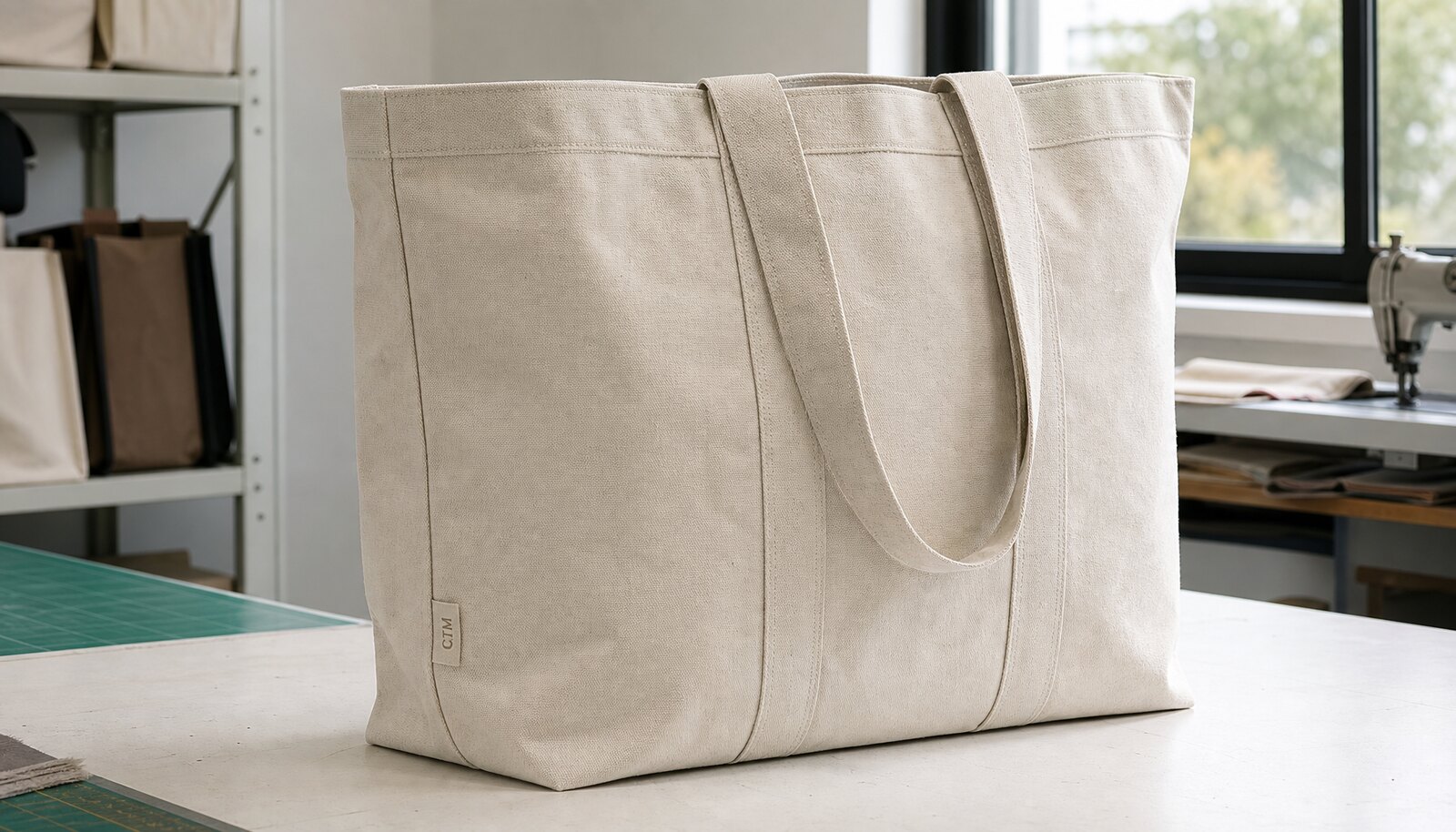
1. Why large canvas tote bags fail buyer expectations
Large canvas tote bags look straightforward, which is exactly why procurement teams get caught by them. The bag has only a few visible elements—fabric, handles, seams, print, and packing—but each one affects the landed cost and the customer experience. When the purchase is for retail resale, a trade show program, a bookstore launch, or wholesale distribution, the tote is no longer a simple accessory. It is a carry item that has to survive handling, stay presentable on shelf or in a carton, and fit a very specific commercial use case.
The most common sourcing mistake is letting the supplier define the bag from a vague brief such as “large, natural, good quality, with logo.” That wording leaves too much room for interpretation. One factory may assume a soft promotional tote. Another may build a heavier retail bag. A trading company may forward the order to whichever factory has free capacity and accept whatever fabric is easiest to source that week. By the time the bags arrive, the buyer may find the handles too short, the print slightly off-center, or the bag body too thin to hold shape.
For large canvas tote bags, the buyer’s job is to turn expectations into measurable specs. The decision is not just style. It is the intersection of carry load, fabric structure, decoration method, carton efficiency, and acceptable defect level. A good RFQ makes those tradeoffs visible before price comparison begins.
- Define the tote by end use first: retail carry, giveaway, grocery-style use, or premium merchandise.
- Do not approve a bag based on a photo alone; ask how it is built and what load it is expected to carry.
- Treat handle length, gusset depth, and bottom reinforcement as functional specs, not optional styling details.
- A “large” tote without a use case often becomes too floppy, too shallow, or unnecessarily expensive to ship.
2. Choose fabric weight by use, not by habit
Fabric weight is one of the first numbers suppliers quote, but it is only useful when tied to the bag’s function. In practice, large canvas tote bags for light retail giveaways or foldable carry use often start around 10–12 oz. That range can be acceptable when the bag is not expected to hold very heavy items and when the customer wants a lower-cost reusable option. For most mainstream retail and wholesale programs, 12–14 oz is the more balanced starting point because it offers better body, better print stability, and less visible distortion after sewing.
When the tote must feel more structured, carry books or bottled goods, or stand up better on shelf, 14–16 oz is often the more defensible choice. The higher weight usually gives the body more stability and improves the way the bag hangs when loaded. But buyers should not rely on nominal weight alone. A loosely woven canvas can feel softer and less stable than a tighter weave of lower nominal weight. Finish also matters: bleaching, dyeing, washing, and pre-shrinking can change hand feel, final size, and sometimes the print surface.
When comparing quotes, ask for the actual fabric construction rather than a generic description. A useful quote should distinguish between greige, bleached, dyed, washed, and pre-shrunk fabric. If the supplier can only say “good canvas” or “heavy canvas,” the quote is not procurement-ready. Ask for a sample swatch or photo from the current roll, not a stock image or a previous order that may have used a different loom run.
- 10–12 oz: suitable for lighter carry, promotions, and lower-cost reusable bags.
- 12–14 oz: the common middle ground for large canvas tote bags in retail and wholesale programs.
- 14–16 oz: better for heavier loads, a more structured look, and stronger shelf presence.
- Ask for fabric state: greige, bleached, dyed, washed, or pre-shrunk.
- If a supplier refuses to define weave or finish, treat the quote as incomplete.
3. Size, gusset, and handle design decide daily usability
Large canvas tote bags are judged by how they behave in real use, not by width alone. Finished width, height, and gusset depth must be considered as one system because they determine both capacity and shape. A bag that is very wide but shallow can look flat and hold items poorly. A bag with a generous gusset but insufficient height can make tall products stick out and reduce perceived quality. For many commercial programs, a finished size around 38–45 cm wide with a 12–18 cm gusset works well, but the right dimensions depend on what the bag is meant to hold.
Handle design is equally important. Buyers often focus on print area and ignore handle drop, but the handle is what determines whether the bag works on the shoulder, in the hand, or over a coat. If the tote is intended for shoulder carry, confirm the drop with real garments or a loaded sample. A handle that is comfortable on a bare-arm sample may become awkward once the user wears outerwear. For hand-carry use, shorter handles can make the bag feel tighter and more upright, which some retail teams prefer.
The supplier should quote handle material, width, length, and stitch pattern separately. A self-fabric handle, cotton tape handle, or webbing handle can all work, but they do not behave the same way. Reinforcement also matters. Cross-stitch or box-X patterns are common because they distribute stress better than a minimal bar-tack approach. If the bag will carry heavier contents, ask exactly how many stitches or stitch rows are used at each attachment point and whether the factory has a standard reinforcement template for that weight class.
- Lock size, gusset, and handle drop together so the bag functions as one system.
- Ask whether the bag must stand upright when empty; that requirement affects fabric choice and structure.
- Do not accept “standard handle” as a sufficient quote term—define material, width, and reinforcement.
- If shoulder carry matters, test with the clothing layers your customer actually wears.
4. Print method should match artwork, order size, and fabric texture
For many buyers, the decoration is the reason the tote exists at all. That makes print method a commercial decision, not a decorative one. Screen printing is usually the most efficient option for bold logos, simple artwork, and repeat orders. It tends to give solid opacity on natural canvas and remains a practical choice when the design has one to three spot colors and the run size justifies the setup. For larger areas of solid color, buyers should still ask the supplier how the ink behaves on the specific canvas texture, because coarse weave can change edge sharpness and opacity.
Heat transfer and DTF can be more practical for smaller runs, more colors, or designs that include fine detail. But they should not be treated as a universal substitute for screen print. On textured canvas, tiny text, hairline rules, and gradients can lose clarity. The buyer should ask for a proof on actual fabric, not only a digital mockup. If the tote is a premium retail item, embroidery or a sewn label may make more sense than a printed graphic, but those options add cost and may limit logo size or placement.
The key sourcing question is not “which method is best?” It is “which method is best for this artwork, on this canvas, at this order size, within this budget?” Include the exact print position, dimensions in millimeters, number of colors, and the acceptable shift tolerance in the RFQ. If the supplier is quoting a small logo close to a seam, ask for a layout proof because even a well-executed print can look wrong if the placement is too near a fold or stitch line.
- Screen print: best for simple logos, bulk orders, and strong opacity.
- Heat transfer or DTF: useful for short runs and detailed artwork, but verify edge clarity and adhesion.
- Embroidery: premium appearance, but not ideal for large filled areas or very small text.
- Ask for a strike-off or print proof on actual canvas whenever the art is small or detailed.
- Define print position in millimeters and include a placement tolerance.
5. MOQ logic changes across fabric, print, and packing
MOQ is not a single universal number for all large canvas tote bags. It changes with the number of variables in the order. A stock natural canvas tote with one-color screen print and bulk packing can often be produced at a relatively low MOQ compared with a custom-dyed bag, private woven label, or retail-ready packed unit. Each added process increases line changes, material usage, and the risk of waste. Suppliers will often express that as a higher MOQ, and in many cases that is a real production constraint rather than a pricing tactic.
What matters to procurement is whether the MOQ reflects the right production route. Ask suppliers to quote the same tote in multiple variants if your launch plan might change. For example, compare a stock natural version, a dyed version, and a version with lining or individual polybagging. You will quickly see which element drives the minimum order. That lets you make a better commercial choice: launch with the simpler version now, or pay for the customization that supports your brand position.
This is also where buyers should watch for hidden costs. A low MOQ can look attractive, but some suppliers offset it by adding separate charges for screen setup, label insertion, carton splits, or manual packing. The practical question is not just how many pieces you must order. It is how much the complete order costs once all labor, setup, and packaging variables are included.
- Lower MOQ is usually tied to stock fabric, standard size, and simple decoration.
- Higher MOQ is common when you add dyeing, lining, labels, special trim, or retail packing.
- Ask for MOQ by variant, not only the base style MOQ.
- Request a line-item quote for setup fees and packing extras so the MOQ does not hide the real cost.
6. Compare supplier routes before you compare price
The cheapest quote on paper is not always the safest sourcing route for large canvas tote bags. Factory direct sourcing is often the better fit when the tote is a repeat program, the spec is clear, and the buyer wants better visibility into fabric selection and stitching control. It is usually easier to verify which fabric roll is being used, what reinforcement standard applies, and whether the print process is the one approved in sampling. For a core retail bag, that visibility matters because small construction changes can alter the product’s feel and perceived value.
Trading companies and sourcing agents can still be useful. They may help when the buyer is managing mixed product categories, needs one point of contact, or does not have the time to coordinate with multiple factories. They can also be helpful if you are still refining the spec and want someone to package the order quickly. The tradeoff is that the buyer must work harder to verify the true production source, because the quote may not clearly show who owns fabric sourcing, who controls the sewing line, and who is responsible for defect correction after shipment.
When comparing factory versus trading-company quotes, ask the same operational questions of both. Who buys the fabric? Who owns the print screens or digital setup? Who approves the pre-production sample? Who inspects the finished cartons? Can they show current production photos, not only showroom images? If the supplier cannot answer these clearly, the quote should be treated as incomplete even if the unit price looks attractive.
- Factory direct: stronger for repeat programs and spec control.
- Trading route: useful for mixed categories or buyers who need simpler communication.
- Compare evidence, not just wording—production photos and current sample photos matter.
- Ask who controls fabric, print setup, inspection, and defect resolution before choosing a route.
7. A more useful sourcing comparison table for procurement buyers
For procurement teams, the useful comparison is not simply a table of specs. It is a decision table that shows what each quote or sourcing route actually buys you, what it leaves out, and where the risk sits. That means comparing the material basis, construction basis, setup costs, packing format, and verification evidence. Two suppliers can both quote a “large canvas tote bag,” but if one uses 12 oz natural canvas with bulk packing and the other uses 14 oz fabric with a lined interior, woven label, and retail polybag, the numbers are not directly comparable until normalized.
The table below is meant to help buyers normalize quotes and shortlist suppliers before sample approval. Use it to decide which variables must be fixed in the RFQ and which can remain open for a second round. It is especially helpful when one supplier is factory direct and another is a trading company, because the quote structure often hides important differences in control and transparency.
- Normalize every quote to the same size, fabric weight, print method, and packing format.
- Require proof of the material basis, not only a written description.
- Keep your RFQ version, sample approval, and inspection criteria aligned so suppliers cannot quote against different assumptions.
8. Sampling should prove construction, not only appearance
A sample for large canvas tote bags is not just a visual approval. It should prove that the bag can be built the same way in bulk, with the same fabric, print method, and reinforcement. If the sample is made from different cloth than the order, it is only a style reference. That may be enough for a design discussion, but it does not protect procurement from a production change. Whenever possible, request a pre-production sample made from actual bulk materials and actual artwork.
The most useful sample review is hands-on. Measure the finished dimensions and handle drop. Check whether the tote stands the way your program requires, if that matters. Load the bag with the intended contents or an equivalent weight and see how the handles behave. Examine the seam line for puckering, thread ends, skipped stitches, and the way the corners fold under strain. View the print at normal customer distance, not only under a close inspection lamp. Small alignment problems that seem minor on a desk can look unprofessional on shelf or in photographs.
If the program needs a woven label, internal pocket, snap, zipper, or insert, those items must be on the approval sample too. Buyers sometimes approve a clean sample and then find that production units include a slightly different label size or no insert at all. That is a process failure, not a simple defect. The sample stage is the place to lock down the bill of materials so the bulk order does not drift.
- Use actual bulk fabric and actual decoration method whenever possible.
- Measure size, handle drop, and print placement on the sample rather than approving by eye only.
- Load-test the sample with the intended contents or a realistic equivalent weight.
- Reject samples that substitute fabric, omit reinforcements, or leave out required features.
9. QC thresholds, inspection methods, and packing control
QC for large canvas tote bags needs clearer thresholds than a generic “check stitching and print.” Start with measurement tolerance. Decide in advance how much variance is acceptable in finished width, height, gusset depth, and handle drop. If the bag is meant for retail presentation, even small dimensional drift can change how it stands on shelf or how it fits into a carton. If it is for wholesale distribution, the main issue may be whether the bag still packs efficiently and carries the intended load. Either way, the tolerance must be written down before production begins.
Stitch quality should be inspected at the stress points first. That means the handle attachment, the bottom seam, and the side seams. A simple pull or load test is more meaningful than a visual scan alone. Ask the factory what stitch density they use and what defect threshold they apply for skipped stitches, broken threads, loose thread ends, and seam opening. For many buyers, it is more useful to agree on counts per inspection lot than to rely on vague language such as “good workmanship.”
Print quality needs its own acceptance criteria. A tote may pass if the logo is clean, opaque enough, centered within tolerance, and free from obvious cracking, bleeding, or major edge blur. If the canvas is coarse, some edge softness may be inherent, but that should be discussed before approval. Do not let the supplier call normal weave texture a defect after the sample has already been approved. Finally, packing must be checked with the same seriousness as the bag itself. Carton quantity, carton labeling, carton strength, and carton moisture condition matter because damaged outer packs create warehouse waste before the product is even sold.
- Set measurable tolerance for size, handle drop, and print position before mass production.
- Inspect handle attachment, bottom seam, and side seams first because those are the most common failure points.
- Use a simple load test with the intended carry weight or a realistic equivalent weight.
- Count visible defects by type: stains, loose threads, skipped stitches, print errors, and measurement outliers.
- Confirm carton count, carton labeling, and carton condition before shipment release.
10. Landed-cost thinking: where the real money moves
For large canvas tote bags, the landed cost is not determined by piece price alone. Fabric weight, print method, handle reinforcement, lining, packing style, and carton dimensions all affect the final cost that reaches your warehouse. A heavier tote can cost more at factory level but may save money by reducing complaints, improving retail presentation, or lowering the chance of replacement orders. A very cheap tote with weak handles or poor print opacity can become expensive once you factor in rework, chargebacks, or customer dissatisfaction.
The best landed-cost comparison normalizes every quote to the same spec and then adds the commercial implications. Start with the same finished size, same canvas weight, same print method, same feature set, and same packing format. Then compare carton dimensions, piece count per carton, and estimated gross weight. A supplier that quotes a low unit price but uses bulky packing may create a worse freight outcome than a slightly higher unit price with tighter packing. That difference matters more when you are shipping by container or when warehouse space is expensive.
Procurement teams should also pay attention to hidden cost triggers: color matching fees, setup fees, manual label insertion, additional QC steps, split cartons, and special packaging requests. None of these are necessarily a problem, but they should be visible before order placement. The commercial goal is to understand the total cost of producing, packing, and moving the bag—not just the sewing cost per unit.
- Normalize all quotes to the same size, fabric weight, print method, and packing format before comparing price.
- Ask for estimated carton dimensions and gross weight, not just piece price.
- Count setup, labeling, and packing labor as part of the true order cost.
- Cheaper unit price is not cheaper landed cost if it adds freight volume or defect risk.
Specification comparison for buyers
| Spec decision | Recommended option | When it fits | Buyer risk to check |
|---|---|---|---|
| Fabric weight | 12–14 oz cotton canvas for most retail and wholesale programs; 14–16 oz when structure and carry strength matter more than price | Brand retail, grocery-style carry, trade-show merchandise, book or catalog programs, and reusable shopping bags that must look substantial | Too-light canvas can twist, sag, or show print strike-through; too-loose weave can feel thinner than the quoted weight |
| Handle construction | Self-fabric or cotton tape handles with turned construction and cross-stitch or box-X reinforcement at the attachment points | Repeat carry, shoulder use, and programs where the bag may be loaded with books, bottles, or packaged goods | A sample can look neat even if attachment density is too low; single bar-tacks often fail first under repeated loading |
| Print method | Screen print for bold logos and repeat orders; heat transfer or DTF for smaller runs and fine artwork; embroidery or woven label for premium positioning | Logo programs, seasonal launches, and mixed-artwork orders where decoration is a major value driver | Fine text, small lines, and gradients can blur on coarse canvas; make sure the print method matches the art, not just the budget |
| Bag size | Finished width around 38–45 cm with a 12–18 cm gusset for genuinely large carrying volume | Retail shopping, event packs, and gifting programs where the bag must hold a meaningful stack of items | Oversized bags without a controlled gusset can become floppy, distort in sewing, and increase carton volume |
| Bottom structure | Reinforced self-fabric bottom or insert panel when upright presentation or load spread matters | Retail shelf display, pharmacy, bookstore, and catalog distribution | No insert may be fine for low-cost giveaway use, but it often weakens presentation and load distribution |
| Lining | Unlined for cost-sensitive programs; lined for premium, printed-interior, or higher-end retail use | Simple promotional use, fashion retail, and programs where the inside finish matters to the customer | Lining adds cost, sewing time, and risk of mismatch between sample and production if not specified clearly |
| MOQ route | Stock fabric plus standard size for the lowest MOQ; custom dye, wash, label, or trim for higher MOQ | Launch testing, repeat orders, and brands that need to balance risk with customization | Low-MOQ quotes can hide surcharges on labeling, color matching, carton splits, or packing changes |
| Packing method | Bulk packed with size and quantity per carton; add inner polybag only when cleanliness or retail presentation requires it | Wholesale distribution, container efficiency, and warehouse-friendly replenishment | Overpacking raises freight volume; underpacking increases dust, crush risk, and warehouse damage |
| Supplier route | Factory direct for repeat programs and tight spec control; trading company for mixed-category or low-communication-burden orders | Stable annual demand, clear BOM/spec control, and buyers who need evidence of actual production conditions | Trading quotes can be convenient, but fabric or trim substitution risk is higher unless the real factory is disclosed and verified |
Buyer checklist before sampling
- Confirm finished size, seam allowance, gusset depth, handle drop, and whether the bag must stand upright when empty.
- Specify canvas weight in GSM or oz, weave feel, and whether the fabric is bleached, natural, dyed, washed, or pre-shrunk.
- State print method, artwork dimensions in millimeters, number of colors, print position, and whether placement tolerance is allowed.
- Define reinforcement points: handle stitch pattern, bottom seam, side seam, and any insert, lining, or stress patch requirement.
- Set the packing format: individual polybag, bulk pack, carton quantity, carton mark, and target master carton dimensions.
- Ask for sample photos before mass production and a pre-production sample made from the actual bulk fabric and actual print method.
- Agree on acceptance criteria for size, color shade, print placement, stitch quality, and visible fabric defects before ordering.
- Request the supplier’s lead time split: sample time, material sourcing time, production time, inspection time, and export packing time.
- Ask whether the supplier can share a current production photo of the fabric, handles, seams, and one finished unit from the line.
- Clarify whether the quote includes setup fees, plate charges, embroidery digitizing, labels, inserts, and carton costs.
Factory quote questions to send
- What is the exact canvas specification in GSM or oz, weave type, and whether the fabric is greige, bleached, dyed, washed, or pre-shrunk?
- Is the quoted handle price based on self-fabric, webbing, or cotton tape, and what reinforcement stitch is included at the attachment points?
- Which print method is included in the quote, what is the setup fee, and what are the artwork size and color-count limits?
- Does the MOQ change by size, print colors, fabric color, label type, lining, or packaging format?
- Are the sample fee, plate fee, embroidery digitizing fee, label fee, and carton cost included or charged separately?
- What are the target finished dimensions and allowed tolerance after sewing and, if applicable, washing or finishing?
- How many pieces are packed per carton, what is the carton test strength, and can you share estimated carton dimensions and gross weight?
- What inspection standard do you use for stitch defects, print defects, stains, loose threads, and measurement tolerance?
- What is the production lead time after sample approval, and which steps can extend it: fabric dyeing, washing, printing, or labeling?
- Can you provide photos of the current fabric, stitching, print setup, and one finished unit from the actual line?
Quality-control points to confirm
- Fabric weight should match the approved spec within the supplier’s stated tolerance and should not feel visibly thinner than the approved sample when compared side by side.
- Finished width, height, gusset, and handle drop should stay within the agreed tolerance band; any out-of-tolerance piece should be counted against the batch, not ignored as a cosmetic issue.
- Handle attachment should use the agreed stitch pattern and reinforcement density, with no skipped stitches, broken seams, or loose thread buildup at the stress points.
- Print placement should be centered or aligned within the allowed tolerance and should show no bleeding, flaking, weak opacity, or obvious image distortion on the woven surface.
- Do a simple load test with the intended use weight; the bottom seam and side seams should not pucker, wave, or open under normal handling.
- Color shade should be consistent across the batch and should not vary sharply between body panels, handles, gusset, and lining if those components are expected to match.
- Cartons should be packed to the agreed quantity, labeled correctly, and free from wet spots, crushed corners, loose contamination, or obvious underfill/overfill.
- If an insert, lining, pocket, label, or zipper is specified, it should be present in every unit and match the approved sample construction.
- Loose threads, oil marks, needle damage, stains, and fabric slubs should be counted and capped in the inspection plan rather than treated as informal judgment calls.
- If retail appearance matters, request one outer-carton and one open-carton sample photo so you can verify presentation before shipment.