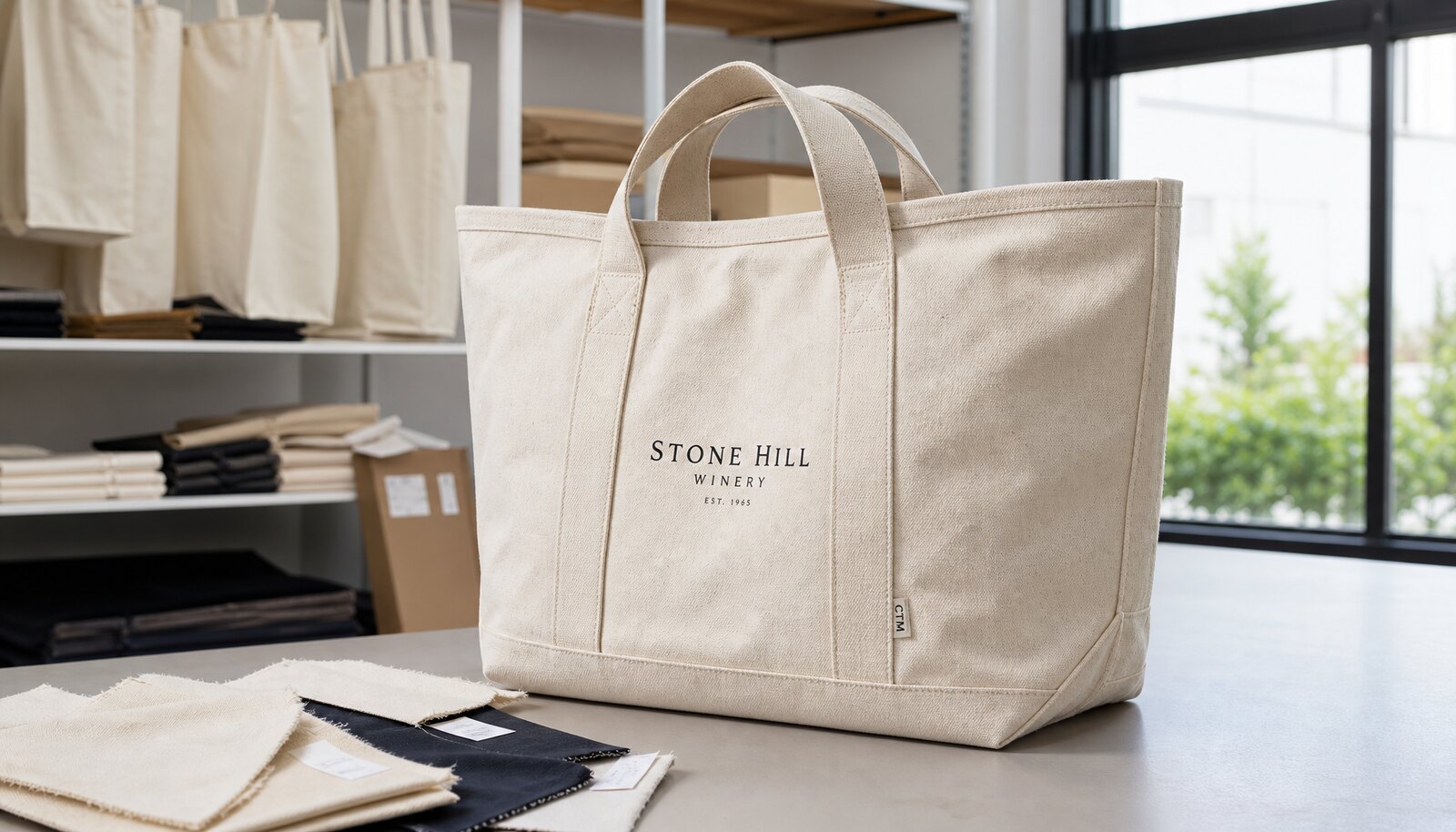
What wineries are really buying
Large canvas grocery bags for wineries are usually doing three jobs at once: retail packaging, brand carryout, and a reusable shopping bag that keeps moving after the tasting-room visit. That is why the buying problem is not simply finding a tote with a logo. The better question is whether the bag survives repeat grocery use, presents the brand cleanly on shelf, and still lands at a cost that works in a seasonal merchandising program.
For procurement, the comparison should start with use case, not with a supplier's standard bag list. A bag used for a two-bottle purchase needs different handle strength, seam reinforcement, and fabric density than a giveaway tote. If the spec is too light, the first complaint will be about failure in use. If it is overbuilt, the freight and carton cost rise without adding much buyer value.
- Define whether the bag is for wine bottles, mixed grocery items, or gift retail before requesting quotes.
- Treat the tote as part of the winery's packaging system, not as a standalone promo item.
- Use one comparison spec across suppliers so price differences reflect real production choices.
Start with a usable spec, not a generic tote
For most winery programs, a large canvas grocery bag sits in the range of 38 to 45 cm wide, 40 to 45 cm high, with a gusset of 12 to 18 cm. That gives enough volume for groceries, tasting-room purchases, and a bottle or two without turning the bag into a floppy oversized carryall. Fabric weight is the next decision. Ten oz canvas can work for light retail use, but 12 oz, roughly 400 to 420 gsm, is the safest default if the bag will actually be used for shopping. Fourteen oz is better when the bag will carry heavier loads, but the extra weight should be justified by the use case.
Handle geometry matters as much as fabric weight. A handle drop around 26 to 30 cm usually works for shoulder carry, while a shorter drop is better for hand carry and a more compact silhouette. Ask for wide self-fabric handles, not narrow tape, unless the design clearly calls for it. Reinforce the handle ends with bar-tacks or an X-box stitch, and make the bottom seam a deliberate decision rather than an afterthought. The goal is a bag that feels stable when full, folds cleanly when empty, and does not need unnecessary structure that raises cost.
- Use 12 oz canvas as a fair benchmark when comparing winery quotes.
- Ask for finished measurements and reinforcement details, not only nominal dimensions.
- Match handle length to how the bag will be carried in a retail setting.
Material choices and what sustainability really means
The sustainable packaging comparison usually comes down to natural cotton, recycled cotton, or a blend. Natural unbleached cotton gives the most stable appearance and usually the cleanest print result. Recycled cotton can strengthen the sustainability story, but buyers need to accept more variation in shade, slub, and surface texture. Organic cotton can support premium positioning, though it usually carries a price premium and needs tighter source control. The right answer is not universal; it depends on how the winery positions the bag and what type of merchandising margin exists.
Sustainability should not be reduced to a single fiber claim. The buyer should also look at dye method, cutting waste, packing format, and carton efficiency. A recycled-content bag that ships in oversized cartons and requires heavy retail packaging may lose part of its environmental advantage. For that reason, the RFQ should request the exact fiber composition, whether the canvas is dyed or natural, whether any polyester content exists in the handles or labels, and whether the supplier can show how waste is managed at cutting and packing.
- Use natural canvas when print consistency and quote stability are higher priorities than fiber storytelling.
- Use recycled cotton only when the supplier can show stable color, repeatable GSM, and consistent stitching performance.
- Avoid vague sustainability language in the RFQ; ask for the actual material build.
Print methods that survive real retail use
For winery grocery bags, the most practical branding options are one-color screen print, water-based or low-VOC ink systems depending the supplier's setup, and a woven side label or patch when the brand wants a more premium finish. Screen print remains the best value for simple logos, strong edge definition, and repeat production. A woven label or sewn patch can look more refined on natural canvas and may age better than a large print field if the bag is handled frequently.
Heat transfer can be acceptable for short-run promotions or designs with many colors, but it is usually not the first choice for a reusable grocery bag. It can crack, crease, or sit too much on top of the fabric instead of becoming part of it. If the design includes fine text, thin lines, or small registration marks, the buyer should request a strike-off on the actual fabric, not a digital proof. On textured canvas, a logo that looks clean on screen can fill in or lose edge definition after printing.
- For simple winery logos, compare screen print against a woven side label before choosing the cheapest method.
- If the design has small text, require a strike-off on the actual fabric weight being ordered.
- Ask how the supplier tests rub resistance and whether the print needs a curing step before packing.
Compare sourcing routes before you compare unit price
The quote itself is less useful than the sourcing route behind it. A direct factory quote usually gives the best control over fabric weight, handle reinforcement, and packing detail, which matters when the bag will be reordered. A trading company can still be useful if the winery needs mixed product categories or one shipment that combines bags with other packaging items, but the buyer should expect less transparency on material sourcing and less direct control over corrective action. A domestic decorator may win on speed and low MOQ, yet the unit cost often rises once you compare the same fabric weight and same print method.
The practical test is whether the supplier can show evidence, not just a price. Ask for a fabric swatch or mill spec, a photo of a sewn sample, a print strike-off, carton markings, and a recent inspection record if one exists. If the supplier cannot tell you the finished GSM, cannot explain handle reinforcement, or only quotes from a brochure image, then the bid is not ready for a fair comparison. The first goal is quote alignment. Only after that should price become the deciding factor.
- Use direct factory sourcing for repeat volume and tighter control of the production spec.
- Use a trading company only when consolidation, mixed SKUs, or coordination matters more than transparency.
- Do not compare bids until every supplier is quoting the same size, fabric weight, print method, and packing format.
MOQ, samples, and lead time are tied together
MOQ is driven by more than the number of bags on the PO. Fabric color, print colors, handle type, and packing format all affect how a factory sets its minimum. A bag in natural canvas with one simple print color can often start at a lower MOQ than a custom-dyed body with multiple print colors and retail sleeves. Sample cost should also be discussed early. Some factories will credit the sample against bulk, but only if that is written into the quote. If the buyer assumes it later, the real comparison becomes misleading.
Lead time should be read as a chain, not a single number. A realistic schedule usually includes sample development, pre-production approval, fabric reservation, cutting, sewing, printing, packing, and export handling. If the factory quotes a very short production window, there may already be stock fabric available, or they may be skipping time for approvals and rework. For a custom winery order, the buyer should expect enough time for a sample round, especially if the bag must match a brand color, specific print finish, or custom packing requirement.
- Ask whether MOQ changes between blank bags, printed bags, and bags with special packing.
- Separate sample lead time from bulk lead time so the schedule is not overstated.
- If the quote sounds unusually fast, ask what step has been removed from the process.
Packing and carton planning can move the landed cost
Packing is one of the easiest places to lose money without noticing it. Bulk packed canvas bags usually give the best landed cost for wineries that receive stock into a warehouse or distribute through multiple retail points. If the bag is being sold as a finished retail item, then a recycled paper sleeve, barcode label, or individual polybag may be justified. The point is that the packing format should follow the channel, not the factory's default habit.
Carton planning matters because canvas bags are bulky before they are heavy. A small change in folding method or bundle count can alter carton dimensions enough to change freight charges. For export shipments, keep carton weights within a practical manual-handling range and make the carton marks easy to read for receiving teams. Ask for the estimated carton size, gross weight, bundle count, and total CBM in the quote. A cheap unit price can become a costly shipment if the cartons are oversized or badly packed.
- Use bulk packing for wholesale and warehouse replenishment unless retail presentation requires more.
- Keep carton weights and dimensions visible in the quote so freight can be compared properly.
- Ask for clean carton marks and SKU labeling if the bags will move through more than one distribution point.
Set measurable QC thresholds before the first bulk run
A winery tote should be approved against measurable thresholds, not only by visual impression. The approved sample should lock the finished size, handle drop, reinforcement method, print position, and fabric shade. If the bag is intended to carry bottles or heavier groceries, the buyer should define a practical load test and ask the factory to run it on the same construction that will be shipped. The goal is not laboratory perfection. It is to make sure the bag performs the way the buyer expects when it lands at retail.
The most common defects are predictable: twisted handles, off-center prints, exposed raw edges, inconsistent gussets, loose stitching at the handle base, and shade drift between cartons. Because of that, the factory should keep a golden sample and use it as the reference during bulk production. A pre-production sample is usually enough to catch the main issues, but top-of-bulk inspection is still worth requiring for larger orders or for the first order with a new supplier.
- Lock the golden sample before bulk cutting starts.
- Use a load test that matches the bag's real use, such as bottle carry or mixed grocery loading.
- Insist on carton-level inspection for color consistency, print placement, and count accuracy.
How to compare landed cost without getting misled
A useful comparison starts with the same commercial basis. If one supplier quotes ex-works, another quotes FOB, and a third includes inland freight, the prices are not actually comparable. The same problem happens when one quote uses 10 oz canvas and another uses 12 oz canvas, or when one includes a woven label and the other does not. For grocery bags, the true landed cost is the sum of fabric, cut and sew, print, packing, inspection, inland handling, freight, duty, and any rework risk the buyer is likely to absorb later.
The easiest way to avoid bad comparisons is to ask every supplier for the same spec sheet and the same packing assumptions. Then build a simple quote matrix that separates unit price from carton cost and shipping cost. If a quote is lower because the fabric is lighter, the buyer should mark that as a spec change, not a savings. If a quote is higher because it includes a pre-production sample, better packing, or a documented inspection step, that may be the more economical option once defects and reorders are considered.
- Use one RFQ spec and one Incoterm across every supplier.
- Treat packaging, inspection, and freight as part of the landed cost, not optional extras.
- Mark any material downgrade or packing change as a specification difference, not a true price advantage.
Specification comparison for buyers
| Spec decision | Recommended option | When it fits | Buyer risk to check |
|---|---|---|---|
| Fabric weight | 12 oz canvas at roughly 400 to 420 gsm as the default comparison point | Retail grocery use, tasting-room sales, and repeat carrying of bottles or mixed goods | Verify finished GSM after washing and finishing, not just mill fabric weight |
| Material route | Unbleached natural cotton or verified recycled cotton, depending brand story | Natural look for everyday retail, recycled content for sustainability messaging | Recycled fiber can create shade variation and weaker print sharpness |
| Handle construction | Wide self-fabric handles with bar-tack or X-box reinforcement | Bags expected to carry heavier grocery loads or two-bottle purchases | Check stitch count, handle attachment width, and pull-test results |
| Print method | One-color screen print or woven side label for a clean brand mark | Simple winery logos, seasonal programs, and medium-to-large runs | Heat transfer can crack, and fine text can fill in on textured canvas |
| Bag structure | Open-top bag with a wide gusset and reinforced bottom seam | General grocery use, tasting-room retail, and easier folding for storage | A weak gusset or bottom seam can fail before the fabric does |
| Supplier route | Direct factory for repeat bulk, trading company only for consolidated sourcing | Teams comparing long-term cost and production control | Hidden margins and weaker defect control can distort the quote |
| Packing method | Bulk packed in tied bundles or flat-packed with carton dividers | Wholesale distribution and warehouse receiving | Individual retail packing adds cost and carton volume if not needed |
| Approval path | Pre-production sample with print, seam, and load checks | First orders, new suppliers, or any spec change | Photo approval alone misses shade, size, and print-registration issues |
Buyer checklist before sampling
- State the finished bag size, including body width, height, and gusset, not just nominal size
- Define fabric weight in oz and gsm, plus whether the canvas is natural, recycled, or blended
- Specify handle length, handle width, and the reinforcement method at each stress point
- Name the print method, number of print colors, Pantone target, and whether a strike-off is required
- Describe the intended load, such as retail groceries, two-bottle carry, or mixed merchandise
- Confirm the packaging format, carton count, master carton size, and any retail sleeve requirement
- Ask for sample cost, sample lead time, bulk lead time, and whether sample cost is credited
- Request the same Incoterm for every quote so freight and inland charges are comparable
- Set a QC standard for dimensions, stitching, print placement, and carton counts before production starts
Factory quote questions to send
- What is the finished GSM after cutting, sewing, and any washing or finishing process?
- Is the quoted price based on the exact finished size, gusset depth, handle length, and reinforcement spec?
- Which print method is included, how many colors are priced, and is a strike-off included before bulk?
- What MOQ applies for blank bags, printed bags, and bags with custom packing?
- What sample types can you provide, what is the sample cost, and how long does sampling take?
- What packing method is included, and what are the carton dimensions, gross weight, and bundle count?
- What inspection standard or in-line QC step do you use before shipment?
- Which Incoterm is the quote based on, and what are the excluded costs such as inland freight, duty, or carton labels?
Quality-control points to confirm
- Measure body size, gusset, and handle drop against the approved sample, with a clear tolerance band
- Confirm the actual fabric weight and weave density against the quoted spec, not a visual estimate
- Inspect seam quality, handle attachment, and reinforcement stitching for skipped stitches or loose ends
- Check print position, color consistency, edge sharpness, and rub resistance on the finished canvas
- Verify that the bag stands and folds as intended, especially if the gusset is meant to support bottle loads
- Run a practical load test that matches winery use, including lift cycles and static weight hold
- Inspect for odor, stains, fiber contamination, and shade mismatch across cartons
- Audit carton marks, bundle count, and packing consistency so receiving teams can match the PO quickly