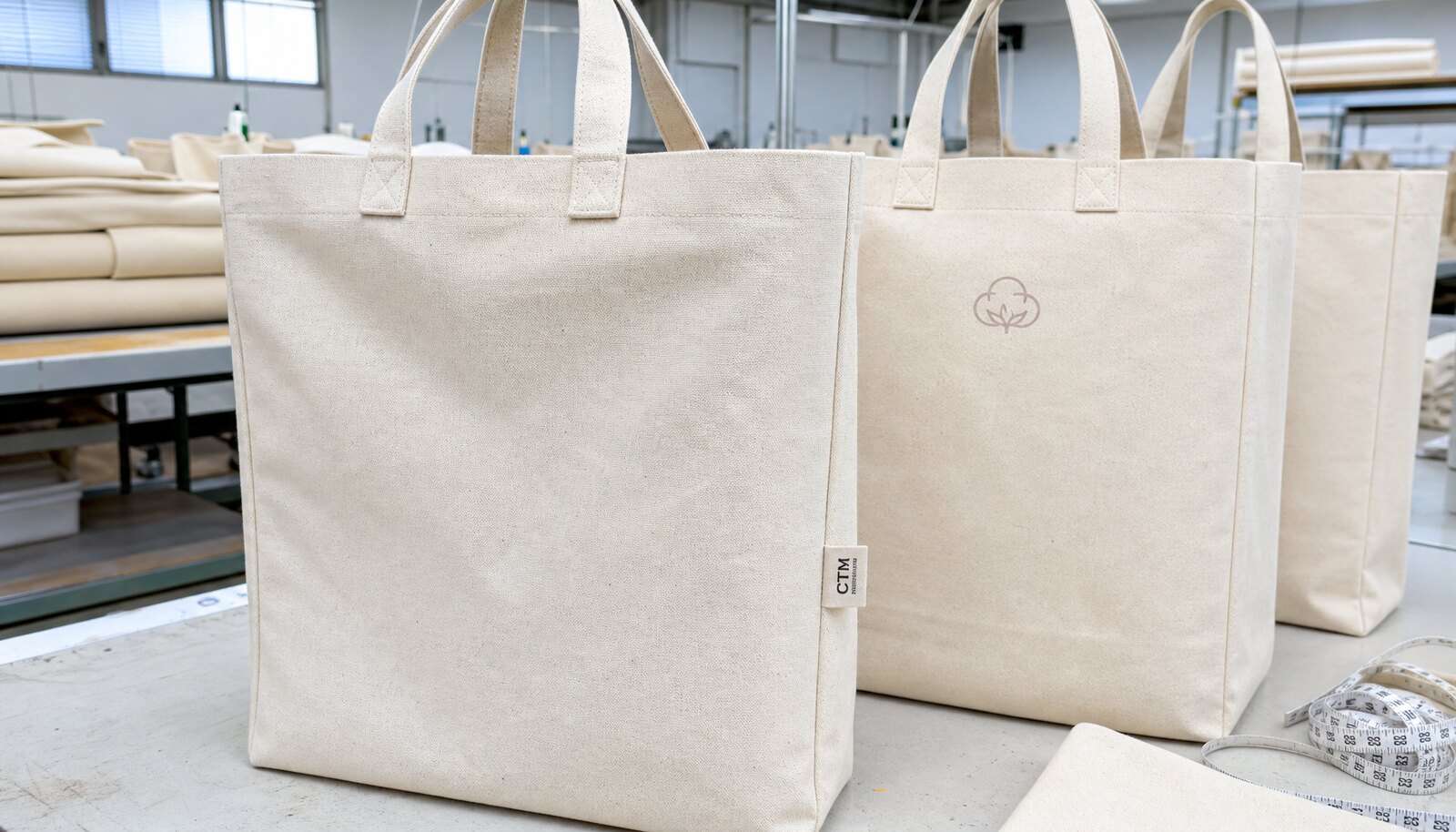
1. Start with the channel, not the bag
Large canvas grocery bags for wellness brands usually fail when the buyer starts with artwork instead of channel needs. A bag that works for a yoga studio retail shelf is not the same spec as a grocery loyalty gift, subscription add-on, or private label checkout item. The use case decides whether the buyer should prioritize structure, print clarity, washing tolerance, or packing efficiency.
For procurement, the first sourcing decision is how the bag will be handled after it lands. If the bag is meant for retail resale, the finish, fold, and label placement have to look clean from six feet away. If it is a promotional grocery carrier, the bag can be simpler, but the handle construction and seam strength matter more than decorative features.
- Retail shelf item: better print face, neat fold, barcode-ready packing.
- Promotional grocery carrier: stronger handles and lower cost per unit.
- Subscription or bundle insert: tighter folded size and carton efficiency.
- Wellness brand gift item: premium hand feel and clean natural canvas color.
2. Choose fabric weight for real carrying load
For this category, the useful range is usually 12 oz to 14 oz canvas, which is roughly 340 to 475 GSM depending on the mill and weave. That range gives enough body for groceries, jars, powders, and bottle-shaped items without becoming unnecessarily rigid or expensive to ship. If you are comparing supplier quotes, make sure the fabric description is not just “heavy canvas.” Ask for oz, GSM, weave density, and shrinkage allowance.
A lighter 10 oz canvas can work for soft goods or retail giveaways, but it often loses shape after repeated carrying and may show seam stress faster. A very heavy 16 oz canvas can feel premium, yet it increases cutting difficulty, sewing time, and carton weight. For private label grocery bags, a middle-heavy canvas usually gives the best balance of cost, appearance, and practical performance.
- 12 oz / 340-380 GSM: good starting point for price-sensitive launch programs.
- 13 oz / 390-430 GSM: common premium sweet spot for wellness retail brands.
- 14 oz / 450-475 GSM: better structure, heavier freight, more sewing effort.
- Pre-shrunk or washed canvas helps reduce dimensional drift after first use.
3. Build the bag around the load path
The biggest production mistake in grocery-style canvas bags is under-specifying the top edge and handle attachment. Customers naturally lift the bag by the handle, then load the corners and bottom with uneven weight. That means the stress path runs from handle stitch to upper side seam to bottom panel. If any of those points are weak, the bag can look fine on arrival and still fail in use.
For wellness brands, a clean look is important, but reinforcement should not be hidden in vague language. Use actual construction terms in the RFQ. State whether you want self-fabric handles, webbing handles, cross-box stitching, X-box stitching, or bar-tack reinforcement. If the bag must carry glass jars or heavier pantry goods, that detail matters more than a slightly lower print price.
- Handle length should match actual carry method: hand carry, shoulder carry, or cross-body style.
- A reinforced top hem prevents the opening from collapsing after repeated loading.
- Bottom seam construction should be specified if the bag will carry dense items.
- If the bag stands upright in retail display, ask for gusset stability and panel alignment.
4. Print method should match artwork, not the other way around
Most wellness brands use simple logos, short taglines, or one-color marks, which makes screen printing the default choice. It is reliable, durable, and easier to repeat across bulk runs. Water-based print usually gives a softer hand and better retail feel on natural canvas, while plastisol can offer stronger opacity on darker canvas or dyed fabric. The right answer depends on the base cloth and how crisp the logo needs to look.
If the brand artwork includes gradients, thin type, or more than two colors, the quote should not be compared on price alone. Digital print may help with complex art, but it can raise unit cost and change the texture of the bag face. Embroidery can work for side labels or small marks, yet it is rarely the best method for a large grocery bag front panel because it adds stiffness and cost. Ask for strike-off or sample print approval before bulk, especially if Pantone matching matters.
- 1-color screen print: best for repeat orders and clean private label branding.
- 2-color screen print: workable for many wellness logos if registration is controlled.
- Water-based print: softer feel, often preferred for premium natural canvas.
- Pantone match should be treated as a target, not assumed by default.
5. Read MOQ as a production plan, not a sales promise
MOQ on canvas bags is usually driven by fabric dye lot, print setup, and sewing line efficiency. A supplier may quote a low number because the bag is simple, but the real cost begins when you change color, print location, or label format. For private label sourcing, it is better to know where the factory’s breakpoints are than to chase the lowest headline MOQ.
A practical MOQ for large canvas grocery bags often sits around 500 to 3,000 pieces per style or color, depending on complexity. Lower quantities are possible, but the buyer usually gives up one of three things: customization flexibility, unit price, or delivery stability. If the launch is a test, a lower MOQ may be worth it. If the program is planned for repeat purchase, it is usually smarter to buy enough to amortize setup and freight.
- One artwork, one color canvas, one print location gives the easiest MOQ.
- Multiple colors or mixed sizes usually raise setup and packing labor.
- Low MOQ can be useful for a pilot, but it should not hide limited QC control.
- Ask whether MOQ changes if the order includes matching pouches or totes.
6. Compare supplier routes by control, not just by unit price
When sourcing large canvas grocery bags for wellness brands, the supplier route matters as much as the spec. A direct factory quote usually gives the best control over fabric, stitching, print, and packing, because the same team handles the order from cutting to carton loading. A trader or sourcing agent can be useful if you need mixed products or help managing many SKUs, but the quote can hide where the actual production happens.
Procurement teams should compare routes based on traceability and corrective action. If a sample has a crooked print, can the supplier identify whether the issue came from screen tension, platen alignment, or fabric slippage? If bulk has a carton packing mismatch, can they fix it before shipment? The cheaper quote is not the better quote if the supplier cannot explain where quality drift enters the process.
- Direct factory: best for repeat orders and clear accountability.
- Trading company: useful for complex programs, but validate factory identity and QC ownership.
- Local converter: shorter communication loop, but often limited on MOQ and fabric choice.
- Mixed sourcing route: can work for urgent buys, but risk of spec inconsistency is higher.
7. Use a quote breakdown that exposes hidden cost drivers
A proper quote for this product should separate fabric, cutting, sewing, print setup, packing, and cartonization. If the factory gives only one unit price, the buyer cannot see whether a cheaper quote is relying on a thinner canvas, looser sewing, or simplified packing. That is how landed cost errors begin. The quote should also name whether the price is ex-works, FOB, or includes inland delivery to port.
For comparison, request the same assumptions from every supplier: same finished size, same GSM, same print count, same handle construction, and same packing method. Even a small change in carton quantity can shift freight and warehouse intake cost. If one factory says its price is lower because it packs 100 pieces per carton and another packs 50, the comparison is not meaningful until the carton math is normalized.
- Unit price alone is not a sourcing decision.
- Carton count changes warehouse handling and ocean freight exposure.
- Print setup and color change charges should be listed separately.
- Freight should be modeled on actual carton size, not estimated bag count.
8. Sample approval needs a written pass/fail standard
The sample stage is where most bag orders are won or lost. A sample that looks close to the photo is not enough; the buyer needs a signed reference that defines acceptable size, color, print density, and handle strength. For large canvas grocery bags, the sample should also confirm that the bag can open flat, hold shape after folding, and carry the expected load without stitch distortion.
A good approval process uses one pre-production sample and, if the order is important, one top-of-bulk sample. The pre-production sample verifies materials and construction. The top-of-bulk sample verifies that the factory maintained the same look after the line started running. If the supplier changes canvas supplier, print ink, or label type after approval, that change should be treated as a formal revision, not a casual substitution.
- Measure finished size at multiple points, not only one edge.
- Inspect print edge clarity and any visible ink strike-through.
- Check handle symmetry and stitch backing on the inside seam.
- Verify that the folded sample matches the packing spec.
9. Packing and carton planning affect both damage rate and margin
Packing is part of the product, not a warehouse afterthought. Canvas bags can pick up lint, crease marks, and print scuffing if they are packed loosely. For wellness retail programs, a simple fold with inner polybag and barcode sticker is often enough. For private label wholesale, bulk packing may be better if the buyer wants faster warehouse intake and lower unit labor cost.
The carton plan should match the route to market. If the bags are going direct to a retail DC, carton dimensions should be optimized for pallet fit and carrier dimensional weight. If they are sold in stores, the buyer may want a cleaner retail fold and a hangtag or side label spec. The same bag can become expensive simply because the packing method was not decided early enough.
- Define fold direction so the print lands on the visible face after unpacking.
- Use carton labels that show style, color, quantity, and PO number clearly.
- Keep carton weights manageable for manual handling and warehouse receiving.
- If polybags are used, specify thickness and whether suffocation warnings are required.
10. Lock the schedule around the slowest step, not the sewing line
Production lead time for large canvas grocery bags is usually not limited by sewing. It is often limited by fabric reservation, print plate approval, sample signoff, and carton material availability. A realistic plan might be 7 to 15 days for samples, 25 to 45 days for bulk after approval, and then transit time based on mode and destination. Buyers who wait to finalize artwork or packing until after sample approval usually lose the fastest part of the schedule.
Schedule risk rises when the order mixes new fabric, multiple colors, or retail-ready packaging. If the product is launching into a wellness promotion or seasonal retail window, build a buffer for one round of sample revisions and one round of pre-shipment inspection correction. The cheapest quote is not useful if the bags arrive after the sell-through period.
- Reserve fabric early if you need a specific natural shade or dyed canvas.
- Approve art and packaging before sample making begins.
- Set a hard date for bulk release after sample approval.
- Keep a second freight option ready if the retail date is fixed.
Specification comparison for buyers
| Supplier option | What to verify | Commercial advantage | Buyer risk to control |
|---|---|---|---|
| Direct sewing factory | fabric swatch, approved sample, seam close-ups, logo test photos, packing pilot, and final inspection evidence | Better sample-to-bulk control and faster production feedback | May be weaker on export paperwork or branded packing unless checked early |
| Trading company | Factory name, production photos, trim-source proof, and who owns QC decisions | Can coordinate small mixed orders and extra services | Markup can hide real factory capability and slow defect decisions |
| Specialized bag workshop | bag size, gusset, handle drop, seam allowance, stitch density, reinforcement patch, and loading expectation | More practical for detailed construction, trims, and repeat programs | Capacity may be limited during peak seasons |
| Low-price general supplier | 8-12 oz cotton canvas, 120-220 gsm cotton, recycled cotton, or blended fabric selected by use case and target price | Useful for simple promotional runs with loose specs | Material downgrades, weak packing, and vague inspection scope can erase savings |
| Retail-ready supplier | fold method, inner bundle, carton count, carton mark, moisture protection, SKU separation, and warehouse receiving needs | Can handle labels, SKU separation, carton marks, and receiving rules | Higher unit cost must be compared against reduced warehouse work |
| Compliance-focused supplier | Fabric records, labeling review, test plan, and production traceability | Safer for retail programs and repeat brand orders | Documentation claims need evidence, not only sales language |
| Local sample room plus bulk factory | Signed sample, bulk factory handoff, first-piece photos, and deviation owner | Good for complex branding before large production | Sample room quality may not match bulk line unless handoff is controlled |
Buyer checklist before sampling
- Define the bag use case: weekly grocery carry, produce bundle, subscription box insert, wellness event retail item, or front-of-store impulse product.
- Lock the fabric target in GSM or oz and state whether natural, bleached, dyed, or pre-shrunk canvas is acceptable.
- Specify finished size, handle drop, gusset depth, stitch type, and whether the bag must stand upright when empty.
- Provide logo artwork in vector format and state the maximum print area, number of colors, and any Pantone targets.
- Set packing requirements: folded method, polybag yes/no, barcode label, carton quantity, and carton test weight target.
- Request one pre-production sample and one top-of-bulk reference sample signed off against the same spec sheet.
- Collect quote breakdowns for fabric, print, sewing, packing, and freight assumptions rather than accepting one lump sum.
- Confirm lead time by stage: sample, material reservation, bulk production, QC, and shipment booking.
Factory quote questions to send
- What fabric weight, weave count, and shrinkage allowance are you quoting, and is the canvas pre-shrunk or not?
- Is the print a direct screen print, heat transfer, digital print, or woven label application, and what is the setup charge per color?
- What is your MOQ by color and by artwork change, and how does MOQ change if we use only one side print?
- Can you provide measurements for finished size, handle length, handle drop, and seam allowance tolerance?
- What carton size, carton quantity, and master carton gross weight are included in the quote?
- What samples are included before bulk, and will the bulk follow the approved sample exactly?
- What are your inspection standards for stitch count, print alignment, and fabric defects, and can you share AQL or equivalent internal criteria?
- What is the production schedule from art approval to ex-factory date, and what delays most often affect it?
Quality-control points to confirm
- Fabric GSM or oz matches the approved spec within the agreed tolerance and no weak spots appear near the fold or handle seam.
- Handle reinforcement is symmetrical, stitch density is even, and no loose threads remain at stress points.
- Print registration stays within the approved tolerance and color density is consistent across front and back panels.
- Finished dimensions are within tolerance for length, height, and gusset so the bag packs and shelves correctly.
- Seams are straight with no skipped stitches, puckering, or exposed raw edges at the top hem and side gusset.
- Packing count matches the carton label and inner polybag or insert format, with no mixed lots.
- Sample-to-bulk match is verified for canvas color, print shade, and label placement before shipment release.