Start With the Event Job, Not the Bag
For wellness brands, a large canvas grocery bag is rarely just a giveaway. It may need to hold sample bottles, brochures, supplements, retail purchases, or a mixed media kit while still looking clean enough to represent the brand in public. That means the buying decision starts with the job the bag must do, not the artwork or the unit price. A bag that works for a stack of flyers can fail completely once glass bottles, jars, or boxed products are added to the load.
The most useful RFQ question is not how cheap the bag can be. It is what size, weight, and construction will survive the exact items handed out at the event. If the team only needs a light literature carrier, the spec can stay simpler. If the bag is part of a premium wellness kit, the structure needs to support heavier content without losing shape, ripping at the handles, or looking soft and underspecified on the table.
- Literature-only: light load, flat pack, lower fabric weight
- Mixed sample kit: medium load, gusseted body, stronger handles
- Retail-style carryout: higher load, reinforced seams, heavier canvas
Choose a Spec That Survives Real Use
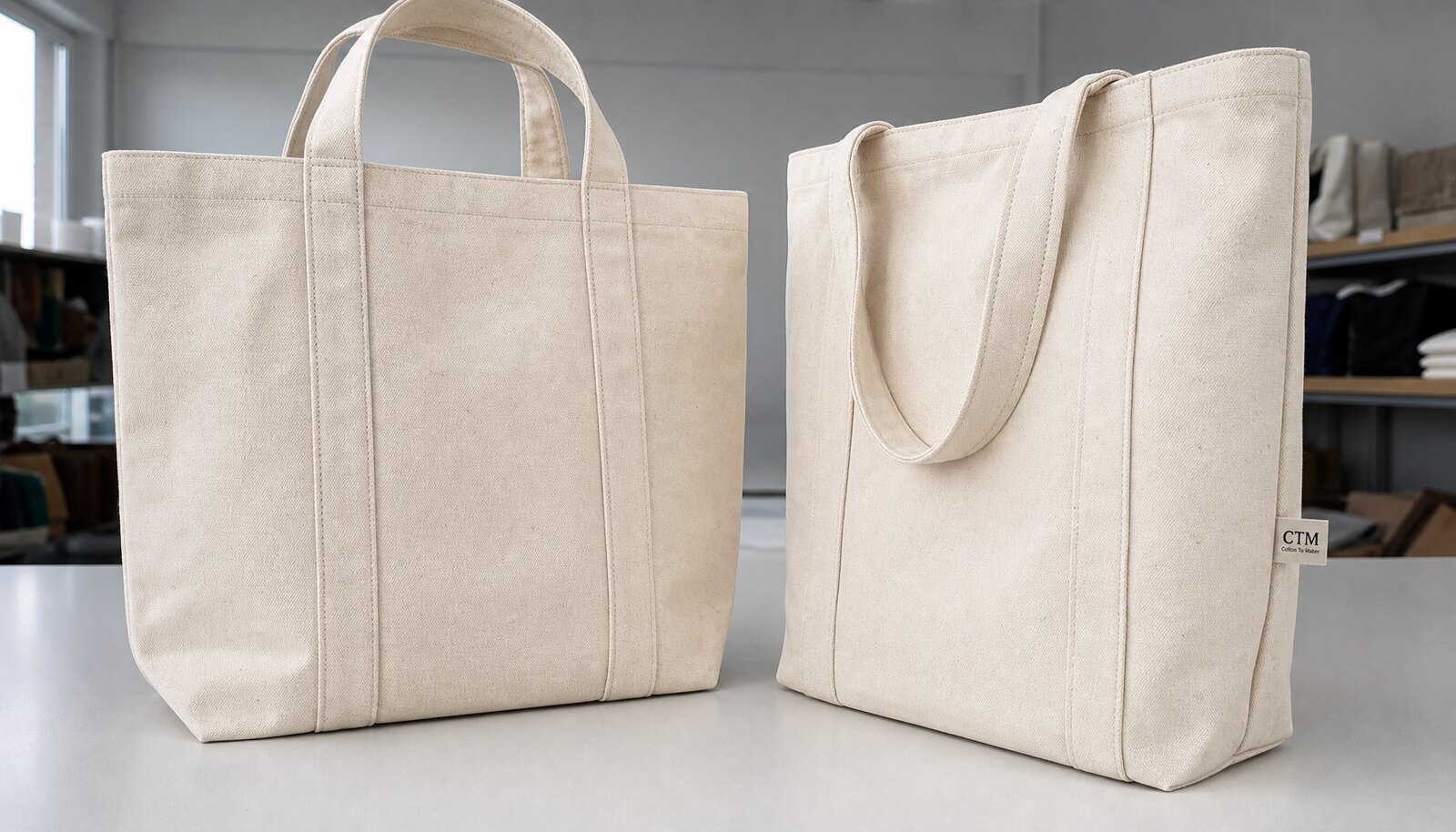
A practical starting spec for a large canvas grocery bag is around 15 x 16 x 4 in or 38 x 41 x 10 cm, with handles long enough for shoulder carry if the event audience is moving through a venue. For most wellness-brand events, 10 oz canvas, roughly 340 GSM, is the best balance between cost and perceived quality. It gives the bag enough body to stand up at a booth, folds flat for shipping, and still feels substantial when handed to a buyer or attendee.
If the bag is expected to carry heavier products, move to 12 oz or about 410 GSM and reinforce the bottom seam. The weak point is usually not the panel itself but the load points around the handles and the seam allowance. Ask the factory for the handle width, handle drop, stitch density, and whether the bottom is single-stitched or double-stitched. If your event includes glass or metal packaging, a wider gusset and stronger handle attachment are not optional.
- 8 oz or about 280 GSM: light literature and low-budget handouts
- 10 oz or about 340 GSM: default choice for most event giveaways
- 12 oz or about 410 GSM: better for heavier kits and premium positioning
- 16 oz or about 545 GSM: only when the bag needs a very firm retail feel
Compare Sourcing Routes Before You Request Prices
The sourcing route changes the quote more than many buyers expect. A direct factory usually gives the best control over fabric, stitching, and print setup, but only if the spec is tight and the approval process is disciplined. A trading company or sourcing agent can simplify communication and combine multiple suppliers, but the added margin is often hidden inside the quote. A domestic printer using imported blanks can be useful when speed matters more than unit cost, especially if the event date is fixed and the bag body can stay standard.
To compare routes cleanly, hold everything constant. Use the same dimensions, the same GSM, the same print area, the same handle length, the same packing method, and the same incoterm. If one supplier quotes a lighter fabric or leaves out polybagging, that is not a real saving. The quote should make it obvious what is included and what will be charged later. Otherwise procurement ends up comparing different products, not different sources.
- Use one spec sheet across all suppliers.
- Use one artwork file and one packing standard.
- Ask for the same incoterm on every quote.
- Require exclusions to be listed line by line.
Print Method and Brand Finish
For a wellness brand, the print should look intentional rather than promotional clutter. One or two spot colors usually age better on canvas than complex gradients, and they simplify setup. Screen printing is still the default for large canvas grocery bags because it is economical at volume and gives solid coverage on natural fabric. Water-based and plastisol systems both work; what matters is whether the ink cures cleanly and sits well on the weave. If the logo is fine-lined or multi-color, a heat transfer or digital transfer may be safer for a short run, but the unit cost rises and abrasion resistance can fall.
Embroidery and woven labels can make sense when the bag is part of a premium retail campaign, but both add time and can cause puckering on softer canvas. Keep the art file in vector format, define the color target clearly, and state logo placement in millimeters from the top edge and side seam. Many failed approvals are placement problems rather than print problems. A strike-off on the actual bag fabric is the cheapest way to catch that before bulk production starts.
- Keep the logo away from seams, stitch rows, and the gusset fold.
- Limit fine lines, tiny reversed text, and thin border rules.
- Approve the strike-off on the actual bag color, not only on a digital mockup.
- Use a backup artwork layout if the brand mark must fit multiple sizes.
MOQ, Samples, and Approval Gates
MOQ logic is mostly about setup time, not factory mood. If the factory is cutting from stock canvas and printing one or two colors, a 500 to 1,000 piece MOQ is common for custom work. If the order needs custom-dyed fabric, special trims, multiple print hits, or mixed decoration methods, the MOQ rises because changeover cost is real. Ask whether the MOQ is per color, per design, or per order. Those are different numbers, and they affect the final quote more than many buyers expect.
Sample flow should have three gates: material confirmation, pre-production sample, and final golden sample. The material swatch tells you the hand feel and color. The pre-production sample tells you whether the real bag dimensions, seams, and logo placement work. The golden sample becomes the reference for bulk inspection. If the event date is fixed, build the approval calendar backward from that date and freeze the artwork before the sample enters production. Late changes usually cost more in rework than the first sample did in the first place.
- Ask whether the sample charge will be credited against the bulk order.
- Freeze one signed sample for each colorway or decoration method.
- Record all tolerances on the approval sheet before production starts.
- Reject any sample that changes GSM, handle length, or logo size without notice.
Packing, Cartons, and Giveaway Readiness
Packing affects both freight cost and the moment the bag reaches the event team. For large canvas grocery bags for wellness brands event giveaway planning, the default is flat-folded bulk packing in master cartons. That keeps carton volume down and protects the budget on ocean or air freight. If the bags are going into VIP kits, direct mail, or a premium retail box, individual polybags or belly bands may be necessary, but that should be a deliberate choice because it adds labor and material cost.
Carton count should match how the bags will be distributed on arrival. If one sales team needs 50 bags per location, a carton pack of 50 or 100 can reduce repacking time. If the bags go to a fulfillment center, standardize the outer carton label, SKU code, and color description so receiving does not become a manual counting exercise. Moisture protection matters on canvas because a damp carton can leave a smell or spotting that reads as poor quality, even when the sewing is acceptable.
- Keep carton weight manageable for warehouse handling.
- Specify outer carton dimensions before freight is booked.
- Use clear carton marks for SKU, quantity, color, and PO.
- Add desiccant only when the shipping route justifies it.
Lead Time and Schedule Risk
Simple printed canvas bags can move faster than buyers expect, but only if the artwork and sample stages are tight. A realistic timeline for a stock-fabric, one-color program is often 5 to 10 days for sampling, 20 to 35 days for bulk after sample approval, and then shipping on top. Add more time when the plan includes embroidery, custom fabric, metal fittings, multiple print passes, or a large color split. The schedule risk is usually not the sewing itself. It is the back-and-forth on art changes, approvals, and packing decisions.
Work backward from the event date and leave room for freight, customs, and a second round of samples if the first strike-off misses the mark. For a fixed launch or wellness roadshow, I would rather lock a simpler spec early than chase a premium finish that forces air freight later. If the calendar is tight, ask the factory which steps can run in parallel: fabric reservation, plate making, carton design, and label approval. Done properly, parallel work can save a week without weakening the bag.
- Freeze the order quantity before bulk production starts.
- Keep a 10 to 15 percent schedule buffer for approvals and freight.
- Reserve freight space as soon as the PO is issued.
- Hold an urgent reprint contingency for damaged cartons or late logo changes.
Build a Quote You Can Compare
The quote should let procurement compare apples to apples. Ask for a line-item price for the blank bag, decoration, packing, cartonization, and export handling, then add freight and duty separately to calculate landed cost. A low ex-works price can hide a thinner fabric, a smaller handle, or a print method that looks fine on paper but fails in inspection. The only number that matters for event planning is the delivered cost per usable bag.
A useful way to expose weak quotes is to request three variants on the same sheet: base spec, improved construction, and premium finish. If the factory can price 8 oz, 10 oz, and 12 oz canvas with the same artwork and packing method, you can see the price curve clearly. That helps the buyer decide where the real break point is. In many cases, the jump from 10 oz to 12 oz is small enough to justify the heavier bag, especially if the event kit includes glass or multiple products.
- Ask for unit price at 1,000, 3,000, and 5,000 pcs.
- Separate one-time setup charges from recurring unit costs.
- Keep the incoterm identical across all suppliers.
- Request the carton pack ratio used in each quote.
- Compare the sample-to-bulk delta, not only the sample price.
QC Thresholds That Matter on Canvas Bags
Quality control on canvas giveaway bags is mostly about repeatability. The bag does not need luxury-level finishing to be acceptable, but it does need to look like one batch instead of five different jobs stitched together. The common problems are off-center prints, uneven handle lengths, weak bar-tacks, over-trimmed seams, and fabric shade drift between lots. For public events, even minor defects are visible because the bags are carried in crowds and photographed.
Set acceptance criteria before production starts. For a standard large canvas grocery bag, define dimensional tolerance, a print registration window, seam strength expectations, and carton accuracy in writing. Use the same approval logic for every supplier so the buyer is not relying on feel. If the product will be carried with heavier samples, add a simple load test and a seam-pull check. It is faster to reject a weak run in the factory than to replace failed giveaways after the event.
- Dimensions should stay within plus or minus 1 cm of the approved spec.
- Logo placement should stay within 5 mm of the signed sample.
- Handle attachment should pass an 8 to 10 kg static hang test for at least 10 seconds.
- No loose threads, oil marks, broken stitches, or needle damage should appear on visible panels.
- Carton labels must match the PO and packing list exactly.
- Canvas shade should match the approved swatch across the shipment.
Specification comparison for buyers
| Spec decision | Recommended option | When it fits | Buyer risk to check |
|---|---|---|---|
| Direct factory | Best for 1,000+ pcs when you can manage a tight spec and sample approval | You want the lowest recurring cost and control over GSM, print, and packing | Quoting gaps on setup charges, freight, and packing can erase the unit advantage |
| Trading company or sourcing agent | Useful when you need one contact for multiple factories or mixed product lines | The team lacks factory experience or needs help with artwork, documentation, and follow-up | Margin is less visible; confirm who actually makes the bag and who owns defect claims |
| Domestic printer on imported blanks | Good for fast domestic turnaround on a fixed bag blank | The event date is close and you can accept a standard bag body with local print | Blank quality may be fine, but fabric choice and size flexibility are usually limited |
| Promo distributor | Simple if you need one PO and one invoice | Your procurement process values admin simplicity over factory transparency | You may pay for convenience and have less leverage on MOQ or defect resolution |
| Stock bag plus local branding | Best for the fastest handout when branding can stay light | You need a low-risk stock bag and only a small logo or label | The bag may not stand up to heavier kits or a premium brand presentation |
| Nearshore cut-and-sew factory | Strong option for lower transit time to US or EU regional markets | You need more responsive replenishment and a closer factory network | Per-unit cost can be higher; confirm yarn, fabric, and print capacity |
| Dual-source plan | Practical when marketing wants a local sample and procurement wants offshore scale | You need to show a prototype quickly, then place the bulk order with a larger factory | Do not let the sample supplier and bulk factory drift on spec |
| Private-label partner with in-house decoration | Useful for branded programs that need the same supplier to manage sewing, print, and labels | Your brand needs stable repeat orders and fewer handoffs | Ask whether decoration is truly in-house or subcontracted |
Buyer checklist before sampling
- Confirm the event use case and the maximum load the bag must carry.
- Fix finished size, gusset, handle length, and handle drop before asking for price.
- Set the target fabric weight in GSM and the acceptable hand feel.
- Approve the artwork in vector format with Pantone references or a clear color target.
- Decide the print method and the exact logo placement on the bag.
- Align MOQ with the event quantity and any planned reorder window.
- Choose the packing format, carton pack count, and whether polybags are required.
- State the incoterm, freight mode, and destination port or warehouse.
- Name the sample approver and set the approval deadline in the schedule.
- Write the QC tolerance and defect rejection rules into the PO or spec sheet.
Factory quote questions to send
- What is your unit price at 1,000, 3,000, and 5,000 pcs on the same spec and incoterm?
- What is the actual fabric weight in GSM, and is it measured or only nominal?
- What is included in the quoted price: print, labels, packing, cartons, and export handling?
- What are the setup charges for screens, plates, embroidery files, or color matching?
- Can you supply a blank sample and a pre-production sample before bulk starts?
- What are the carton dimensions, pack count, and gross weight for shipping?
- What tolerances do you hold for bag size, handle length, and logo placement?
- Who performs cutting, printing, and sewing, and are those steps in-house or subcontracted?
- What is the normal lead time after sample approval, and what events trigger delays?
- Can you quote an alternate option with lighter fabric, heavier fabric, or different packing so we can compare landed cost?
Quality-control points to confirm
- Fabric weight matches the approved swatch or agreed GSM range.
- Finished dimensions stay within a practical tolerance, usually around plus or minus 1 cm on body size.
- Handle lengths match and the attachment points are reinforced with consistent bar-tacks or box-X stitching.
- Seam allowance, stitch density, and bottom construction are consistent from bag to bag.
- Logo placement stays within the approved registration window, and the print is centered correctly.
- Print coverage is even, with no pinholes, smudging, cracking, or cure issues on the fabric weave.
- No visible oil marks, stains, broken stitches, loose threads, or needle damage appear on the outer panels.
- Shade variation stays within the approved sample and does not drift across cartons.
- Carton count, SKU marking, and PO labels match the packing list exactly.
- A random load and hang test confirms the handles and seams hold under the expected event use.