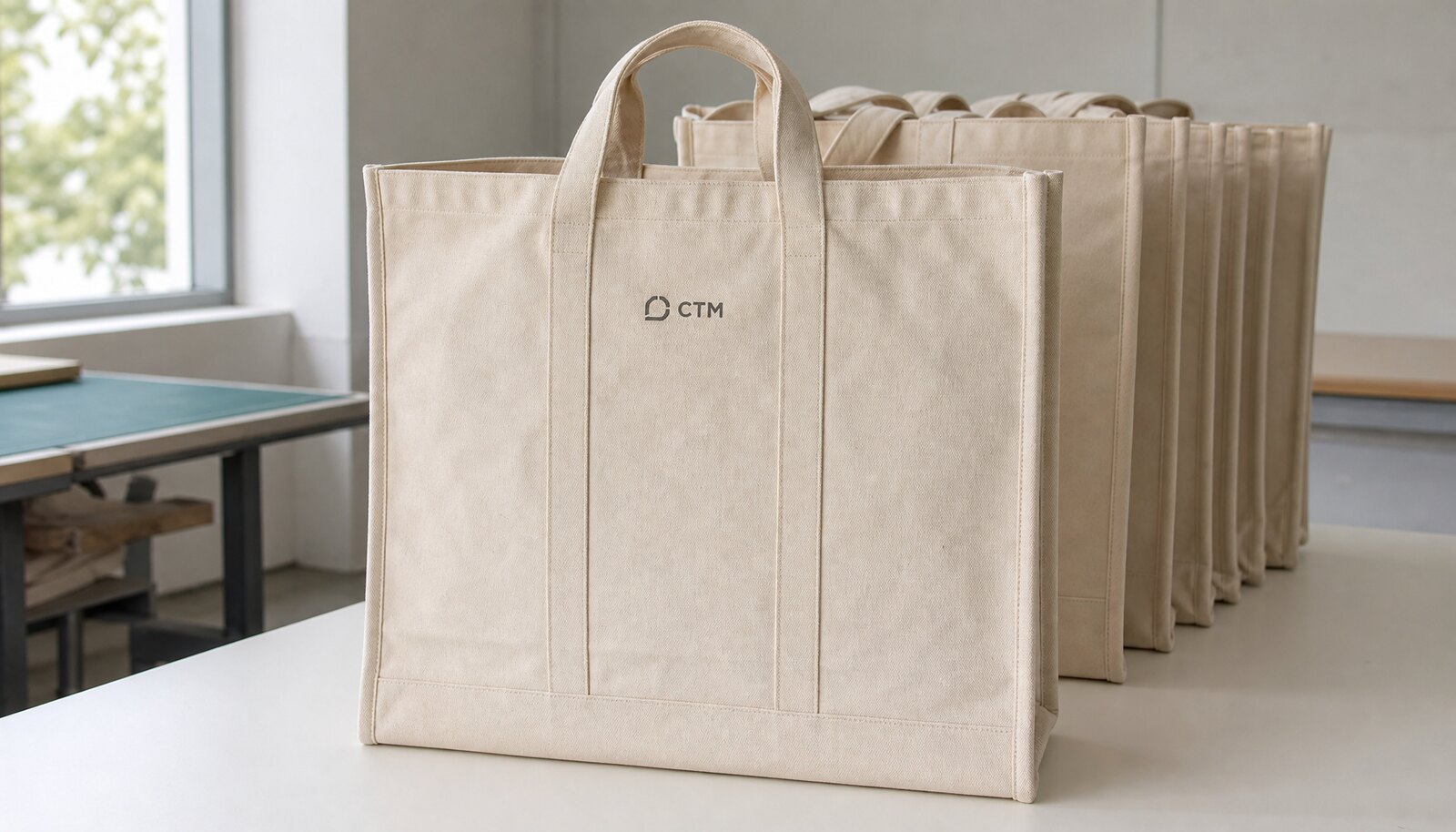
1. Why this reorder memo matters more than the first PO
Large canvas grocery bags for trade shows are simple enough to buy once and complicated enough to disappoint on reorder. The first production run often gets attention from design, marketing, and the event team, so the buyer catches errors early. The second run is different. People assume the bag has already been approved, so the order moves faster and more lightly through procurement. That is when a supplier can substitute a softer canvas, change stitching density, shift print placement, or alter packing without the buyer noticing until the cartons reach the warehouse.
A reorder memo prevents that drift by turning the bag into a controlled specification, not a memory. For B2B procurement, the memo should answer four questions before a PO is released: what exactly are we buying, what will it cost landed, what quality standard must the supplier hit, and what happens if the shipment is late or defective? If the memo does not answer those questions clearly, the buyer is not really planning a reorder; they are hoping the previous order will repeat itself.
Trade show totes have a different use pattern from retail shopping bags. They are often filled with literature, product samples, bottle items, or mixed giveaways and then carried for a day, folded into a car, and reused later. That means the right spec is usually a balance of structure, print quality, and freight efficiency, not the cheapest canvas available. The memo should help procurement protect that balance on every repeat order.
- Use the memo as the controlled reference for the next PO.
- Treat the prior approved sample as evidence, not as a substitute for a written spec.
- Plan for repeat use, event handling, and warehouse receiving, not only for the initial giveaway moment.
2. Start with the real use case: what the bag must carry and how it will move
Before requesting quotes, define the bag by its actual job. A trade show tote may need to hold a folded catalog, a tablet-sized brochure set, a bottle sample, and some branded collateral. If it will be handed out at registration, the bag must be easy to stack, quick to fill, and large enough that staff are not forcing items into it. If it will be sold or reused after the show, the buyer should care more about seam strength, print durability, and shoulder comfort.
The most useful starting dimensions for a large canvas grocery bag are often around 15 x 16 x 7 inches or 16 x 18 x 6 inches. These are practical because they create enough volume for literature and samples without turning the bag into a bulky box that costs more to ship and store. The gusset depth matters as much as the headline size. A bag can look large on paper and still fail in real use if the bottom area is too narrow to hold sample boxes flat.
Ask the supplier to quote finished dimensions, seam allowance, and handle drop separately. Do not let the factory hide the important numbers inside a generic template. Handle drop is especially important when the tote will be carried over the shoulder during a show. If the handles are too short, the bag becomes awkward when full; if they are too long, the bag swings and may drag near the floor. Buyers should define whether the bag needs hand carry, shoulder carry, or both, because that choice affects the handle length, sewing pattern, and even the top hem reinforcement.
- Define what the bag will carry, not just how big it should look.
- Specify finished dimensions, gusset depth, and handle drop as separate quote items.
- Check whether the bag must sit upright on a table or only hang from the shoulder.
3. Fabric weight, finishing, and the cost of getting structure wrong
For reorder planning, a common and practical canvas range is 10 oz to 12 oz, or roughly 340 to 410 GSM. That range usually gives enough body for trade show reuse and a better print surface than very light canvas. A lighter bag can save money, but the savings are easy to lose if the tote wrinkles badly, collapses under catalogs, or comes back with print complaints because the fabric is too open or soft. A heavier bag can make the brand feel more premium, but it raises textile cost and shipping weight, so the procurement team should evaluate both the unit price and the landed cost.
The factory should state the measured fabric weight and whether the material is pre-shrunk, washed, or softened. These are not cosmetic details. Pre-shrunk canvas can improve size stability after humidity swings and storage, while a washed finish can change the hand feel enough to affect print clarity and bag stiffness. If the supplier cannot explain the finishing process clearly, procurement should treat that as a warning sign. A broker can say 'heavy canvas' very easily; a real manufacturer should be able to name the weave, width, weight, and finishing step.
For trade show programs, buyers should also consider natural canvas color behavior. Natural or ecru canvas is usually the most flexible choice because it is easier to source, it shows printed logos clearly, and it avoids dye-lot complexity. If a custom dyed color is required, ask for a lab dip or color reference before production. Custom color adds time, may increase MOQ, and can create reordering problems if the shade drifts between production lots. In a reorder memo, color should be treated as a controlled input, not a design afterthought.
- 10 oz to 12 oz canvas is a practical repeat-use range for most trade show programs.
- Ask for measured fabric weight, not just marketing language like 'heavy duty' or 'premium cotton.'
- If custom color matters, approve a lab dip or physical color standard before production starts.
4. Print method and artwork control: how to avoid expensive surprises on repeat orders
For most large canvas grocery bags used at trade shows, one- or two-color screen printing remains the most procurement-friendly choice. It gives stable repeatability, predictable setup charges, and acceptable durability on natural canvas. It is usually the best default when the logo is simple and the artwork does not change from show to show. The key advantage for a reorder is consistency: once the screens are built and the print position is locked, the second run can be quoted and produced with far less uncertainty.
Heat transfer can work for short runs or for artwork that changes by city, sponsor, or campaign. It is also useful when the buyer needs a faster turn. The tradeoff is that the print may sit more like a layer on top of the fabric, and buyers may dislike the feel or appearance after the bags are folded, stacked, and unpacked. Embroidery is usually not the right fit for a grocery-style tote unless the business wants a premium retail look and accepts a higher per-unit cost.
Artwork should be supplied in vector format, and procurement should insist on a proof that shows the exact print size and placement relative to the bag seam, top hem, and gusset line. A logo that looks balanced on a flat mockup can appear too low once the tote is filled. For that reason, the best practice is to approve the art on a real bag sample, not only on a digital proof. If the design includes fine text, thin outlines, or small registration details, the buyer should ask the supplier how much line gain or edge softening to expect on canvas. Natural texture can blur weak artwork, especially on low-contrast prints.
- Use screen printing for stable artwork and repeat programs.
- Use heat transfer only when speed or artwork variation matters more than tactile finish.
- Approve print size and location on an actual bag sample, not only a digital rendering.
- If artwork is detailed, ask the factory what minimum line thickness it can hold on the chosen canvas.
5. MOQ, setup charges, and the decision table procurement actually needs
MOQ is one of the easiest terms to misunderstand because it is rarely just a total quantity. For canvas bags, the minimum may be set by fabric color, screen count, print setup, packing format, or even by the width of the loom roll. A quote that says '2,000 pcs MOQ' may still become more expensive if the order is split across two colors, two print positions, or multiple sizes. Procurement should ask for the rule behind the MOQ, not just the number itself.
The real decision is whether the supplier can support the reorder pattern you need across the year. If the trade show calendar uses 1,200 bags in spring and 1,200 in fall, it may be cheaper to run one larger lot and warehouse part of it than to pay two separate setup charges and risk color differences between lots. But that choice only works if storage cost, cash flow, and damage risk are acceptable. This is where procurement and marketing should agree on a demand forecast before the PO is issued.
A useful quote comparison should separate setup, unit price, and re-run cost. Ask for the screen charge, sample charge, label charge, and any special packing charge as line items. If a supplier offers a lower unit price but a much higher setup charge, the apparent savings may disappear as soon as the second order is placed. For reorders, the buyer should also ask whether the factory will keep the screens, cutting markers, or print film on file and for how long. That detail matters if the next order is placed several months later.
- Confirm whether MOQ applies by SKU, color, size, artwork, or packing format.
- Break setup cost out from unit cost so the repeat order math stays visible.
- If the bag is used across multiple events, compare one larger production run against two smaller runs with storage included.
6. Supplier comparison: how to tell a real manufacturer from a broker
Procurement value improves sharply when the sourcing route is clear. A direct factory usually gives better control over fabric sourcing, sewing, print quality, and final packing. An exporter or trading layer can still be useful, especially if they manage multiple product categories or have strong English-language support, but the buyer must know whether the trading company actually owns the production process or simply passes instructions to an unseen subcontractor. For reorder programs, that distinction affects accountability when quality slips or shipment dates move.
To verify a real manufacturer, ask for the factory address, business registration, and photos or video of the sewing, printing, and inspection areas that match the supplier name on the quote. Ask which steps are in-house and which are outsourced. A real factory should be able to answer without confusion. If the supplier refuses to state where production happens, or if every question is answered with 'we can arrange,' the buyer should slow down and verify more carefully. This is especially important when the reorder will be repeated, because change control is much easier when the production owner is identifiable.
Buyer verification should also include references and document review. Request recent audit documents if available, ask for customer references from repeat orders in similar categories, and check whether the supplier has experience with carton pack counts, mixed-SKU handling, and shipping documents. If the order is destined for a retailer, distributor, or event warehouse, the supplier should also understand labeling, pallet build, and any destination-specific receiving rules. A manufacturer who can speak clearly about those requirements usually saves time later.
A simple supplier scorecard helps procurement compare quotes without being misled by price alone. Score the supplier on factory transparency, sample response speed, QC process, ability to hold repeat specs, clarity on incoterms, and willingness to accept inspection and claim terms. The buyer does not need a perfect score; the buyer needs the lowest-risk supplier that can reliably repeat the spec when the next show cycle comes around.
- Ask for factory address, registration, and evidence of in-house production.
- Verify which processes are direct and which are outsourced before you compare price.
- Use a scorecard for transparency, QC, repeatability, and shipping support, not only unit cost.
7. A landed-cost framework that makes quote comparisons usable
Procurement teams often evaluate canvas tote quotes by factory price alone, but reorder planning should use landed cost. For a bulky item like a canvas grocery bag, freight, carton volume, packing method, inspection, duties, and domestic receiving can change the true cost materially. A quote that looks attractive at EXW may become less competitive once cartons, palletization, origin charges, ocean freight, import duty, and destination handling are added. Buyers should ask every supplier to state the incoterm and exclude nothing important by assumption.
The key incoterms to understand are EXW, FOB, CIF, and DDP. Under EXW, the buyer assumes the greatest responsibility after factory pickup, which can be workable if the company already has a freight forwarder and import team. FOB is often easier for organized importers because the supplier handles export clearance and delivers to the port. CIF includes freight and insurance to the destination port, but the buyer still handles import clearance and local charges. DDP can sound simple because the seller quotes delivery duty paid, yet the buyer should confirm exactly which duties, taxes, and domestic fees are included. If those items are vague, the landed cost may not be as predictable as it appears.
A practical landed-cost worksheet should include these lines: unit price, setup charges, sample fees, carton and labeling charges, freight per carton or per cubic meter, insurance if applicable, import duty, customs brokerage, destination delivery, inspection fees, and expected rework allowance. For trade show programs, add a small buffer for replacement units. That buffer matters because a short shipment of even a few dozen bags can create a fulfillment scramble that costs more than the bags themselves.
Payment terms matter here as well. Buyers should ask whether the supplier accepts deposit plus balance after inspection, and whether the order can be held until the pre-shipment inspection passes. Common structures are 30/70 or 40/60, but the right split depends on buyer leverage and supplier trust. If the order is a repeat with stable specs, procurement may be able to negotiate less upfront exposure. If the supplier insists on full payment before inspection, the buyer should weigh the risk carefully and consider a different source or stronger contractual safeguards.
- Ask every supplier to quote the incoterm explicitly.
- Build a landed-cost worksheet that includes freight, duty, brokerage, and destination handling.
- Negotiate payment around inspection milestones when possible, especially for repeat orders.
8. Sample approval, inspection rights, and the timeline from sign-off to shipment
A reorder should follow a controlled timeline, not a vague promise. The useful path is usually: RFQ and art confirmation, sample quote, blank or strike-off sample, pre-production sample, buyer approval, production, in-line or final inspection, packing confirmation, shipment, and receiving. Each gate should have a named owner and a deadline. Without that structure, the buyer may assume a sample is approved while the supplier assumes a verbal note was only a suggestion. That gap is one of the most common sources of surprise on repeat orders.
The sample that matters most is the pre-production sample made with final fabric, final print, final handles, and final carton pack format. A blank sample can confirm feel and dimensions, but it cannot prove print placement or packed appearance. If the bag is expected to carry a meaningful weight, the sample should be loaded to test handle attachment and seam stability. Buyers do not need laboratory-level testing for every reorder, but they do need a repeatable acceptance method. A simple weight test, fold test, and visual inspection performed against a signed reference sample can catch many problems before mass production.
Inspection rights should be written into the purchase order or buying agreement. If the order is large enough to matter, the buyer should reserve the right to inspect before shipment or to use a third-party inspection service. Define what happens if defects exceed the agreed threshold: rework, replacement, discount, or shipment hold. Put the threshold in measurable terms whenever possible, such as acceptable size variance, print placement tolerance, and defect rate by sample lot. If the supplier cannot commit to inspection cooperation, that is a risk signal, not a minor administrative issue.
For timing, 30 to 45 days from approved sample to production completion is a useful planning range for standard repeat canvas programs, but only if fabric is available and artwork is locked. Add transit time, customs clearance, and warehouse intake on top of that. If the bags are needed for a fixed trade show date, the buyer should backward-plan from the receiving deadline, not the factory completion date. That simple change often prevents the false confidence that leads to late arrivals.
- Use a stage-gate timeline with named owners for sample, approval, production, inspection, and shipment.
- Approve a pre-production sample with final fabric, print, handles, and packing.
- Write inspection rights and defect remedies into the PO or contract before production starts.
9. QC thresholds that are specific enough to be useful
High-level QC language such as 'good quality' does not protect a procurement team. The defects that hurt large canvas grocery bags for trade shows are often small, repeatable, and visible only when the order is unpacked at scale. That is why QC should be written as measurable acceptance criteria. The factory needs to know what matters most: seam integrity, print placement, color consistency, size tolerance, and load performance.
A strong QC note should specify the fabric weight range, the acceptable dimensional tolerance, and the stitch quality expected at stress points. Buyers may not need an engineering lab, but they should define a reasonable stitch length and require consistency across the run. If the bag has self-fabric handles, the attachment area should be reinforced with box-x or equivalent stitching, and the buyer should check for balanced placement so the bag hangs straight. Print registration should be checked against the sample under normal viewing distance, not just from arm’s length. On natural canvas, slight texture variation is normal; blurred edges, smudged areas, and weak ink laydown are not.
Color tolerance deserves its own note. If the bag is natural canvas, the buyer should define what level of slub, shade variation, and fiber specking is acceptable. If the tote is dyed, the supplier should provide a matching standard and the buyer should define an acceptable delta or visual reference. Shrinkage should also be addressed when the bag is washed, steamed, or exposed to humidity. A pre-production sample can be conditioned and re-measured to make sure the finished dimensions stay inside tolerance after finishing. Finally, packing quality should be verified before shipment: exact carton counts, clear carton marks, and a pack format that will not crush handles, crease logos badly, or create receiving disputes at the DC.
If the buyer wants extra protection, use an escalation ladder. For minor defects below the threshold, the supplier can offer rework or a partial credit. For major defects, the buyer should reserve the right to reject the lot, hold payment, or require replacement shipment. That escalation path makes the buying agreement more enforceable and reduces arguments after the bags arrive.
- Set measurable tolerances for size, stitch consistency, print placement, and color variation.
- Require reinforcement at stress points and verify handle symmetry on the approved sample.
- Define defect escalation in advance: rework, credit, replacement, or shipment hold.
10. Packing, freight, and warehouse handling for bulky canvas totes
Canvas bags are low-cost individually and expensive in volume if packing is ignored. Their bulk makes carton design a real procurement issue, not a logistics afterthought. Flat-packed cartons with consistent bundle counts are usually the best choice for event fulfillment and distribution centers because they simplify counting, receiving, and pallet build. If a buyer requests individual polybags without a reason, freight volume and warehouse handling usually rise. If the customer channel requires retail presentation or protected packing, then polybags may be justified, but the cost should be visible in the quote.
Ask for carton dimensions, net and gross weight, and the number of bags per carton before approving the PO. Those numbers drive the freight estimate, especially for air shipments or urgent replenishment orders. Because the bag is lightweight but bulky, volumetric weight can dominate the freight bill. A quote that seems competitive at the factory can look very different after palletization and destination charges. Buyers should also confirm whether cartons are export-ready with clear marks, whether master cartons are single-SKU, and whether the packing list matches the event warehouse’s receiving rules.
If the order will be split across multiple shows, warehouse handling should be part of the reorder plan. A production lot can be divided into staged releases, but only if the cartons are clearly marked and the buyer knows which shipment is reserved for which event. Otherwise, the wrong cartons get opened first and the next show runs short. This is one of the easiest ways for a good product order to become an operational issue. A reorder memo should therefore state the packing logic: full lot to one location, split by event, or mixed with buffer stock held at a central warehouse. That decision affects freight, storage, and the ability to respond to last-minute changes.
- Request carton dimensions, gross weight, and pack count with every quote.
- Use flat packing and clear carton marks unless the channel requires retail-ready individual packing.
- Plan how cartons will be allocated across events or warehouses before production begins.
Specification comparison for buyers
| Spec decision | Recommended option | When it fits | Buyer tradeoff and sourcing consequence |
|---|---|---|---|
| Fabric weight | 10 oz to 12 oz canvas, about 340 to 410 GSM | For trade show totes that must hold catalogs, samples, and giveaways while still feeling structured | Lower GSM usually reduces unit cost, but it can distort print appearance and increase complaints about softness; higher GSM improves body but adds material cost, carton weight, and freight volume |
| Bag size | Large grocery size around 15 x 16 x 7 in or 16 x 18 x 6 in | When the bag must carry literature and sample kits without looking like a fashion tote | A shallow gusset may pass dimensional checks yet fail in actual packing; a deeper gusset raises usable volume but increases cubic freight and can make the bag collapse if the canvas is too light |
| Handle construction | Self-fabric handles with box-x stitching or reinforced cross-stitch | When buyers want a clean retail look and repeated shoulder carry | Reinforced handles cost slightly more and may need a stronger sewing line, but they reduce the risk of returns, rework, or broken-carry complaints at events |
| Print method | 1 to 2 color screen print for most reorders; heat transfer only for short runs or variable artwork | When logo consistency and per-unit cost matter more than photo-level detail | Screen setup creates upfront cost but lower repeat cost; heat transfer lowers setup but can look patchy, add hand-feel, or fail brand acceptance if edges lift after folding |
| Decoration location | Single front print centered above the gusset line | When you need fast approval, simpler setup, and lower screen cost | Artwork placed too low can disappear when the bag is filled; moving the print higher may reduce visible area but improves brand readability in actual use |
| MOQ structure | Base MOQ by fabric color and print setup, not just total units | When buying mixed sizes, multi-drop deliveries, or seasonal event quantities | A quote that hides per-color or per-screen MOQ makes the unit price look lower than it is; ask for the exact surcharge for split lots and extra screens |
| Packing method | Flat packed by carton with bundle counts and carton marks | When cartons move through 3PL, DC intake, or event fulfillment | Loose packing may save labor at the factory but creates receiving issues downstream; unnecessary polybags increase freight volume and warehouse handling cost |
| Lead time | Sample approval plus 30 to 45 days production for standard canvas programs | When artwork is stable and fabric is in stock | Custom dye, new screens, or holiday congestion can extend the schedule; a buyer should work backward from the event date and include buffer time for inspection and transit |
| Supplier route | Direct factory or experienced exporter rather than a trading layer for repeat trade show programs | When you need repeatable specs, stable QC, and clear change control | A direct factory is easier to audit for process control, but a broker can still work if they disclose the actual maker and accept factory verification, inspection, and escalation terms |
Buyer checklist before sampling
- Confirm bag size, gusset depth, handle length, and target filled weight before requesting quotes.
- Lock fabric weight in GSM or oz, not just 'heavy canvas' or 'thick cotton.'
- Approve one print method and one print location for the reorder, with artwork in vector format.
- Set carton pack count, master carton dimensions, and whether individual polybags are required.
- Define acceptable tolerances for size, stitching, print registration, color variance, and load capacity.
- Reserve sample approval time before production starts, especially if the same bag is used across multiple trade shows.
- Ask every supplier for trade terms, payment schedule, inspection rights, and defect escalation steps before you compare price.
Factory quote questions to send
- What exact fabric weight in GSM or oz will you use, and can you quote a measured tolerance range?
- Is the MOQ based on total bags, by color, by artwork, by size variant, or by carton configuration?
- What is included in the unit price: cutting, sewing, print setup, labeling, folding, polybag, and carton packing?
- Can you share carton size, carton weight, pack quantity per carton, and estimated cartons per pallet for freight planning?
- What sample types are available: blank sample, strike-off, pre-production sample, and top sample with final packing?
- What production lead time applies after sample approval, and what changes it if we reorder with the same spec?
- Which incoterms do you quote most often: EXW, FOB, CIF, or DDP, and what costs are excluded from the price?
- What inspection options do you allow, and what happens if we find defects, shortages, or late shipment?
- Can you confirm the factory location, ownership, and which processes are in-house versus outsourced?
- Can you provide recent audit documents, business registration, and references from buyers with repeat orders?
Quality-control points to confirm
- Fabric weight must match the approved range; reject bags that fall below the measured standard or feel noticeably thinner than the signed sample.
- Stitching should be consistent with no skipped stitches, loose loops, or broken seam lines at the handle attachment and gusset corners.
- Specify stitch length, such as a consistent machine setting, and require even tension without puckering along the top hem and side seams.
- Handle length and symmetry should stay within agreed tolerance so the bag hangs evenly when loaded and does not twist on one side.
- Print placement must sit square to the bag body, remain legible after folding, and stay within the agreed color tolerance on natural canvas.
- Require a simple adhesion check for printed ink or transfer graphics, such as rub resistance and tape pull on the approved sample, before mass approval.
- Define a shrinkage expectation for canvas that may be washed or steam-pressed, and test that the finished size remains within tolerance after conditioning.
- No visible oil stains, heavy slub clusters, broken threads, loose fibers, untrimmed tails, or fabric holes should appear on saleable units.
- Carton packing must keep counts exact, with carton marks, item description, quantity, and PO reference visible for receiving.
- Use a carton-drop or handling check on the pre-production pack format so the buyer can verify that corners, handles, and print do not crease badly in transit.