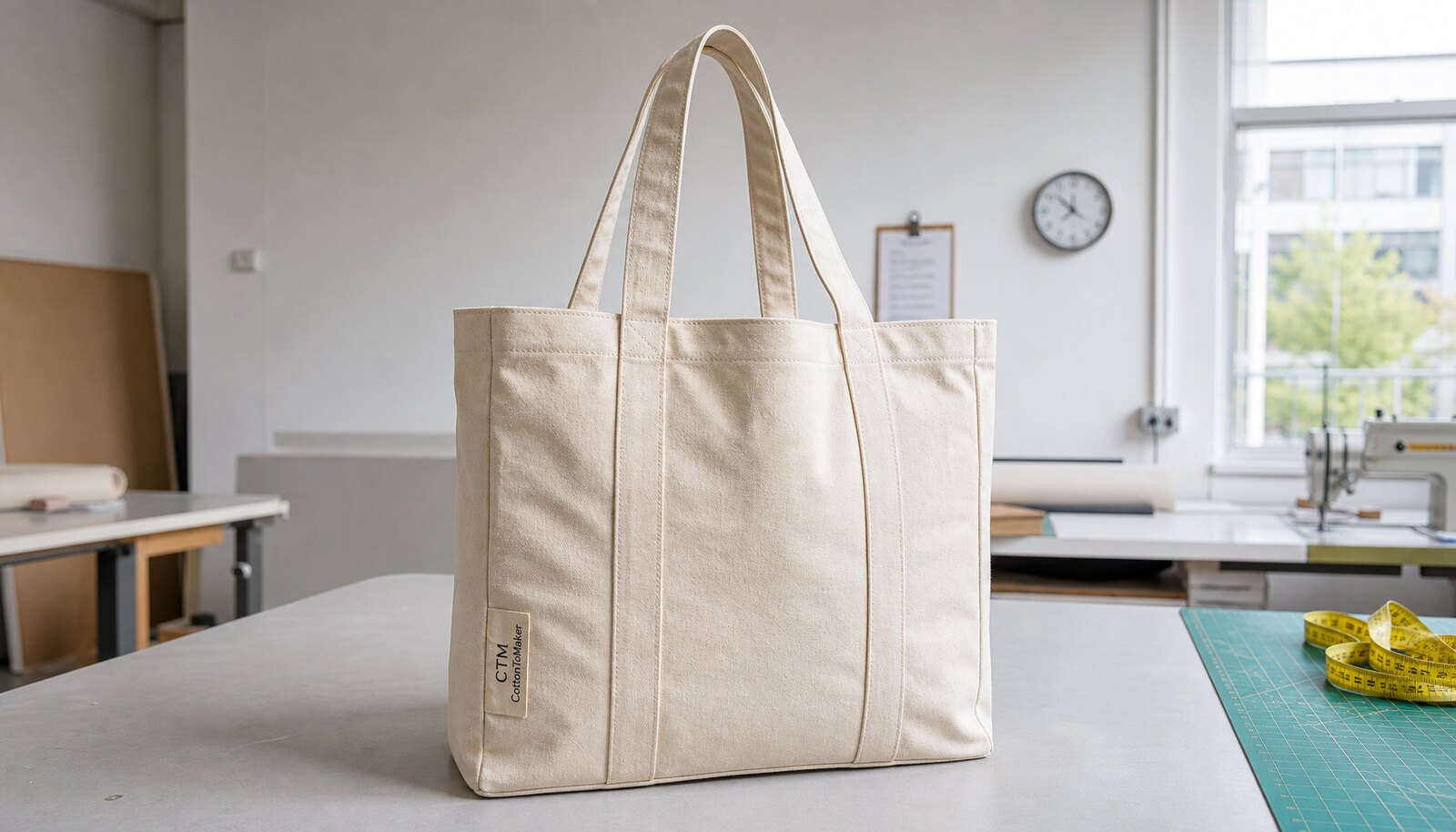
Why subscription-box buyers need a tighter canvas spec
Large canvas grocery bags for subscription boxes are not ordinary promotional totes. The bag has to protect the contents, fit the carton, present the brand cleanly, and survive enough consumer use to justify its cost. That means the quote is only useful when the factory understands the real job: a repeated-use carry bag that ships efficiently and looks disciplined when the customer opens the box.
The common mistake is asking for a tote quote before defining the internal product load and the packing method. A bag that looks fine as a standalone sample can fail in the box if the gusset is too wide, the handles are too long, or the fabric is too soft. For this product, the first sourcing decision is not print or color; it is whether the bag must act as a retail bag, an insert sleeve, or a bundled carry solution.
- Define the bag’s role in the subscription: carrier, gift item, refill pack, or retail-resale tote.
- Share carton internal dimensions before asking for bag dimensions.
- State whether the bag must ship flat, folded, or lightly pre-shaped.
Start with fabric weight, not artwork
For most subscription applications, 10-12 oz canvas is the practical middle ground. It is heavy enough to feel substantial, print well, and hold shape, but it is not so heavy that freight becomes unnecessary waste. If the subscription pack includes dense goods, bottles, or boxed products, 14 oz canvas is usually a safer quote baseline because it handles seam stress better and looks more premium on arrival.
If your brand wants a softer, more retail-friendly hand feel, the factory may suggest a slightly lighter canvas with tight weave and proper finishing. That can work, but only if the sample does not collapse under load. Ask for the fabric basis weight in GSM or oz, the weave density, and whether the cloth is pre-shrunk or washed after sewing. Those details change size stability, print sharpness, and final carton count.
- 10 oz canvas: workable for light subscription kits and low-load retail inserts.
- 12 oz canvas: the safest all-rounder for premium grocery-style bags.
- 14 oz canvas: best for heavier bundles, high perceived value, or repeated consumer use.
The right bag build depends on the carton, not just the logo
A large canvas grocery bag for a subscription box should be designed from the inside out. Measure the packaged contents, then map them to the carton, then size the bag so it fits that exact receiving flow. A bag that is too tall wastes carton headspace; a bag that is too wide causes distortion, while an oversized gusset can force the handles to bunch awkwardly when folded.
The most useful dimensions to give the factory are finished width, height, and gusset depth, plus handle length and handle drop. If the bag is meant to stand upright in the box, tell the supplier. If it is meant to be laid flat beneath other inserts, say that too. These simple facts help the factory quote the correct cut size and reduce sample rounds.
- Typical usable size range: 15 x 16 in to 16 x 18 in with a 4-6 in gusset.
- Handle drop should match carry comfort and carton fold height.
- A stable base or boxed bottom matters more than a flashy print for retail-grade use.
Compare sourcing routes before comparing unit price
Not every quote means the same thing. One factory may sew in-house and print on-site; another may outsource decoration; a third may source pre-made blanks and decorate them locally. For procurement, these are different supply routes with different risk profiles, even if the line item looks similar. A direct factory quote usually gives you better control over size, stitch, and print placement, while a trading route may be easier for low-volume experiments but harder to audit when problems appear.
For subscription-box programs, direct factory sourcing usually wins when repeatability matters. If you expect reorders, seasonal artwork, or multiple pack formats, a supplier that controls cutting, sewing, printing, and packing is easier to manage. The tradeoff is that you need cleaner RFQ data. If your brief is vague, direct factories will quote differently from each other because each one is filling in the gaps with its own assumptions.
- Use direct factory sourcing when you need repeatable spec control and stable reorder performance.
- Use a trading route only if you are testing artwork or want to compare small pilot options quickly.
- Treat blank-stock plus decoration as a separate sourcing route, not the same as made-to-order canvas production.
How to read a factory quote line by line
A useful quote should show more than a single unit price. It should separate fabric, sewing, printing, sample cost, packaging, and any setup fees. If those items are hidden inside one number, you cannot compare suppliers properly. For example, a lower unit price may be offset by a high print plate fee, expensive samples, or a carton spec that creates extra freight cost.
The best way to compare quotes is to normalize them against the same target spec: same fabric weight, same bag size, same print method, same packing, and same delivery term. Then ask for price breaks at specific volumes, such as 1,000, 3,000, and 5,000 pieces. This gives procurement a real scaling view and shows whether the factory pricing is based on true production economics or just a rough estimate.
- Unit price should be tied to an exact spec, not a generic tote description.
- Setup costs must be separated from production costs.
- Carton size and gross weight should be shown so logistics can estimate landed cost.
Print method choices that affect approval risk
For subscription-box totes, screen printing is usually the most economical choice when the logo is simple and the color count is low. It gives solid coverage on natural canvas and is easy to repeat across replenishment runs. If your art includes small detail, gradients, or many colors, a heat transfer or digital method may be more practical, but you should expect different feel, durability, and setup behavior.
If the brand wants a quieter premium look, a woven side label or stitched label can be a better solution than a large printed graphic. It reduces visual noise, avoids ink mismatch, and often survives handling better. The tradeoff is that a label does not replace a strong print system if the whole bag is supposed to function as a branded retail item. Decide what the bag is meant to communicate from one meter away.
- Screen print: best for bold logos, repeat orders, and lower decoration cost.
- Heat transfer/digital print: better for complex art, but sample approval must be tighter.
- Woven or sewn label: good for restrained branding and lower risk of color shift.
Sample approval: where most production mistakes start
The sample stage should confirm more than appearance. A proper pre-production sample must show the final fabric, final stitching, final print method, and final fold or pack style. If the factory sends a loose artwork proof or a blank prototype with a different fabric weight, that is not a real approval sample. It may help with design discussion, but it cannot be treated as production signoff.
Before bulk cutting begins, compare the sample against a simple acceptance sheet: dimensions, gusset shape, handle reinforcement, print position, color target, and fold size. If the bag must sit flat in the subscription box, test it in the actual carton. This one step prevents a lot of expensive rework, especially when the bag is taller or stiffer than expected.
- Approve only samples made from the actual bulk fabric and actual print method.
- Test the sample in the shipping carton, not just on the table.
- Record every approved dimension and placement reference in writing.
MOQ logic and why low minimums can be expensive
MOQ is not just a factory rule; it is a production efficiency point. Canvas bags require fabric cutting, sewing setup, print setup, and packing labor. When the order is very small, those fixed steps are spread across fewer units, so the unit price rises. That is why a quote for 500 pieces can look disproportionately high compared with 3,000 pieces, even if the spec is almost identical.
For subscription-box programs, the practical MOQ often sits around 1,000-3,000 pieces per color or design, depending on whether the supplier is weaving new fabric or using stock canvas. If you plan multiple subscription tiers or seasonal variations, it may be smarter to standardize the bag construction and only change the print. That keeps the MOQ manageable while reducing the risk of leftover inventory.
- Lower MOQ usually means higher unit cost and less leverage on print or packing customization.
- One bag body with multiple artwork versions is often cheaper than multiple body specs.
- If the supplier offers very low MOQ, confirm whether the bags are stock items or true made-to-order production.
Packing, carton efficiency, and warehouse receiving
Packing is part of the product spec. If the bag is meant for subscription boxes, it must pack in a way that protects the shape without wasting carton space. Ask the factory how many pieces go into one inner pack, whether the bags are polybagged, and how the outer carton is marked. If your warehouse uses scanning or carton-level receiving, those details matter as much as the print color.
Export carton size affects freight, but it also affects store-and-forward handling, especially for retailers or distributors who break bulk. A clean packing spec should state the number of pieces per carton, whether the carton is double-walled, and the gross weight range. If the bag has a stiff print or a heavy gusset, a tighter carton count may prevent crushing and print transfer marks.
- Flat packing improves carton efficiency but should not crease the print area.
- Polybagging helps dust protection but adds labor and plastic content.
- Carton marks should match SKU, color, quantity, and purchase order number.
Lead time, schedule risk, and landed-cost comparison
Lead time on a custom canvas tote is usually driven by four things: fabric availability, print queue, sewing capacity, and approval speed. A factory may give a short production window, but if the sample is not approved quickly or the artwork requires another revision, the calendar slips immediately. In real sourcing, the supplier’s promise is only useful when it is tied to a defined approval timeline and a clear pre-production checkpoint.
For landed cost, do not compare ex-factory price alone. Add the sample cost, setup fees, export carton cost, and freight impact from the carton dimensions and gross weight. A slightly more expensive bag can land cheaper if it packs better or uses less bulk material. This is especially true for subscription-box programs where the bag moves through a fulfillment center before reaching the consumer.
- Sample lead time: often 5-10 days depending on print complexity and material stock.
- Bulk lead time: commonly 25-40 days after sample approval for standard canvas production.
- Landed cost should include carton efficiency, not just product price.
Specification comparison for buyers
| Spec decision | Recommended option | When it fits | Buyer risk to check |
|---|---|---|---|
| Fabric weight | 10-12 oz natural canvas for general subscription inserts; 14 oz if the bag carries heavier retail bundles | Best when the bag must feel premium, stand upright, and survive repeat use | Too-light fabric looks flimsy and can distort after printing; too-heavy fabric raises carton weight and freight cost |
| Bag size | Typical finished size around 15 x 16 in or 16 x 18 in with 4-6 in gusset | Fits mixed subscription contents, promotional inserts, and bundled retail packs | If internal product dimensions are not shared, the bag may be too shallow, too narrow, or oversized for the carton |
| Handle construction | Self-fabric handles reinforced with cross-stitch or boxed stitch | Works for grocery-style carry loads and consumer-facing subscription deliveries | Thin handles may twist or tear at the seam when packed with hard goods |
| Print method | Screen print for 1-2 solid colors; heat transfer or digital print for complex artwork; woven label for restrained branding | Choose based on artwork complexity and repeat volume | Low-resolution logos, fine gradients, or poor color targets cause rework and delayed approval |
| Closure style | Open top for easy packing; zipper or snap only if product retention matters | Subscription boxes that already contain protected inner packs and do not require full enclosure | Added closures increase labor, hardware risk, and sample revision time |
| Supplier route | Direct factory with tote-bag experience and in-house sewing plus printing | Best for controlled spec, stable repeat orders, and lower unit cost at scale | Trading routes can hide sub-suppliers, making QC responsibility unclear and quote comparisons harder |
| MOQ strategy | 1,000-3,000 pcs per color/design is practical for custom canvas production; lower MOQ usually costs more per unit | Fits launch runs, pilot subscriptions, and seasonal promotions | Very low MOQ may indicate stock blank goods or outsourced decoration with weaker consistency |
| Packing method | Flat pack in polybags or bulk-packed with dividers, then export cartons with carton marks | Use when carton efficiency and fast fulfillment matter | Over-packed cartons crush the bags; under-defined packing creates warehouse counting errors and damage claims |
| Lead time structure | Sample 5-10 days, bulk 25-40 days after approval depending on print and sewing load | Works for planned subscription calendar releases | Factories that promise very short lead times without confirming fabric stock, print queue, and approval timing often miss ship dates |
Buyer checklist before sampling
- Send the factory the final bag size, target fabric GSM or oz weight, handle length, gusset depth, and whether the bag must stand upright in the subscription box.
- Share artwork in vector format plus Pantone targets, and state whether the logo must be screen printed, heat transferred, woven, embroidered, or label-stitched.
- State the target carton count, inner packing method, and whether bags must be folded to a defined finished size for warehouse receiving.
- Ask for unit price by MOQ tier, sample cost, tooling or plate cost, and freight-ready carton dimensions and weights.
- Require production photos or a pre-production sample signoff before bulk cutting begins.
- Confirm acceptable tolerances for size, stitch density, print placement, and color variation before order release.
Factory quote questions to send
- What canvas weight do you recommend for this bag size and load, and is the fabric pre-shrunk or bio-washed?
- Is the quote based on in-stock natural canvas or newly woven fabric, and how does that change lead time and consistency?
- Which print method is included in the price, how many colors are covered, and what is the setup cost per design?
- What is the MOQ per color and per print version, and what price break applies at 1,000, 3,000, and 5,000 pieces?
- Can you quote the bag with reinforced handles, boxed stitching, and a gusset, and what is the cost impact for each upgrade?
- How will the bags be packed for export, what is the carton size and gross weight, and how many pieces fit per master carton?
- What sample stages are available before bulk production, and which dimensions, print positions, and color references will you use for approval?
- What QC standard do you apply for stitch defects, print misalignment, and size tolerance, and can you share inspection photos before shipment?
Quality-control points to confirm
- Fabric weight matches the approved GSM or oz target within the factory tolerance stated on the quote.
- Finished dimensions stay within an agreed tolerance, especially bag height, width, gusset depth, and handle length.
- Handle seams are reinforced evenly and do not show skipped stitches, loose thread ends, or seam distortion under hand load.
- Print placement stays within the approved location window and the color is visually consistent across the bulk lot.
- Bag opening, gusset shape, and fold pattern allow the product to fit the subscription carton without bulging.
- Carton count, inner pack count, and carton markings match the packing list to avoid warehouse receiving errors.
- Sample approval photos and the final pre-shipment inspection record reference the same approved spec sheet.