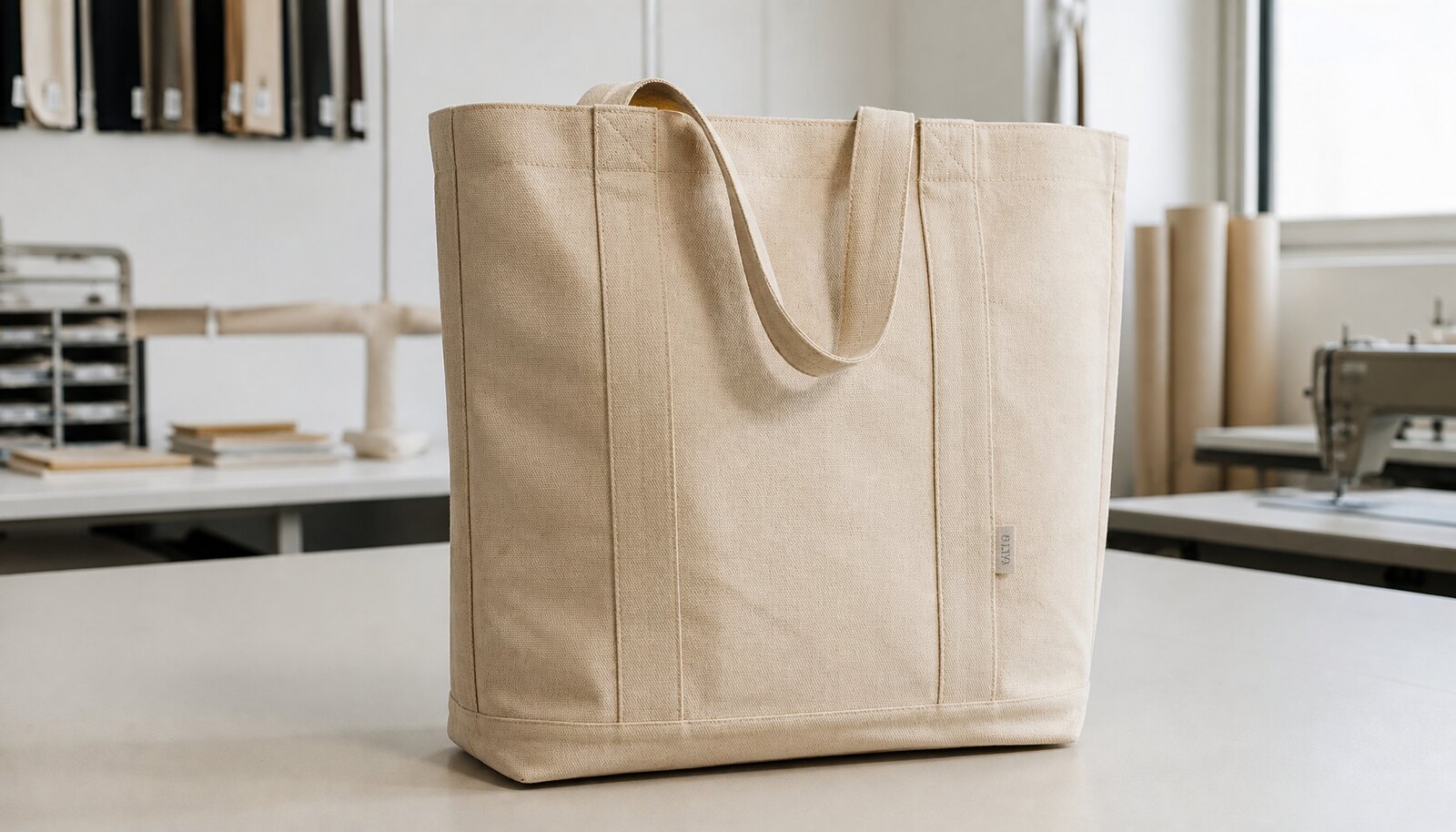
Why this tote is a different sourcing problem
Large canvas grocery bags used in subscription boxes are not bought like retail shopping totes. They have to work as both a brand carrier and a shipping-friendly insert. That means the bag has to look substantial in the customer’s hands, but it also has to fold flat, pack efficiently, and survive warehouse handling without arriving crushed, dirty, or badly printed.
For procurement teams, the sourcing risk is usually not the base bag. It is the combination of size, fabric weight, print method, and packing format. A tote that looks fine in a sample room can become expensive or awkward once it is stuffed into a monthly box, palletized, or sent through a fulfillment center.
- Treat the tote as part of the subscription box system, not as a standalone gift item.
- Balance customer-facing appearance against freight, carton density, and packout speed.
- Build the RFQ around finished use, not just color and logo placement.
Start with the right size and fabric weight
The most workable spec for this category is usually a large flat tote in the 12 oz / 400 GSM range, with a reinforced bottom and enough body to stand upright on a shelf or in a box. If the tote is too light, it will collapse and look cheap. If it is too heavy, you pay for it in fabric cost, sewing time, and freight volume. Many buyers end up in the 10–12 oz range because it gives a good balance between structure and cost.
For subscription box insert work, the finished size matters more than the marketing description. A bag labeled as “large” means nothing if the exact flat dimensions do not fit the planned packout or the intended retail use. The supplier should quote finished width, height, gusset depth if any, and handle drop. If your box is already fixed, the tote should be dimensioned to slide in without distortion.
- Common workable spec: 14–16 in. wide, 15–18 in. high, with or without a bottom gusset depending on fill volume.
- Use 10 oz canvas for value-oriented programs with lower fill weight.
- Use 12 oz canvas when the bag needs a more premium hand feel or repeated grocery use.
- Specify whether you need bleached, natural, or dyed canvas before quoting.
Choose the print method by artwork, not by habit
For large canvas grocery bags, screen print is still the default for most private label programs because it keeps unit cost under control and produces clean results on simple logos. One-color artwork with bold strokes is the easiest and safest route. If the artwork has tiny text, fine outlines, or multiple colors, the print method needs to be reviewed before sample approval, because the canvas texture can make thin details look weak.
Heat transfer and digital transfer options sometimes solve low-volume or variable-name projects, but they are not the best answer for every brand. They can work for short runs or promotional launches, yet buyers should ask how the print behaves after folding, rubbing, and warehouse handling. If the tote is meant to feel like a durable grocery item, the decoration should not look like a sticker.
- One-color screen print: best for stable artwork and repeat orders.
- Multi-color print: possible, but confirm alignment tolerance and setup cost.
- Woven label or stitched patch: good for cleaner branding with less print risk.
- Avoid tiny reverse-out text unless the fabric and ink system were proven in sampling.
How to structure MOQ so the quote stays usable
MOQ logic on this item depends on more than the bag itself. Fabric color, print color count, label type, and packaging method can all create separate minimums. A buyer may get one attractive unit price on a blank bag, then discover that the private label patch, custom folding, or printed carton marks push the order into a much higher committed quantity. That is why the RFQ should separate the bag spec from the decoration and packing spec.
The most efficient route is usually one body color, one print version, and one packing format. If you need multiple SKU variants for the subscription box calendar, the cleanest approach is to keep the base bag the same and vary only the printed insert card or outer box messaging. Every extra tote variant adds sewing, print, and inventory complexity.
- Ask for MOQ separately for blank bags, printed bags, and label-added bags.
- Confirm whether the MOQ is by color, by design, or by total order quantity.
- If you need two sizes, assume separate tooling, separate sample approval, and separate reorder risk.
- Do not let the quote hide a high setup fee inside the unit price.
Compare the main sourcing routes before you invite quotes
The best sourcing route depends on how much control you want over fabric, decoration, and packing. Factory direct sourcing usually gives the sharpest control on spec and better transparency on cost drivers. A vetted trading partner can reduce communication friction if your team buys many different packaging items, but the buyer still needs clarity on who owns sampling and QC. Domestic sourcing can help with speed and small launch quantities, but it often raises unit cost sharply once you scale.
If your team compares quotes without separating those routes, you will end up comparing a factory price against a reseller price and calling it a market benchmark. That is not a real comparison. Use the same bag spec, same artwork, same label placement, same carton plan, and same inspection expectation across all suppliers.
- Build one comparison sheet for direct factory, trading partner, and local supplier quotes.
- Match the same packed quantity, not just the same per-piece price.
- Ask each supplier to confirm who is responsible for sample revisions and artwork setup.
Supplier route comparison for subscription box tote sourcing
The table below is the practical comparison buyers usually need before they decide where to place the order. It is less about theory and more about how the route affects quote quality, timing, and risk. The same tote can be sourced in different ways, but each route changes the level of control you get over sample approval, packing, and landed cost.
Use this to decide whether you want a lower ex-factory number, faster responsiveness, or tighter production control. The wrong route for the wrong launch stage is one of the easiest ways to miss a box calendar.
- Write decisions in measurable language, not only descriptive wording.
- Ask for sample photos plus one physical approval sample for important orders.
- Keep quotation, sample approval, and inspection notes tied to the same spec version.
Sampling should prove construction, not just appearance
A sample for this category has to do more than show the logo. It should prove the canvas weight, the hand feel, the print opacity, the stitch density, and the folding behavior. A clean-looking photo is not enough. If the bag is going into a subscription box, the sample should also be tested for how it lies flat, how it refolds after unpacking, and whether the logo stays centered when the fabric is under tension.
The most useful approval flow is one pre-production sample followed by a physical reference sample retained by both buyer and factory. If your packaging or color spec changes later, the reference sample should remain the control point. That reduces the chance of a “same as before” misunderstanding on a reorder.
- Measure sample dimensions with the handles relaxed and the bag laid flat.
- Rub the printed area by hand to see if the ink flakes or lightens.
- Check the seam ends and handle joins for loose threads or weak bartacks.
- Confirm that the sample matches the agreed fold and packing format.
Packing details can quietly change your unit economics
For subscription box work, packing is not a minor detail. A tote that ships flat and clean can save labor at the fulfillment center, while a loosely packed bag can take extra time to unfold, stack, and inspect. If the supplier packs bags in a way that traps wrinkles, dust, or odor, the bag can fail the first visual check even if the sewing is acceptable.
The quote should state how many pieces go into one inner pack and one master carton, plus the carton dimensions and gross weight. That information drives both freight calculation and warehouse handling. If the bags are going into an e-commerce fulfillment flow, the carton count should also support simple receiving and binning without repacking.
- Prefer flat folding with consistent orientation.
- Use inner poly or paper wrap only if it protects the finish without adding too much labor.
- Confirm outer carton markings, carton count, and pallet pattern before production release.
- If odor matters, request ventilation or longer post-print curing time.
Landed cost depends on more than the ex-factory number
When buyers compare quotes on large canvas grocery bags, they often focus on the factory price per piece and miss the hidden costs. Setup charges, label sewing, special folding, carton changes, inspection, and freight all matter. A lower unit price can disappear once the supplier adds packing fees or the cartons become inefficient for shipping. For subscription box programs, the landed cost can also rise if the bag occupies too much cubic volume relative to its value.
A clean way to compare is to build three numbers: ex-factory unit price, packed carton cost, and landed unit cost after freight and import charges. Even if you do not have final freight figures yet, you can still estimate risk by asking the supplier for carton dimensions and gross weight. That gives your logistics team something real to work with.
- Request quotes in both blank and fully branded versions.
- Convert carton size into cubic volume before comparing suppliers.
- Treat heavy canvas and oversized folding as freight drivers, not just material choices.
- Do not ignore inspection or repacking costs if the launch calendar is tight.
A practical QC plan for first production
The first bulk order should be treated as a control run. If the canvas weight, print density, and handling process are new to the supplier, set a tighter acceptance standard than you might use on a routine reorder. The goal is not to reject product over cosmetic noise; it is to catch anything that would be obvious to a retail buyer or subscription customer the moment the bag leaves the box.
A good QC plan includes measurements, visual standards, and pack control. Measure the bag size, verify stitch integrity, compare print placement against the approved sample, and inspect the carton count. If your team has a receiving warehouse, align the QC criteria with the same unpacking and counting method used on arrival so the factory is not working to one system and the warehouse to another.
- Accept only consistent handle reinforcement with no loose threads at stress points.
- Reject off-center prints that miss the approved placement window.
- Track carton count and carton weight on the production report.
- Use one master reference sample for the factory and one for the buyer.
Specification comparison for buyers
| Supplier option | What to verify | Commercial advantage | Buyer risk to control |
|---|---|---|---|
| Direct sewing factory | fabric swatch, approved sample, seam close-ups, logo test photos, packing pilot, and final inspection evidence | Better sample-to-bulk control and faster production feedback | May be weaker on export paperwork or branded packing unless checked early |
| Trading company | Factory name, production photos, trim-source proof, and who owns QC decisions | Can coordinate small mixed orders and extra services | Markup can hide real factory capability and slow defect decisions |
| Specialized bag workshop | bag size, gusset, handle drop, seam allowance, stitch density, reinforcement patch, and loading expectation | More practical for detailed construction, trims, and repeat programs | Capacity may be limited during peak seasons |
| Low-price general supplier | 8-12 oz cotton canvas, 120-220 gsm cotton, recycled cotton, or blended fabric selected by use case and target price | Useful for simple promotional runs with loose specs | Material downgrades, weak packing, and vague inspection scope can erase savings |
| Retail-ready supplier | fold method, inner bundle, carton count, carton mark, moisture protection, SKU separation, and warehouse receiving needs | Can handle labels, SKU separation, carton marks, and receiving rules | Higher unit cost must be compared against reduced warehouse work |
| Compliance-focused supplier | Fabric records, labeling review, test plan, and production traceability | Safer for retail programs and repeat brand orders | Documentation claims need evidence, not only sales language |
| Local sample room plus bulk factory | Signed sample, bulk factory handoff, first-piece photos, and deviation owner | Good for complex branding before large production | Sample room quality may not match bulk line unless handoff is controlled |
Buyer checklist before sampling
- Lock the tote size by finished flat dimensions, not by vague capacity language.
- Specify canvas weight in oz or GSM and state whether you will accept +/- tolerance.
- Define handle length, handle width, and reinforcement stitch style before sampling.
- Approve one print method based on artwork complexity and unit-cost target.
- State whether the bag must ship flat, be pre-folded, or be pre-inserted into the subscription box.
- Request a sample that shows fabric, print opacity, seam alignment, and label placement.
- Ask for carton quantity, carton dimensions, and pallet pattern before finalizing the PO.
- Confirm the supplier’s QC plan for stitch strength, print rub resistance, and dimension tolerance.
Factory quote questions to send
- What is your exact fabric spec in oz and GSM, and what tolerance do you allow on finished bag weight?
- Which print method do you recommend for this artwork, and what is the unit cost difference versus the next option?
- Can you quote separate pricing for blank bag, one-color print, woven label, and full private label packing?
- What is the MOQ by color, by print design, and by packaging format?
- How many days do you need for sample making, sample courier dispatch, and mass production after approval?
- What carton size and pack count do you recommend to protect the bags while keeping freight efficient?
- What QC checks do you perform on stitch count, handle strength, print registration, and fold consistency?
- What items are excluded from your quote, such as artwork setup, sewing labels, outer carton marks, or third-party inspection?
Quality-control points to confirm
- Finished size must match the approved spec within a tight tolerance, especially if the tote must fit a box insert or fulfillment slot.
- Canvas weight should be verified by GSM or oz per square yard, not only by supplier description.
- Seam construction must be even, with no skipped stitches, loose threads, or weak corners at the handle joints.
- Handle attachment should use consistent bartacks or reinforced stitching with no puckering at the stress points.
- Print opacity should cover the canvas texture cleanly without pinholes, smearing, or ghosting at the logo edges.
- Color consistency should be checked against the approved sample under daylight-equivalent lighting.
- Fold and pack method must be repeatable so every carton contains the agreed quantity and the bags sit flat.
- Label placement should stay within the approved position tolerance and not interfere with sewing or folding.
- Carton count, carton marking, and gross weight should be verified before export release.