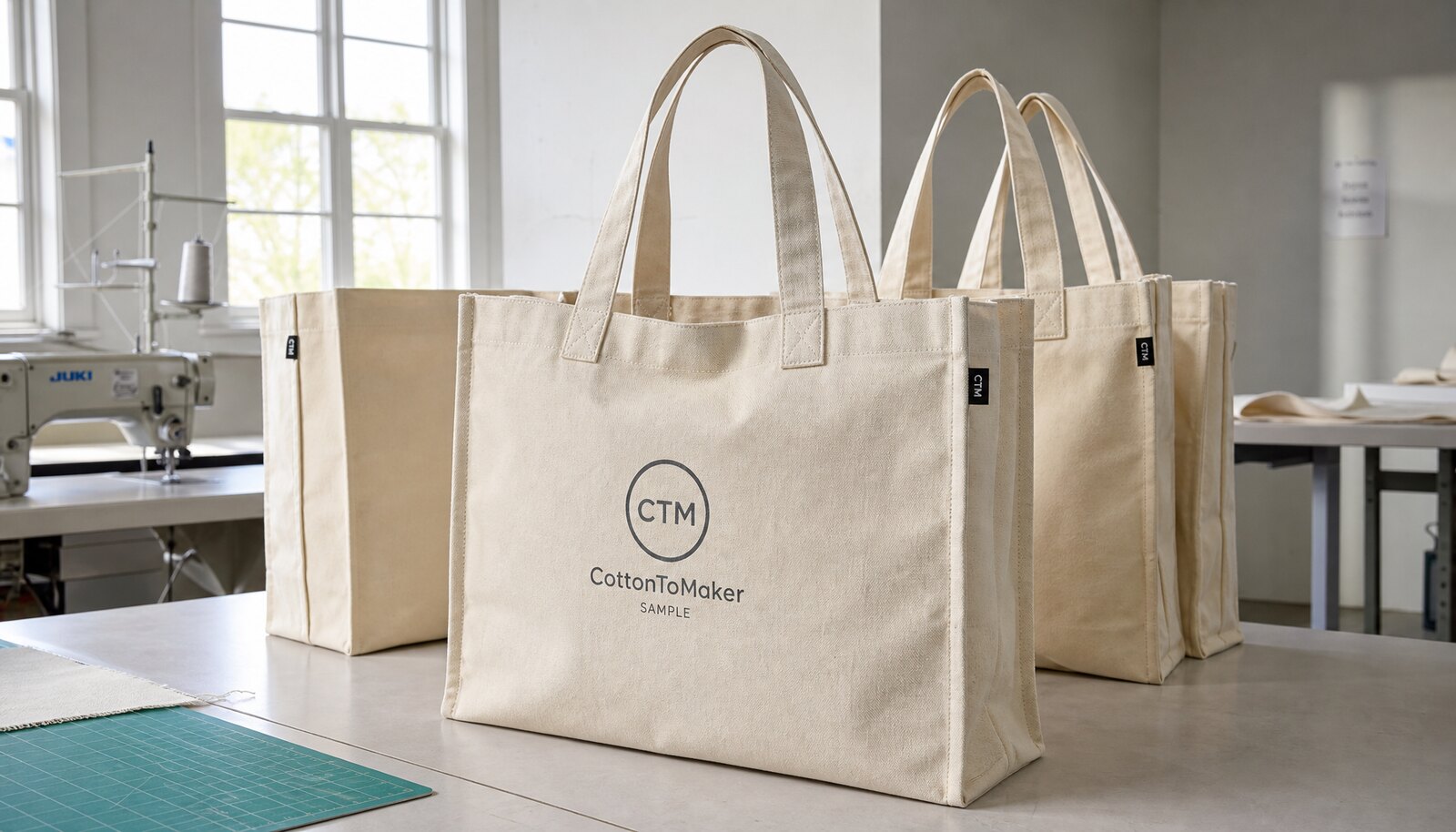
What schools really need from a large canvas grocery bag
Schools rarely buy these bags as generic grocery carriers. In practice, the bag is usually doing one of four jobs: holding books from a fair, carrying supplies for a parent event, serving as a reusable welcome bag, or acting as a resale item in a fundraiser. That matters because the right spec is not just about size. It is about load, print visibility, and whether the bag still looks acceptable after repeated use.
For procurement teams, the first mistake is quoting the bag like a simple promo item. A school order should be written like a use-case spec. If the bag will carry books and folders, a light canvas body that works for giveaways may fail in real use. If it is only for a one-day distribution, paying for heavy construction is wasteful. The goal is to match the construction to how the bag will actually move through the school program.
- Define the main use: event giveaway, library carry, retail resale, or staff pack.
- State the expected load in practical terms, such as books, folders, or lunch items.
- Decide whether repeat washing, foldability, and shelf appearance matter.
Choose fabric weight by load, not by habit
Canvas weight drives both price and performance. For large canvas grocery bags used in schools, 10-12 oz canvas, roughly 340-400 gsm, is a common starting point when the bag is for light daily carry or event distribution. It keeps the cost manageable and still feels more substantial than a thin nonwoven or poly tote. If the bag will carry books, catalogs, or heavier supplies, 14-16 oz canvas, roughly 470-540 gsm, is the safer spec because it resists sagging and keeps the bag upright at the bottom panel.
The fabric decision should also include whether the canvas is washed, dyed, or left natural. Natural unbleached canvas usually gives the cleanest school-friendly look and avoids color matching issues. Dyed canvas can look premium, but it adds color consistency risk across lots. If the school wants a bright seasonal run or retail resale, state whether slight shade variation is acceptable. If not, ask the supplier to quote the same lot or the same dye batch where possible.
- 10-12 oz canvas: best for giveaways and lighter loads.
- 14-16 oz canvas: best for books, library use, and higher perceived value.
- Specify natural, bleached, or dyed canvas up front to avoid surprise color variation.
Construction details that change the bag in use
A school buyer should pay attention to gusset depth, handle length, and reinforcement. A wider gusset lets the bag stand better on a table and carry boxed items without collapsing. A longer handle drop is useful when staff or parents wear the bag over a coat, but too long a handle makes the bag swing awkwardly. The handle attachment is where many low-cost bags fail first, so the stitch pattern matters more than most product sheets admit.
For this category, ask the factory to show the handle stitch method in the sample photos. A reinforced box-X or bar-tack at the stress point is more useful than decorative stitching with no real reinforcement. If the bag is intended for heavier books, ask for a cleaner bottom seam and enough seam allowance to tolerate repeated loading. A good quote should state the finished dimensions, handle width, handle drop, and reinforcement method, not just the flat bag size.
- Gusset depth affects stability and usable volume.
- Handle length affects comfort and classroom or event usability.
- Reinforced stress points matter more than decorative seams.
Print method choices: cost, durability, and artwork limits
For most school programs, screen printing is the default because it gives a clean logo, decent durability, and controlled cost at volume. One or two solid colors work best on canvas, especially when the school logo is simple and the order quantity is large enough to absorb setup. If the artwork has small text, thin lines, or multiple colors, you need to decide whether the visual gain is worth the extra setup and print risk.
Heat transfer and DTF can handle more detailed graphics, but they are not the automatic answer. On heavy canvas, the print film must survive folding, friction, and handling by students or parents. Embroidery can look premium on smaller placements, but it is rarely the most efficient choice for a large front graphic. The practical rule is simple: the more complex the art, the more you should insist on a physical sample, not just a digital proof.
- Use screen print when the logo is simple and the run is large.
- Use heat transfer or DTF only when the artwork justifies the added risk.
- Ask for print placement dimensions so the logo does not drift on the finished bag.
Compare sourcing routes before you compare prices
Not every supplier quote means the same thing. A direct factory quote gives you the cleanest view of material, labor, and setup cost, which is useful when you want repeat orders or a custom school program. A trading company or sourcing agent can be helpful when you need export support, consolidated cargo, or help managing several product lines, but you need factory disclosure and sample control so the quote does not hide a change in production source.
A domestic decorator using imported blanks can work for urgent school deadlines or small programs, especially if the bag body is standard and the only variable is the logo. The tradeoff is that the blank bag may not match the exact size, fabric, or finish you would specify in a direct custom order. In other words, route choice is a sourcing decision, not just a logistics decision. If the route changes, the spec changes too.
- Use direct factory sourcing when custom construction and repeatability matter.
- Use an agent only if factory identity and sample control stay transparent.
- Use local blank decoration only when the schedule is tight and the spec is flexible.
How to read a quote without missing the hidden cost
A usable quote should separate the unit price from setup and packaging charges. If the supplier gives one single number with no detail, you cannot compare it against another factory. For large canvas grocery bags for schools wholesale buying checklist work, ask for pricing by quantity tier, print color, sample fee, plate or screen charges, and packing format. The unit price may look attractive, but the quote can still be expensive once you add logo setup, individual polybags, inner cartons, and export cartons.
MOQ logic also needs to be visible. A supplier may quote a low unit price at 5,000 pieces but require a higher MOQ for custom size, custom color, or more than one print position. That is normal. What matters is whether the MOQ is driven by fabric ordering, print screen setup, dye batch, or carton packing. Once you know the reason, you can decide whether to simplify the spec or buy the larger quantity.
- Request unit price by quantity tier, not one flat number.
- Separate bag price, print setup, labels, and packing in the quote.
- Ask why the MOQ exists so you can decide whether to simplify the spec.
Sample approval should test the real production route
A sample is useful only if it matches the bulk route. A showroom sample made from different fabric or a different print process can hide problems that show up later in production. For school orders, the pre-production sample should use the same canvas weight, same thread, same print method, and same packing style as the bulk order. If the supplier cannot do that, the sample is not proving enough.
When you approve the sample, treat it like a golden sample for the PO file. Measure the finished size, inspect the seams, verify print placement, and physically load the bag. If the bag is intended for textbooks, put textbooks in it. If it is intended for parent shopping use, load it like a grocery bag. A practical sample test is more useful than a perfect-looking sample that fails after the first few uses.
- Use a pre-production sample from bulk materials, not a display sample.
- Approve one physical sample as the reference for bulk inspection.
- Test the bag with the actual items it is expected to carry.
Packing and distribution matter for school programs
Packing is often ignored until cartons start arriving in the warehouse. For schools, bulk-packed canvas bags are usually the most efficient option because they reduce packaging waste and lower carton volume. But if the bags are going into retail resale or individual gifting, you may need polybags, barcode stickers, or insert cards. Decide this before the factory books materials, because packing changes carton dimensions, freight cost, and handling time.
Carton count and carton size should be part of the quote, not an afterthought. A bag that is inexpensive by unit price can become costly if the cartons are oversized or the pack count is inconsistent. Ask for the number of bags per carton, the gross weight, and whether the carton marking follows your warehouse requirement. If the school distribution will be handled by volunteers or internal staff, make the packing easy to count and easy to open.
- Bulk pack is usually best for warehouse efficiency and lower cost.
- Retail or gift use may justify polybags and labeled inserts.
- Check carton count, gross weight, and mark format before approving production.
Lead time risks and landed-cost reality
Lead time is not just production time. For a school program, the schedule risk usually sits in four places: artwork approval, sample approval, raw material availability, and freight booking. If the order is for a fixed school term or fundraising event, leave enough time for corrections after the first sample. A supplier who promises a fast ship date but cannot explain the critical path is not giving you a reliable schedule.
Landed cost should be compared on the same basis. One quote may look lower because it is ex-works or FOB and leaves freight, duties, and local delivery to you. Another may include export packing or inland trucking. When you compare large canvas grocery bags for schools, normalize the quote against the same terms, then add freight and receiving costs. That is the only way to see which supplier actually fits the budget.
- Build time for artwork, sample approval, and freight booking into the plan.
- Compare quotes on the same trade term before judging price.
- Include cartons, inland transport, and warehouse receiving in the landed cost.
Specification comparison for buyers
| Spec decision | Recommended option | When it fits | Buyer risk to check |
|---|---|---|---|
| Supplier route | Direct factory order with clear artwork, size, and packing spec | Best when the school district, importer, or distributor wants custom construction and repeat orders | Confirm who controls cutting, printing, and final inspection; avoid quotes that hide subcontracting |
| Supplier route | Trading company or sourcing agent with named factory disclosure | Useful when you need multi-category sourcing or help managing export paperwork | Make sure the factory is not changed after sample approval |
| Supplier route | Domestic decorator using imported blanks | Fits urgent programs and smaller budgets with limited customization | Check whether blank bag quality, country of origin, and print durability meet your target |
| Fabric weight | 10-12 oz canvas, about 340-400 gsm | Good for school events, parent giveaways, and light daily carry | Risk of sagging if the bag will hold textbooks, laptops, or heavy books |
| Fabric weight | 14-16 oz canvas, about 470-540 gsm | Better for library use, book fairs, staff packs, and reusable grocery carry | Higher cost and more bulk in carton packing; confirm the handle stitch can match the heavier body |
| Print method | 1-2 color screen print with a simple logo | Best for volume orders where durability and cost control matter | Check color registration, print hand feel, and curing so the ink does not crack or rub off |
| Print method | Heat transfer or DTF for complex artwork | Useful for multicolor school graphics, gradients, or short runs | Test wash and flex durability; some films fail faster on heavy canvas folds |
| MOQ strategy | Start with one standard body color, one print location, and one carton pack | Helps keep first order price and risk under control | Too many variables can push the MOQ up or force expensive setup charges |
| Packing route | Bulk-packed bags with agreed carton counts and clear label marks | Efficient for school distribution, fundraising, and warehouse receiving | Verify carton dimensions, count per carton, and whether individual polybags are needed |
Buyer checklist before sampling
- Confirm the exact use case: student giveaways, book fairs, library carry, fundraising retail, or staff welcome packs.
- Lock the finished size, gusset depth, handle length, and target load before requesting quotes.
- State the target fabric weight in gsm or oz and note whether you want washed or unwashed canvas.
- Specify print method, number of colors, print placement, and whether the logo must stay centered on both sides.
- Decide if you need woven labels, side labels, or only a printed logo.
- Set the order quantity by tier and say whether you can combine sizes or colors to reach MOQ.
- Define packing: bulk pack, individual polybag, inner carton, or retail-ready insert card.
- Give the destination port or warehouse ZIP so freight and cartonization can be priced realistically.
- Ask for a pre-production sample made from bulk fabric, not a showroom sample.
- Require a clear production calendar that shows sample approval, bulk production, inspection, and ship date.
Factory quote questions to send
- What is the finished fabric weight after finishing, not just the base fabric weight?
- What stitch construction do you use at the handle attachment and gusset stress points?
- Which print method are you quoting, and what is the setup charge for each color or side?
- Can you confirm the actual bag dimensions, handle drop, and acceptable tolerance after sewing?
- Will the pre-production sample use the same fabric, thread, print ink, and packing as the bulk order?
- What is your MOQ by size, color, and print variation?
- What is included in the unit price: bag only, printing, labels, polybag, carton marks, and export cartons?
- What are your lead time, sample time, and production time after sample approval?
- What overrun or underrun policy do you use, and how do you handle shortages in a bulk order?
- Can you provide carton size, carton count, gross weight, and shipping terms for landed-cost calculation?
Quality-control points to confirm
- Fabric weight matches the approved swatch and does not feel thin, uneven, or lightly woven in the body panels.
- Bag dimensions stay within the agreed tolerance for width, height, and gusset after sewing and pressing.
- Handle attachment uses reinforced stitching at the stress point, with no skipped stitches or loose thread ends.
- Print placement is centered and aligned with the approved artwork position on every panel.
- Ink coverage is even, fully cured, and does not crack when the bag is folded by hand.
- Seams are straight, corners are clean, and there are no needle holes, oil stains, or fabric snags.
- Carton counts match the packing list, and the case pack is consistent across every carton.
- A practical load test with books or an agreed weight does not cause handle failure, seam split, or visible distortion.