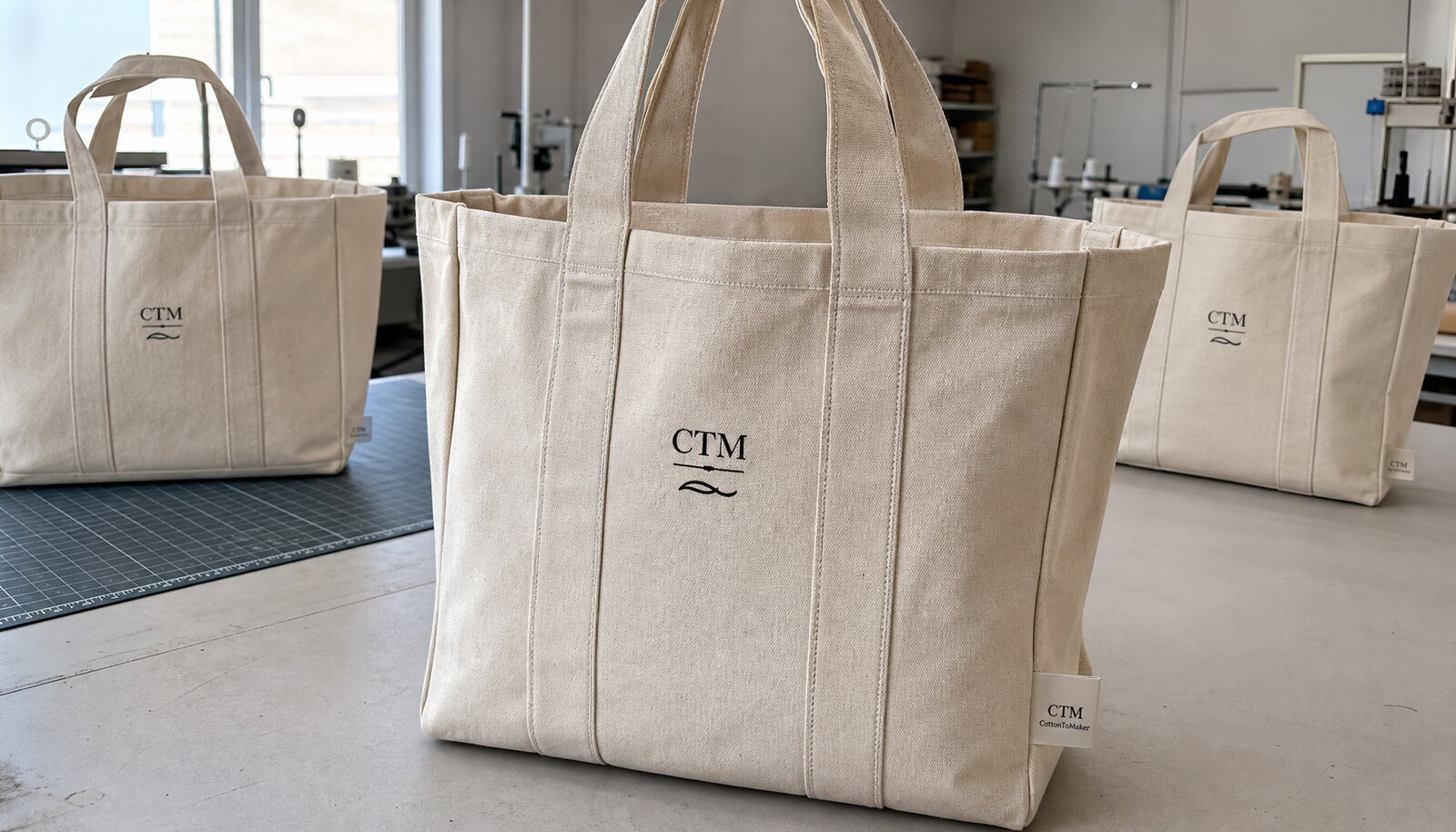
Why hotel buyers need a precise bag specification, not a loose tote description
Large canvas grocery bags for hotels are easy to describe and surprisingly easy to misbuy. A procurement team may think it has ordered one standard item, while the supplier is quoting a different cloth weight, seam build, print method, and pack format. The result is not only a price gap. It is a quality gap that shows up after the first property receives the bags and realizes they are too soft, too small, too flimsy, or too expensive to land.
For hotel buyers, the real task is to turn a marketing object into a controlled purchase item. The bag may be used as a guest amenity, a gift-with-stay item, a shop SKU, or a branded grocery carrier. Those uses look similar from a distance, but they drive different requirements for load capacity, branding clarity, carton presentation, and reorder consistency. If the spec is loose, the supplier fills the gaps with its own assumptions.
The best hotel specs read like a short product engineering brief. They define finished dimensions, fabric basis, handle construction, print location, packing, and acceptance criteria. That gives procurement a better way to compare quotes line by line and gives the supplier a clear target to sample against before cutting bulk. It also reduces back-and-forth later, when the order is already in motion and small ambiguities become expensive.
A good spec is also a brand-control tool. In hotels, the tote is often handled at check-in, carried through the lobby, photographed by guests, and reused in public. That means the bag is not just packaging; it is a visible extension of the property brand. A bag that looks right in a sample room but wrong on arrival can affect both guest perception and internal confidence in procurement. The cost of precision is modest compared with the cost of replacing a weak or off-brand run.
There is another reason to be exact: many buyers source the same bag for several properties. A loose description may allow each supplier to quote a slightly different interpretation, and the first production run can become the hidden standard for the next reorder. Once that happens, the buyer is no longer comparing suppliers; it is comparing memories. A written specification prevents that drift and gives the hotel group a stable baseline for repeat buying.
- Do not request a “large canvas grocery bag” without a finished size and use case.
- Separate amenity use from retail resale use; the same bag often should not serve both without a stronger spec.
- Treat packing and carton labeling as part of the product, not as an afterthought.
Fabric weight, weave, and finish: what actually drives performance and price
Canvas weight is one of the biggest sources of quote spread, but the quoted number is not always comparable across suppliers. Some factories quote greige fabric weight, some quote finished weight after washing or bleaching, and some quote a nominal ounce value that is more sales language than measurement. Procurement should ask which basis is being used before comparing prices.
A practical starting range for hotel programs is 8–10 oz for lighter amenity use and 10–12 oz for grocery carrying or retail resale. In GSM terms, many buyers see roughly 280–340 GSM for midweight canvas and 350–420 GSM for heavier builds. Those are useful working bands, not universal thresholds. The real result depends on weave density, finishing method, and how much the fabric is expected to hold its shape after loading. A tightly woven 10 oz bag can outperform a loosely woven 12 oz bag if the construction is better, so the fabric spec should never be separated from the sewing spec.
The weave should be called out as well. Buyers often focus on the weight and ignore how the weave affects print clarity and bag body. A tighter plain weave tends to give cleaner logo edges and a more structured feel; a looser weave can be softer but may show more distortion near seams or under load. If the hotel wants a premium gift-shop look, the buyer should request a sample photo or actual hand sample under the intended print method rather than assuming all canvas behaves the same.
Finish matters almost as much as weight. Natural canvas is usually the easiest option to source and generally prints cleanly. Bleached natural gives a brighter retail look, but buyers should ask for shade tolerance and color control because bleaching can vary between lots and mills. Dyed canvas is attractive for boutique hotel branding, yet the buyer should require rub resistance and colorfastness targets so a dark bag does not transfer dye onto garments, luggage, or counter surfaces.
If the bag is intended to carry real groceries, ask the supplier what load the seam and handle construction can support in production conditions, not just in a marketing claim. The cost difference between a lighter and heavier build is not only the fabric; it also affects cutting waste, needle wear, sewing time, and carton weight. That is why landed cost can move more than expected once the spec is finalized. The buyer should think in terms of finished performance, not fabric weight alone.
One practical sourcing tip: ask for the fabric basis in the quote and the sample notes. If the supplier writes only “10 oz canvas” with no clarification, the number is too vague for repeat buying. If the supplier states “10 oz finished natural canvas, 3/1 weave, no wash finish” or something similar, the quote becomes much more useful for comparison and reorder control.
For hotel programs that will be restocked over time, consistency matters as much as the first shipment. A fabric that looks acceptable in one lot but varies significantly in shade or hand feel creates a reordering problem later. Buyers should ask whether the factory controls the mill source and whether the same fabric lot can be repeated. That is especially important when the bag is used across multiple properties or combined with printed inserts or labels that need to match the tone of the cloth.
- Ask whether fabric weight is quoted before or after finishing.
- Require shade approval for bleached or dyed canvas under daylight and indoor light.
- Match fabric weight to the load expectation, not to a vague idea of premium.
- If the bag will be washed or reused often, include shrinkage and colorfastness in the fabric discussion.
Bag dimensions that work in hotels without becoming awkward at checkout or in-room display
A useful large grocery bag must have real volume, but it also needs a shape guests can carry comfortably. A common procurement range is roughly 15–18 in wide and 13–16 in high, with a 4–6 in bottom gusset and, when needed, a side gusset for better standing shape. That range is wide enough to hold packaged groceries or folded textiles, yet not so oversized that the bag becomes floppy or difficult to display in a hotel shop.
Handle geometry is where many specifications fail. Buyers often focus on overall bag size and ignore handle drop, which determines whether the bag can be carried on the shoulder, held from the hand, or stacked neatly for retail. A total handle length around 24–28 in with a 10–12 in drop is often workable for hotel use, but the right number depends on whether the bag is meant to be carried from front desk to room, from valet to car, or from shop to street. A taller guest-use bag may need slightly longer handles to feel comfortable, while a shop item may need cleaner proportions for shelf presentation.
The open mouth and gusset behavior deserve attention too. A bag that stands upright in sample form may collapse once printed or packed if the gusset is too shallow or the side seam is weak. If the hotel wants a shelf-ready product, ask for a filled sample with the intended pack load. That simple check tells you more than a flat drawing alone. For procurement, the goal is not maximum dimensions; it is dimensional control that supports the actual use case.
This is also where buyers should define which measurement matters most. Some teams care about usable internal volume, while others care about the outside footprint for display or warehousing. Those are not the same thing. If the tote is meant to fit on a specific retail shelf or in a guest package, write the external dimension. If the goal is carry capacity, add gusset depth, opening width, and handle geometry. The more specific the measurement target, the less likely the production sample is to drift.
For multi-property sourcing, avoid local variations unless there is a functional reason. A hotel group may be tempted to let each property pick a slightly different size or handle style. That can seem flexible in the moment, but it makes stock management harder and weakens the benefit of scale. One master size, one master print placement, and one packing format usually produce better control and lower long-term buying friction.
A final detail that often gets missed is how the bag behaves when filled. Some canvas totes look fine empty but become awkward when loaded because the sides buckle or the mouth closes too tightly. That matters in hotels, where the bag may carry gift items, local purchases, or groceries and still need to look presentable when handed to a guest. A filled sample, even if rough, is one of the fastest ways to see whether the geometry really works.
- Write finished dimensions and allowed tolerance for each critical component.
- Specify gusset depth separately; it changes capacity and sewing time.
- Ask for a filled sample or dimensional photo if the bag must stand on retail shelves.
- If multiple properties use the bag, keep one master size unless there is a real functional reason to vary it.
Construction details that determine whether the bag survives repeated use
For hotel procurement, canvas bag construction is not a minor detail. It is where many quality failures start. The most common weak points are the handle roots, gusset corners, and the seam where the body turns into the bottom panel. If those areas are not reinforced, the bag may pass a visual check but fail after a few uses or after one heavy grocery load.
A stronger construction usually combines a bottom gusset, side gusset, locked seams, and bar tacks or equivalent reinforcement at the load points. A simple seam-only build can be adequate for low-stress amenity use, but once the bag is expected to carry heavier items, the buyer should ask how stress is transferred away from the handle edge. The difference is often visible in the sample: stronger bags feel a little more structured and less likely to fold sharply at the root.
Handle build deserves the same level of attention. Buyers should ask whether the handle is self-fabric, webbing, or a blended construction, and whether it is double-stitched or topstitched with reinforcement at the attachment point. Handle width also matters. A very narrow handle may be comfortable for light use but cut into the hand when the bag is full. Wider handles can improve comfort and visual quality, but they may add cost and alter the bag’s final look. The buyer should tie the handle spec to the intended load rather than choosing a style purely by appearance.
If the tote is going into a hotel shop, the visible inside finish matters more than many teams expect. Loose threads, unfinished seam ends, or uneven turn-in allowances are noticeable when a guest opens the bag. That does not mean every tote must be luxury-grade, but it does mean the internal finish should match the brand position. A premium urban hotel can usually justify a cleaner finish and tighter stitch standard than an amenity bag that is handed out for one-time use.
It is also worth specifying whether the bag must be washable or simply wipeable. Some hotel buyers assume a canvas tote can be laundered, but after print and label choices are made, wash performance may not be consistent enough for regular laundering. If washing is important, say so upfront and require the supplier to confirm shrinkage, colorfastness, and print performance after the intended cleaning cycle. If washing is not a requirement, do not pay for construction features that are only useful for laundry durability.
A practical sourcing habit is to inspect the turning points and stitch consistency under normal light before asking for any marketing sample photos. Those are the areas where craft quality shows up first. If the seam line is straight, the reinforcement is even, and the handles are symmetric, the factory is usually controlling the line well. If those basic points are off, the buyer should be cautious about assuming the bulk run will improve on its own.
- Ask for bar tacks or equivalent reinforcement at all load points.
- Specify handle width, attachment style, and seam allowance, not just handle length.
- Inspect internal finish and thread trimming if the bag will be guest-facing or retail-facing.
- Define washability only if the program truly needs it.
Print method, artwork limits, and the hidden cost of design complexity
For most hotel logos, screen printing remains the most efficient choice because it balances cost, durability, and visual sharpness on canvas. It is usually the best option for one- or two-color artwork with a strong brand mark. The print sits well on natural canvas, and the setup cost is easier to control when the order will repeat. For procurement, that matters because a small design change can create new screens, new approvals, and a new cost line.
Transfer printing and digital printing can help when the artwork has gradients, small type, or a photographic look, but they should be chosen with eyes open. On rough canvas, fine detail can soften, and the print can feel less integrated into the fabric than a proper screen print. If the bag is a premium shop item, the buyer should request a strike-off on the actual fabric, not just a digital proof. Embroidery can look upscale, but on larger grocery-style bags it may pucker, add thickness near seams, and create more complexity around wash performance.
Print rules should be written as procurement limits, not design hopes. State the maximum number of colors, the allowed print area, and the acceptable deviation in placement. If the logo sits near a seam or gusset, write a placement rule that accounts for distortion when the bag is loaded. Buyers should also ask whether the supplier is using water-based, plastisol, or another ink system, because drying, hand feel, and rub durability can differ. The point is not to specify the chemistry for its own sake; it is to avoid mismatches between the artwork and the production method.
Small text is a common failure point. A logo can look sharp on a screen, yet the fine letters may break up once printed on textured canvas. If the brand mark includes a tiny tagline, legal line, or web address, consider whether it is actually necessary on the bag. Many hotel programs get better results by printing the primary logo cleanly and moving the secondary information to a label, hangtag, or insert card. That choice often improves both readability and re-order stability.
The buyer should also think about print placement in relation to the bag’s natural fold line. If the artwork crosses a deep crease, it may crack or distort more quickly in use. A centered, single-face print is usually the least risky. Multi-panel art can work, but only when the supplier shows strong registration control and the artwork is simple enough to survive normal sewing variation. For a hotel bag, restraint often looks more expensive than trying to print everything at once.
If the program may repeat across seasons or properties, ask the supplier to archive the screen setup, artwork version, and approved sample. That saves time later and helps the buyer protect consistency. The real cost of artwork is not only the first setup; it is the cost of reproducing the same result six months later without debate.
- Use screen print for repeatable hotel logos and simple brand marks.
- Use transfer or digital printing only when the artwork requires it and the rub test is acceptable.
- Do not approve a complex logo method before seeing a strike-off on the real fabric.
- Write placement tolerance so a small shift does not become a disputed defect.
How to compare supplier quotes without getting fooled by scope gaps
The most useful quote is not the cheapest unit price; it is the one that tells you exactly what is inside the number. Hotel buyers should request separate lines for fabric, stitching, printing, packing, and carton specification whenever possible. If a supplier quotes one all-in number with no detail, it becomes difficult to see whether the apparent savings came from a lower fabric basis, a weaker seam build, or a simplified pack method. That is how procurement ends up comparing bags that are not truly equivalent.
A good comparison also looks at the route to production. A direct factory quote usually gives the best visibility into material choice, line capacity, and packing control. It is often the strongest option when a hotel group wants a stable repeat program. A trading company can be helpful if the internal procurement team needs one point of contact, but it may add a margin layer and can blur responsibility if sample quality and bulk quality diverge. A regional decorator or stock holder can move quickly on short runs, but it may be limited on fabric options, exact carton labeling, and consistent replenishment.
To make the comparison real, ask each supplier to quote the same spec three ways: EXW, FOB, and delivered to your consolidation point. Add carton dimensions and cartons per pallet if the bags will be warehoused centrally. Then compare not only unit price but also freight density, packing protection, and rework risk. A bag that folds compactly can ship more efficiently than a bulkier alternative, which may matter more than a few cents of sewing cost on a large hotel rollout.
There is also a hidden scope issue in sampling. Some suppliers will include a basic pre-production sample, while others will charge separately for artwork revisions, print screens, or courier shipment of multiple sample rounds. That does not make one supplier better or worse by itself, but the buyer should know where those costs sit. If sample work is not explicit, a cheap quote can become expensive after revisions begin.
For multi-property rollouts, compare the supplier’s ability to repeat the same result rather than only their ability to make a first sample. Ask how they retain approved references, who signs off the final bulk release, and whether the same production line will be used for reorders. Those details matter because a hotel program is often judged over time, not in a single shipment.
A simple internal discipline helps: keep one comparison sheet with the same columns for every supplier and do not let one vendor answer in a different format. That alone reduces quote noise and keeps the team focused on the details that actually affect landed quality.
- Require quotes to state whether packing, labels, and inserts are included.
- Compare EXW, FOB, and delivered pricing so freight does not hide the real cost.
- Use the same artwork file and the same packing instruction across all suppliers.
- If the supplier cannot explain a price difference, assume a scope difference until proven otherwise.
Supplier route comparison for hotel buyers: factory direct, trading company, or local converter
The supplier route should match the program’s complexity. Factory direct is usually best when the bag spec is fixed, the order is repeatable, and carton labeling must match a hotel distribution plan. It gives the buyer more control over fabric procurement, sewing details, and production scheduling. For multi-property hotel groups, that control is often worth more than a small price advantage because it reduces drift between reorders.
A trading company can be a practical route if the hotel team lacks in-house product development capacity and needs a coordinator to manage artwork, sampling, and multiple factory options. The tradeoff is that procurement must be stricter about documentation. Ask the trader to identify the actual factory, the responsible QC owner, and what happens if the line changes. If the intermediary is unable to provide traceable factory information or sample accountability, risk rises quickly.
Local converters or domestic decorators can work well for urgent replenishment, launch events, or very small pilot runs. They are often faster and easier to communicate with, but they may have fewer fabric choices, less competitive pricing on heavier canvas, and less flexibility on carton engineering. They are best judged on responsiveness, proofing speed, and consistency—not only on per-unit cost.
Useful supplier audit questions include: Who buys the fabric? Who owns the print screens? Who signs off the pre-production sample? What happens if the first cartons fail a receiving check? If the answer to those questions is vague, the route may not be strong enough for a hotel rollout.
For a global hotel group, the right route may even vary by program stage. A local converter can be sensible for a launch or a seasonal promotion, while factory direct may be better for the steady replenishment program that follows. Procurement should not treat one channel as universally superior; it should match the route to the level of control, speed, and repeatability needed.
The key is accountability. A buyer wants to know who can actually fix a problem if the handle length is wrong, the print shifts, or the carton labels are misprinted. If the route does not make that obvious, the quote may be attractive on paper but weak in execution.
- Choose factory direct for repeat hotel programs and controlled packaging.
- Use a trading company only if it can document the factory, the QC process, and the sample approval chain.
- Use local conversion for speed, but verify material consistency and replenishment ability.
- Ask who owns screens, pattern files, and approved samples so reorders do not depend on one person’s memory.
What belongs in the quote request so the numbers are actually comparable
The RFQ should read like a production instruction, not a shopping request. A supplier should know the finished bag size, canvas basis, color, print method, handle build, packing format, carton count, and inspection expectation before it prices the job. If those items are left open, each vendor fills the blanks differently and the quote becomes a negotiation tool rather than a procurement document.
A strong RFQ also names the sample stages. Buyers should ask for a visual proof or mockup, then a pre-production sample made with the intended fabric, print process, and pack method, followed by a sealed golden sample. This matters because a nice sample made by hand may not reflect bulk sewing reality. The print may shift once the production line speeds up, the handles may measure differently, or the fold may change once the bag is machine packed.
If the hotel group is buying for several properties, the quote request should ask whether one artwork can be used with different property names, whether carton marks will vary by destination, and whether any packaging changes are needed for regional distribution. The more the quote depends on assumptions, the more likely it is to create a receiving dispute later. Procurement gets better leverage when every supplier is pricing the same technical package.
It helps to include a short decision summary at the top of the RFQ: intended use, target load, desired look, required pack format, and whether the bag is for internal use or retail sale. That reduces back-and-forth and gives the supplier context for choosing the right sewing and print method. The goal is not to over-engineer the request; it is to prevent avoidable ambiguity.
Do not forget timelines. A useful RFQ asks the supplier to separate sample lead time, material purchase lead time, bulk production lead time, and dispatch timing. If the hotel opening date or promotion launch is fixed, this split becomes critical. A supplier can often make a sample quickly but still need longer for fabric sourcing or print setup. Clear timing lines help buyers spot schedule risk early.
Finally, include the commercial details that affect the real total cost: payment term, Incoterm, destination, and any assumptions about rework or replacement. That is especially important for hotel groups that buy through central procurement but receive goods to several locations. If the quote does not define the destination, freight assumptions can bury the true unit cost.
- Include a one-page tech pack with dimensions, artwork, labels, packing, and carton marks.
- Ask for a pre-production sample and a sealed golden sample.
- Name the approval point that releases bulk fabric cutting.
- Request separate pricing for optional items such as individual polybags or insert cards.
Quality control that is specific enough to stop rework before shipment
QC for canvas bags needs to go beyond visual approval. A hotel buyer should define measurable pass/fail thresholds before bulk production starts. The first layer is dimensional control: finished width, height, gusset depth, handle length, and handle drop should each have their own tolerance. Overall size is useful, but it does not catch a short handle or a shallow gusset that reduces usable capacity.
The second layer is strength. At minimum, ask the factory to document a load or pull test for handles and high-stress seams. Many procurement teams use a practical static load test in the 5–7 kg range for amenity use and 8–12 kg for grocery-style use, with zero seam failure and no permanent handle tear. If the bag is sold at retail or expected to handle heavier loads, the buyer may need a higher target or an agreed pull-force standard from the supplier’s lab or a third-party inspector. The exact figure should be tied to the intended use, not copied from another product category.
The third layer is print and color performance. For dark dyed fabrics, specify rub or crocking checks so color does not transfer. For printed logos, ask for dry rub and, if relevant, wet rub performance using a named reference method such as ISO 105 or AATCC. If the bag will be washed or reused often, include wash performance in the acceptance standard. For hotel use, a bag that looks acceptable on the table but sheds color in a guest laundry cycle is a procurement failure.
Quality control should also cover thread finish and needle damage. Canvas can show broken stitches, snags, and skipped needles very clearly, especially on natural fabric. Ask the factory to check for loose threads, open seam ends, and stitch density consistency along the handle and top edge. Those are small issues individually, but together they create the impression of a low-grade bag.
Finally, control the packout. Cartons should show the right SKU, quantity, property name or destination code, and lot number. Ask for carton compression or corner crush checks if the bags are packed tightly or stacked for cross-dock freight. A weak carton can make good bags arrive as poor bags because the edges wrinkle, the count shifts, or the outer box collapses in transit. That is why packaging belongs in the QC conversation, not only in logistics.
If third-party inspection is part of the process, define the AQL target or the inspection rule in the PO or quality appendix. Even a simple inspection plan is better than none. The important part is consistency: the same dimensional tolerances, the same load test, the same visual defects list, and the same carton check used on every order. That keeps the supplier aligned and makes reorders less dependent on informal judgment.
- Set a dimensional tolerance for each component, not just the total bag size.
- Use written load or pull-test targets tied to the intended use case.
- Add rub/crocking checks for dyed or dark fabrics.
- Require carton labels to match SKU, lot, quantity, and destination before dispatch.
- If you use third-party inspection, name the AQL target in the PO or quality appendix.
Sample approval checkpoints: how to avoid approving the wrong thing
A sample should prove the production method, not just the design intent. For canvas bags, the biggest risk is approving a hand-finished sample that the bulk line cannot reproduce at speed. To reduce that risk, the sample should be made with the same material basis, same print method, same handle spec, and same packing approach intended for production. If any of those elements change later, the sample approval loses its value.
A practical approval sequence is: artwork proof, pre-production sample, and sealed golden sample. The artwork proof confirms the design layout and print placement. The pre-production sample confirms the bag construction. The sealed golden sample becomes the physical reference for QC and receiving. Store it where both procurement and the supplier can access the same version if a dispute arises.
The sample test should include real-use loading. Fill the bag with items that approximate hotel reality: folded textiles, boxed goods, or a grocery-style load. Watch whether the gusset opens evenly, whether the handles sit flat, and whether the print stretches or cracks under shape change. If the bag needs to stand on a shelf, test that condition too. A bag that looks good flat may fail visually once it is filled and displayed.
This is also the right moment to catch labeling issues. Verify woven labels, care labels, and any country-of-origin marking before bulk production. A small label mistake can delay customs processing or create a rework batch that costs more than the label itself. It is better to find that error while the sample is still on the table than after a carton has already been labeled and booked.
Where the hotel program spans multiple properties, the sample should also confirm destination labeling logic. If one property name changes or a regional code is added, confirm that the supplier can update the carton marks without changing the underlying bag spec. That prevents a small administrative change from turning into a new production event.
The most important discipline is to make sample approval traceable. Keep the signed spec sheet, the approved artwork, the physical sample, and the date of approval together. When the bulk shipment arrives, the receiving team should not have to guess which version was approved. Traceability saves time, avoids disputes, and gives the buyer stronger control over repeat orders.
- Do not approve a hand-made sample unless it represents the actual production method.
- Keep a sealed golden sample and a signed spec sheet together.
- Test the bag filled, not only flat on the table.
- Confirm labeling and destination marks before cutting bulk fabric.
Specification comparison for buyers
| Spec decision | Recommended option | When it fits | Buyer risk to check |
|---|---|---|---|
| Fabric weight | 10–12 oz natural canvas for hotel retail; 8–10 oz for light amenity use | Use 10–12 oz when the bag must hold groceries, keep its shape, or present as a retail SKU | A thin bag may look acceptable in a photo but collapse at the gusset, reveal contents, or wear through faster at stress points |
| Weave and finish | Tight plain weave, natural or bleached natural finish, with finish basis clearly stated | Best when buyers need consistent print clarity and predictable hand feel | If the supplier quotes oz only, the actual fabric density may still vary enough to affect strength and print sharpness |
| Bag construction | Bottom gusset plus side gusset, reinforced stress points, lockstitch seams, and bar tacks at handle roots | Good for repeated guest use, grocery loading, and bags that may be resold in a hotel shop | Simple seam-only construction often fails at the handle roots first and can distort once filled |
| Handle geometry | 24–28 in total handle length with 10–12 in drop, adjusted by intended carry style | Works for shoulder carry, front-desk handoff, and shelf display without feeling undersized | Short handles reduce comfort; overly long handles twist in packing and can look sloppy on shelf |
| Handle build | Double-stitch or reinforced attachment with clear seam allowance and matched pair tolerance | Best for heavier loads or bags expected to be reused multiple times | Uneven handle pairs create a visible defect and make the bag hang crooked when carried or displayed |
| Print method | Screen print for 1–2 colors; transfer or digital only for small runs or artwork that requires it | Screen print is ideal for hotel logos, strong contrast, and repeat orders | Fine type, gradients, and small marks can blur or crack if the artwork is not matched to the process |
| Artwork scope | One strong logo face with optional small woven label; avoid full-bleed artwork unless the supplier proves control | Fits most hotel branding programs and keeps the bag easy to reorder | Large multi-color art raises setup cost, complicates sampling, and increases rejection risk if registration drifts |
| Closure option | Open top unless retail presentation or security requires zipper, snap, or magnetic closure | Open top works for grocery convenience and reduces cost and failure points | Extra closures add cost, pack bulk, and another inspection item on the line |
| Color choice | Natural, bleached natural, black, navy, or stone | Natural suits eco positioning; darker neutrals suit boutique retail or premium gifting | Dark dye can rub off if fixation is weak; bleaching can create shade variation lot to lot |
Buyer checklist before sampling
- Define the use case first: guest amenity, in-room retail, gift-with-stay, or resale grocery bag, because GSM, handle length, print limits, and packing format change with the application.
- Lock the exact bag size, including finished width, gusset, height, and handle drop, so sample approvals are based on a measurable target instead of a rough description.
- Specify canvas weight in oz and GSM, plus whether the fabric is raw, bleached, or dyed, so factories quote the same material basis.
- State print area, number of colors, artwork file type, and acceptable registration tolerance, especially if the hotel logo contains small text or fine lines.
- Request seam details: stitch type, seam allowance, bar tacks, and any reinforcement patching at handle roots or gusset corners.
- Confirm packing method, carton count, carton dimensions, carton labels, and whether individual polybags are allowed or prohibited by sustainability policy.
- Require a pre-production sample approval against a signed spec sheet before bulk cutting begins, and keep a sealed golden sample for receiving checks.
- Ask for the production schedule split into sample, material purchase, bulk sewing, printing, inspection, cartonization, and dispatch.
- Ask the supplier to quote landed-cost components separately so packaging changes, inland freight, or rework can be compared without guesswork.
- Build a rejection threshold in writing for missing labels, wrong carton counts, print shift, seam failure, or dimensions outside tolerance.
Factory quote questions to send
- What exact fabric weight, weave density, and finishing basis are you quoting, and is the price based on greige, bleached, or dyed canvas?
- How are the handles built, what stitch pattern is used at the root, and do you bar tack every load point or only the outer edges?
- What is the MOQ per color, per size, and per print design, and what changes if we combine several hotel properties under one artwork family?
- Which print method do you recommend for this artwork, and what is your measurable tolerance for logo placement, registration, and color variation?
- What carton size, carton quantity, inner packing, and outer label format are included in your quotation?
- Can you quote EXW, FOB, and delivered pricing so we can compare freight and packing impact across supplier routes?
- What sample stages are included before bulk production, and at what point is fabric cutting released?
- What QC evidence do you provide before shipment: in-line checks, final inspection report, photos, or third-party AQL records?
- If artwork changes after approval, what is the charge for remake, plate setup, or print screen revisions?
- What failure issues have you seen most often on this bag style, and how do you prevent them during production?
Quality-control points to confirm
- Finished dimensions should stay within a written tolerance, typically ±0.5 in for width and height; if the bag has a gusset or oversized retail shape, define tolerance for each component separately, not only the overall size.
- Handle length and handle drop should be checked separately, with a tighter tolerance on matched pairs so the bag hangs evenly in use.
- Fabric weight should be verified by supplier certificate plus spot check, not only by a catalog claim; note whether the weight is finished fabric or greige basis.
- Seam construction should show no skipped stitches, loose ends, open seams, or pulled bar tacks at handle roots and gusset corners.
- Load testing should be specified in writing: many buyers use a static hold test around 5–7 kg for amenity use and 8–12 kg for grocery-style carry, with no seam failure, handle tear, or permanent distortion.
- Pull-test targets should be written for handle attachment and critical seams; ask the factory to state the test method they use and the minimum pass force they can document, rather than accepting a vague promise.
- Print durability should be checked with a dry rub and wet rub reference standard; for dyed fabrics, add a crocking check so color transfer does not mark clothing or hotel surfaces.
- Colorfastness should be set against an accepted standard such as ISO 105 or AATCC methods; if the bag is dark dyed or washed after use, include wash and rub performance targets in the PO.
- Dimensional tolerance should also cover gusset depth, handle width, and label placement, because those details affect capacity and the finished retail appearance.
- Cartons should be checked for compression resistance, corner crush, and label accuracy; the outer carton must show SKU, color, quantity, lot code, destination, and property name if multiple hotels are receiving stock.