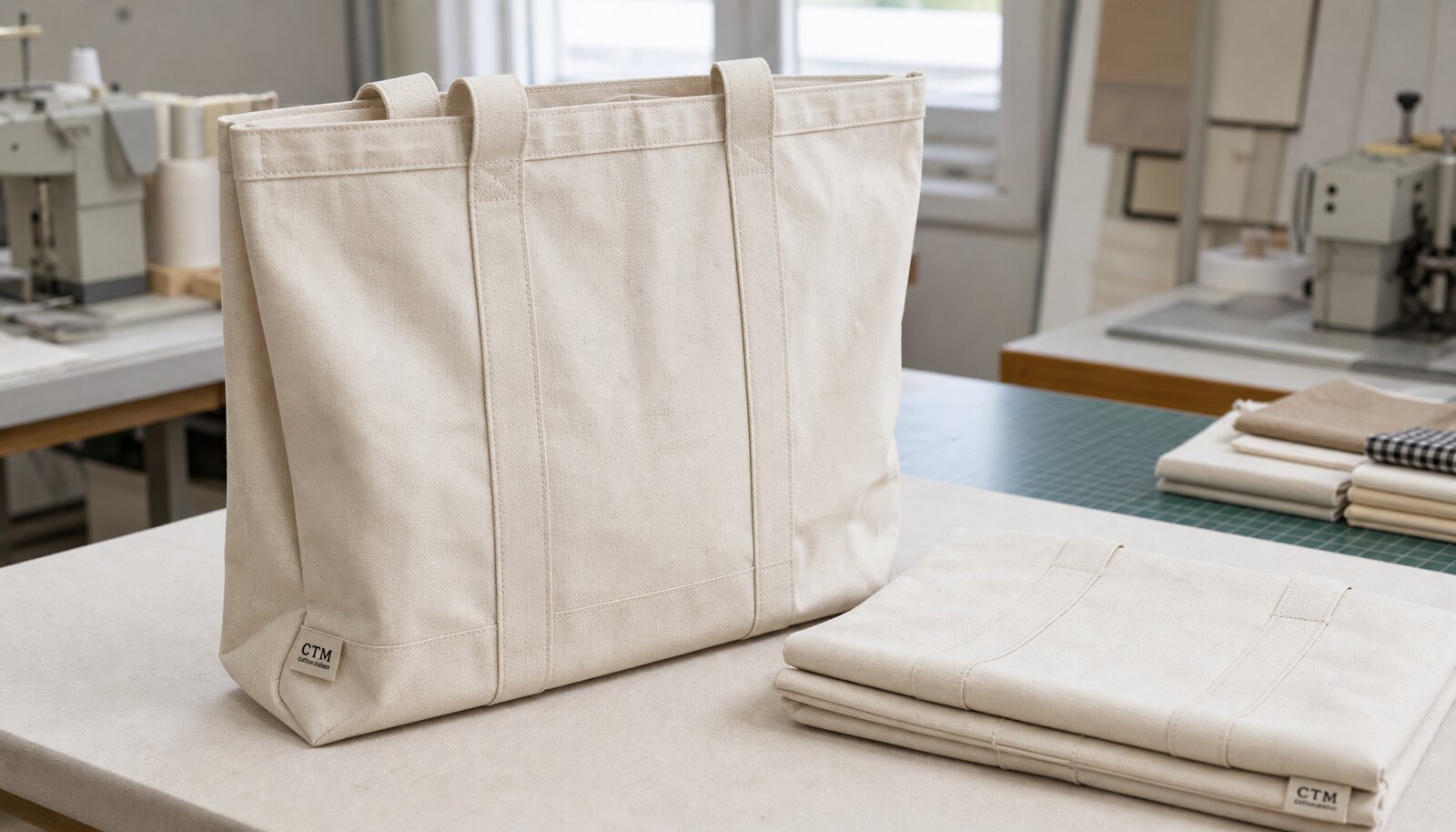
Start With the Retail Job, Not the Bag Name
Large canvas grocery bags for gift shops are usually bought for a different reason than trade-show totes or grocery-store utility bags. They need to look good on a shelf, hold a meaningful retail purchase, and survive repeated customer handling without looking flimsy. That means the spec should start with the buying job: is the bag meant to carry candles, books, boxed gifts, glassware, or mixed seasonal merchandise?
If the supplier only hears large canvas grocery bag, the quote often comes back with a generic pattern, a loose fabric recommendation, and a packing method that works for bulk shipping but not retail resale. A better RFQ defines the customer experience. Say whether the bag should feel premium, whether it will be sold as a standalone item, and whether it needs to support resale markup through print quality and packaging presentation.
- Define the retail load first: light gifts, medium mixed goods, or heavier boxed items.
- State whether the bag is for checkout resale, gift-with-purchase use, or wholesale distribution.
- Decide early if the bag needs a premium shelf look or only functional carry performance.
Choose Fabric Weight Around the Load and Shelf Price
For this category, 8 oz canvas can work for lightweight retail use, but many gift shops settle around 10 oz because it gives a better hand feel and hides through-visibility on the shelf. If the bag is expected to carry heavier gifts or if the customer will reuse it often, 12 oz canvas is safer. In metric terms, many buyers think in the 270 to 400 GSM range, with 340 GSM around the middle ground for balanced cost and durability.
Fabric weight alone does not solve the problem. Buyers should also ask whether the cloth is natural, bleached, garment-washed, or dyed, because those choices affect color consistency, shrinkage, and print sharpness. A soft washed canvas can feel more premium but may raise cost and cause more size variation. A tighter weave gives cleaner print edges, while a looser weave can look rustic but may show strike-through on darker inks.
- Use 8 oz or about 270 GSM when the bag is decorative or carries light items only.
- Use 10 oz or about 340 GSM for the most common gift-shop resale balance.
- Use 12 oz or about 400 GSM when the bag must feel substantial or carry heavier gift sets.
- Ask the supplier to state whether the quoted fabric is raw, bleached, or pre-washed.
Lock the Construction Before You Talk Price
A large bag can still fail in retail if the construction is sloppy. For gift shops, a practical size is often around 40 x 35 x 15 cm or a similar large tote footprint, but the right size depends on product mix and shelving. Handle drop matters more than many buyers expect. If the handles are too short, the bag looks stiff and is uncomfortable on the shoulder. If they are too long, the bag loses its clean shape on the peg or shelf.
Ask the factory how the seams are built, not only whether the bag has a bottom gusset. A good retail tote usually needs reinforced handles, a clean top hem, and a gusset that keeps the body standing or at least sitting flat enough for display. On a quote sheet, specify seam allowance, whether the handles are self-fabric or cotton tape, and whether the handle joint uses bar-tacks, an X-box, or another load-bearing stitch.
- State finished width, height, gusset depth, and acceptable tolerance for each dimension.
- Specify handle length and handle drop, not just total strap length.
- Require reinforcement at the handle base so the bag does not fail under mixed retail loads.
- If the bag must stand on shelf, ask for a gusset and bottom structure that supports that display use.
Pick the Decoration Method by Artwork and Reorder Plan
Screen printing is usually the most practical option for one or two spot colors, especially when the logo is simple and the order is large enough to absorb setup cost. It gives clean edges, repeatable results, and a feel that most gift-shop buyers accept as retail grade. If the design is detailed, has gradients, or changes frequently, digital print or transfer print can work for short runs, but the buyer should verify hand feel and durability before approving bulk.
For premium gift-shop positioning, do not ignore low-cost branding details such as a woven side label, a small patch, or a sewn-in label. These details often give a better retail impression than trying to force a complex full-front print onto canvas. If the artwork is meant to sit inside a box set or gift bundle, a more restrained logo placement can look more expensive than large coverage printing.
- Use screen print for stable repeat orders with simple logos and solid colors.
- Use digital or transfer print only when the artwork complexity justifies the extra risk.
- Consider a woven label or side label if the retail story depends on subtle branding.
- Confirm whether the print will be soft hand, thick ink, or washed-through look before approval.
Understand MOQ Logic Before You Compare Quotes
MOQ is rarely just a factory policy. It is usually a function of fabric procurement, print setup, sewing line efficiency, and packing labor. A larger custom size with a special fabric weight and multiple print colors may require a much higher MOQ than a stock size with one logo. If the factory says the MOQ is 3,000 pieces, that does not always mean the supplier is inflexible; it may mean the current cloth roll width and print screen setup do not support a smaller run without waste.
To compare suppliers properly, ask for pricing tiers tied to the same spec. Separate the cost of fabric, sewing, print setup, sample charge, and packing so you can see whether a low unit price is just hiding a high setup fee. For gift shops, the right question is not only the unit price. It is whether the quote supports a repeatable retail program after the first shipment.
- Request tiered pricing at three quantity levels so you can see how real the MOQ is.
- Separate setup, sample, packaging, and freight from the base bag price.
- Ask whether changing only the logo color or print placement triggers a new MOQ.
- Confirm whether stock fabric lowers MOQ compared with custom-dyed canvas.
Approve Samples Against Measurable Criteria
A good sample is not just a preview of the look. It is the first chance to catch dimension drift, weak stitching, poor print curing, and handle issues before bulk production starts. The best approval process uses one pre-production sample or golden sample and compares it against the spec sheet line by line. If the bag is meant for retail resale, sample review should also include how it folds, how it hangs, and how it looks after a little handling.
The most common mistake is approving based on photos only. That hides seam puckering, rough print edges, and stiffness that may not suit the gift-shop channel. If possible, test the sample with a real product load. Look at the closure behavior, gusset shape, and how the bag sits on a shelf or counter. If the sample feels cheap in the hand, customers will feel the same thing at retail.
- Measure finished dimensions on the sample, not only the cut size before sewing.
- Inspect print alignment, color density, and reverse-side strike-through.
- Check handle anchoring by loading the bag with a realistic gift-shop product mix.
- Reject samples with loose threads, poor top hems, or uneven gusset formation.
Pack the Bag for Retail and for Transit, Not Just for Shipping
Gift shops often need bags that arrive clean, flat, and easy to display. That means packing matters almost as much as the bag itself. A flat-packed bag with a sensible inner quantity is usually better than overstuffed cartons that crush shape and add labor at receiving. If the bag is sold at retail, buyers may also need barcode stickers, belly bands, or a simple insert that explains the product without cluttering the design.
Packing should protect the canvas from moisture, oil, and warehouse dust, but it should not turn the bag into a plastic-heavy item that feels cheap. For many retail programs, an inner polybag or a clean bundle wrap is enough, followed by a master carton with clear marks. Ask the supplier to state carton size and gross weight because those numbers affect freight, warehouse handling, and store replenishment labor.
- Specify inner pack quantity and whether the bags are folded, stacked, or tied in bundles.
- Ask for carton dimensions and gross weight before approval of the packing plan.
- If retail-ready, define label placement, barcode format, and whether a belly band is included.
- Avoid bulky packing that damages the folded shape or raises landed cost.
Plan Lead Time Around Fabric, Printing, and Seasonality
For a straightforward custom canvas tote, a realistic sample timeline is often measured in days, while bulk production is usually measured in weeks. If the supplier already has the right fabric in stock and the print is simple, the schedule can move faster. If the order needs custom fabric, special dyeing, or multiple print colors, the schedule slows down because fabric procurement and print setup become the gating steps.
Holiday buying and gift-shop seasonal planning make this more sensitive. The problem is not only factory capacity. It is the risk of delayed artwork approval, late sample signoff, and carton or label shortages. Buyers should treat the schedule as a chain, not a single date. If one step slips, the whole launch slips, so the quote must show the starting point for lead time and the dependencies that stop production.
- Ask for lead time from artwork approval, not from initial inquiry.
- Clarify whether the supplier can hold greige fabric or finished goods for repeat orders.
- Identify what delays the order most: print screens, fabric sourcing, labels, or packing materials.
- Build buffer time if the order ships before holiday retail peaks.
Compare Landed Cost by Supplier Route, Not by Unit Price Alone
Two suppliers can quote the same bag at different unit prices and still produce very different landed costs. A direct factory may look more expensive at first but can win once you remove the trading margin, reduce rework, and control packing. A local print shop can be useful for small runs, but the fabric base may not be the same and the replenishment economics can break down on the second order. For a gift shop program, the best route is often the one that keeps the spec stable across reorder seasons.
When comparing landed cost, include the hidden pieces that procurement teams often bury in the spreadsheet: sample charge, setup cost per color, carton count, inner pack labor, inland transfer, and any relabeling work. If the supplier cannot quote on the same basis, the lowest price is not comparable. You want a supplier who can tell you how the quote changes when the canvas weight changes, when the print moves from one color to two, or when the packing shifts from bulk to retail-ready.
- Compare quotes on the same fabric weight, size, and print method.
- Make sure freight basis, carton count, and packing format are identical across suppliers.
- Watch for hidden charges on screens, plates, labels, and packing labor.
- Use landed cost to judge the route, not only the ex-factory number.
Write the RFQ So Suppliers Quote the Same Thing
A strong RFQ for large canvas grocery bags for gift shops is short on marketing language and long on production detail. Start with the finished size, fabric target, print method, artwork count, handle construction, and packing requirement. Add whether the bag is for shelf resale, wholesale distribution, or bundled gifting. That gives the factory enough information to quote the actual work instead of filling gaps with assumptions.
The cleanest quotes come when the buyer also states what is not negotiable. For example, if the canvas weight must not drop below a target, if the logo has to stay soft, or if the carton count must fit a certain warehouse receiving limit, write it down. This prevents the common mistake where one supplier quotes a premium construction and another quotes a downgraded version that looks cheaper on paper but fails in retail use.
- Include a one-page spec sheet with size, fabric weight, print method, packing, and target date.
- State acceptance criteria for sample approval and bulk inspection.
- Ask the supplier to list every setup and packing cost separately.
- Refuse quotes that do not specify fabric weight, seam method, and print process.
Specification comparison for buyers
| Spec decision | Recommended option | When it fits | Buyer risk to check |
|---|---|---|---|
| Blank stock bag plus local print | Fastest route for small retail launches | You need low setup, a quick test run, or a seasonal gift-shop assortment | Stock sizes vary and the canvas weight may not match across replenishment lots |
| Direct factory with in-house screen print | Best balance of control and repeatability | You want a custom size, one to two logo colors, and a stable reorder program | Confirm screen count, ink curing, and whether print setup is charged per color or per side |
| Direct factory with digital or transfer print | Use for short runs with detailed artwork | Your logo has gradients, fine lines, or multiple colors and the MOQ is tight | Print feel, wash durability, and color match can differ from screen print |
| Trading company sourcing across factories | Useful when you need multiple bag options in one RFQ | You are comparing several constructions or asking for bundled product sourcing | Specification drift is common if the trader does not own the sewing and print process |
| Regional nearshore converter | Good for urgent launches and lower freight exposure | You need shorter transit, easier samples, or smaller total order values | Unit cost may be higher and fabric choice can be narrower than in Asia-based sourcing |
| Integrated export factory | Best for consistent bulk replenishment | You want controlled fabric, sewing, printing, and packing under one supplier | Verify that the factory truly controls fabric source and does not sub out the print step |
| Stock program bag with woven label or patch | Practical when the brand can live with a standard body size | You want branded retail packaging without paying for a full custom build | Stock bodies often force compromise on gusset depth, handle length, or presentation |
| Dual-source approved factory plus backup factory | Safest route for ongoing gift-shop replenishment | You need continuity through peak holiday buying and want to avoid single-source risk | Both suppliers must be approved against the same GSM, trim, and print standard |
Buyer checklist before sampling
- Lock the finished size, gusset depth, handle length, and target fill weight before asking for price.
- State the fabric target in GSM or oz and allow a tolerance band so suppliers do not quote different cloth weights.
- Specify print method, number of colors, print placement, and whether the logo must stay soft to the touch.
- Define whether the bag is for shelf display, checkout resale, or packed-in-carton wholesale delivery.
- Ask for carton quantity, carton dimensions, carton gross weight, and whether polybags or belly bands are included.
- Request a pre-production sample or golden sample and make approval depend on actual measurement, not only photos.
- Ask for seam and handle construction details, including bar-tack or X-box reinforcement.
- Confirm lead time from artwork approval, not from inquiry date.
- Request the factory's exact quote basis for fabric, print setup, sample charge, and outer carton packing.
- Compare one quote sheet against another only after every supplier uses the same spec line items.
Factory quote questions to send
- What is your quoted fabric weight in GSM or oz, and does that include a tolerance range on the raw canvas?
- Is the bag cut size custom, or are you pricing it from an existing stock pattern?
- How many print colors are included, what method will you use, and what is the setup charge per side?
- Will you sew the handles with bar-tack, X-box, or simple backstitch, and what is your standard seam allowance?
- What is the minimum order quantity for this exact size, fabric weight, and print combination?
- What sample stage do you provide before bulk production, and is the sample charge refundable on order?
- How will the bags be packed for shipment, including inner pack quantity, carton count, and carton dimensions?
- What is your lead time after artwork approval, and what usually pushes the schedule out?
Quality-control points to confirm
- Canvas weight matches the target spec within the agreed tolerance and is not substituted with a lighter stock cloth.
- Finished dimensions stay within the agreed tolerance for width, height, and gusset depth after sewing and pressing.
- Handles are centered, cut to the same length, and reinforced with bar-tacks or an equivalent load-bearing stitch pattern.
- Print registration is clean, ink coverage is even, and no major strike-through or smudging shows on the reverse side.
- Top hem, side seams, and bottom seams are secure with no skipped stitches, loose threads, or seam puckering that affects retail appearance.
- Bag odor, stains, oil marks, and lint are controlled so the goods can go straight into gift-shop distribution.
- Carton count matches the packing list, and each carton is labeled with style, color, quantity, and gross weight.
- If the bag includes a woven label, side label, or hangtag, placement and attachment strength are checked before mass packing.