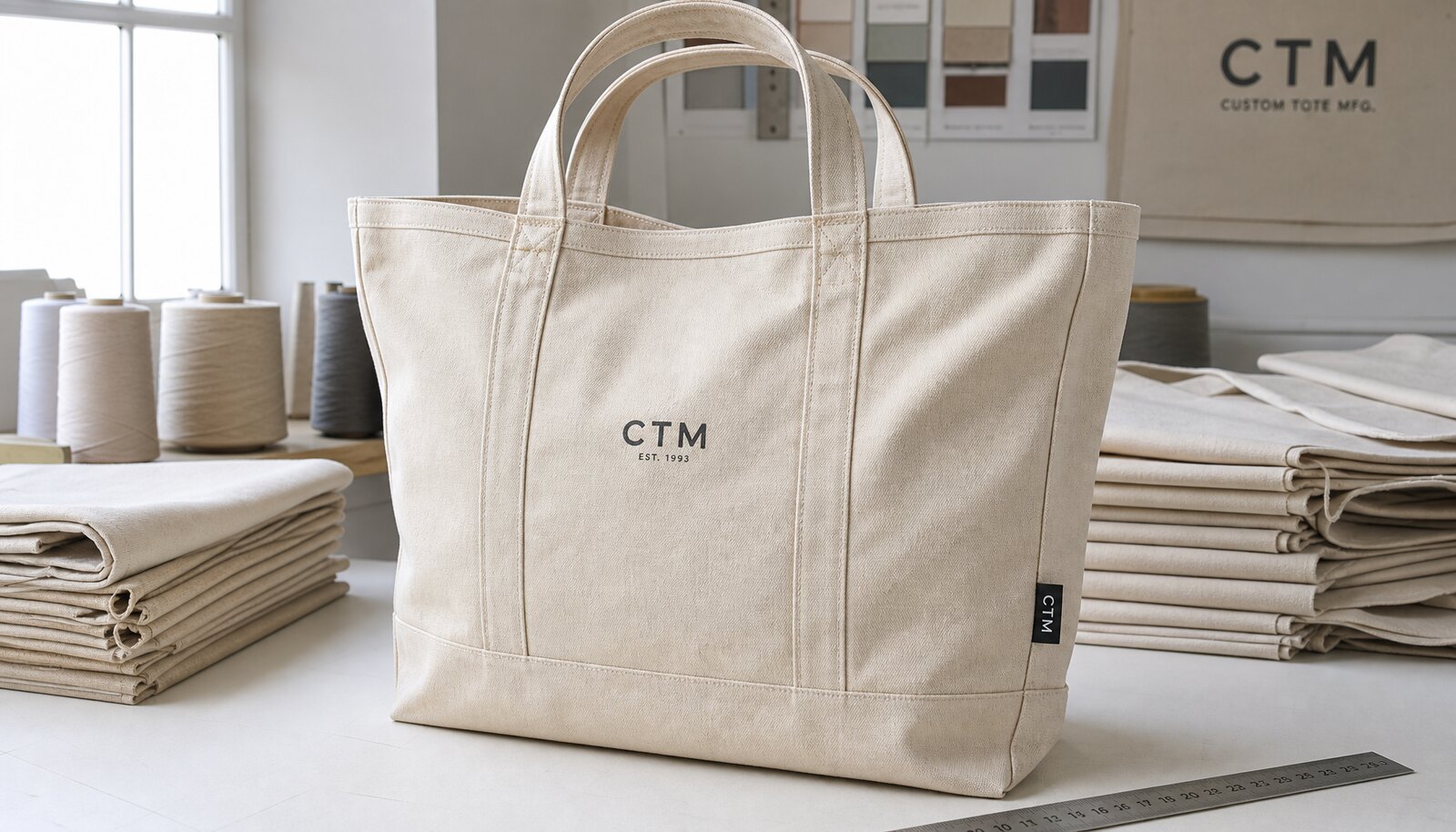
Why Gift Shops Need a Different Bag Spec
Large canvas grocery bags for gift shops are not the same product as a generic supermarket tote. The buyer is usually balancing three jobs at once: carry heavier retail items, look good on a shelf, and leave enough margin after print, packing, and freight. A bag that works for folded apparel can fail in a gift shop if it sags under a candle set, a boxed mug, or a stack of books. The right spec starts with the retail load, not with a standard tote template.
Gift shops also care about the bag as part of the store experience. The customer may buy it as a reusable carry bag, a wrap replacement, or an add-on at checkout. That means the canvas needs enough body to stand up, the handle length needs to feel comfortable in hand, and the logo has to read clearly from a few feet away. If the bag looks underbuilt, it lowers the perceived value of the store program even when the print itself is good.
- Think in terms of the items the bag will carry, not just the brand message it will print.
- A large gift-shop bag should hold weight without distorting the logo panel or collapsing the bottom.
- Shelf appeal matters because the bag may be sold as an impulse purchase, not only used for checkout.
Set the Size Before You Request Quotes
Most quoting problems start with vague dimensions. If one supplier assumes a 14 x 16 inch body and another quotes 18 x 14, the unit prices are not comparable even if the artwork is identical. For gift shops, a practical starting point is often a body around 15 to 18 inches wide, 14 to 16 inches high, and 6 to 8 inches deep with a gusset that lets the bag stand open. That range gives enough room for boxed gifts and keeps the product visibly different from a small event tote.
Handle spec matters just as much as body size. A handle that is too short can make the bag awkward over a coat, while a handle that is too thin will cut into the hand when the bag is loaded. For most retail gift-shop use, buyers usually want reinforced handles about 1 to 1.5 inches wide, with enough drop for shoulder carry if the bag will leave the store in winter or with bulkier items. The bag should also have a clean top hem and a stable base seam so the structure does not twist after a few uses.
- State width, height, gusset, handle length, and handle width in the RFQ.
- Include acceptable tolerance, especially if the bag must fit a display fixture or shelf bin.
- If the bag will carry bottles, ceramics, or boxed sets, prioritize gusset depth and base reinforcement.
Choose the Canvas Weight and Body Structure
Canvas weight drives almost every other decision. A 12 oz bag can work for lighter retail use, but it may feel too soft for a premium gift shop line. A 14 to 16 oz canvas, roughly 400 to 450 gsm, is a safer starting point when the bag needs to carry more weight and still look structured on the shelf. Heavier fabric usually gives better shape, less handle distortion, and a cleaner print surface, but it also increases sewing time and freight weight.
The surface finish matters as much as the numeric weight. Natural unbleached canvas usually looks more premium and hides small sewing variations better than a bright white finish, while bleached canvas gives a cleaner background for logos with lighter colors. If you want a more retail-ready bag, ask whether the fabric is prewashed or shrunk before cutting, because a raw canvas that shrinks after delivery can distort both dimensions and print position. Buyers should also ask whether the factory uses reinforced corners, bottom bar-tacks, or double stitching on the load-bearing seams.
- Use 14-16 oz canvas for most gift-shop programs that need both structure and resale appeal.
- Use lighter canvas only when the bag is an add-on, not a main retail item.
- Ask for the fabric specification in GSM, weave, and finish so you can compare quotes correctly.
Compare Sourcing Routes Before You Compare Prices
The cheapest unit price often comes from the least transparent quote. A direct factory with in-house sewing and printing usually gives the cleanest production control, because the same team handles fabric cutting, stitching, logo placement, and packing. That makes it easier to correct problems before bulk starts. A trading company can still be useful if you are buying several product lines at once, but you need to know whether they are quoting from a real factory spec or a blended estimate across different sources.
Domestic decorators on imported blanks can work for simple rush orders, but they are a weak fit if the bag design itself is custom. Once the size, handle, gusset, or reinforcement changes, the blank route usually stops being efficient. For a gift-shop buyer, the key question is not only who gives the best price, but who can reproduce the same bag every repeat order without changing the fabric lot, the stitch path, or the print placement. If the supplier cannot explain that clearly, the quote is not ready for comparison.
- Ask who actually owns the sewing line and who signs off the final inspection.
- Treat a trading company quote as different from a factory quote unless the production path is fully visible.
- If you need repeatability, prioritize a supplier that can keep the same fabric source and print process across reorders.
Pick the Logo Method That Matches the Retail Price Point
For large canvas grocery bags, screen print is usually the best default. It handles bold logos well, keeps setup sensible for bulk orders, and stays readable on textured canvas. One or two spot colors are usually enough for a gift shop bag unless the brand identity depends on detailed artwork. If the logo is too small, too thin, or too close to the seam, the canvas texture can break the edges and make the print look weaker than the proof suggests.
Sewn labels, woven side tabs, embroidery, and patch applications all have a place, but each one changes the bag economics. A woven label works well when the buyer wants a more premium feel and does not need a large front logo. Embroidery can look strong on heavier canvas, but it is slower and can pull the fabric if the stitch density is too tight. Heat transfer is better reserved for short runs or artwork with many colors, because it can look less natural on woven canvas and may not age as well through retail handling.
- Use screen print for broad retail appeal and stable repeat orders.
- Use woven labels or sewn patches when the brand wants a quieter, more premium look.
- Provide vector artwork and Pantone references so the printer can control edge quality and color matching.
Build the MOQ Around the Real Cost Drivers
MOQ is rarely about the bag alone. It is usually driven by fabric sourcing, print setup, cutting efficiency, and packaging. A natural canvas bag with one one-color screen print can often be made at a lower MOQ than a custom-dyed fabric bag with a woven label and special carton marking. That is why two suppliers can quote the same bag type and still give very different minimums. The real question is what parts of the production need to be changed for your artwork and packaging, because every change adds setup and waste.
A useful quote should show volume breaks, not a single unit price. Ask for pricing at the first production level you expect to buy, plus a higher repeat-order level if the product succeeds in store. The quote should also separate one-time fees from recurring costs so you know what drops on the second order. If the supplier hides print screen charges, sample fees, or special carton markings inside the unit price, it becomes difficult to compare options or forecast margin accurately.
- Natural canvas, one-color print, and standard packing usually support the lowest MOQ.
- Custom dyeing, multiple print colors, woven labels, and retail-ready inserts usually raise MOQ.
- Ask for setup fees separately so you can see the real repeat-order unit cost.
Approve the Sample With Measurable Checks
A PDF proof is not enough for a canvas bag. The sample must show the actual fabric hand feel, the seam behavior, the print saturation, and the way the bag folds. The first approval stage should usually be a physical pre-production sample, not a digital mockup. That sample should be checked against a written spec sheet that includes bag dimensions, handle length, gusset depth, fabric weight, print size, and packing method.
The sample review should focus on measurable points, not just general approval language. For example, confirm that the logo sits within the agreed placement window, the handles are evenly attached, the stitching is straight, and the bag opens square rather than twisting at the base. If the bag is intended for heavier retail use, fill it with representative product and inspect how the handle anchor, seams, and print panel react under load. A sample that looks fine empty can fail once it is actually used in the store.
- Use the approved sample as the reference for bulk inspection, not the artwork file alone.
- Measure the bag filled and empty if the end use depends on shape retention.
- Reject samples that show uneven handle placement, weak seam reinforcement, or print distortion near edges.
Treat Packing as Part of the Product, Not an Afterthought
Gift-shop bags are often sold, displayed, or handed over immediately, so packing affects the buyer experience more than it does for a warehouse-only tote. Some programs need a flat-folded bag in a master carton for export efficiency. Others need a retail-ready fold with a hangtag, barcode, or belly band so the store can put it directly on display. If the buyer wants a polished retail shelf, ask how the factory will keep the bag crease consistent and protect the logo from rubbing during transport.
Packing also changes damage risk. Canvas can pick up fold marks, dust, and moisture during long freight cycles, especially if the carton is overfilled or the bag is packed too tightly. If the bag has a dark print on natural canvas, rubbing can leave visible marks. If the product will travel by ocean, ask whether the factory uses inner polybags, desiccant, or moisture-resistant cartons. The goal is not fancy packaging for its own sake. The goal is to receive bags that look ready to sell, not like a bulk item that needs rework in the destination warehouse.
- Define whether the bag ships flat, folded with tissue, or retail-ready with barcode and hangtag.
- Confirm carton counts and outer carton dimensions so warehouse receiving is predictable.
- Protect printed faces from scuffing if the bags are packed tightly for export.
Plan Lead Time and Landed Cost Before You Commit
Lead time for a custom canvas bag is usually a chain of smaller tasks: artwork confirmation, sample making, sample approval, fabric reservation, bulk cutting, printing, sewing, packing, and final inspection. If any one of those steps slips, the whole schedule moves. For a standard one-color bag, production can be relatively straightforward after approval. Add custom dyeing, extra print colors, or special labels, and the timeline becomes more sensitive to fabric availability and print setup.
Landed cost is where many sourcing decisions are misread. A low ex-factory price can be offset by heavier freight, larger cartons, more packing labor, or extra relabeling at destination. A 16 oz bag may cost more to make, but if it sells better at retail, it can still be the stronger buy. The right comparison is total cost against margin, not unit price alone. Ask every supplier to quote the same destination terms, the same packing format, and the same quantity break so the numbers reflect the real delivered cost.
- Build schedule slack for sample approval and artwork revisions before bulk starts.
- Compare ex-factory price, packing, freight, duty, and receiving labor together.
- Do not choose a lighter bag only because the headline unit price is lower.
Write the RFQ So Suppliers Can Quote the Same Product
A good RFQ for large canvas grocery bags for gift shops should remove room for interpretation. Start with the exact bag dimensions, fabric weight, handle construction, print method, logo file, and packing format. Then specify what is non-negotiable and what can be adjusted. If the supplier can quote with the same inputs across three quantity bands, you will know which factory is technically solid and which one is only competitive because it made assumptions.
Do not send a logo alone and expect a useful reply. Include the target sales channel, the retail role of the bag, and the load it needs to carry. That context tells the factory whether to prioritize structure, print clarity, or minimum freight volume. When the quote comes back, verify that the reply matches your spec line by line. If the supplier has substituted fabric weight, changed the packing format, or omitted setup fees, send it back before sample approval. That is the fastest way to avoid production mistakes.
- Send one spec sheet and one artwork file format to every supplier.
- Require the same quantity breaks, incoterm, and packing format in every quote.
- Treat any hidden substitution in fabric, print, or packaging as a revision, not a final offer.
Specification comparison for buyers
| Spec decision | Recommended option | When it fits | Buyer risk to check |
|---|---|---|---|
| Sourcing route | Direct factory with in-house cutting, sewing, and printing | Best for recurring orders, tighter spec control, and clear responsibility for sewing and logo placement | Confirm that the same factory will make the sample and bulk lot, not a different subcontractor |
| Sourcing route | Trading company that manages several factories | Useful when you need mixed product categories or do not yet know the right bag factory | Ask who actually owns the production file, approves QC, and handles after-sales claims |
| Sourcing route | Domestic decorator on imported blanks | Works for simple rush orders with a standard bag and one-color print | Check whether the blank bag weight, handle reinforcement, and fabric hand feel match the retail standard |
| Fabric weight | 14-16 oz canvas, about 400-450 gsm | Good balance for gift shops that sell candles, books, boxed sets, and heavier impulse items | Make sure the quote is truly on that GSM, not a lighter fabric called by an inflated ounce label |
| Fabric weight | 12-14 oz canvas, about 340-400 gsm | Fits lower-price retail programs where the bag is light, foldable, and not meant for heavy loads | Risk of soft body, sagging gusset, and poorer shelf presentation if the bag is filled |
| Print method | Screen print with one to two spot colors | Best for bold logos, clean retail branding, and repeat orders with stable artwork | Check registration tolerance and ink coverage on textured canvas so the logo does not look broken |
| Print method | Sewn patch, woven label, or embroidery accent | Fits premium gift-shop bags where the brand wants a more tactile finish | Confirm the logo remains readable at retail distance and does not push unit cost beyond margin |
| Packing route | Flat-folded in master cartons with barcode and carton mark | Best for export bulk orders and efficient freight | Verify fold lines do not damage the print and that carton counts match the receiving workflow |
Buyer checklist before sampling
- Fix the final bag size, including width, height, gusset, handle length, and acceptable tolerance.
- State the canvas weight in GSM or ounces and whether the fabric is natural, bleached, or dyed.
- Define the logo method, color count, artwork file type, print placement, and maximum print area.
- Specify handle reinforcement, seam finish, and whether the bag needs a structured base or loose open body.
- Confirm packing style, carton quantity, barcode needs, hangtag needs, and whether retail-ready folding is required.
- Request the sample type you want approved first: pre-production sample, size sample, or print strike-off.
- Ask for the quote on the same incoterm, destination, and quantity breaks so suppliers can be compared fairly.
- State the target delivery window and any event or seasonal deadline that affects the schedule.
Factory quote questions to send
- What is the exact fabric weight, weave, and finished hand feel used for the quoted bag?
- Who is responsible for cutting, sewing, printing, packing, and final inspection?
- What is the MOQ by design, color, and print method, and what changes will increase that MOQ?
- Which setup fees are separate from unit price, including print screens, sampling, labels, and packaging?
- What dimensional tolerance do you hold for bag body, gusset, and handle length?
- Can you provide a physical pre-production sample before bulk production starts?
- What packing format, carton size, and carton count per case are included in the quote?
- What lead time applies after sample approval, and what parts of that timeline are fixed versus variable?
- What inspection standard do you use for sewing, print alignment, stains, and carton counts?
- Can you quote the same spec at three volume breaks so we can compare repeat-order economics?
Quality-control points to confirm
- Measure the fabric weight and confirm it matches the approved GSM or ounce spec.
- Check bag dimensions, handle length, and gusset depth against the approved sample and tolerance sheet.
- Inspect seam quality, bartacks, X-box reinforcement, and handle pull strength on a filled bag.
- Verify print position, logo size, color match, and edge sharpness on the actual canvas texture.
- Reject visible stains, oil marks, broken threads, skipped stitches, or loose fibers on front panels.
- Confirm that the bag stands and folds as expected, without collapsing the gusset or twisting the body.
- Audit carton counts, inner packing, barcode placement, and carton marks before shipment release.
- Compare a random production sample against the approved pre-production sample, not against a PDF proof.