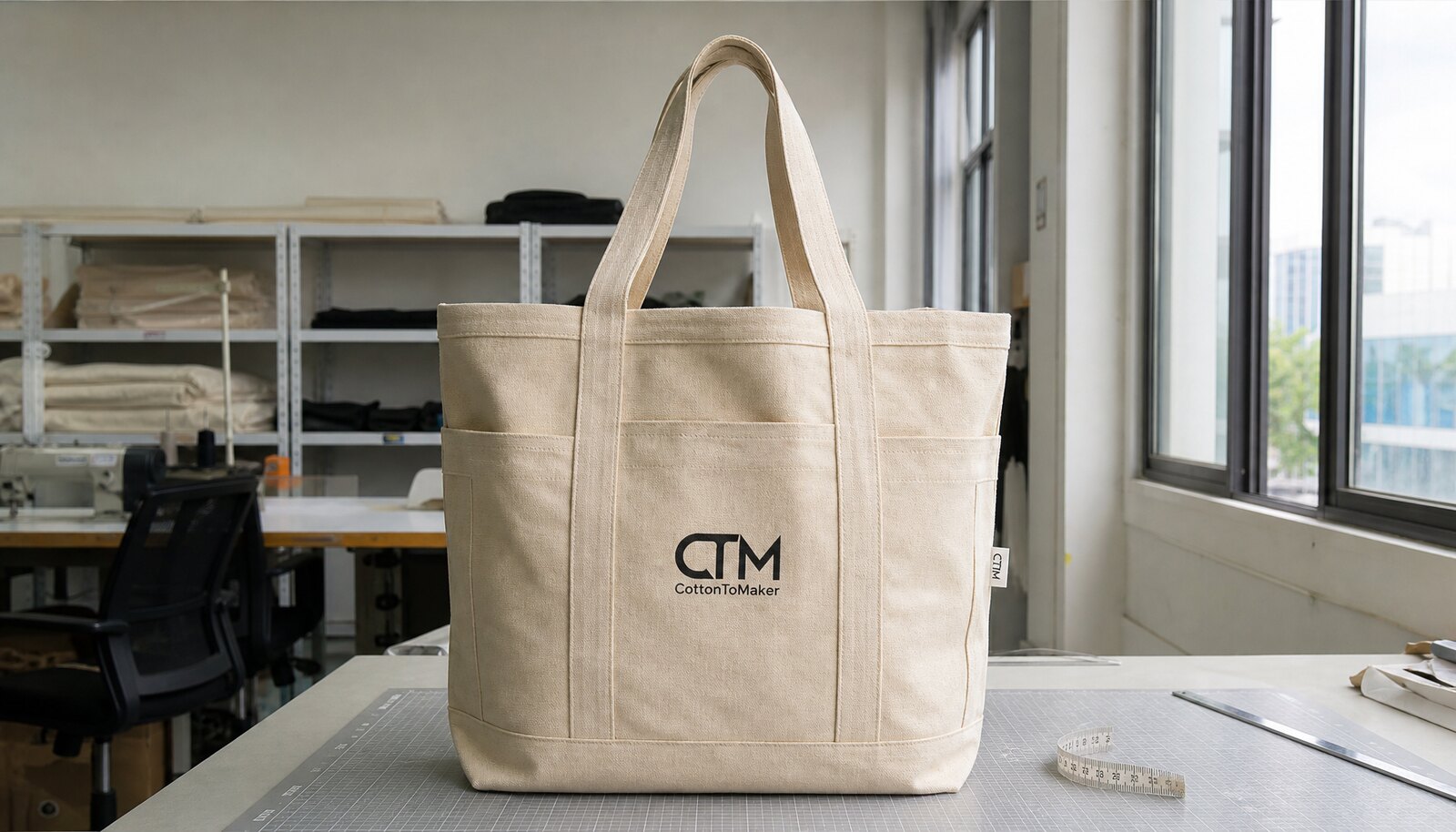
1. What this reorder memo is solving
For large canvas grocery bags, the main reorder risk is not whether the bag looks good in a sample room. The real problem is whether the second or third PO lands with the same fabric hand feel, the same print sharpness, and the same packing efficiency that your warehouse already built around. Ecommerce brands usually discover the pain only when inventory arrives too early, too late, or with a carton size that eats freight budget.
This memo is for buyers who already know the bag sells, but need a cleaner buying file for the next replenishment. If your current supplier quote is vague on GSM, stitch construction, overrun allowance, and packing format, you do not yet have a reorder-ready spec. The goal here is to make the RFQ and quote comparison strong enough that the factory is quoting the same product, not just a similar-looking tote.
- Use this when you need a stable replenishment style, not a one-off promotional bag.
- Treat lead time, carton packing, and print method as part of the product spec.
- Keep the bag function centered on grocery carry, warehouse efficiency, and repeat buyability.
2. Start with the use case, not the logo
A large grocery tote for ecommerce is usually loaded with pantry items, boxed goods, or multi-item orders. That means the bag has to stay open enough to pack quickly, carry weight without handle failure, and survive being folded, stacked, and redistributed by a fulfillment team or consumer. If the bag is only defined by art position, the quote will drift toward whatever the factory makes easiest rather than what your buyers actually need.
A practical spec starts with load behavior. For most reorder programs, 12 oz to 14 oz canvas is the safe zone because it balances body structure and unit cost. If your customers carry heavy groceries or your brand wants the bag to feel premium, 14 oz to 16 oz is often better, but freight, sewing time, and carton count will move up. If the bag is mostly a promotional add-on, lighter canvas can work, but the risk of sagging, handle stretch, and poor shelf impression increases.
- Define real use: grocery carry, subscription box insert, marketplace add-on, or retail resale.
- State load expectations in kilograms or practical content examples, not only “heavy duty.”
- If the bag must stand open, call out gusset depth and bottom panel stability.
3. Fabric weight, weave, and finish decisions that change the quote
Canvas bag pricing moves more from fabric weight and finish than many brand teams expect. A 340 GSM canvas and a 470 GSM canvas may look like a small spec change on paper, but they are not the same cutting behavior, sewing speed, or shipping weight. Heavier cloth usually improves drape control and perceived quality, but it can also reduce carton count and raise freight cost. This matters when you are comparing suppliers whose unit prices look close but whose carton loading assumptions are not.
Ask the factory to quote on the same finished fabric basis. Natural greige canvas is usually the lowest cost route. Bleached or dyed canvas raises cost and can introduce shade variation from lot to lot. Enzyme-washed or softened canvas can improve hand feel for retail programs, but it changes shrinkage behavior and may affect print registration. If your ecommerce brand is sensitive to repeat orders, the safest route is a controlled fabric spec with a clear tolerance range and no discretionary fabric substitutions.
- 12 oz to 14 oz canvas is the common reorder range for grocery use.
- State whether the cloth is natural, bleached, dyed, or washed before cutting.
- Confirm pre-shrink treatment if your print placement or finished size is strict.
4. Print method choices: low cost is not the same as low risk
For large canvas grocery bags, most reorder programs are best served by one-color or two-color screen printing. Screen print is usually the cheapest way to get durable, readable branding on a coarse surface, and it holds up better than many buyers expect if the artwork is kept bold. Water-based printing can feel softer and more premium, but you need to verify opacity on natural canvas and make sure the factory has repeatable drying control.
If the artwork has fine lines, gradients, or small reverse text, the bag may need a different method or a simplified logo version. Buyers often lose time because the quote is based on a full-color brand file that cannot be reproduced cleanly on heavy canvas. If you want embroidery, woven patch, or sewn label, treat that as a different product route, not a minor decoration tweak, because labor and placement tolerance change materially.
- Use bold artwork for coarse canvas; avoid tiny text that will fill in or blur.
- Request print size in centimeters or inches, plus exact placement from top seam.
- For multi-color art, confirm whether each color needs a separate screen and setup charge.
5. Supplier route comparison for a reorder program
When the same style is being reordered, the supplier route matters as much as the product spec. A direct factory with sewing, cutting, printing, and packing under one roof usually gives better control over sample-to-bulk consistency. A trading company can still work, but only if they can prove exactly which factory will run the order and how the QC handoff is managed. For ecommerce brands that need predictable replenishment, hidden handoffs are a common cause of delays and mixed packing.
If you are comparing options, separate the questions of price and execution. A lower quote from a multi-layer sourcing route may still cost more after sample fees, local consolidation charges, or packaging changes. The table below is the kind of comparison a buyer team can use before sending a PO.
- Prefer the route with the fewest handoffs for stable reorder styles.
- Make the supplier identify the actual production site, not just the sales office.
- Use the same pack standard across quotes so carton cost is comparable.
6. How to compare quotes without being misled by unit price
A useful quote for large canvas grocery bags should be itemized. If fabric, sewing, print, packing, and carton details are all hidden in one line, the comparison is not reliable. Many buyer teams compare only the bag unit price and miss the real drivers: print setup, special finishing, polybag labor, carton compression limits, or minimum run requirements for a specific color. That is how a seemingly cheaper supplier becomes more expensive at landing cost.
The cleanest comparison is to normalize all quotes to the same assumptions. Use the same GSM, same size, same decoration area, same pack count, and same destination term. Then compare how each supplier handles sample charges, overruns, underruns, replacement policy, and whether freight-ready cartons are included in the quoted price. If a supplier will not break out those items, the quote is not mature enough for final sourcing.
- Normalize size, fabric weight, print method, and packing before comparing unit price.
- Ask for a landed-cost view, not only EXW price, if freight is material to the program.
- Watch for hidden costs in special carton marks, retail tags, or extra inner packing.
7. Sample approval: what to inspect before bulk release
A good pre-production sample should be made from the actual bulk fabric, with the actual print method and the same handle reinforcement that will go into production. Paper approvals are not enough for canvas grocery bags because the bag’s behavior changes when the cloth is cut, sewn, and loaded. A sample that looks acceptable on a table may still twist at the handle, collapse at the gusset, or print too faintly on natural canvas.
During approval, focus on issues that affect reorder consistency: dimension accuracy, handle symmetry, seam strength, and print opacity. If your brand needs exact placement, measure from seam to print edge and top opening to print top. For bags intended to hold groceries, try a simple load test in the sample room: fill it with weighted items and watch where the fabric pulls, where the handles tilt, and whether the bottom panel stays flat.
- Approve the sample only after checking the actual bulk fabric, not a substitute cloth.
- Measure finished size, handle length, and print placement against a written tolerance sheet.
- Test one sample with weight to expose weak seam alignment or handle pull.
8. Packing, carton loading, and warehouse fit
Packing is a cost lever, not just a logistics detail. Large canvas grocery bags can ship flat in bulk, polybagged in small packs, or individually packed for retail presentation. The right choice depends on whether your ecommerce operation wants fast receiving and compact storage or retail-ready presentation with barcode compliance. If the bag is too tightly packed, creasing can affect the first impression. If the pack is too loose, carton count falls and freight cost rises.
Ask the factory to quote with carton dimensions, gross weight, and pack quantity per carton. This lets your warehouse judge whether the shipment will fit standard pallet patterns and whether there is an issue with carton density. For ecommerce brands, a practical pack count often falls between 10 and 20 bags per inner carton segment depending on size and fabric weight. Include carton marks, barcodes, and any country-of-origin requirements in the RFQ so the packing quote is real.
- Decide whether inner polybags are required for retail cleanliness or only for moisture protection.
- Confirm carton size and gross weight before the order is released.
- Align pack count with your warehouse receiving workflow, not only factory convenience.
9. Lead time, reorder timing, and schedule risk
For a stable reorder, the lead time is usually driven by fabric availability, screen setup, sewing capacity, and packing labor. A realistic range is often 25 to 45 days after sample approval for standard canvas grocery bags, but that can stretch if the fabric needs dyeing, the print has multiple colors, or your packaging spec is more demanding than the prior run. Peak season can also create queue time even when the factory says the order itself is straightforward.
Reorder planning should be built backward from inventory depletion, not forward from a hoped-for ship date. If your warehouse sell-through is predictable, hold a safety stock buffer that covers fabric delays and inspection time. For imported goods, consider customs and transit variability as part of the lead time, not an afterthought. The most common schedule mistake is starting the reorder after the buy team has already seen the inventory curve flatten.
- Track production days separately from transit days and customs days.
- Treat fabric dyeing, special wash, or complex packaging as schedule risks.
- Build a reorder trigger before stock reaches the final third of on-hand inventory.
10. Buyer checklist for a clean RFQ and fewer production surprises
A strong RFQ reduces back-and-forth and filters out weak suppliers. The most effective reorder briefs for large canvas grocery bags are short but precise: they define the fabric, the print, the packing, and the expected QC standard in language the factory can price. The checklist below is the minimum information that should travel with the RFQ so quotes can be compared on equal ground.
If you send only artwork and a bag photo, you will get a wide spread of assumptions back from suppliers. That may look like market competition, but it is often just different interpretations of the same bag. The result is messy sample approval, cost creep, and avoidable delay. Tight specs are not over-engineering; they are a way to make the quote useful.
- Bag size with tolerances
- Fabric GSM and finish
- Print method, colors, and placement
- Handle length and reinforcement style
- Packing format and carton target
- Sample requirements and approval rules
- Lead time and shipment window
- Overrun, underrun, and replacement policy
Specification comparison for buyers
| Spec decision | Recommended option | When it fits | Buyer risk to check |
|---|---|---|---|
| Fabric weight | 12 oz to 14 oz canvas, usually 340 to 470 GSM | Daily grocery use, better structure, fewer complaints about bag sagging | Too light for heavy loads; too heavy can raise freight and shrink usable pack volume |
| Bag size | Approx. 15 x 16 x 6 in. with gusset and 22 in. handles | Ecommerce grocery assortments, reusable shopping, subscription add-ons | Oversized bags can distort print placement; undersized bags can reduce perceived value |
| Print method | 1 to 2 color screen print or water-based print for simple logos | Large repeated runs with stable artwork and low decoration cost | Fine detail may blur on coarse canvas; multi-color print can lift cost and extend lead time |
| Supplier route | Direct factory with in-house sewing and print, not a trading-only quote | When you need fewer handoffs and better control of sample-to-bulk matching | Trading quotes can hide subcontracted packing, inconsistent QC, or unexpected surcharge lines |
| MOQ logic | 1,000 to 3,000 pcs per color/style for standard blank or printed bags | Reorders with known sell-through and predictable carton loading | MOQ may rise if custom size, heavier GSM, special wash, or complex print alignment is added |
| Packing format | Bulk packed or polybagged 10 to 20 pcs per inner carton, then master carton | Wholesale, distributor, and ecommerce replenishment shipments | Retail-ready packing increases labor and carton count; confirm barcode and carton mark requirements |
| Sample route | Pre-production sample with actual fabric, handle length, print size, and carton mark | Any reorder after artwork or spec changes | Paper approvals do not reveal shrinkage, handle twist, or print opacity issues |
| Lead time | About 25 to 45 days after sample approval, depending on fabric stock and print complexity | Routine reorders with stable material sourcing | Peak season, fabric dyeing, or new packaging can add 1 to 3 weeks |
| Quote structure | Ask for itemized fabric, print, sewing, packing, and freight-ready carton data | When comparing multiple suppliers or landed-cost scenarios | A low unit price can hide packaging upgrades, overrun limits, or paid sample charges |
Buyer checklist before sampling
- Fix the exact bag size, fabric weight, handle length, gusset depth, and whether the bag must stand upright when empty.
- Define the load target in real use, not just the product name: groceries, pantry items, promotional kits, or marketplace shipping add-ons.
- Choose one decoration path first: blank, 1-color print, 2-color print, woven label, or sewn patch; do not leave artwork decisions open during quoting.
- State whether you need natural, bleached, dyed, or enzyme-washed canvas, because color and finishing change both cost and repeatability.
- Provide carton pack count, master carton size target, and whether inner polybags are required for retail or ecommerce warehousing.
- Request a pre-production sample made from the same GSM and print method as bulk, not a simplified mock sample.
- Set acceptable tolerances for size, handle symmetry, print registration, and stitching density before production starts.
- Ask for the factory’s overrun/underrun policy and any charge for split shipments or storage if you cannot take the full lot at once.
Factory quote questions to send
- What is the exact canvas GSM and finished fabric width you are quoting, and is the fabric greige, bleached, or dyed before cutting?
- How many stitches per inch are used on handles and side seams, and do you reinforce stress points with bar-tacks or cross stitching?
- Is the quoted print cost based on one side or both sides, and what is the add-on for extra colors, larger coverage, or pantone matching?
- What is your MOQ by color and by artwork version, and does the MOQ change if we keep the same fabric but change only print placement?
- Can you itemize sample fee, plate or screen charge, packing cost, carton labeling, and any export document fee separately?
- What are the standard size tolerance, print tolerance, and acceptable shade variation limits for bulk production?
- What carton count, carton dimensions, and gross weight will you use for a 40HQ estimate, and can you share a packing list draft before mass production?
- How many days after sample approval do you need for bulk, and what production step is most likely to delay the schedule?
Quality-control points to confirm
- Fabric weight must be within the agreed GSM range, with no obvious thin spots, slubs that affect print, or weave distortion near handles.
- Handle attachment must be symmetrical, reinforced, and capable of repeated lift testing without seam opening or thread pop.
- Printed area must match approved art size and placement, with no obvious bleeding, cracking, ghosting, or color shift on the same run.
- Bag dimensions must stay within the agreed tolerance after sewing and, if washed or pre-shrunk, after finishing.
- Stitching density should be consistent across main seams, gusset joins, and handle ends; loose threads and skipped stitches should be limited to minor trimming only.
- Carton packing must protect shape and print surface; crushed corners, wet cartons, or mixed lots should be treated as shipment risks, not minor defects.
- Barcodes, carton marks, and pack counts must match the purchase order and packing list exactly before warehouse release.
- Random carton sampling should include at least one bag from the top, middle, and bottom layers of each sampled carton to catch compression damage or odor issues.