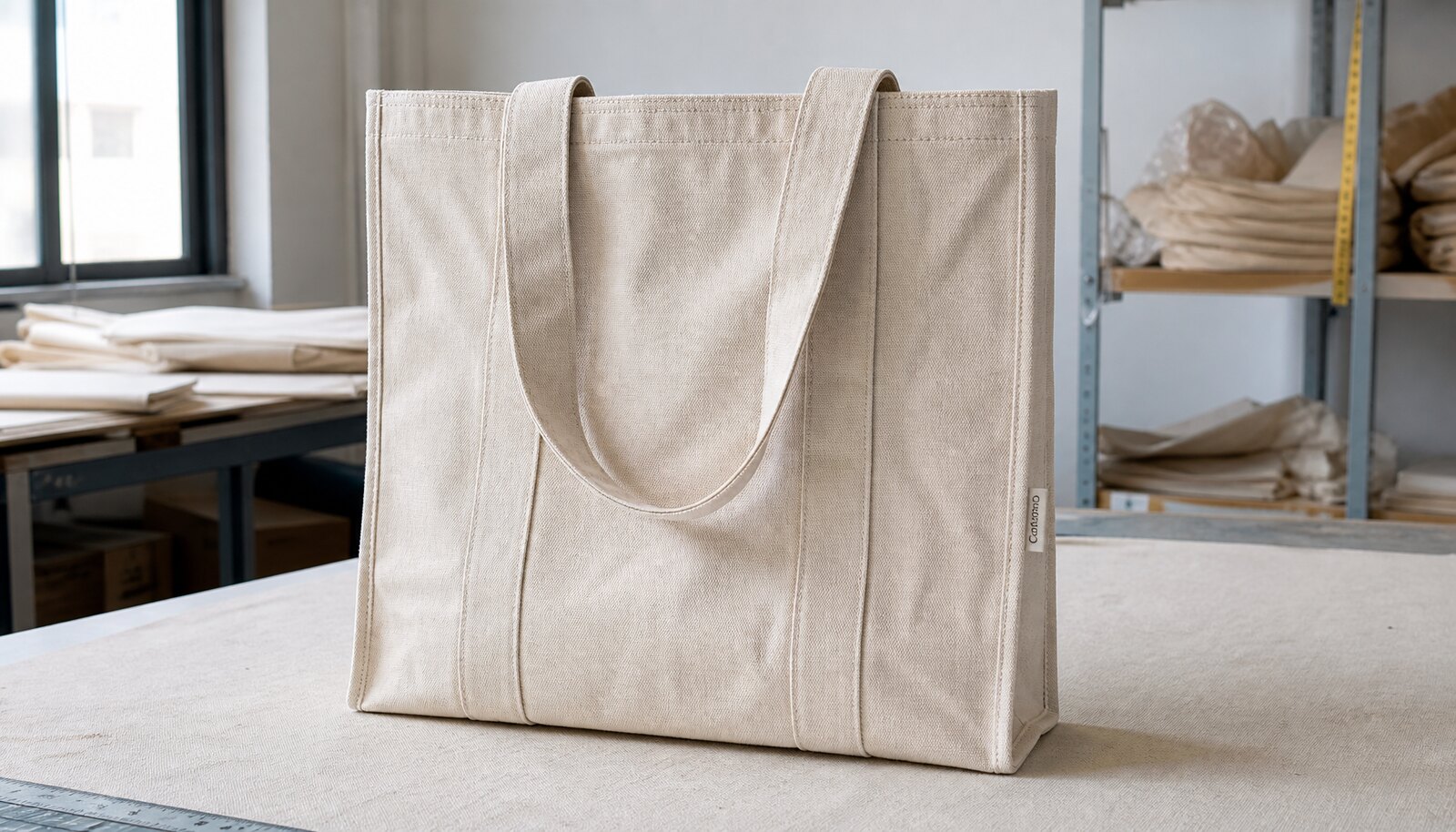
Why cosmetic brands buy large canvas grocery bags differently
Cosmetic brands do not buy large canvas grocery bags the same way a supermarket buyer does. The bag often has to carry boxed skincare, glass bottles, sampling kits, or gift sets, and it usually needs to look clean enough to sit in a retail display or be handed out with a premium purchase. That changes the spec. You are not just buying a carry bag; you are buying a brand touchpoint that still has to survive rough packing, customer use, and freight compression.
The practical buying mistake is treating all canvas the same. A promotional bag for a lightweight event pack can work on 10 oz canvas, but a heavier retail tote with jars and bottles usually needs stronger cloth, better corner reinforcement, and a print method that stays crisp on textured fabric. If the bag will be reused, cosmetic brands should think in terms of load, print appearance, and shelf presentation, not only unit price.
- Typical cosmetic use cases: gift-with-purchase, holiday bundles, retail checkout, PR kits, sampling packs
- Common failure points: stretched handles, misaligned logo, weak bottom seam, cartons that crush in transit
- Buying target: a bag that looks premium enough for the brand, but is still simple enough to quote and repeat
Start with the load case, not the artwork
Before you send an RFQ, define what the bag must carry. A canvas grocery bag for a cosmetic brand may hold two skincare boxes, a body lotion bottle, and a pouch; or it may hold six lightweight sample items. Those two loads can require very different construction. If the heaviest normal use is not stated, suppliers will quote to the cheapest interpretation, and the bag may look right in the sample room but fail in the market.
For most cosmetic wholesale programs, 12 oz to 16 oz cotton canvas is the workable range. Around 12 oz is usually fine for promotional and everyday carry if the fill weight is moderate. Move toward 14 oz or 16 oz when the bag must stay upright, support heavier bottles, or carry more brand value. If you want a soft hand feel and lower freight, stay near the lower end. If you need shape retention and stronger perceived quality, go heavier.
- State the expected filled weight or item list in the RFQ
- Specify whether the bag needs to stand upright on a shelf or collapse flat for packing
- If the bottom will carry glass jars, ask for reinforced seam construction and a wider base or gusset
Fabric weight, weave, and finish: where quotes usually diverge
Canvas looks simple until suppliers quote different cloth sources. One factory may use a looser weave at the same nominal GSM, while another quotes tighter weave and better yarn consistency. That difference shows up in print sharpness, stiffness, and how the bag hangs after filling. If your logo has fine lines or small type, a cleaner weave matters more than the headline GSM.
For cosmetic brands, unbleached natural canvas is the most common route because it reads clean and upscale without overcomplicating color matching. Bleached white canvas can work when the brand needs a brighter print background, but it may show storage marks and dust more easily. If the brand wants a softer look, ask for pre-washed or enzyme-washed cloth only if the supplier can prove the finish will not shrink the final dimensions beyond tolerance.
- Ask for canvas weight in oz or GSM, plus tolerance on bulk fabric
- Request yarn count or weave density if the print includes fine text
- Confirm shrinkage allowance before cutting, not after bulk sewing
Choose the print method by artwork complexity and order size
Print method is one of the biggest cost and quality drivers. For one-color or two-color logos with clean edges, screen print is usually the most economical and dependable route at volume. It gives strong opacity on natural canvas and is easier to repeat across reorders. The tradeoff is setup cost and less flexibility if you change art often. If the design has gradients, photo-style elements, or many colors, digital print or heat transfer may be better for the sample run or a smaller launch.
Embroidery can look premium, but it is usually best for smaller logo areas and limited color count. On large grocery bags, embroidery adds labor and can stiffen one area of the bag, which is not always desirable if the tote needs to fold flat. Buyers should compare print coverage area, color count, curing method, and wash or rub resistance rather than assuming one method is universally better.
- Screen print: best for repeat orders and simple branding
- Digital or heat transfer: useful for short runs and artwork changes
- Embroidery: premium feel, but usually not the cheapest option for large logo coverage
MOQ logic: what really changes the unit price
MOQ is not only a factory policy issue; it is a cost structure issue. The bag price changes with fabric width utilization, cutting efficiency, print setup, color changes, and packing labor. A supplier may offer a low MOQ for one simple logo and one size, but the same factory may need a higher MOQ once you add a second colorway, a second print position, or custom inner packing. Buyers who compare only the unit price often miss that a lower MOQ can carry hidden restrictions on materials or artwork.
For cosmetic brands, a practical MOQ strategy is to start with one core size, one fabric color, and one print version for launch, then plan the second run after sell-through. If the bag is linked to a campaign, make sure the MOQ supports forecast flexibility. A direct factory can sometimes hold a reasonable MOQ if the brand keeps dimensions standard and uses existing canvas stock. Custom dye, special lining, or complex finishing will push MOQ up quickly.
- Lower MOQ usually works best with standard canvas color and limited print colors
- MOQ rises when you add custom dyeing, special handles, lining, or multiple SKUs
- Ask whether the MOQ is based on one design, one material lot, or one production batch
Comparison table: sourcing routes for cosmetic-brand grocery totes
Not every supplier route gives the same outcome. A direct factory, a trading company, and a local decorator all solve different problems. The right route depends on whether your priority is price control, development speed, or small-batch flexibility. For a wholesale buying program, comparing sourcing routes early helps avoid quote apples-to-oranges errors.
Use the table below when you are deciding whether to buy directly from a canvas tote factory or through an intermediary. The key is not just the headline price. It is how much control you keep over fabric, stitching, print approval, packing, and repeat orders.
- Direct factory: better for spec control and repeatability
- Trading company: useful when you need mixed items or more hand-holding
- Local decorator: practical for urgent small runs, but usually not the lowest landed cost
What a useful sample approval process looks like
Do not approve a tote sample on appearance alone. A cosmetic-brand bag should be checked in the same way the customer will use it: loaded, folded, carried, stacked, and displayed. The best sample process starts with a blank material swatch, then a sewn pre-production sample, then a fully printed reference sample. If the supplier skips straight to bulk, you lose the chance to catch fabric substitution or stitch issues before production.
When reviewing samples, pay attention to handle symmetry, print placement relative to seam lines, and the way the bag stands when partially filled. If the tote collapses awkwardly on a shelf or twists under load, the design may need a base reinforcement or a different handle drop. Approval should be based on a simple written standard, not on memory or a photo in chat.
- Approve dimensions after sewing, not the cut pattern
- Compare printed color against a physical reference under neutral light
- Test at least one filled bag for seam creep and handle comfort
Buyer checklist for RFQ and sample sign-off
A short, clean RFQ gets better quotes than a vague one. Cosmetic brand buyers often send artwork first and only mention the bag size later. That creates preventable confusion. The better order is: use case, size, fabric, print, handle, packing, then artwork. Suppliers can quote faster when they know exactly what is fixed and what is still open for development.
This checklist is designed for procurement teams that need to compare offers from multiple factories. It keeps the focus on things that alter cost or quality: cloth weight, print coverage, stitching type, packing method, and lead time. If the supplier cannot answer these items clearly, the quote is not ready for final comparison.
- Bag size, gusset depth, and target load weight
- Canvas weight in GSM or oz with tolerance
- Print method, number of colors, and print area size
- Handle length, width, and reinforcement requirement
- Folding style, polybag use, carton count, and carton marks
- Sample type, approval path, and production lead time
- Target annual volume and reorder forecast if relevant
Packing, carton efficiency, and freight control
Packing is often ignored until the freight quote arrives. Large canvas grocery bags can take up a surprising amount of carton volume, especially if they are folded poorly or include thick printing that prevents compact stacking. For importers, the carton count per cube can matter as much as the unit price. A slightly cheaper bag that ships in oversized cartons can erase the savings once ocean freight, warehouse receiving, and repacking are added.
Ask for a packing plan that reflects the actual channel. Retail-ready packaging may need individual polybags, barcode labels, and specific carton marks. Bulk promotional shipments may not need polybags, but they do need consistent folds and count accuracy. If the order is palletized, make sure the carton dimensions stack cleanly and the top layer is not crushed. The right packing specification also lowers count disputes during receiving.
- Specify bags per carton and whether the count is manual or machine-verified
- Require carton dimensions and gross weight in the quote
- Use one fold standard across all cartons to avoid warehouse inconsistency
Lead time risk: where schedules usually slip
Canvas bag schedules usually slip in four places: fabric sourcing, print approval, sewing bottlenecks, and packing changes after approval. Cosmetic brands often accelerate the artwork phase and then lose time on final color approval. If you are launching around a seasonal retail window, build in time for strike-offs or pre-production samples before bulk release. A quote that looks fast may only be fast if the factory already has matching canvas in stock.
For bulk orders, split the timeline into clearly priced stages: sample approval, material booking, sewing, print curing, final inspection, and export packing. This makes it easier to compare suppliers honestly. A factory that can sew quickly but needs longer for print or packing may still be the best choice if the product is simple. Do not compare lead time without knowing whether the supplier has pre-existing fabric stock or must source each component after PO.
- Separate sample lead time from bulk lead time
- Confirm whether fabric is stock or mill-ordered
- Ask what happens to schedule if artwork is revised after sample approval
Specification comparison for buyers
| Spec decision | Recommended option | When it fits | Buyer risk to check |
|---|---|---|---|
| Fabric weight | 12 oz to 16 oz cotton canvas, depending on fill weight and print coverage | Best for cosmetic gift-with-purchase, retail resale, or promo packs with boxed skincare | Too-light canvas will distort at the bottom seam; too-heavy canvas raises cost and carton weight |
| Construction route | Factory-made with reinforced stress points and cut-and-sewn panels | When brand presentation and repeatability matter more than the lowest unit price | Hand-finished samples can hide production inconsistency at scale |
| Print method | Screen print for simple logos; heat transfer or digital for multi-color artwork; embroidery only for small marks | Screen print suits high-volume, low-color branding; digital suits short runs or gradient artwork | Ink crack, misregistration, and poor wash rub resistance if the factory does not control curing |
| Handle length and drop | Long shoulder drop with bar-tacked handle bases | When shoppers may carry the bag over the shoulder or alongside a coat | Handles that look strong but are not bar-tacked can fail under a full grocery load |
| Closure / opening | Open top unless product protection or anti-spill control is needed | Best for retail checkout, event gifting, and broad consumer use | Open tops expose loose items if the bag is also used for cosmetics kits or sampling sets |
| Lining or lamination | Unlined for standard retail; light lamination only when spill resistance is a real use case | When the bag may carry jars, bottles, or humid product bundles | Lamination can add stiffness, cost, and recycling concerns |
| Supplier route | Direct factory with in-house cutting, sewing, and print control | Best for brands needing custom dimensions, repeat orders, and clear QC ownership | Trading layers can hide the actual production line and reduce accountability on spec changes |
| MOQ strategy | Tiered MOQ by size, fabric color, and print complexity | Useful when the brand wants multiple SKUs or seasonal artwork | Low MOQ quotes may be based on shared materials, which can limit customization and lead time control |
| Packing format | Bulk packed by count with size labels and export cartons sized for pallet efficiency | When importers want lower freight and easier warehouse receiving | Loose packing increases carton damage, count errors, and repacking labor |
Buyer checklist before sampling
- Define the real load case: sample kits, boxed cosmetics, store carryout, or giveaway packs, then size the bag around the heaviest normal fill.
- Lock fabric weight in GSM or oz and specify acceptable tolerances, not just "canvas".
- Choose the print method based on artwork color count, logo edge detail, and expected order volume.
- State handle length, strap width, stitch density, and whether bar-tacks are required.
- Set packing requirements: folded size, unit insertion, carton count, carton marks, and pallet preference.
- Request sample approval against a physical reference or printed spec sheet before bulk sewing starts.
- Compare quotes using the same fabric construction, print coverage, and packing assumption.
- Confirm lead time separately for blank material, printed production, and ocean or air-ready packing.
Factory quote questions to send
- What exact canvas weight are you quoting, in oz or GSM, and what tolerance do you allow on bulk fabric?
- Is the price based on cut-and-sewn production with bar-tacks at the handle base, or only basic stitching?
- Which print method is included, how many colors are priced, and what is the setup charge?
- What is your MOQ for one size, one color, and one print version, and how does MOQ change if we add a second SKU?
- What unit price includes: bag, print, individual folding, polybag, carton packing, and export marks?
- What sample type will you send: blank material sample, pre-production sample, or fully finished reference sample?
- What carton size and carton weight do you propose, and how many bags per carton at the quoted packing method?
- What is your normal production lead time after sample approval, and what causes delays on your line?
Quality-control points to confirm
- Fabric weight matches the approved range and feels consistent across panels, not only on the main body.
- Seams are straight, stitch length is even, and handle joins include reinforcement at stress points.
- Handle length, drop, and symmetry are within tolerance so the bag hangs evenly when loaded.
- Print registration is accurate, color density is even, and curing resists light rub-off on white cloth.
- Bag dimensions are measured after sewing and fall within the agreed tolerance for width, height, and gusset depth.
- Bottom seam and corner stress points hold a test load without thread pop or seam creep.
- Folding method and carton count match the packing list, with no mixed sizes inside one carton unless approved.
- Cartons are strong enough for export stacking and show correct shipping marks and SKU labeling.