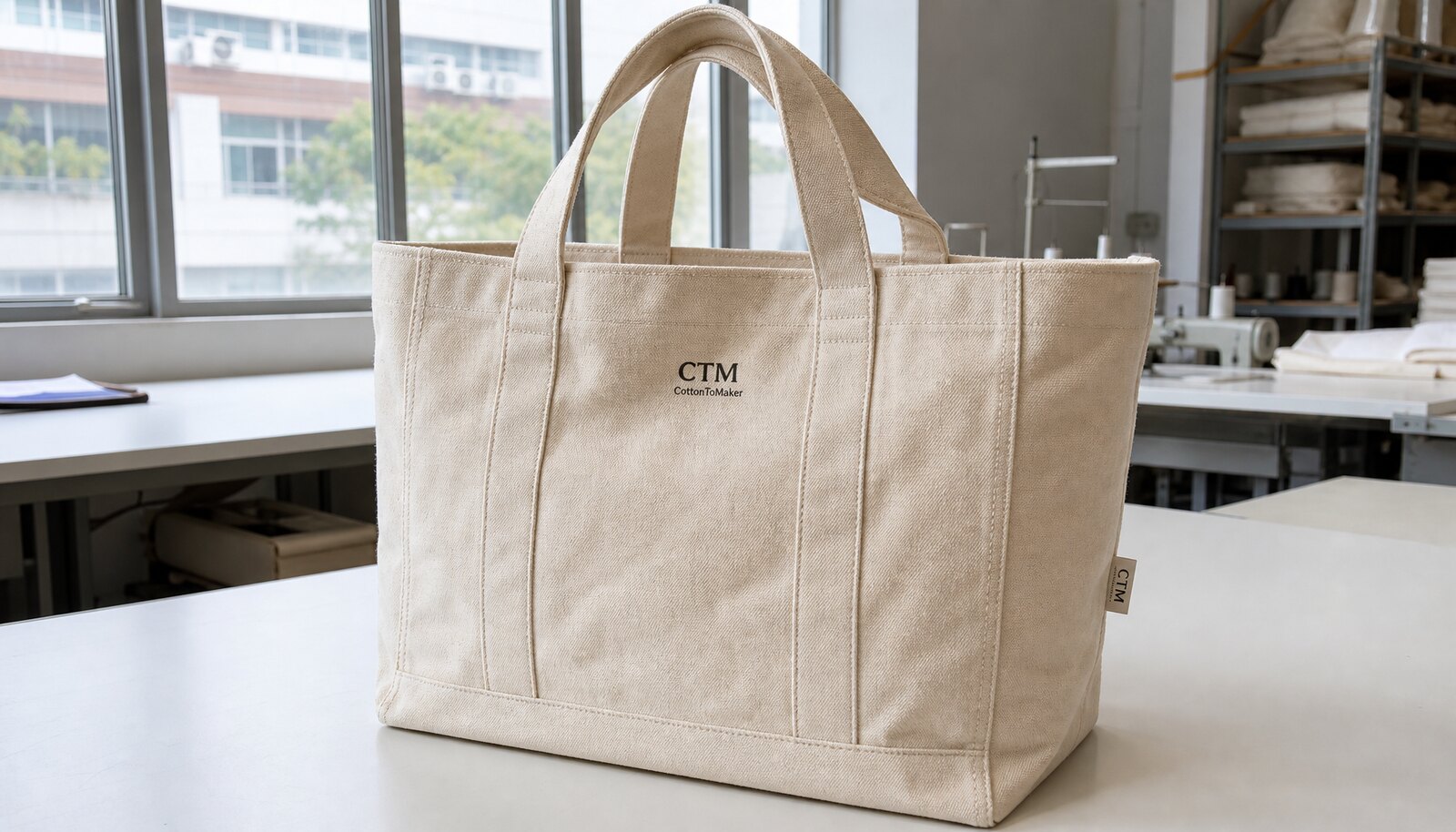
Why cosmetic brands buy large canvas grocery bags
Large canvas grocery bags are not just a commodity tote for cosmetic brands. They often sit at the intersection of packaging, merchandising, and promotion. A brand may use them as a retail add-on, a gift-with-purchase, a launch bundle carrier, a shopping bag for store staff, or a reusable item that customers keep in circulation long after the campaign ends. That makes the tote part of the brand experience, not an afterthought.
For buyers, the commercial question is simple: does the bag help the brand look more established while surviving daily handling? If the canvas is too light, the bag wrinkles, collapses, and feels disposable. If the print is too heavy or poorly cured, the bag can look cheap or crack early. If the MOQ is too high, the campaign becomes overstock. If the lead time is too optimistic, the launch misses the shelf date. Procurement needs a bag that is visually aligned with the cosmetic line and operationally feasible for the calendar.
Cosmetic packaging also raises the quality bar. Jars, glass bottles, pumps, and boxed sets make a tote look bad quickly if the base sags or the handles distort. A buyer should therefore evaluate the bag against the real product bundle, not against an empty sample photo. For a premium cosmetic program, the tote should carry weight, hold shape, and present cleanly on shelf or in e-commerce imagery.
The procurement question is not simply 'Can the factory make a canvas bag?' It is 'Can this exact bag be repeated at the right minimum quantity, with the right pack-out, on the right date, without turning the launch into a stock problem?' That is the lens used in the rest of this review.
- Treat the tote as a branded accessory with inventory risk, not as a generic bag purchase.
- Define whether the tote is a sellable retail item, a free gift, or a shipping insert; the spec changes with the job.
- Evaluate the bag with the real cosmetic kit inside, not just as an empty sample.
Start with the use case, not the artwork
The most reliable way to quote large canvas grocery bags is to start from the product bundle the tote must carry. Finished size should be chosen around the inner dimensions of the kit, carton, or retail set. Common grocery-style sizes for cosmetic programs often fall around 35-45 cm wide, 30-40 cm high, and 10-15 cm gusset depth, but those numbers are only starting points. A set of boxed skincare items needs different proportions than a bundle of loose jars or a stack of folded textiles.
Handle drop is another procurement detail that gets ignored too often. A short handle may be fine for hand carry, but it can look awkward on a shelf or shoulder. Too long, and the bag hangs untidily and uses unnecessary fabric. If the tote will be carried with a coat or layered clothing, the handle drop should be tested on a person, not just on paper. For retail use, the handle length should also work with the desired display method, such as hooks, shelves, or folded stacks.
The body structure should also match the commercial intent. A tote that must stand upright in a store display needs more stiffness than a simple event bag. If the bag is meant for gift-with-purchase, buyers may prioritize visual impact and cost control. If it is sold as a product, buyers should ask for stronger fabric, cleaner seam finish, and more consistent dimensions. The purchase order should explain the use case in plain language so the factory understands where to spend effort.
A useful internal check is to place the actual cosmetic items into a dimensional mock-up before finalizing the quote. This makes size, gusset depth, and handle drop decisions much more concrete than sending the factory only a logo file and a rough tote idea.
- State the weight of the real bundle the bag must carry, not just the bag size.
- Ask the supplier to confirm whether the tote can stand upright when empty if shelf display matters.
- If the bag is sold retail, align the tote spec with the brand's packaging quality, not with the cheapest event bag standard.
Build the MOQ around material, decoration, and packing choices
MOQ is not a single number. It is the combined effect of fabric purchasing, cutting efficiency, sewing changeover, decoration setup, and packing labor. A supplier may give a low MOQ for one-color screen print on stock canvas, but the same supplier may require a much higher quantity once you ask for custom dyeing, woven labels, multiple print positions, or individual retail packing. Buyers should ask for MOQ by variable, not only by product line.
A structured MOQ review should separate five drivers: fabric, color, print method, label or trim, and packing configuration. Fabric often sets the first floor because mills and converter minimums can force a batch size. Color adds risk if the canvas must be dyed or matched to a brand shade. Print method matters because screens, plates, or transfer setup can make a small run expensive. Labels and trims add manual operations. Packing affects how many pieces fit per carton and how long the factory needs for finishing.
For cosmetic brands, the most common misunderstanding is assuming that a supplier's MOQ is the same for every spec combination. In reality, MOQ can be 300 pieces for a blank stock tote, 500-1,000 pieces for one-color print, and significantly higher when the buyer adds custom fabric, multiple colors, or retail-ready packing. The quote should show whether MOQ applies per design, per color, per print version, or per size. If the factory does not state this clearly, the buyer does not yet have a usable MOQ answer.
The other point that matters is whether the supplier is talking about visible MOQ or real production MOQ. A quote that seems to allow 200 pieces may be built on stocked blank bags or on a mixed batch of similar orders. That can be useful for testing, but it is not the same as a repeatable program MOQ for a branded cosmetic line.
- Ask for MOQ by fabric type, by bag color, by print method, and by label style.
- Request the supplier's minimums for each add-on, such as woven label, hangtag, inner care label, or polybag.
- If you plan several SKUs, ask whether any components can be shared to reduce total minimums.
Sourcing routes: compare them on MOQ, timing, and risk
Not all sourcing routes behave the same way. A direct factory order usually offers the best control over build quality, but the buyer must manage artwork approval, schedule discipline, and inspection. A trading company can simplify communication, combine different items, and sometimes offer a lower visible MOQ, but the real factory cost may be harder to see. Stock blank bags plus local printing can move the fastest, but the buyer gives up control over fabric consistency, shade, and exact dimensions.
The right route depends on the brand stage. If the bag is being tested in a short launch or pop-up event, speed and lower inventory risk may matter more than absolute consistency. If the tote is becoming a repeat brand asset or part of a retail collection, the brand should usually favor a factory route that allows stable reorders and better documentation. In sourcing terms, the cheapest first order is not always the cheapest program.
The table above is meant to help procurement compare route by route. To use it properly, buyers should compare quotes on the same incoterm, the same packaging count, and the same artwork. If one supplier quotes the bag folded in bulk and another quotes individual polybags with barcode stickers, the prices are not directly comparable. A line-by-line review is necessary before unit price can be trusted.
One practical decision cue: if the cosmetic brand expects a second order, prioritize repeatability over the lowest trial run price. The extra work of documenting fabric, print, carton, and handle details pays off when the reorder arrives and the factory can actually reproduce the first shipment.
- Do not compare two offers unless fabric weight, print method, packing, and incoterm match.
- If a supplier switches from factory-direct to sourced stock, treat the new price as a different sourcing route.
- For repeat programs, ask how easy it is to repeat the exact fabric and color in the next order.
How to read a quote line by line
A good factory quote should let a buyer understand what is included and what is excluded. At minimum, the quote should separate fabric cost, cutting and sewing, printing or decoration, label work, packing, and carton preparation. It should also identify whether screen fees, artwork setup, sample costs, or special handling are one-time charges or recurring charges. If a supplier only sends a single unit price, the quote is too shallow for procurement decision-making.
The most common hidden cost drivers for large canvas grocery bags are fabric weight, print coverage, and packing format. Heavy canvas uses more material and slows sewing. Large logos, full-panel prints, or multiple placements can increase setup and curing time. Individual polybags, tissue wraps, barcode stickers, and retail folding instructions all add labor. Freight can also change meaningfully because canvas is bulky even when it is not especially heavy. A buyer should ask for carton dimensions and carton gross weight if the order will move by air or if warehouse cube matters.
For useful price comparison, ask for at least three quantity breaks if the supplier can support them. A quote at 500, 1,000, and 3,000 pieces can reveal where the line becomes efficient. The buyer should also ask whether the sample fee is refundable, whether the first screen is included, and whether the quote assumes one approved artwork version or multiple versions. That way, the quoted unit price reflects the real order instead of a simplified placeholder.
A quote should also show whether the supplier is quoting to a print-ready file or to a bag concept that still needs artwork work. If the supplier must redraw the logo, rebuild the layout, or translate the spec into production language, that is a scope item and should be visible in the offer.
- Separate one-time charges from recurring unit cost.
- Ask for carton dimensions and gross weight, not just bag price.
- Compare price at the same print coverage and packing density, or the numbers are meaningless.
Choose the print method for cosmetic-brand presentation and durability
Print method should follow both brand image and handling reality. Screen print remains the most common choice for large canvas grocery bags because it is economical at volume and usually gives good opacity on natural canvas. It works well for simple logos, bold type, and repeat orders. The tradeoff is setup time and limited flexibility if the artwork changes late.
Digital print and transfer can be useful for smaller runs, more colors, or artwork that includes gradients or photographic detail. They are flexible, but they can also feel less integrated with the fabric surface and may not be the most durable choice for a bag that will be folded, rubbed, and reused many times. A woven label or sewn label can create a more premium, understated look when the brand does not need full-panel graphics. In cosmetic retail, a cleaner design often performs better than an overprinted bag that competes with the packaging inside it.
A procurement review should also cover print tolerance. Ask the supplier how they control registration, cure quality, and color matching. If the bag is white or natural canvas, ask whether the ink will show through or ghost on the back side. If the tote will be washed or handled frequently, ask for a rub test and inspect for cracking after repeated flexing. A print that looks good in a sample photo but cracks after a few uses is not acceptable for a reusable cosmetic tote.
When the artwork is simple, buyers sometimes save money by limiting the print area and using a small logo placement. That can improve perceived quality as well as lead time, because the factory spends less time on setup and curing. The result is often more premium than a large, low-opacity print covering most of the front panel.
- Use screen print for repeat artwork and medium-to-higher quantities.
- Use digital or transfer if the artwork changes often or has many colors.
- Require a rub, crack, and color check on the approved sample if the bag will be reused frequently.
Write the sample approval note like a production instruction
A sample should not be approved just because it looks nice on a table. It should be treated as the production reference that the factory will follow for the full order. That means checking dimension, stitch quality, handle placement, print position, label placement, and the way the bag folds or stands. Cosmetic brands should test the bag with real products inside, because a bag that looks balanced empty may distort badly once filled with jars or boxed sets.
The approval note should remove guesswork. If the print is 5 mm too low, say so. If the canvas feel is too soft, state whether the change should be made by increasing fabric weight or tightening the weave. If the bag needs to stand upright in retail display, make that a requirement. If there is a barcode sticker or care label, confirm its exact location and size. The more specific the sample comments, the fewer surprises in bulk production.
A useful internal rule is to approve the sample only after the team has tested both appearance and function. Check it under the same light used for signoff. Load it with the intended product weight. Fold it the way warehouse staff will fold it. This is where buyers prevent expensive rework. Production problems often start when the sample process is treated as visual only.
For stronger control, keep the approved sample in two places: one with the brand team and one with procurement or QC. That makes it easier to compare bulk goods against the same reference without debate.
- Check dimensions after pressing and folding, not just immediately after sewing.
- Load the sample with the actual cosmetic kit weight before approval.
- Document every comment in writing so the factory cannot interpret feedback loosely.
Lead time should be reviewed as a production schedule, not a promise
Lead time for large canvas grocery bags is a chain of steps. Sample development is usually the first stage and often takes around 7-14 days, depending on artwork complexity, label needs, and whether the supplier already has suitable fabric in stock. Once the sample is approved, bulk production can take roughly 25-45 days for a standard custom order, but this depends heavily on fabric availability, print queue, and packing requirements. If the bag requires custom dyeing, special washing, or multiple decoration steps, the schedule stretches further.
A practical lead-time review should break the order into visible milestones: material booking, sample or mock-up, print plate or screen preparation, bulk cutting, sewing, decoration, finishing, packing, carton labeling, and shipment booking. Buyers need to ask which of those steps are on the critical path. In many factories, the slowest points are not sewing and packing; they are fabric confirmation and print approval. If the buyer changes artwork late or asks for a different carton spec after sample approval, the timeline can slip even when the sewing team is ready.
The table above should be read as an operational range, not a promise. A factory that says '30 days' may mean 30 days after all approvals, with fabric already booked and artwork frozen. Another factory may mean 30 days from initial deposit, which is a very different reality. Procurement should ask for a dated schedule with milestone checkpoints. That creates accountability and helps the brand align the tote with the launch calendar.
If the cosmetic launch date is fixed, add a buffer for sample feedback and freight booking. In practice, a small amount of schedule slack is cheaper than missing a seasonal launch or delaying a retail set because the tote arrived late.
- Ask for a dated schedule from deposit to shipment, not a single lead-time number.
- Confirm whether the lead time assumes stock fabric, one print color, and standard packing.
- Keep an internal owner for artwork and carton approval so the schedule does not stall waiting for comments.
Plan packing and carton specs before bulk sewing starts
Packing is part of the product, especially for cosmetic brands that care about presentation and warehouse handling. A tote sold in retail may need clean folding, a consistent pack count, and barcode or case labeling. A giveaway bag may tolerate simpler bulk packing, but it still needs to survive transit without creasing, mildew, or damage. If the bags are packed too tightly, the canvas can develop hard folds that are difficult to remove before display. If they are packed too loosely, the cartons waste cube and raise freight cost.
The packing spec should define whether the bags are folded, polybagged, tied, bundled, or bulk packed. It should also define how many pieces go into an inner pack or master carton, what the carton dimensions are, and what the maximum gross weight should be. Heavy 12-16 oz canvas bags can push a carton toward handling limits quickly, especially if they are individually wrapped or include inserts. If the supplier cannot tell you the piece count per carton and the resulting gross weight, the quote is incomplete.
For retail channels, buyers should also specify barcode sticker location, carton mark format, and whether a master carton needs a product description or color code. This matters because warehouse teams often reject cartons that are technically correct but operationally unclear. In practice, poor carton labeling creates more delay than a small sewing defect does. That is why packing should be approved at the same time as the bag sample.
A useful shortcut is to ask the supplier for a carton loading photo and a pack-out sheet before mass production. That gives the buyer a quick view of whether the claimed carton count is practical or whether the bags will crush each other during transit.
- Specify fold method and pack type before production starts.
- Set carton gross weight and piece count together so warehouse handling stays realistic.
- Ask for barcode and carton mark placement if the bags will go through retail distribution.
Compare landed cost, not just the factory price
The lowest factory price can still be the worst business choice if it leads to higher freight, higher inventory risk, or more rework. A real landed-cost review should compare the same incoterm, the same packing method, and the same product spec. For canvas bags, weight and volume both matter in shipping, which means a heavier tote can cost more even if the factory price only moves slightly. Buyers should also account for local receiving, warehouse handling, repacking, and any quality inspection cost on arrival.
To compare offers properly, convert each quote into a cost per sellable unit at the same destination. Then layer in the commercial effect of MOQ. A lower unit price with a higher MOQ can tie up cash and create leftovers after the campaign. A slightly higher unit price with a lower MOQ may preserve flexibility and reduce markdown risk. That tradeoff is often more important than saving a few cents on sewing. For cosmetic launches, speed and sell-through usually matter more than chasing the absolute lowest invoice.
A sensible procurement decision is one that protects the launch date, keeps the tote consistent with the brand's packaging, and leaves room for repeat ordering. If the bag is going to become a reusable brand asset, ask whether the supplier can support the same fabric and print on reorders. Repeatability has value even when it is not obvious in the first quote.
Where possible, ask finance or logistics to sanity-check freight cube before final award. The difference between a compact pack and a bulky pack can change the landed cost enough to alter the sourcing decision.
- Compare total destination cost per sellable tote, not only ex-factory unit price.
- Include freight, handling, repacking, and inspection in the landed-cost view.
- Weigh inventory risk against per-piece savings when MOQ is high.
Specification comparison for buyers
| Sourcing route / spec choice | MOQ band to expect | Lead time band to expect | Unit cost behavior | Main risk to buyer |
|---|---|---|---|---|
| Direct factory custom cut-and-sew, stock fabric, one print color | 300-1,000 pcs is a common practical band; ask whether MOQ is per color or per artwork | Sample 7-14 days; bulk 25-40 days after approval if fabric is already available | Usually efficient once the artwork and repeat order are stable | Spec drift between quote and production; buyer must lock artwork, color, packing, and carton marks |
| Direct factory custom cut-and-sew, custom dye or custom weave | 1,000-3,000+ pcs is more realistic because material booking drives the batch size | Sample 10-20 days; bulk 35-55+ days after approval, depending on dyeing and fabric booking | Higher first-order cost and higher working capital tie-up | Color mismatch, fabric availability delays, and rework if the approved swatch is not controlled |
| Factory with in-house printing, stock canvas | 500-1,500 pcs often works well for branded cosmetic programs | Sample 7-14 days; bulk 30-45 days after approval, with print queue and curing as the variable | Usually more predictable than split sourcing because sewing and print are coordinated | Print queue becomes the bottleneck; late artwork changes are expensive |
| Stock blank bag plus local printing | 100-500 pcs can be realistic if the blank bag is already in inventory | Blank stock can move in days; printing can add 3-10 days depending on queue and method | Lowest entry MOQ, but total cost can rise with local print, freight, and handling | Shade, size, and weave may vary by lot; brand consistency can be weak |
| Trading company or sourcing agent | Can appear lower at the start if they aggregate orders, but factory-level minimums still apply | Variable; quoting is fast, but actual production follows factory capacity | May include coordination margin or mixed-service fees | Less visibility into who owns quality and schedule; responsibility can be blurred if issues arise |
| Heavy canvas 12-16 oz / 340-450 GSM | MOQ may be similar to medium canvas, but some factories increase minimums because sewing and packing are slower | Often 2-5 days longer than medium canvas at the same spec because handling is bulkier | Higher fabric cost and freight cube; the unit price rises faster on small lots | Bulky seams, carton weight limits, and more sensitivity to stitch quality |
| Medium canvas 8-10 oz / 240-340 GSM | Usually the easiest spec for lower-volume promotional or GWP programs | Often the fastest custom route because cutting and sewing are simpler | Lower unit price, but perceived value may be lower for premium retail use | Softer structure, lower load confidence, and more show-through if under-specified |
| Screen print, one location, one color | Setup is usually easiest to absorb at repeat volume; MOQ can stay lower if artwork is simple | Adds screen prep time, but production itself is efficient once approved | Cheaper at volume and often the best fit for repeat logos | Color registration, cure quality, and rub resistance must be checked before bulk |
Buyer checklist before sampling
- Define the bag's job first: retail product, gift-with-purchase, event giveaway, or shipping insert for bundled cosmetics.
- Lock finished size, gusset depth, handle length, and seam style before requesting any quote.
- State the exact fabric weight in oz or GSM and whether the canvas is natural, bleached, dyed, recycled, or washed.
- Provide vector artwork and confirm print size, placement distance from seam/edge, and number of print colors.
- Ask every supplier to quote the same incoterm, same carton count, same folding method, and same label requirement.
- Request a pre-production sample, photo proof, or pre-shipment reference before bulk sewing starts.
- Confirm whether the quote includes screen setup, plates, hangtags, barcode labels, inserts, and individual polybags.
- Ask for a dated production plan with material booking, sample approval, print prep, sewing, packing, and dispatch milestones.
- Request a load test and seam inspection standard tied to the real product weight, not a generic tote test.
- Build internal approval time for artwork, sample comments, carton labels, and barcode signoff so the factory is not waiting on your response.
Factory quote questions to send
- What is the MOQ by color, by artwork version, and by print method?
- Is the MOQ based on stock fabric, greige fabric, custom-dyed fabric, or already-dyed stock?
- What fabric weight, weave density, and shrinkage allowance are included in the quoted price?
- How many print colors are included, and what is the surcharge for each extra color or second print location?
- Is the quote for finished bags, sewn bodies, or bags plus packing materials?
- What is the sample fee, and is any part of it refundable against bulk volume?
- What is the lead time after sample approval, and which steps are most likely to extend it?
- How many days are needed for fabric booking, screen preparation, cutting, sewing, packing, and export booking?
- Does the unit price include individual polybags, tissue, inserts, barcode stickers, hangtags, or retail labels?
- What carton size, carton quantity, and gross weight are included in the quote?
Quality-control points to confirm
- Finished size should be checked against a written tolerance plan. A practical starting point is tighter control on width and height, with gusset and handle-drop tolerances slightly wider because those can vary more during sewing and folding. Ask the supplier to state the target dimensions on the approved sample sheet.
- Stitch quality should be checked at the seam type that carries the load. Ask for a reference count in stitches per inch or stitches per centimeter for side seams, top hem, and handle attachment. Acceptance should cover missed stitches, broken stitches, skipped stitch lines, and loose thread tails at visible edges.
- Handle reinforcement should use a repeatable structure such as bar tack or box-X stitch. Ask the factory to show the reinforcement location on the sample and to confirm the stitch pattern, thread type, and end-point count. A handle that twists under load or shows uneven reinforcement is not acceptable for a cosmetic tote.
- Seam strength should be verified by loading the bag with the real product weight plus a test margin. A practical buyer request is a static load hold and a repeated lift/set-down check. The bag should not split at the gusset, corner, or top hem during the test.
- Print quality should be checked for registration, opacity, and rub resistance. Ask for a wet rub and dry rub check on the approved sample or pre-production lot if the tote will be handled often. Acceptance should cover blur, ghosting, pinholes, ink cracking, and color shift after flexing.
- Color control should be tied to a physical master sample or swatch. If Pantone matching is required, the PO should state whether the supplier must match visually to the approved standard or within an agreed delta range. Do not rely on the supplier's 'close enough' wording.
- Fabric quality should be checked for weight, weave consistency, and visible defects. If the bag is meant for repeated use, ask for evidence of fabric weight measurement rather than a verbal claim. Buyers can also ask for a shrinkage check after steam or wash conditioning if the tote will be reused often.
- AQL guidance should be defined before the order ships. For many non-technical tote programs, buyers use a general final inspection at a defined AQL level for major, minor, and critical defects, then classify defects in writing. Keep the reference point in the PO so the inspection standard is not open to interpretation.
- Carton and pack-out quality should be checked alongside the bag itself. Acceptance should cover fold direction, pack count, barcode position, carton marks, gross weight, and whether the bags recover from folding without permanent creasing or damage to print.
- Pre-shipment inspection should include one sample from the first carton, middle cartons, and last cartons if the order is large enough to vary by time or operator. That helps catch print drift, fold changes, or sewing adjustment issues before the full shipment is released.