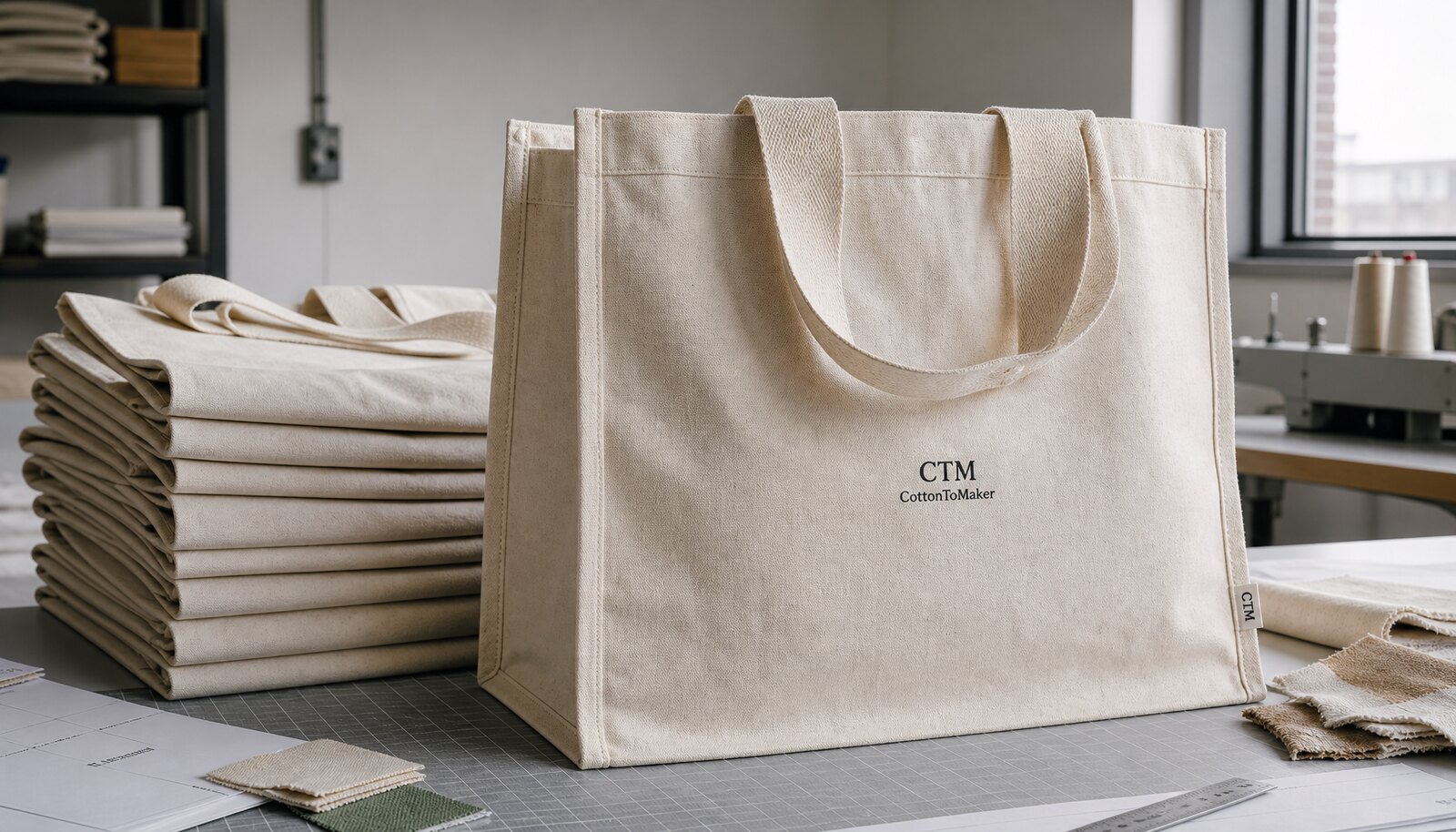
What buyers are really pricing in a large canvas event bag
For corporate events, large canvas grocery bags are usually bought as carry bags for attendee kits, sponsor giveaways, conference literature, or premium welcome packs. The printed logo matters, but the real buying question is whether the bag will hold the event contents without looking flimsy, whether it can be packed efficiently, and whether the landed cost still works after freight, cartons, and print setup are added. If you only compare unit price, you can end up with a bag that looks cheap, arrives late, or fails in the hand.
The spec has to be tied to the use case. A bag that carries a notebook and brochure set can be lighter than one that must handle a bottle, catalog, and sample kit. Large canvas grocery bags for corporate events also need a cleaner finish than a general supermarket tote. Buyers usually want a natural cotton look, neat stitching, a visible logo, and a format that feels more premium than a basic promo bag without pushing the program into retail-level cost.
- Start with the event contents, not the bag name.
- Separate carry performance from print decoration.
- Treat freight, packing, and sampling as part of pricing, not extras.
Choose the right canvas weight before you compare quotes
Canvas weight drives both feel and cost. For corporate event bags, 12 oz to 14 oz canvas, roughly 406 to 475 GSM, is the practical middle ground. It gives the bag structure, helps the print sit cleanly, and avoids the limp look that buyers often reject. If the event uses heavier inserts or the bag must be reused after the event, 14 oz is usually easier to defend. If the program is very price-sensitive and the contents are light, a slightly lower weight can work, but the bag should still stand upright and keep shape at the bottom corners.
Ask the supplier for the actual fabric specification, not just the ounce label. Weave count, yarn quality, and whether the fabric is natural, bleached, or pre-shrunk can change the handfeel and shrinkage. A 12 oz bag made from loose weave fabric may feel weaker than a tighter 11 oz or 12 oz construction. For event buyers, the visible difference is often in the edge finish, seam stability, and how much the bag wrinkles after folding.
- 12 oz to 14 oz is the main buying lane for premium event totes.
- Heavier fabric improves body and print appearance but increases freight weight.
- Natural and bleached canvas have different visual impact and stain tolerance.
Why the same tote can quote very differently from supplier to supplier
Two quotes can look similar on paper and still land at very different total cost. One supplier may price only the blank bag body and add print setup, carton charges, and packing labor later. Another may include everything except shipping. Some factories calculate from fabric consumption, while others use a standard bag template and absorb or hide waste in the quote. For a procurement team, the job is to make each supplier quote the same finished product definition so the differences are visible.
The comparison gets clearer when you split the bag into cost drivers: fabric, cutting loss, sewing labor, print method, handle reinforcement, packing, and carton volume. Screen printing with one color is usually the most efficient for a clean corporate logo. If the artwork uses gradients or multiple small colors, the supplier may propose heat transfer, but that can create a different handfeel and durability profile. A quote that is low because it excludes one of these items is not a real bargain.
- Ask whether the price includes one side print or both sides.
- Confirm if setup charges are one-time or repeated across reorders.
- Request packaging and carton data on the same quotation sheet.
Supplier routes: direct factory, trading company, or mixed sourcing program
For large canvas grocery bags for corporate events bulk pricing plan decisions, the supplier route matters as much as the spec. Direct factories usually give the best control over fabric, sewing detail, and print consistency once the program is standardized. Trading companies can help when the buyer needs mixed bag styles, lower upfront volume, or more handholding across multiple SKUs. The downside is that the real production site, process control, and capacity planning may be less transparent.
If the event program is recurring, a direct factory relationship is usually stronger because the factory can archive your pattern, artwork placement, and packing spec. If the order is a one-time sponsor package with several gift items, a sourcing partner may be easier to manage. The key is to compare not just price, but who owns sample approval, who handles workmanship issues, and who can scale the same spec on the next reorder.
- Direct factory: better control, clearer process, stronger repeatability.
- Trading company: easier coordination for mixed programs, but more indirect control.
- Mixed sourcing: useful when the event needs different bag types in one shipment.
A practical bulk pricing plan: how order quantity changes unit cost
Canvas tote pricing usually improves in steps, not in a straight line. Setup cost for screen printing, cutting, and sewing preparation is spread across more units as volume rises. A quote at 500 pieces may look much higher per unit than 1,000 or 3,000 pieces because the fixed cost burden is not yet diluted. Buyers should request breakpoints at 500, 1,000, 3,000, and 5,000 pieces if the event is large enough to scale. That gives procurement a clean way to compare reorder economics.
The biggest mistake is assuming the cheapest first quote is the best plan. For corporate events, a small over-order can sometimes be cheaper than a shortfall if the supplier has to reopen a production run. On the other hand, if the event date is firm and leftover inventory has no reuse plan, overbuying can lock cash into stock that ages in the warehouse. A useful bulk pricing plan includes the best quantity for event coverage, the safety margin, and the reorder penalty if you miss the first shipment.
- Use quantity breakpoints to see the real scaling effect.
- Separate event demand from safety stock.
- Compare the cost of shortage against the cost of leftover inventory.
Print method choices that matter more than artwork presentation
For a canvas grocery-style event bag, screen print is usually the first choice because it is durable, cost-effective, and looks clean on natural fabric. One or two solid colors are ideal. If the logo has fine text, thin lines, or gradient effects, the print may need to be simplified for production. Buyers often send a web logo and expect the factory to make it work without adjustment, but the production-ready version should be checked before quote finalization. Small font sizes can fill in on textured canvas.
Heat transfer can help with complex color art or smaller runs, but the finish is different and can feel less integrated with the fabric. Embroidery is rarely the best value for large event bags unless the program is very premium and the logo area is small. If the brand cares about tactile quality and repeated use, a clean screen print on a good-weight canvas normally gives the best balance of price and appearance.
- Screen print works best for bold, simple logos.
- Heat transfer is a fallback for complex or short-run artwork.
- Embroidery adds cost and usually fits smaller logo areas.
Sample approval should prove construction, not just artwork
A sample is not only for color approval. It should confirm fabric handfeel, actual size, handle length, handle placement, print position, and how the bag folds and stands. For corporate event orders, the best sample is a sewn pre-production sample made from the real fabric and real trim. A printed paper proof is not enough because it will not show seam bulk, print bleed, or gusset behavior. If the bag carries inserts or bottles, the sample should be loaded and tested by hand before signoff.
Buyers should also decide what sample changes are acceptable before production starts. For example, a slight tone difference in natural canvas can be acceptable, but handle length, bag width, and logo position should stay within agreed tolerance. If the first sample is wrong, do not approve it with a verbal note. Send a revised mark-up and ask for a second sample or a photos-on-finished piece confirmation. That small discipline avoids a whole production run of near-miss bags.
- Require a sewn sample from real materials, not a digital mockup.
- Load-test the sample with the actual event contents.
- Set acceptance tolerances for size, print position, and handle placement.
Packing and carton planning can change the landed cost more than buyers expect
Canvas bags are bulky relative to their weight, so packing efficiency matters. Bulk packed master cartons are usually the best fit for event programs because they reduce labor and carton volume. If retail presentation is not required, individual polybags can be avoided or limited to a simple protection sleeve. The packing spec should include the number of pieces per carton, carton dimensions, gross weight, and whether cartons need outer marks for event distribution or warehouse receiving.
Freight cost often rises faster than the factory price when the carton size is too large or the bag is folded inconsistently. A slightly improved folding method can save real money on a long shipment. For importers and distributors, the carton spec is part of the quote comparison because the same 1,000 bags can ship very differently depending on whether they are packed 20 or 50 per carton. A supplier that can optimize folding and carton fill may offer better landed cost even if the factory unit price is slightly higher.
- Bulk packing is usually the default for corporate events.
- Carton count affects freight, warehouse handling, and receiving time.
- Ask for carton dimensions before you compare ocean or air freight.
Lead time risks are usually caused by sample delay, not sewing
Standard lead time for a simple canvas event bag is often 30 to 45 days after sample approval, but that number is only meaningful if the sample is approved quickly and the artwork is final. Delays usually come from revised logos, late purchase order changes, or fabric sourcing if the supplier does not keep the right canvas in stock. When an event date is fixed, buyers should work backward from the ship date and include time for sampling, production, carton QA, and transit buffer.
For urgent programs, it can be better to simplify the spec than to push for speed on a complex build. One-color print, a standard natural canvas shade, and a straightforward sewn label will move faster than a fully customized packaging program. If the supplier says they can shorten lead time, the buyer should understand which step is being compressed. Cutting corners on inspection or skipping the pre-production sample is where most late-event failures begin.
- Plan backward from the event date, not from order date.
- Artwork revisions are the most common schedule slip.
- Simpler specs ship faster and with less production risk.
Use a QC standard that matches event-level visibility
A corporate event bag can look acceptable at a glance and still fail in use. The inspection plan should cover seam quality, print alignment, size tolerances, handle reinforcement, loose threads, stain control, and carton labeling. An AQL-based final inspection is useful, but it should be paired with measurable production criteria. For example, if the approved size is 40 x 35 x 15 cm, define the acceptable range before production so the factory does not interpret it loosely.
If the bag carries a logo that will be photographed on-site, print alignment and logo crispness become more important than on a generic promotional tote. Buyers should also inspect the natural canvas shade across cartons because visible shade drift can make the program look inconsistent on a registration desk. For repeated corporate orders, a photo record of the approved sample and first production carton helps keep future reorders aligned.
- Use both visual checks and measured tolerances.
- Control shade variation if multiple fabric lots are involved.
- Record sample photos and keep them with the purchase order.
Specification comparison for buyers
| Spec decision | Recommended option | When it fits | Buyer risk to check |
|---|---|---|---|
| Fabric weight | 12 oz to 14 oz canvas, about 406 to 475 GSM | Corporate events where the bag must feel premium, hold catalogs or gift sets, and survive repeated use | Too light and the bag collapses or shows print distortion; too heavy and freight cost rises fast |
| Bag size | Large format around 40 x 35 x 15 cm or 16 x 14 x 6 in | Event kits, brochures, notebooks, drink bottles, and mixed giveaways | If the gusset is too shallow, the bag looks big but carries poorly; if too deep, carton count drops |
| Handle construction | Cross-stitched long handles with 2.5 to 3 cm width | When attendees may carry the bag on shoulder or load heavier items | Short or narrow handles fail in field use and trigger complaints even when the bag body is fine |
| Print method | 1 to 2-color screen print for large clean logos; heat transfer only for small runs or complex art | Best for corporate events that need clear branding and controlled unit cost | Overly detailed artwork on canvas can blur; multi-color print adds cost and registration risk |
| Supplier route | Direct factory for repeat volumes; trading company for mixed SKUs or smaller program testing | Direct sourcing when you can standardize spec and want stronger price control | Trading route can hide factory details and make yield, packing, and QC responsibility less clear |
| MOQ logic | 500 to 1,000 pcs per color/artwork for custom production; lower only if using stock fabric and simple print | Corporate events with approved artwork and a single delivery window | Low MOQ often means higher setup cost per bag, less shade control, and fewer packing options |
| Packing method | Bulk packed in master carton with polybag if required; avoid overpacking each piece unless retail presentation matters | Events where budget and freight efficiency matter more than shelf display | Individual bagging increases labor and carton volume; confirm whether cartons must be inner-boxed |
| Lead time | 30 to 45 days after sample approval for standard canvas and one-color print | Most corporate event schedules with moderate urgency | Artwork approval delays, dye-lot differences, and carton delays are the usual schedule slip points |
| QC standard | AQL-based inspection plus measured tolerances for size, stitch density, print alignment, and load handling | Any event program where reprints are expensive or the bags are part of sponsor visibility | If the supplier only offers visual inspection, hidden issues in seam strength and handle attachment can pass |
Buyer checklist before sampling
- Confirm final bag size, gusset, handle drop, and usable loading weight.
- Specify fabric type, GSM/oz weight, color tolerance, and shrinkage expectations.
- Send vector artwork and define logo size, print position, and Pantone references.
- Ask for sample photos plus one physical pre-production sample before bulk approval.
- Agree carton packing, barcode or hangtag needs, and shipment marks before production.
- Record inspection checkpoints for stitching, print adhesion, stains, and quantity count.
Factory quote questions to send
- What is the exact canvas GSM, weave count, and whether the fabric is bleached, natural, or recycled stock?
- Is the price based on screen print, heat transfer, embroidery, or no print, and what setup fee applies per color?
- What handle length, width, reinforcement stitch, and seam allowance are included in the quote?
- How many pieces per carton, what is the carton measurement, and does the quoted price include outer carton marks?
- What is the sample charge, sample lead time, and whether the sample cost is refundable after order confirmation?
- Which parts of the quote change if the order quantity moves from 500 to 1,000 to 3,000 pieces?
- What inspection standard is used before shipment, and can you share in-line and final QC photos?
- What is the production lead time after sample approval, and what delays are most common for this bag style?
Quality-control points to confirm
- Fabric weight should be within an agreed tolerance range, not a vague '12 oz' statement without measurement method.
- Stitching around handles and side seams should be even, with no skipped stitches, loose ends, or seam puckering.
- Print position should stay within a practical tolerance so logos do not drift into seams or gussets.
- Bag opening and gusset should match the approved sample, because small changes affect usable volume and carton packing.
- Handles should pass a reasonable load test without thread popping, especially for event kits that include bottles or catalogs.
- Cartons should be dry, clean, and labeled with style, quantity, color, and PO number for receiving control.
- Shade variation between cartons should be separated and reported before shipment if multiple dye lots are used.