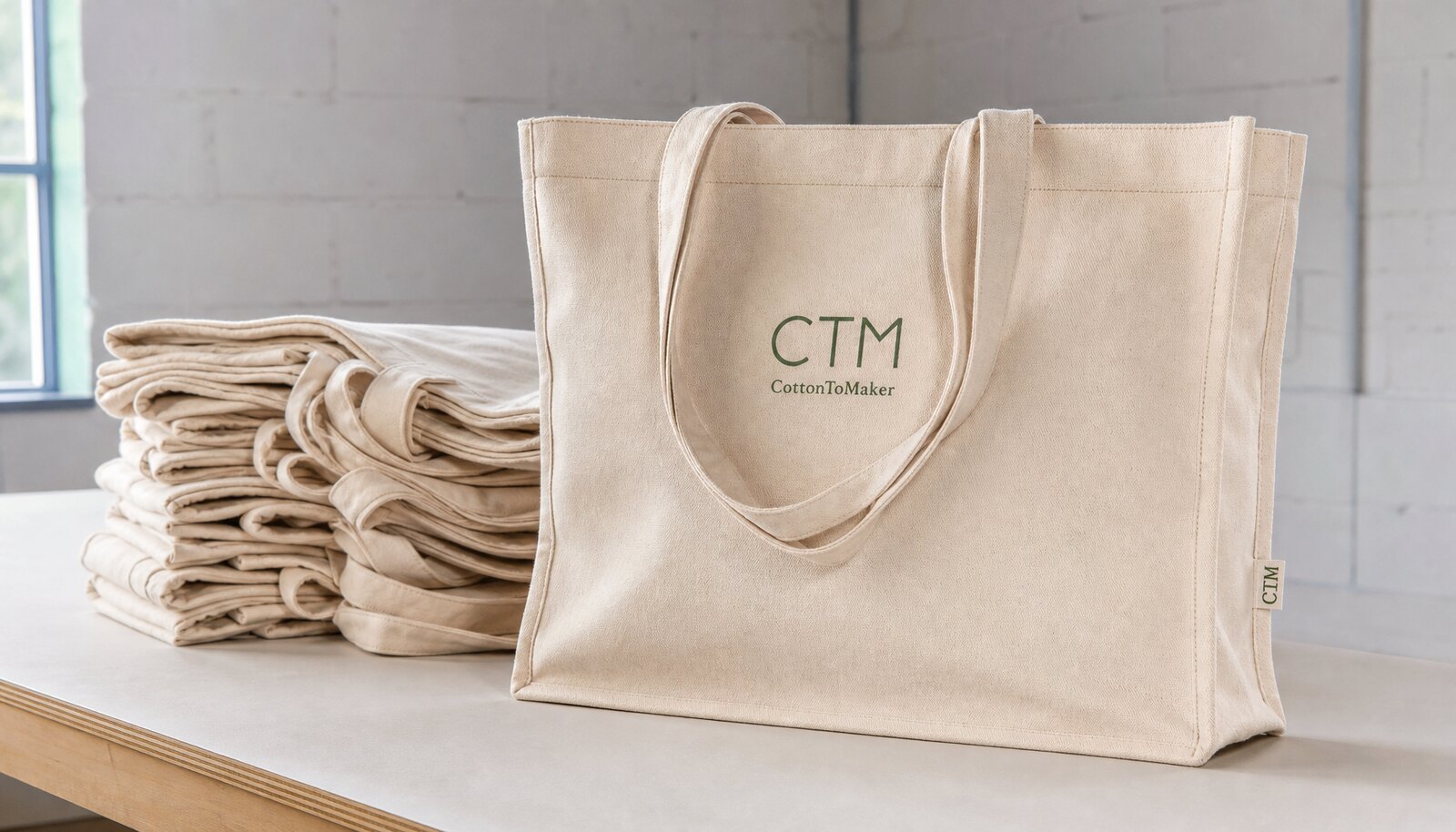
Why boutique grocery bags need a different sourcing brief
Boutique buyers are not simply sourcing a carry bag. They are buying a customer-facing packaging item that needs to hold product weight, present the brand well at checkout, and remain usable after the sale. That changes the procurement logic. A grocery bag for a boutique has to handle candles, jars, skincare sets, pantry items, and mixed gift purchases while still looking clean enough to sit beside premium merchandise. If the fabric is too thin, the bag collapses under load and feels disposable. If it is too heavy or overbuilt, the buyer pays for stiffness the shopper may not need and freight that adds no retail value.
The right brief starts with use conditions, not artwork. A supplier can only quote accurately if the buyer tells them what the bag must carry, whether it will be sold or given away, whether it needs to stand upright, and what the packaging role is at checkout. That is why the best wholesale checklist begins with operational requirements. Once the use case is clear, fabric weight, handle style, construction, and print method become much easier to specify.
For procurement teams, this matters because a large canvas grocery bag can appear simple while hiding several cost drivers. Fabric weight affects durability and cube. Handle construction affects labor and failure risk. Print method affects setup cost and reprint consistency. Packing detail affects both retail presentation and landed cost. The buyer who defines these items early tends to get cleaner quotes and fewer surprises later in production.
- Write down the heaviest typical load in kilograms or pounds, not just a generic use description.
- Confirm whether the bag must stand upright on a counter or only function as a hand-carry package.
- If the bag will be resold, include shelf presentation, label, and display requirements in the RFQ.
Set the fabric spec before you ask for prices
Canvas weight is one of the most important drivers of performance and cost. For most boutique grocery applications, 10–12 oz cotton canvas, roughly 340–400 GSM, is a practical range. It usually gives enough body to hold shape without making the bag feel bulky or overly rigid. Lighter canvas can work for light gifting or low-load retail packaging, but it often loses structure once the bag is filled. Heavier canvas can improve perceived quality and load tolerance, but it also increases material cost, sewing effort, and freight cube.
A buyer should not accept a quote that only says “heavy canvas.” That phrase is too loose to support procurement decisions. Ask for the exact ounce weight or GSM, the weave type, the cotton content, and whether the number refers to greige fabric, dyed fabric, or a finished bag after washing or finishing. If the supplier is silent on those points, the buyer cannot be confident that a reorder will match the first shipment.
Fabric provenance also matters when the bag is part of a branded retail program or when the buyer needs stronger documentation for sustainability, import, or customer transparency reasons. Even when the order does not require formal certification, a clear fabric origin trail helps reduce substitution risk. The goal is not to overcomplicate the order. The goal is to make the spec concrete enough that the supplier cannot quietly swap to a different cloth after the sample is approved.
- 10 oz canvas suits light boutique packaging and lower-cost promotions.
- 12 oz canvas is a safer default for mixed retail purchases and repeat customer use.
- If provenance matters, ask for mill or origin disclosure in writing before the PO is issued.
Choose the bag structure based on how it will be used at checkout
The bag body should match the way customers actually shop. A flat tote is simpler and cheaper, but it limits volume and can look thin when filled. A side gusset gives more width and makes it easier to pack boxed items, candles, or multi-item purchases. A box-bottom design stands more neatly on shelves and in baskets, but it adds sewing complexity and requires better control at the corners and bottom seams. For boutiques that mix apparel accessories with grocery-style items, a gusseted or box-bottom bag is often the more practical format because it supports the product better and presents the brand more cleanly.
Handle construction should be specified with the same care. Self-fabric handles create a cleaner aesthetic and can work well when the load is moderate. Cotton webbing handles are often the better choice when buyers expect heavier content, stricter load tests, or repeat customer reuse. The handle is a common failure point because it carries both force and consumer perception. If it feels weak in hand, the bag will be judged as low quality even if the body fabric is acceptable.
This is where buyers should ask for exact construction details rather than broad language. Handle width, handle length, stitch rows, bar-tacks, top hem construction, and seam allowance all affect durability. If the supplier cannot explain those items on the sample sheet, the quote is not yet complete enough to compare.
- Use a side gusset when the bag needs extra capacity without becoming too boxy.
- Use a box-bottom when upright presentation and stable packing matter most.
- Specify reinforcement at the handle attachment point and top edge, not just the handle material.
Qualify suppliers on control, not on friendliness or first price
The supplier route changes the outcome. A direct factory with tote specialization usually offers the most direct control over fabric, stitching, and packing. That is valuable when the buyer wants repeatable reorders, stable artwork, and fewer hidden markups. A trading company or sourcing agent can be useful when the buyer needs help coordinating multiple items, language support, or sample collection from several factories. The tradeoff is that layered pricing can make unit comparisons misleading unless the supplier discloses the underlying production source and the quote basis clearly.
Good supplier qualification goes beyond checking a website and asking for a catalog. Buyers should ask how many canvas tote programs the factory runs each month, what machines it uses for cutting and sewing, how it controls print registration, and whether it has a documented inspection process. The goal is to understand whether the factory can hold a tote spec at volume or whether it mainly handles generic promotional bags. That distinction often determines whether the second order matches the first.
A practical way to qualify vendors is to ask for one sample, one production-style quote, and one QC process description. If the sample looks right but the supplier cannot describe how it will hold tolerances in production, the risk remains high. If the factory is transparent about its limits, that is usually a better sign than vague promises of “best quality.”
- Use direct factory quotes when you want visible control over material and construction.
- Use a sourcing partner only when they disclose the factory source and cost components clearly.
- Do not compare a factory FOB quote against a middleman landed quote without normalizing the basis first.
Normalize quotes so landed cost is actually comparable
A low unit price is not a useful outcome by itself. Procurement teams need a landed-cost comparison that includes the bag price, print setup, sample charges, packing labor, carton cost, freight basis, duty, and any domestic receiving or drayage cost. Two quotes can appear close at the unit level and still land far apart once carton size, packing density, and shipping term are included. Canvas bags are especially prone to this problem because their cube can grow quickly when they are packed loosely or individually wrapped.
The buyer should request the same Incoterm from every supplier, ideally on the same basis, before evaluating price. If one supplier quotes EXW and another quotes FOB or DDP, the numbers are not comparable. Ask for the same currency, the same port or warehouse basis, and the same packaging assumptions. If the supplier includes insert cards, hangtags, or individual polybags, that should be written into the quote line by line. Otherwise, the quote may look lower only because important items were left out.
The most useful quote format is one that separates fixed and variable costs. Fixed items include artwork setup, screen charges, sampling, and die or plate charges if any are needed. Variable items include the bag body, handle sewing, print per unit, and packing per unit. Once those are separated, the buyer can see where the supplier has room to negotiate on future reorders and where the price is fixed by material or labor.
- Ask every supplier to quote on the same Incoterm and the same currency.
- Separate sample charges from bulk pricing so later negotiations stay clean.
- Request carton dimensions and estimated freight cube before accepting the quote.
Use the sample stage to approve more than appearance
A digital mockup proves only layout. It does not prove fabric hand, seam behavior, handle comfort, or print durability. For a canvas tote program, the pre-production sample is the real approval gate. The buyer should inspect the exact fabric, the actual construction, the final print method, and the packing method in one sample run. Then the sample should be handled the way the customer will use the bag: filled, lifted, set down, folded, and checked at the stress points.
The approval process should be measurable. Before production starts, define acceptable finished dimensions, print placement tolerance, seam appearance, and any unacceptable defects. This avoids the common problem where the sample “looks fine” but nobody has written down what fine means. Buyers should also keep a sealed approval sample and a measured reference sample in procurement records so later reorders can be checked against the same baseline.
If the supplier cannot match the sample consistently before mass production, the bulk run is unlikely to improve. For that reason, some procurement teams request a pre-production strike-off for the logo and a separate sewn sample for construction. That extra step is usually worth it when the logo placement, handle shape, or body proportions are important to the brand.
- Measure finished width, height, and gusset depth from the approved sample.
- Test handle comfort under load, not only by visual inspection.
- Approve print, seam, and carton labeling together so no part of the order remains ambiguous.
Build a QC standard that can be measured in production
High-level quality statements like “good stitching” or “strong bag” are not enough for wholesale buying. The buyer should define measurable inspection criteria. A practical QC plan for canvas bags usually covers fabric weight tolerance, finished dimension tolerance, stitch density, print registration, visible defect limits, and carton standards. These items should be written into the PO or the quality agreement so the factory is not left to interpret them later.
AQL is useful when the buyer wants a standard inspection framework, but it needs to be defined clearly. Buyers should specify the acceptance level for critical, major, and minor defects rather than referring to AQL in general terms. The actual thresholds depend on the buyer’s risk tolerance, but the important point is to make the inspection logic explicit. For a branded retail bag, a small print misalignment may be a major defect even if the fabric itself is fine. For a resale program, a missing barcode or label may be more serious than a small thread issue.
Load testing should also be realistic. The bag should be tested with the intended customer load, not a generic weight that has no connection to use. Hold the load long enough to expose seam creep or handle stretch, then inspect for tearing, deformation, or bottom seam distortion. If the buyer wants a carton drop or compression expectation, that needs to be stated before shipping, because packaging requirements influence packing density and carton spec.
- Ask for an agreed AQL framework with critical, major, and minor defect definitions.
- Specify stitch density or stitch-per-inch targets where construction quality matters.
- Require a load test that reflects the actual boutique use case, not an arbitrary lab weight.
Treat packaging and cartonization as part of the product spec
Packaging is not just a logistics detail. It affects brand presentation, freight cost, and the chance of damage in transit. If the bag is sold at retail, the buyer may need individual folding, insert cards, size stickers, barcode labels, or individual polybags. If it is used only as checkout packaging, bulk folding may be enough. The supplier should not guess which format is acceptable. Every packaging choice changes labor and cost, so it must be quoted explicitly.
Carton planning matters because canvas bags are volume-heavy. A bag can be light enough in pounds but still expensive to ship if the carton cube is large. Buyers should ask for carton dimensions, gross weight, and piece count per carton so they can compare freight impact between suppliers. Two quotes with the same unit price can produce very different landed costs if one supplier packs efficiently and another overpacks or underpacks. The best comparison is made after normalization to unit cost, cube, and freight basis.
If the bags are going by ocean, ask whether cartons are palletized and whether any specific stacking or moisture protection is required. If they are going by air, packing density becomes even more important because volumetric weight can dominate the price. In both cases, the carton spec should be visible before the order is confirmed.
- Specify whether bags should be bulk packed, individually polybagged, or retail-tagged.
- Request carton dimensions and gross weight before confirming the order.
- If cartons must be shelf-friendly, include side labels and count labels in the RFQ.
Control lead time, payment terms, and reorder behavior up front
A standard lead time of 30–45 days after sample approval can be realistic for a simple canvas tote program, but it should be treated as a planning baseline rather than a promise. Production slips usually happen when artwork changes after approval, when a new print color is added, when the packing method changes, or when fabric has to be sourced specifically for the order. If the buyer needs the bags for a seasonal launch, the schedule should include time for sample review, revisions, and shipping delays, not just sewing time.
Payment terms deserve the same attention as product specs. A first order may require a deposit, but procurement should still ask how the balance is handled, whether the supplier will reserve production capacity, and what happens if the buyer requests a production pause after sample approval. Reorder terms matter too. If the order is likely to repeat, the buyer should ask whether the factory will hold the approved fabric, screens, labels, or cut patterns for the next run. That can reduce both lead time and the risk of variation.
Reorder control is especially important for branded tote programs because even small changes in cloth color, handle length, or print placement can make the next batch look different. The best practice is to keep the approved sample, production photos, and spec sheet in one record and reference them in every reprint or replenishment PO. That gives procurement a defensible baseline when the factory tries to simplify or alter the next run.
- Build extra time for artwork sign-off and sample revisions.
- Keep one sealed approval sample and one measured reference sample in procurement files.
- Write reorder conditions into the PO so the factory must repeat the approved build, not reinterpret it.
Use a procurement checklist that leads to a better PO, not just a better conversation
The buyer checklist should translate into a purchase order that can survive production. That means the order has to reflect the same dimensions, fabric weight, print method, packing detail, inspection standard, and logistics basis used during sourcing. A good PO is precise enough that the factory can produce it without guessing and procurement can inspect it without arguing over intent. That is the difference between a useful buying checklist and a generic sourcing note.
Before issuing the PO, the buyer should make sure the supplier has confirmed the spec in writing and that all commercial terms are aligned. If there is any mismatch between the sample and the quote, resolve it before production starts. A bag order is not the place to rely on unwritten assumptions. Small omissions, such as handle width or carton count, often turn into avoidable disputes once the shipment is underway.
For procurement teams managing multiple boutique accounts or store formats, it helps to create a standard tote spec sheet and reuse it with minor modifications. That keeps sourcing consistent across vendors and makes price comparisons easier over time. The more repeatable the spec, the more accurately the team can measure supplier performance and reorder outcomes.
- Convert the approved sample into a written spec sheet before releasing the PO.
- Match PO language to the quote, sample, and inspection plan so there is one source of truth.
- Track supplier performance on dimension accuracy, defect rate, on-time ship date, and reorder consistency.
Specification comparison for buyers
| Spec decision | Recommended option | When it fits | Buyer risk to check |
|---|---|---|---|
| Fabric weight | 10–12 oz cotton canvas, roughly 340–400 GSM | Boutique grocery carry bags that need body, a premium hand feel, and enough strength for mixed retail purchases | Ask whether GSM refers to finished fabric, greige fabric, or washed fabric; a quote can look comparable while the actual material is different |
| Fabric provenance | Specify cotton content, weave type, finish, and origin disclosure when it matters to your compliance program | When the bag is part of a branded retail line, sustainability claim, or import documentation review | Vague fabric descriptions hide substitutions, inconsistent dye lots, or compliance gaps |
| Bag structure | Flat tote with gusset or full box-bottom gusset | Best for groceries, candles, jars, and mixed boutique purchases where upright capacity matters | A shallow gusset reduces usable volume; oversized gussets can distort print placement and seam stress |
| Handle style | Self-fabric handles or cotton webbing handles with bar-tack reinforcement | Self-fabric suits a cleaner retail look; webbing handles suit heavier loads and stricter load tests | Thin handles are a common complaint on heavier loads and often fail first at the attachment point |
| Print route | 1–2 color screen print for repeat orders; heat transfer for short runs; woven label or embroidery for premium accents | Screen print is usually the most practical balance for boutiques ordering recurring volume | Complex artwork raises setup cost and can expose registration problems on natural canvas |
| Supplier route | Direct factory with tote specialization | Best when you need controlled pricing, repeat reorders, and spec discipline | Requires stronger buyer oversight on sample approval, tolerance limits, and carton detail |
| Supplier route | Trading company or sourcing agent | Best when you need mixed product consolidation, smaller initial exploration, or language support across factories | Margin stacking can hide actual factory cost and make quote comparison misleading |
| MOQ strategy | Start with one bag construction, one fabric weight, and one or two print colors | Fits first-time boutique programs or seasonal tests where demand is not yet proven | Low MOQ often means higher unit price and less flexibility on customization |
| Packing method | Bulk packed in labeled cartons, or folded with insert cards if shelf-ready | Boutiques that plan resale or gifting often need neat retail-facing presentation | Loose folding can crease printed areas; retail inserts increase labor and carton volume |
Buyer checklist before sampling
- Define the actual carry use: light boutique purchases, mixed grocery loads, or heavier jar-and-bottle baskets.
- Lock the fabric spec before quoting: exact ounce weight, GSM, cotton content, weave, finish, and whether the weight is measured before or after washing.
- Choose one print route for the first order and keep the artwork simple enough to survive repeated production with the same result.
- State finished dimensions, gusset depth, handle length, seam allowance, and whether the bag must stand upright when empty.
- Request a full quote that separates unit cost, print setup, sample charge, packing charge, carton cost, and freight assumptions.
- Ask every supplier to quote on the same Incoterm so landed-cost comparisons are actually meaningful.
- Approve a physical pre-production sample before mass production, not just a digital proof.
- Specify carton count, carton dimensions, palletization if needed, and any retail insert or barcode requirements.
- Set acceptance criteria for stitch quality, print placement, fabric defects, dimensional tolerance, and load performance.
- Put reorder controls in writing so later batches match the approved sample instead of becoming a new interpretation.
Factory quote questions to send
- What exact fabric weight are you quoting, and is it measured on greige cloth, dyed cloth, or finished bag material?
- What is the cotton content, weave type, and finish of the canvas, and can you confirm the mill source if we need provenance control?
- Is the quoted price based on flat tote, side gusset, or box-bottom construction, and what are the exact finished dimensions?
- How many stitch rows are included on the handles, side seams, and bottom seams, and are bar-tacks included at stress points?
- Which print method is included, how many colors are covered, and what is the setup charge per color or per screen?
- What is the MOQ per colorway and per artwork version, and can mixed colors share one production run without changing unit cost?
- What is included in the quote for samples, inner packing, carton labels, master cartons, and any export paperwork?
- Which Incoterm are you quoting, from which port or warehouse, and what costs are excluded from the price?
- How does freight change if carton dimensions or carton count change, and is the estimate based on gross weight or volumetric weight?
- What dimensional tolerance, stitch tolerance, print defect standard, and inspection method do you use for bulk acceptance?
Quality-control points to confirm
- Fabric weight should match the approved sample within an agreed tolerance, typically ±5% for finished production lots unless the buyer has specified a tighter requirement.
- Finished dimensions should stay within a stated tolerance, for example ±0.5 cm to ±1.0 cm on small tote dimensions and a clear rule for gusset depth.
- Seams should be straight, evenly stitched, and reinforced at handle joins and top edges with no skipped stitches, broken thread, or visible seam puckering.
- Stitch density should be measured and agreed in the spec, not described only as “strong stitching”; buyers should ask for a stitch-per-inch or stitches-per-3-cm target.
- Print color should match the approved strike-off within a defined tolerance, with no serious misregistration, pinholing, bleeding, cracking, or undercured ink.
- Handle length should be consistent across the lot so the bag carries level and does not twist when loaded.
- A practical load test should be performed on the finished bag using the buyer’s intended use case, with the test weight held long enough to expose seam creep or handle failure.
- Color tolerance should be checked against the approved sample under standard light, especially for natural canvas where background tone affects ink appearance.
- Cartons should pass a drop or compression expectation agreed in advance, and the packing should protect printed faces from abrasion during transit.
- Carton count, label accuracy, SKU marks, and any barcode or retail stickers should match the packing instructions exactly.