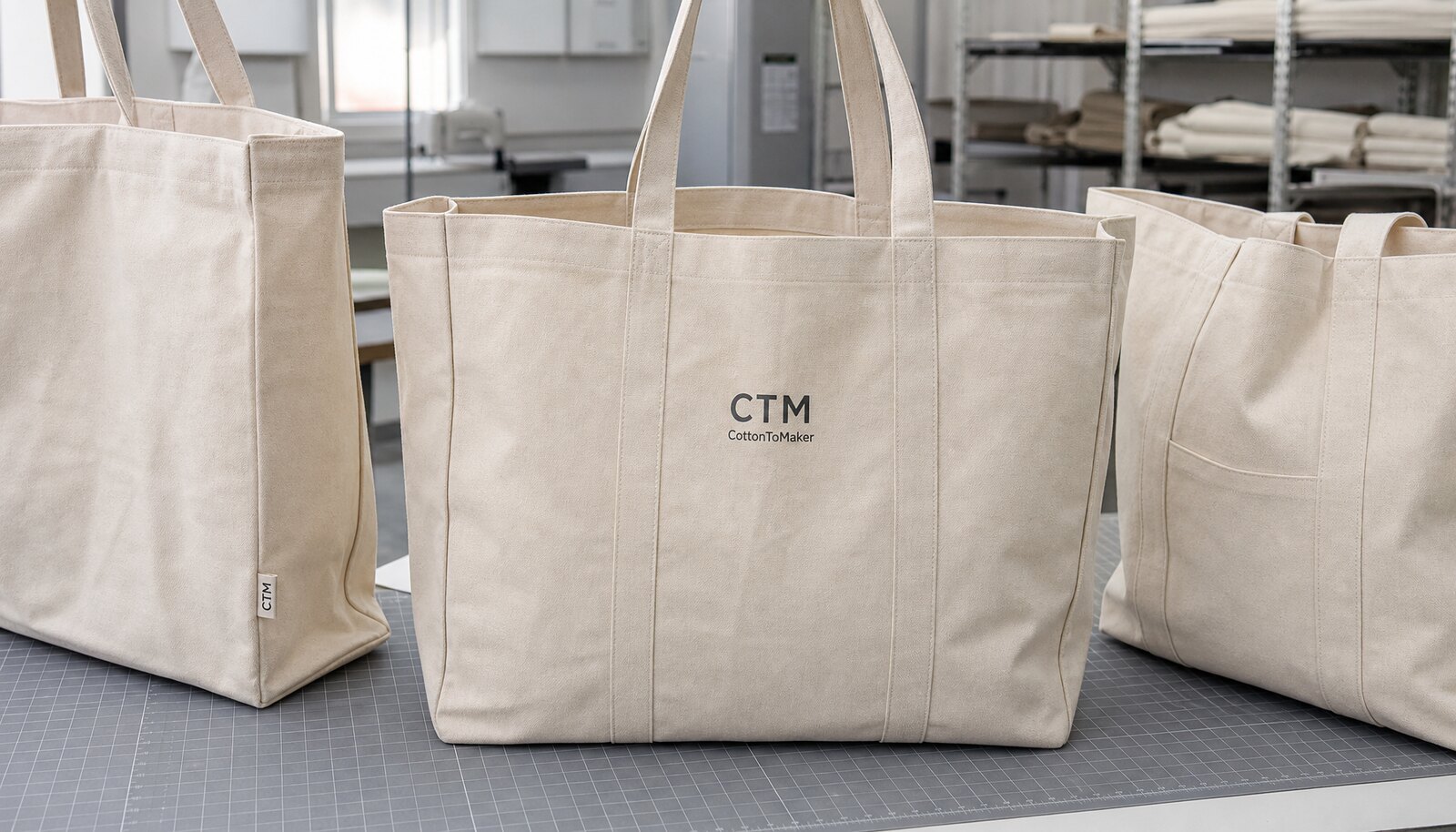
Why this bag is a procurement item, not a generic tote
Large canvas grocery bags for boutiques sit between retail packaging and soft goods. They have to look good on a shelf, carry real weight without collapsing, and arrive in a pack format that a store or warehouse can receive without rework. That combination makes the buying decision more commercial than cosmetic. A buyer is not just paying for a printed cotton bag; they are paying for a usable retail SKU that needs repeatability, replenishment, and defect control.
The main sourcing mistake is to ask for a 'large canvas bag' and compare quotes by unit price alone. One supplier may be pricing a lighter cloth, another may be folding differently, and a third may be hiding screen setup or packaging charges in the landed cost. If the spec is not locked, the quote is not comparable. For boutique programs, the bag needs to be judged as a repeat order item: it must hold shape, print cleanly, ship efficiently, and reorder without redesign.
- Treat the bag as a retail SKU with a stable spec, not a one-off promotional item.
- Compare quotes only after the fabric, size, handle, print, and pack method are fixed.
- The cheapest factory line is often the one with the weakest assumptions, not the best value.
Define the spec line by line before you ask for price
For this product, the quote should start with measurable decisions. Buyers should define the finished size, gusset depth, handle length, handle drop, canvas weight, weave, thread color, print area, and packing format. If the bag will carry groceries or mixed retail items, handle reinforcement and seam structure matter as much as the outer appearance. A boutique buyer often wants a premium hand feel, but not at the expense of collapsible side panels or weak load points.
The best RFQs sequence the spec from the most expensive variables to the least expensive ones. Start with fabric weight and finish, then confirm whether the bag is washed, greige, or raw. Lock the handle construction and reinforcements next. Only then finalize the artwork, label, and pack format. That order matters because fabric and construction changes affect cutting yield, sewing time, and defect tolerance much more than a logo placement tweak.
- Use GSM or oz, not a vague phrase like heavy canvas or premium canvas.
- Require the supplier to state whether the bag is pre-shrunk, washed, or raw.
- If the bag will be displayed folded, approve the fold shape and outer dimension as part of the product spec.
MOQ is driven by setup points, not just bag count
MOQ for large canvas grocery bags for boutiques is usually a stack of smaller minimums. Fabric minimums come first: if the supplier has to weave, dye, wash, or cut from a new lot, the material minimum can be higher than the final bag count suggests. Then come production setup minimums, especially for screen printing, label tooling, and line changeovers. Finally, packing minimums can matter if the supplier only wants to run a certain carton count or pallet pattern.
This is why two quotes with the same MOQ can behave very differently. One supplier may quote 1,000 pieces total, but require that all pieces share one color and one artwork. Another may allow the same total but split it into two variants with a higher unit cost. For reorders, the economics often improve because the supplier can reuse screens, fabric knowledge, and packing instructions. Buyers should ask whether the MOQ changes once the first run has been approved and whether the supplier will hold fabric for replenishment.
- Ask whether MOQ is per size, per color, per artwork, or per carton configuration.
- Find out if a second print color creates a new setup charge or a new MOQ tier.
- If you plan to reorder, ask for a separate replenishment MOQ and lead time.
Lead time is a chain of smaller clocks
Lead time only looks simple when it is quoted as one number. In practice, the schedule has several clocks: fabric readiness, sample approval, print setup, sewing capacity, packing, and export booking. If the fabric is in stock and the artwork is simple, a supplier can move quickly. If the canvas must be woven or dyed to order, the schedule stretches before cutting even begins. That is why a 35-day promise can become a 50-day delivery without any one team 'slipping'; the early stages were never separated in the quote.
Buyers should ask the factory to break the schedule into line items. A useful quote tells you how many days are tied to sampling, how many to material preparation, how many to sewing, and how many to packing and dispatch. Peak season changes the picture further. In busy months, sewing may still be available, but sample review, print approval, or carton booking can become the bottleneck. The buyer who understands the bottleneck can protect launch dates by approving faster, reserving fabric earlier, or simplifying the artwork.
- Ask for the lead time after sample approval, not just the total calendar promise.
- Separate custom fabric time from sewing time so the real risk is visible.
- If the launch date is fixed, plan for a buffer around artwork approval and carton booking.
How to compare sourcing routes without being fooled by unit price
A direct factory quote usually gives the best visibility into fabric sourcing, sewing line control, and inspection ownership. That matters when the bag becomes a core retail item and the spec needs to stay stable across seasons. A trading company can help if the order is small or if you are bundling multiple products, but the buyer still needs to understand which factory is actually making the bags. Local converters are useful for urgent replenishment, especially when stock blanks are available, but they often trade away fabric options and cost flexibility to gain speed.
For boutique grocery bags, the lowest quote is not the safest sourcing route if it hides the wrong assumptions. A stock blank plus decoration can be cheap and fast, but only if the blank fabric, size, and handle strength already meet the retail standard. A trading route can look flexible until you discover that the real factory has a much stricter MOQ or a longer queue. The comparison table below is meant to reveal which route fits the order, not just which route sounds cheapest.
- Compare who owns the fabric, the printing process, and the final inspection.
- Ask whether the quoted lead time includes sampling, or only bulk production.
- If a route sounds unusually cheap, assume a hidden constraint until the supplier proves otherwise.
Sample approval should cover the bag, the print, and the pack
The sample process should not end at the first visual approval. For this product, the buyer should see at least a prototype or reference sample, then a pre-production sample from the final fabric and construction, and ideally a packing sample that shows the fold and carton count. A clean-looking sample can still fail in bulk if the fabric lot changes, the print lands closer to a seam, or the carton pack is inefficient. The sample is the place to catch those issues before the cost of rework appears.
The most useful approval sample is the one that lets procurement verify the exact commercial version: final size, handle length, logo position, label placement, and fold style. If the sample does not show the full package, the bulk order remains exposed to avoidable dispute. Buyers should also retain a golden sample with the approved artwork, signed size measurements, and a photo record of the carton label. That gives the team a concrete reference if a later shipment drifts from the approved standard.
- Measure the actual sample flat and after light shaping, not only in a product photo.
- Approve the carton fold and count-per-carton before bulk sewing starts.
- Keep a signed golden sample tied to the PO and artwork version.
QC acceptance criteria buyers can actually enforce
Procurement teams need inspection criteria that map to the way canvas totes fail in the real world. AQL 2.5 major and 4.0 minor is a practical baseline for many retail orders, but only if the defect definitions are written in advance. Load-bearing seams should be checked more aggressively than the middle panel. Handle joins, bottom corners, and gusset seams are the first places where poor sewing shows up. Stitch density should be strong and consistent, with 8-10 stitches per inch on the load-bearing seam as a workable target for most sewn canvas tote constructions.
Dimensional control matters because large bags reveal distortion quickly. Buyers should set tolerances for body length, body width, gusset depth, handle drop, and print placement. The usual practical range is about +/- 6 mm on the main body dimensions, +/- 5 mm on gusset and print placement, and exact carton counts at shipment. Print quality should be checked for edge bleed, misregistration, and adhesion. If the supplier promises wash resistance, test the approved print under a dry rub and a damp rub, and if needed a wash test on the same ink system. That is the difference between a cosmetic approval and a usable QC standard.
- Define major and minor defects before the order is released.
- Check the highest-stress areas first: handles, corners, side seams, and bar-tacks.
- Reject bulk if the supplier changes fabric lot, print method, or packing format without written approval.
Packing, cartons, and freight can change the landed cost
A canvas bag is easy to underprice if the quote ignores packing efficiency. Flat-packed bags usually give the best balance for boutiques because they keep cartons uniform, reduce warehouse labor, and make counts easier to verify. If the supplier folds bags inconsistently or stuffs them loosely, the unit price may look attractive while the carton volume and receiving labor quietly rise. Carton dimensions, gross weight, and pieces per carton should therefore be part of the price conversation, not an afterthought.
Carton marks are also a sourcing issue, not only a logistics issue. The outer carton should carry the SKU, size, color, PO number, pieces per carton, gross and net weight, carton number, and any retailer-specific barcode or destination code. If the order goes to a distributor or chain retailer, a mismatch in carton marks can cause receiving delays even when the bags themselves are correct. Buyers should review a carton mockup or mark specification the same way they review the print artwork.
- Ask for carton size and gross weight so you can compare true landed cost.
- Use a consistent fold pattern to avoid mixed carton density and receiving disputes.
- Verify carton marks before shipment, not after the truck leaves.
Quote traps and exception handling
The most common quote trap is a headline MOQ that is not actually comparable across suppliers. A factory might quote 2,000 pieces, but that number could apply only to one artwork and one color, while a second artwork needs a new minimum. Another trap is a quote that assumes standard canvas but quietly substitutes a lighter cloth if the buyer does not specify the exact GSM or oz. A third trap is a lead time that starts after all approvals but does not say when those approvals are expected, which makes the schedule look shorter than it is.
Exception handling should be written into the RFQ. State what happens if the supplier cannot source the approved fabric lot, if a carton overpacks, if a print color shifts, or if a replenishment order uses the same screens but a different fabric dye lot. Buyers should also ask for line-item pricing when things change: one extra print color, a higher handle spec, a different label, or a stronger carton. That makes it easier to decide whether the change is worth the cost, rather than accepting a vague surcharge.
- Watch for hidden charges: screen setup, plates, label tooling, testing, palletization, and export documents.
- Ask for a priced option list so changes can be approved without renegotiating the whole order.
- If the supplier wants to substitute fabric or finish, require written approval before bulk continues.
What a clean RFQ should include for boutique grocery bags
A strong RFQ makes suppliers quote the same product. For large canvas grocery bags for boutiques, that means one drawing or spec sheet with finished dimensions, gusset size, handle drop, fabric weight, weave, finish, print area, artwork file, label details, fold method, carton count, and destination requirements. The RFQ should also state the commercial use case: retail resale, store giveaway, seasonal promo, or replenishment. A supplier who understands the use case will quote the right construction and not just the cheapest sewn version available.
The RFQ should also include the reorder assumption. If you expect a second order, the supplier should know whether the first run is a test, a seasonal launch, or a long-term SKU. That changes how they reserve fabric, allocate sewing time, and price setup. For a boutique program, the best result is not only one acceptable order; it is a spec that can be reordered with fewer surprises, a clearer lead time, and less negotiation friction.
- Provide one controlled spec sheet instead of long email instructions.
- State the reorder assumption so the supplier can quote a realistic replenishment path.
- Tie the quote, sample, and inspection notes to the same version number.
Specification comparison for buyers
| Sourcing route | Best fit | MOQ and setup behavior | Lead-time profile | Buyer risk to verify |
|---|---|---|---|---|
| Direct factory | Repeat boutique programs with one bag size, one canvas color, and stable artwork | MOQ usually binds to fabric color, print color count, and cut efficiency, but can improve with reorder history | About 35-55 days after sample approval when fabric is available; custom dye or heavy peak season pushes longer | Confirm who owns fabric, sewing, and inspection, and whether substitutions need written approval |
| Trading company | Smaller test orders or mixed product baskets when you need flexibility | MOQ may look low at the quote stage but can split by factory booking, packaging version, or artwork | Typically 40-60 days because the trading layer adds coordination time | Verify the real factory, the exact spec, and who pays if rework is needed |
| Local converter | Urgent regional replenishment or branded programs that need fast turn | Lower MOQ if blank stock exists, but limited fabric weight, color, and handle options | Often 2-4 weeks if stock blanks are on hand and decoration is simple | Check blank stock consistency, print durability, and whether the bag is truly the same as the approved sample |
| Stock blank plus decoration | Seasonal promos, events, or short-life retail trials | Lowest setup cost, but color and size choices are usually narrow | Fastest route when inventory exists, but artwork changes can be limited by stock | Confirm inventory depth, exact blank spec, and whether the supplier can reserve stock until artwork approval |
| Material | 8-12 oz cotton canvas, 120-220 gsm cotton, recycled cotton, or blended fabric selected by use case and target price | Before price comparison | Different cloth weights, backing, or certification claims make quotes hard to compare | |
| Construction | bag size, gusset, handle drop, seam allowance, stitch density, reinforcement patch, and loading expectation | Before sampling | Weak stress points create returns and failed inspections | |
| Decoration | screen print, heat transfer, embroidery, woven label, or hangtag matched to fabric texture and brand durability needs | Before artwork approval | The wrong method can crack, bleed, pucker, or fail on the chosen fabric | |
| MOQ | Base MOQ plus change drivers | During quote review | Custom colors, trims, and packing can change minimums |
Buyer checklist before sampling
- Lock the finished size, gusset depth, handle drop, and seam reinforcement points before asking for pricing.
- Require the exact fabric weight in GSM or oz, plus weave type, finish, and shrinkage allowance.
- State whether MOQ applies per size, per color, per artwork, per label version, or per total order value.
- Ask the supplier to separate fabric, cutting, sewing, print setup, label, packing, carton, and inspection costs.
- Approve a pre-production sample that uses the final fabric lot, print placement, label position, and pack method.
- Set the inspection standard in writing, including AQL level, major defect definitions, and carton count rules.
- Define packing rules in the RFQ: fold style, pieces per carton, barcode format, carton marks, and pallet plan.
- Ask how the quote changes if you add a second print color, switch canvas weight, or request a different handle construction.
- Confirm whether the supplier is reserving raw fabric, greige stock, or finished blanks, because that changes both timing and substitution risk.
- Capture the reorder assumption up front so the supplier can quote a replenishment lead time rather than only a first-run schedule.
Factory quote questions to send
- What exact canvas spec is included in this quote: GSM or oz, weave, finish, and expected shrinkage after production?
- Does the MOQ apply per artwork, per color, per size, per packing version, or only to the total PO value?
- If the order is split across two print colors or two bag colors, how does the unit price and lead time change?
- What part of the schedule is fixed by fabric sourcing, screen preparation, sewing capacity, and packing, and what part is flexible?
- Is the bulk fabric already in stock, or does it need weaving, dyeing, washing, or pre-shrinking before cutting starts?
- How many samples are included, and will the pre-production sample be made from the same fabric lot and construction method as bulk production?
- What QC checkpoints are performed before shipment, and which defects are treated as major versus minor?
- What is the accepted tolerance for finished dimensions, handle length, handle drop, and print placement?
- How are the bags packed for shipment, including fold style, carton count, gross weight, and outer carton marks?
- Which costs are excluded from the quote, such as print plates, screen setup, label tooling, testing, pallets, or export documents?
Quality-control points to confirm
- Use AQL 2.5 for major defects and 4.0 for minor defects unless your buyer standard is stricter, and define the defect list before production starts.
- Load-bearing seams should show 8-10 stitches per inch on the approved sample, with full bar-tacks or X-box reinforcement at handle joins and no skipped stitches, open seams, or loose thread bundles.
- Finished size tolerance should be explicit: body length and width within +/- 6 mm, gusset within +/- 5 mm, handle drop within +/- 6 mm, and print position within +/- 5 mm of the approved artwork location.
- Print adhesion should pass a dry rub check and a tape test on the approved production sample; if wash durability is claimed, require a wash test on the same artwork and ink system.
- Canvas weight should match the approved lot within a practical tolerance of about +/- 5 percent, and any substituted fabric lot should be approved in writing before bulk runs continue.
- There should be no visible holes, oil stains, major slubs, torn seams, or panel distortion that changes the bag silhouette on retail display.
- Carton count must match the packing list exactly, with no mixed sizes unless the PO allows it and no unexplained overpack or underpack.
- Carton marks should verify SKU, PO number, size, color, pcs/carton, gross and net weight, carton number, country of origin, and orientation marks where required.