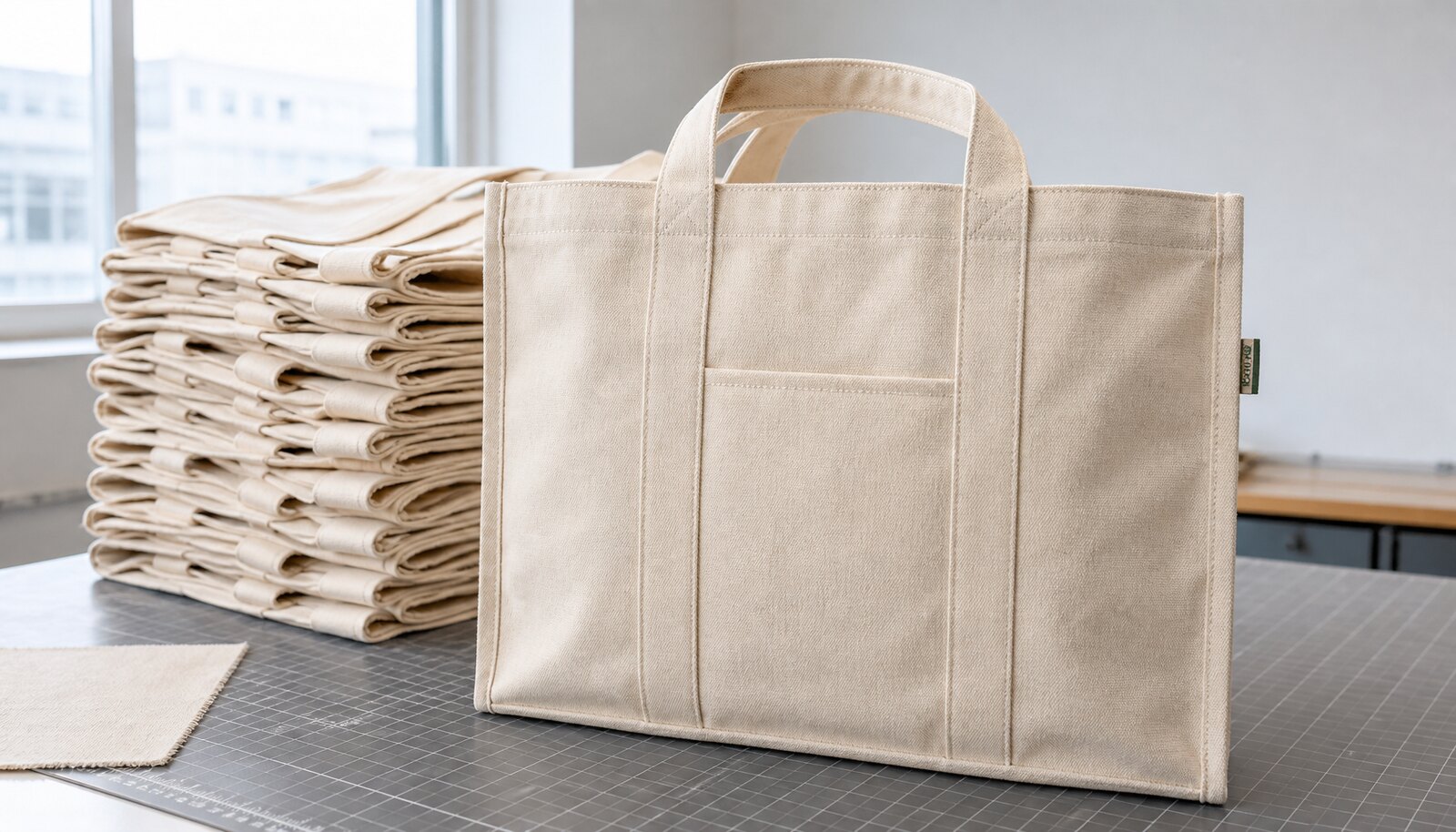
Why carton planning changes the bag quote
For large canvas grocery bags for boutiques, the carton is not just a shipping box. It affects unit cost, print scuffing, warehouse receiving speed, and whether the bag arrives retail-ready or needs rework. A supplier can quote a very attractive bag price and still leave you with inefficient cartons that push freight costs up or create damage in transit. If the bags are large, folded badly, or packed too tightly, the carton cube grows quickly and the product arrives with hard creases across the front panel.
Buyers often focus on fabric and printing first, then leave packing until the last email. That is backward. When a bag is going into a boutique assortment, the carton plan should be part of the spec sheet from day one. The right carton count can reduce CBM, simplify counting at receiving, and lower the risk of crushed corners. The wrong carton plan can make a good bag look cheap when the case is opened.
- State whether the bag must arrive shelf-ready or only warehouse-ready.
- Include carton loading targets in the RFQ, not after the sample is approved.
- Treat carton cube as a real cost driver, not an admin detail.
Start with the bag spec that drives packing efficiency
For this product type, the most practical spec range is usually 12 oz to 14 oz canvas when the bag is meant for grocery carry and boutique resale. Lighter fabric can work for low-load promotional use, but it tends to deform when stacked in cartons and does not hold its shape well after repeated folding. Heavier canvas improves hand feel and stiffness, but every extra ounce affects sewing speed, cost, and carton volume. If your brand wants a premium tactile feel, a 14 oz natural canvas with reinforced seams is often the safer commercial choice than an underbuilt 10 oz bag that looks flat in the carton and weak on shelf.
Finished size matters as much as fabric weight. A larger bag with a deep gusset is easier to merchandise, but it also traps more air and can become awkward to fold consistently. For carton planning, the goal is not only to fit as many pieces as possible. It is to fit a repeatable fold that protects print areas and keeps the stack uniform. If the bag has a wide bottom, confirm whether the factory folds along the gusset or folds the side panels first, because that changes the carton count and the crease line on the front panel.
- Common retail range: 12 oz-14 oz canvas for load-bearing grocery use.
- Use gussets if the bag needs to stand and stack cleanly.
- Ask for the folding method in the sample stage so the carton dimension is realistic.
Pick a print method that survives folding and freight
Screen print is usually the default for large canvas grocery bags for boutiques because it gives stable color and a predictable unit cost. It is the strongest choice for one or two solid colors and medium-size logos. When the artwork is simple, screen print also gives the supplier better control over registration and ink build. For more detailed graphics or short runs, heat transfer may be quoted, but it needs careful testing because repeated folding can stress the edge and cause visible wear after transit or retail handling.
If your logo is large and sits across a fold line, do not approve the proof only on a flat artwork image. Ask the factory to show how the image lands after folding and packing. Some prints look crisp flat but split visually where the bag crease runs through the logo. That is not a design problem; it is a packing and placement problem. In many cases, moving the print higher or narrowing the artwork can save both print yield and carton appearance.
- Screen print: best for simple, repeat order programs.
- Heat transfer: best only when detail or short-run flexibility matters more than durability.
- Ask for folded print placement proof, not just flat artwork approval.
Know the cost drivers before you compare supplier quotes
The quote for a canvas grocery bag is usually driven by fabric weight, handle build, print setup, sewing time, and packing density. Buyers sometimes compare only the FOB unit price and miss the hidden differences. A factory quoting a lower unit cost may be using lighter canvas, simpler stitching, or a looser carton count that inflates freight. Another factory may quote a higher unit price but include tighter carton packing, which lowers your total landed cost per sellable bag. Those are not equivalent offers.
A useful quote should separate the bag body, print setup, handle reinforcement, packing method, and carton specification. If the factory cannot explain the cost of each element, the quote is hard to control later. A clean RFQ helps procurement teams compare apples to apples and forces the supplier to show whether the margin is coming from the bag spec or from poor packing efficiency.
- Fabric weight changes raw material cost and seam handling time.
- Print colors can increase setup cost faster than buyers expect.
- Packing density often matters more than a small unit-price difference.
Use a supplier comparison model that includes cartons, not only the bag
When you source large canvas grocery bags for boutiques, compare suppliers by both product capability and shipping discipline. A factory that sews well but cannot pack efficiently will still create problems in transit. A trading company may be easier to talk to, but the carton details often arrive late or are copied from a previous order that does not match your bag size. For importers and distributors, the better route is usually the supplier that can show a real sample, clear carton dimensions, and a documented pack sequence.
The comparison below is designed for buyer teams that need a practical sourcing view, not a generic spec list. Use it to separate factories that understand carton planning from suppliers who only quote the bag itself.
Supplier route comparison for large canvas grocery bag programs
Use this table to compare sourcing routes before you issue a final PO. The right route depends on your order size, launch timing, and whether carton efficiency or low MOQs matter more.
Define the measurable checks around fabric weight, size tolerance, handle pull, seam strength, logo rub, stains, loose threads, and carton count verification. Add tolerance ranges only where the buyer truly cares, and ask for photos that show the measurement point, not just a finished product overview.
- Write decisions in measurable language, not only descriptive wording.
- Ask for sample photos plus one physical approval sample for important orders.
- Keep quotation, sample approval, and inspection notes tied to the same spec version.
Sample approval should include fold, print, and carton fit
A good sample for this product is not only about fabric color or logo placement. The bag should be folded the same way bulk goods will be packed, then inserted into the proposed carton count. That is the only way to discover if the stack height causes pressure marks, whether the handles spring open, or whether the print area rubs against the carton wall. If your sample arrives loose and uncompressed, it can hide a real transit problem.
For approval, ask the supplier to send one production-like sample and one packed sample photo showing the folded sequence. Examine the handle symmetry, seam finish, and print curing. Rub the print lightly after folding. If ink transfers, the cure is not ready for bulk. Also check whether the side gusset opens cleanly after the bag is unfolded, because a bad fold can permanently crease the base and make the bag look used before it reaches the shelf.
- Approve the sample in the same fold method planned for bulk packing.
- Look for rubbed print, handle twist, and uneven side gussets.
- Do not sign off until you have a carton-pack photo or video from the factory.
Packing choices that protect margin in transit
Flat packing is usually the best balance between protection and volume for large canvas grocery bags. It keeps the carton count predictable and avoids the bulk of individual retail packaging. If the brand wants each bag separately polybagged, the added labor and plastic cost should be visible in the quote, because it can materially increase both labor time and carton dimension. In humid shipping lanes, a light desiccant pouch may be worthwhile, especially when the bags are natural canvas and the route includes long ocean transit or transshipment.
Master carton quality matters more than many buyers realize. A 5-ply export carton is often the practical minimum for this category, especially when cartons are stacked high in a container. Ask for clear gross and net weight labels, SKU information, and count per carton on the outer case. If the cartons are mixed-color or mixed-size, require a mark system that warehouse staff can read quickly. Mixed cartons may save space, but they increase receiving errors and can slow retail allocation.
- Flat packed bags usually ship more efficiently than retail packed units.
- Polybags add labor and volume; use them only when required.
- Use strong cartons and clear carton labels to prevent warehouse mistakes.
Lead time risk usually sits in printing and packing, not sewing
Many buyers assume sewing is the bottleneck because the product is textile-based. In practice, the schedule risk often appears in fabric prep, print approvals, and final packing. If the artwork changes after sample approval, the production line may stop while screens or transfer tooling are remade. If the carton spec is not frozen early, the factory may need to repack at the end, which can add days and introduce packing defects. For seasonal boutique programs, those delays matter more than a small unit-price discount.
A realistic lead time split for this category is often 7 to 10 days for sample development, then roughly 25 to 40 days for bulk after all approvals, depending on fabric availability, print complexity, and packing requirements. If the factory promises a very short schedule, confirm whether they are using stock fabric, whether the print is simple, and whether the quoted time includes final inspection and carton loading. A fast quote is not useful if the cartons are not ready to ship correctly.
- Confirm whether the schedule includes screen making, material sourcing, and packing.
- Freeze the carton spec before bulk starts.
- Treat post-approval artwork changes as a schedule risk, not a small revision.
QC thresholds that prevent avoidable claims
For large canvas grocery bags for boutiques, quality control should focus on the failures that are expensive after shipping. Handle stitching is the first priority. The bag should have clean reinforcement at the stress point, with no skipped stitches, loose thread clusters, or uneven bar tacks. The second priority is print durability. If the bag will be folded repeatedly in cartons, the print must survive compression without visible cracking or sticky offset. The third priority is carton integrity. A strong bag packed into a weak carton still arrives damaged.
Define acceptance thresholds before you approve bulk. For example, specify that the bag must open square, handles must sit evenly, and carton corners must survive normal stack pressure without collapse. If your buyers sell through boutiques, the unboxing moment matters. A bag that arrives with a bent front panel or a scuffed logo may still function, but it will not present as premium. That is why transit appearance should be part of QC, not an afterthought.
- Inspect handle stress points, print curing, and carton corner strength.
- Set a visible standard for crease depth and scuff tolerance.
- Require carton labels and counts to match the packing list exactly.
Specification comparison for buyers
| Spec decision | Recommended option | When it fits | Buyer risk to check |
|---|---|---|---|
| Fabric weight | 12 oz to 14 oz canvas for grocery load use | Boutiques want a sturdier feel, less print show-through, and better carton shape retention | Too light a fabric can distort in packing; too heavy raises cost and slows sewing |
| Bottom construction | Gusseted base with bar-tacked stress points | Products need to stand in cartons and hold rectangular retail goods or produce kits | Flat bags may ship cheaper but collapse under load and wrinkle more in transit |
| Print method | Screen print for 1-2 solid colors; heat transfer only for short runs or photographic detail | Brand owners need repeatable logos with controlled ink cost | Transfers can crack after folding if substrate and curing are weak; multi-color screens raise setup cost |
| Handle reinforcement | Cross-stitch plus bar tack at stress points | Large grocery bags carry heavier retail bundles or bottled items | Weak handle sewing is the most common field failure after carton compression |
| Supplier route | Factory-direct with carton spec included in RFQ | Importers need control over material, pack count, and shipping cube | Trading layers hide carton inefficiency and weaken accountability on sampling and QC |
| MOQ strategy | Split MOQ by color if same fabric and same print screen | Buyers need assortment without overstocking one SKU | Mixing many colorways can create fabric dye-lot variation and uneven carton fill |
| Packing format | Flat packed, 50-100 pcs per polybag master carton, with desiccant if transit is humid | Targeting ocean freight and warehouse receiving efficiency | Over-compressed packing can crease print areas and slow retail prepping |
| Carton spec | 5-ply export carton with edge protection and clear gross/net weight labeling | Long ocean transit, stack pressure, or mixed cargo consolidation | Weak carton board or poor load distribution leads to corner crush and seam abrasion |
| Lead time control | Sample approval before bulk with 7-10 days sample, 25-40 days production typical after approval | Launches with fixed in-store dates or seasonal promotions | Orders that skip pre-production signoff often slip on printing, sewing, or packing details |
Buyer checklist before sampling
- State the exact bag use case: grocery carry, boutique purchase bag, gift-with-purchase, or retail resale pack, because load target changes the fabric and handle build.
- Lock the target fabric weight in oz or GSM, plus the acceptable tolerance range, before asking for quotes.
- Specify finished size, gusset width, handle length, seam allowance, and whether the bag must stand upright in a carton.
- Define print method, print size, number of colors, and whether the artwork sits on one side or both sides.
- Include carton pack count, master carton size limits, stack height expectations, and whether inner polybags are required.
- Ask for sample photos of stitching, handle reinforcement, and carton loading before bulk approval.
- Request production lead time split into material prep, printing, sewing, inspection, and packing.
- Ask the supplier to quote landed-volume impact: pcs/carton, cartons/pallet, and estimated CBM per 1,000 pcs.
Factory quote questions to send
- What exact canvas weight are you quoting, and is that finished fabric weight or greige weight before printing and washing?
- What handle reinforcement do you recommend for a bag that must hold retail goods or grocery items without seam failure?
- How many pieces fit per master carton at your standard export carton spec, and what carton dimensions do you propose?
- What is your recommended print method for this artwork if we want stable color and controlled setup cost?
- Can you quote the same bag in two packing options: flat pack with polybag and bulk flat pack without polybag?
- What is the sample timeline, and will the pre-production sample reflect the final carton pack method?
- Which inspection points do you include before shipment: print alignment, stitch count, handle pull test, and carton drop resistance?
- What is the MOQ per color, per print screen, and per carton configuration?
Quality-control points to confirm
- Fabric weight tolerance should be stated in the RFQ, ideally within a practical production band rather than a vague 'heavy canvas' description.
- Handle stitching must show clean backtacks or bar tacks with no skipped stitches at the stress zone.
- Print registration should stay within a visible tolerance band and not shift after folding or carton compression.
- Seam allowance should be consistent enough that the bag opens square and does not twist when filled.
- Carton compression test should not crush the corners or crease the print zone beyond acceptable retail appearance.
- Inner polybag, if used, must not trap moisture; add desiccant when shipping into humid lanes or long ocean transit.
- Carton labels should match SKU, color, quantity, and carton count exactly to avoid warehouse receiving errors.
- Pre-production sample must match both the bag spec and the final pack method; approving only the bag without the carton is a common mistake.