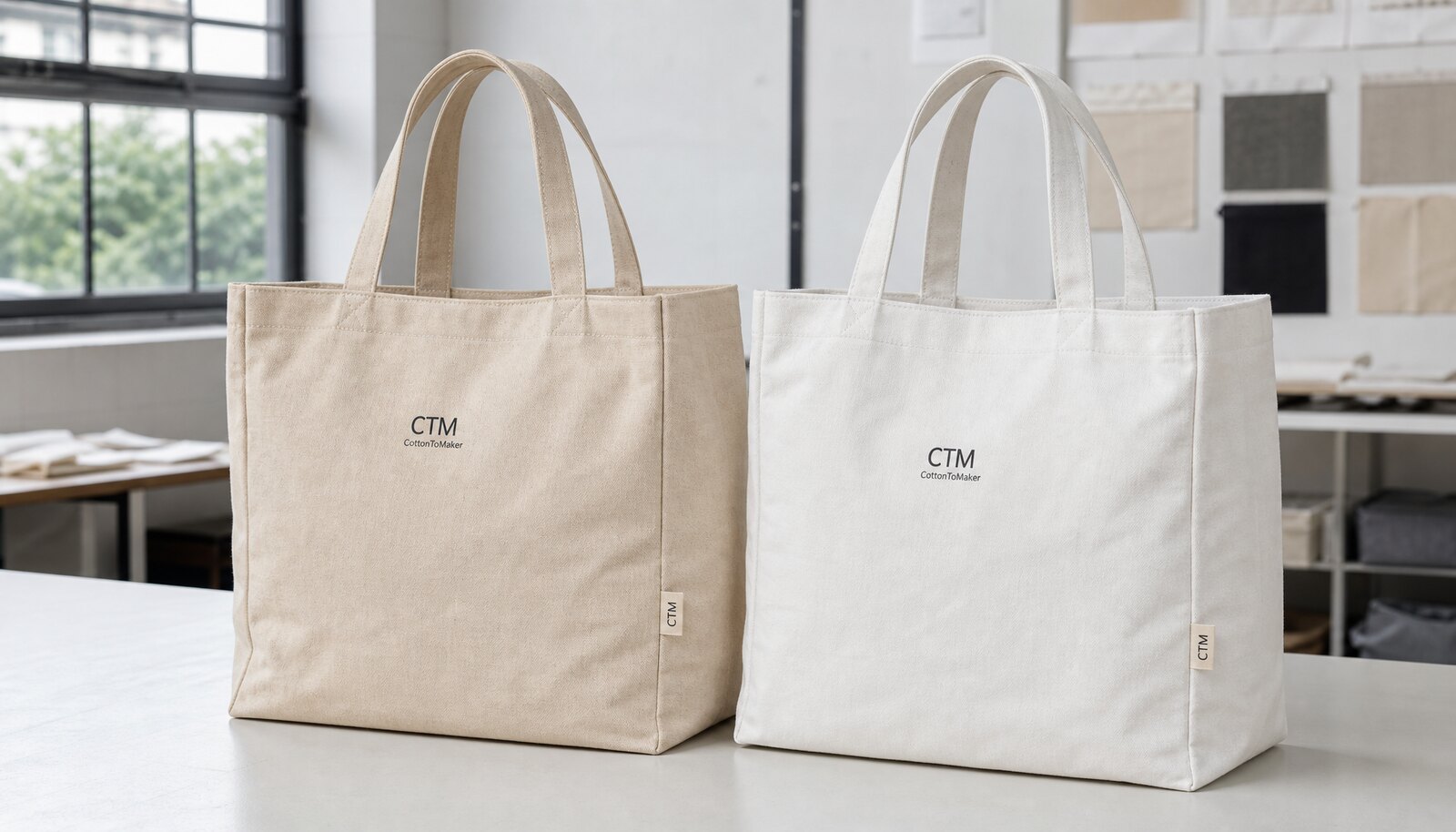
Why apparel brands order this bag differently
Large canvas grocery bags for apparel brands are rarely bought as simple shopping totes. In most cases, the bag serves three jobs at once: a branded carrier at retail, a reusable packaging layer for garment purchases, and a low-cost marketing item that customers keep in circulation. That means the buying decision is not only about size. It also affects print visibility, carton efficiency, and whether the bag feels premium enough to sit beside apparel packaging without looking like a giveaway item.
The mistake many buyers make is using the same spec logic they would use for a standard promotional tote. Apparel brands usually need cleaner stitching, a better fabric hand, and a logo placement that does not fight with the clothing label aesthetic. If the bag is meant to leave the store with folded garments, the opening, gusset, and handle drop need to be built around real retail use, not only a flat product photo.
- Define the bag’s primary role before quoting: retail carrier, gift-with-purchase, e-commerce insert, or seasonal promotion.
- If the bag will be seen with premium apparel, a rough print edge or uneven seam becomes a brand problem, not a minor defect.
- For repeat orders, prioritize a spec that is easy to reproduce across seasons and factories.
Start with the right fabric weight and weave
For a large grocery-style canvas bag, the most common workable range is 12 oz to 16 oz, roughly 340 to 450 GSM depending on the fabric construction. In practical sourcing terms, 12 oz canvas is often enough for light to medium retail use, but 14 oz and above gives a more substantial hand feel and better shape retention. If the brand wants the bag to support heavier apparel purchases or be reused frequently, a heavier cloth usually improves perceived value and reduces sagging at the bottom seam.
Weight alone is not enough. Two fabrics with the same GSM can behave very differently if the weave is looser, the yarn count is uneven, or the finish causes shrinkage after cutting. Ask for both the declared weight and the woven structure. A canvas that is too open can distort the print and show the weave through small logos; a fabric that is too stiff can be harder to sew cleanly at the handle attachment and side gusset.
- 12 oz / 340 GSM: acceptable for lighter retail use, lower cost, more flexible hand feel.
- 14 oz / 380 GSM: a balanced option for most apparel-brand grocery bags.
- 16 oz / 450 GSM: better for premium positioning, heavier carrying loads, or a more substantial shelf impression.
- Ask whether the fabric is pre-shrunk or whether finished size allowance already includes shrinkage after pressing.
Choose the logo method that matches the artwork, not the trend
For large canvas grocery bags, screen printing remains the most efficient logo method when the artwork is simple and the brand wants strong contrast. One-color or two-color screen print is usually the cleanest route for retail use because it is readable from a distance and cost-effective at scale. If the logo has fine detail, a woven side label, woven patch, or stitched brand mark can sometimes deliver a more premium result than trying to force a complex print onto canvas.
The wrong choice here causes the most quote confusion. Buyers send a polished vector logo, but the factory may need to reduce line thickness, increase spacing, or simplify small text to make the artwork printable on textured canvas. If the logo sits too close to a seam, handle, or gusset edge, the print area can warp after sewing. The best RFQ package includes the intended print size, exact placement, Pantone target if relevant, and a second version with simplified artwork for production review.
- Screen print: best for bold branding, repeat orders, and lower unit cost.
- Woven label or side label: better when the brand wants a restrained, premium finish.
- Embossing or debossing is possible on some fabric-label combinations, but it is less common on basic canvas bodies.
- Avoid small reverse text, hairline logos, and gradient artwork unless the supplier proves they can hold detail on canvas.
How MOQ works in real factory quotes
MOQ is rarely just a single number. For custom logo canvas bags, the practical MOQ is driven by fabric inventory, print setup, cutting efficiency, and whether the factory is willing to run a small dye lot or special trim. A supplier may quote a low overall quantity, but if you ask for multiple body colors, multiple logo versions, or special packing, the effective MOQ per variant can rise quickly. That is why procurement teams should separate total order quantity from SKU-level quantity in the RFQ.
The most quote-friendly setup is usually one body color, one logo placement, and one print color. Adding complexity changes the economics: screen setup fees, fabric cutting waste, and packing labor all increase. If the brand wants to test market response, it is often better to buy one stable spec in a moderate quantity than to split the order into too many small variants. The quote should show where the cost changes as quantity rises so the team can see the breakpoints.
- Ask for MOQ by color, by logo version, and by packing style.
- Request the unit price at 500, 1,000, 3,000, and 5,000 pieces if the order may scale.
- Confirm whether the supplier will hold fabric reserve for repeat production.
- If the factory offers a too-flexible MOQ, make sure it is not being offset by fabric substitution or lower stitch count.
Compare supplier routes before you compare prices
The cheapest quote is not always the best route. For large canvas grocery bags for apparel brands, the sourcing path matters: direct factory, trading company, or integrated bag supplier with in-house print and sewing. A direct factory is often better for recurring orders because it gives clearer control over fabric lot, seam construction, and lead time. A trading company may help with consolidated sourcing, but the buyer can lose visibility when problems arise in print approval or carton packing.
Use the sourcing route to match the buying goal. If you need one-time speed and lower coordination effort, a trading route may be acceptable. If you need repeatable quality, tighter QC, and better cost control at scale, factory direct usually wins. The key is not ideology; it is whether the supplier can prove they control the parts of the process that matter most for this product: fabric sourcing, cutting accuracy, print consistency, sewing quality, and packing discipline.
- Request factory photos of sewing lines, print area, and carton packing station, not only product images.
- Ask who owns fabric purchasing and who signs off final shipment inspection.
- For recurring apparel programs, choose the supplier route that can reproduce the same bag six months later without redesign.
A practical comparison of supplier options
Below is the comparison logic buyers can use when evaluating quotes for this bag. The goal is not to chase the lowest unit price; it is to match supplier capability to the risk level of the program. A brand launch bag, a replenishment item, and a seasonal giveaway do not need the same level of process control, but they do need clear acceptance criteria.
When suppliers quote similar-looking numbers, the difference is often hidden in fabric consistency, print setup, carton packing, or how much responsibility they assume for pre-production approvals. Use the table to separate what you are really buying from what looks cheap on paper.
- Write decisions in measurable language, not only descriptive wording.
- Ask for sample photos plus one physical approval sample for important orders.
- Keep quotation, sample approval, and inspection notes tied to the same spec version.
What a usable sample process should look like
A sample that only shows shape is not enough. For a custom logo order, the buyer should get at least a blank sample or fabric swatch, then a printed sample, then a pre-production sample built with final materials and final artwork. That sequence catches three different risks: fabric feel, logo appearance, and factory build consistency. If the supplier skips directly to a near-finished sample without proving the base material, you can miss shrinkage, handle mismatch, or shade variation.
Sample approval should be written like a small spec sheet, not a casual email. Use the sample to lock the bag dimensions, print position, handle drop, stitch type, and packing method. If the sample is slightly off but acceptable, note the acceptable range in writing. Otherwise, the production line may treat the sample as a suggestion rather than the final standard.
- Check the bag flat and loaded, because some issues only show when the body is filled.
- Inspect print edges after folding and after slight bending to see whether the ink cracks or lifts.
- Test the handle seam by hand; it should not separate or ripple under firm pull.
- Approve a production sample only after it matches the agreed fabric lot, not merely the same shape.
QC thresholds that prevent the most common failures
The most common failures on large canvas grocery bags are not dramatic. They are small but visible: crooked logo placement, uneven top hems, handle imbalance, and visible dirt marks on light-colored canvas. Buyers often focus on tensile strength, but retail rejection usually comes from appearance and inconsistency. Set a tolerance on size, print position, and stitching before the order starts so the inspection team has something objective to work with.
For a bag of this type, the buyer should care about both performance and presentation. A sturdy bottom seam matters, but so does whether the bag sits squarely on a shelf or in a folded retail pack. The quality standard should reflect the end use: if the bag is sold folded in a garment store, crease control and visual neatness matter more than for a warehouse-only utility bag.
- Size tolerance: agree a practical range before production begins; otherwise the factory may treat large variation as acceptable.
- Print tolerance: logo placement should be centered within a defined distance from seam references.
- Stitching: inspect bar-tacks, corner reinforcement, and seam allowance consistency across a carton sample.
- Appearance: no oil stains, major loose threads, fabric slubs in the print zone, or carton contamination.
- Carton sample: open a full carton to confirm folding consistency and packing density.
Packing choices that affect damage rate and freight cost
Packing is one of the easiest places to lose money on a canvas bag order. If each bag is individually polybagged, the presentation is cleaner and retail handling is easier, but labor and material cost rise. Bulk packing lowers unit cost and carton volume, but folded canvas can crease hard and arrive with handling marks. Apparel brands should decide based on how the bags reach the customer: shelf display, warehouse distribution, or direct inclusion with garment orders.
Carton optimization matters because these bags are bulky. A small change in folding method or handle direction can improve carton utilization without changing the bag itself. The supplier should provide carton size, quantity per carton, net and gross weight, and shipping mark placement. If your distribution center uses barcode scanning or pallet labeling, make those requirements part of the packing spec from the start.
- Bulk pack: lower cost, suitable for warehouse or wholesale distribution.
- Individual polybag: better for retail-ready presentation and protection from dust.
- Insert cards or barcode labels: useful for apparel brands that resell the bag as a standalone item.
- Agree carton maximum weight before production to avoid warehouse handling issues.
Lead time, schedule risk, and landed-cost comparison
Lead time for a custom logo canvas bag usually depends less on sewing speed and more on fabric availability, print approval, and packing complexity. A simple repeat order can move faster than a first-time program, but only if the artwork is already approved and the supplier has matching fabric on hand. If the buyer changes the logo size or switches from bulk packing to individual polybagging after sample approval, the schedule can slip even if the bag structure stays the same.
To compare landed cost properly, look beyond the unit price. Add artwork setup, sampling, packaging, carton volume, inland freight, and ocean or air freight based on carton count. For a bulky product like canvas bags, the freight difference between a slightly smaller body size or a tighter fold can be meaningful. A quote that looks cheaper on product cost may be more expensive at the warehouse door if carton utilization is poor or if the supplier packs inefficiently.
- Plan extra time for first sample approval and any logo revisions.
- Ask for a production calendar that separates material lead time, sewing, print, inspection, and packing.
- Compare landed cost on carton volume, not just per-piece price.
- If the order is seasonal, reserve time for artwork signoff and freight booking changes.
Specification comparison for buyers
| Spec decision | Recommended option | When it fits | Buyer risk to check |
|---|---|---|---|
| Fabric weight | 12 oz to 16 oz canvas, usually 340 to 450 GSM | Apparel brands that want a sturdy grocery-style bag with premium hand feel and good print hold | Too light can distort under load; too heavy raises unit cost and slows sewing, especially on long handles and gussets |
| Canvas construction route | Tightly woven cotton canvas with controlled shrinkage | Retail bags that need a clean print surface and predictable finishing after washing or steam pressing | Open weave can show print bleed and uneven edges; ask for shrinkage and GSM tolerance before approval |
| Logo method | 1-color screen print for simple branding; woven label or side label for premium restraint | Brands with clean visual identity, lower artwork complexity, and repeat reorders | Fine lines, gradients, and tiny text can fail on canvas; request artwork reduction and minimum line thickness from the factory |
| Bag size | Large grocery format around 38 x 42 cm or 40 x 45 cm with base gusset | Apparel retailers using the bag for shopping, gift-with-purchase, or seasonal packaging | If the bag is too shallow, folded garments spill over; if too wide, carton utilization and freight cost worsen |
| Handle spec | Long shoulder handles with reinforced X-stitch or box stitch | Customers carry the bag from store to home and expect reusable performance | Weak handle bar-tacks cause the most field failures; load test the handle stitching, not just the fabric |
| MOQ route | Factory direct MOQ with one standard fabric and one print position | Brands testing a new style or needing repeat bulk production with stable spec | Low-MOQ offers can hide fabric substitution, reduced stitch count, or mixed packing that complicates QC |
| Supplier route | Direct canvas bag factory rather than trading company for recurring orders | Importers and distributors managing margin, repeat lead times, and specification control | Intermediary quotes may look simpler but can blur who owns fabric sourcing, print approval, and final inspection responsibility |
| Packing method | Bulk polybag with export carton, or individual polybag if retail-ready | Wholesale supply, warehouse distribution, and e-commerce replenishment | Overpacking increases labor and carton volume; underpacking increases scuffing, creasing, and customer complaints |
| Color strategy | Natural, off-white, or one dyed body color with limited print colors | Brands wanting consistent merchandising across apparel collections | Dyed canvas can vary by lot and show shade shift; request bulk shade band and carton-level consistency controls |
Buyer checklist before sampling
- Final bag dimensions with tolerance, including body width, height, gusset depth, and handle drop
- Fabric GSM or oz weight, weave density, and whether the canvas is pre-shrunk
- Logo artwork file, print size, number of colors, and approved Pantone references if needed
- Handle length, handle width, attachment method, and stitch reinforcement detail
- Packing instruction: bulk pack, individual polybag, insert card, barcode sticker, or mixed case pack
- Target carton quantity, master carton size limit, and required carton markings for your warehouse
- Required sample stage: blank sample, printed sample, pre-production sample, and shipment sample if needed
Factory quote questions to send
- What GSM or oz weight is quoted, and what tolerance do you allow on that fabric?
- Is the quote based on woven canvas from the same mill lot, or may you substitute equivalent fabric?
- How many print colors are included, and what is the surcharge for a second print position or larger logo size?
- What is the exact MOQ by color and by artwork version, and can you mix colors in one order?
- What are the packing details per carton, carton dimensions, and gross weight?
- What lead time applies after sample approval, and what happens if artwork approval is delayed?
- Which QC standard do you use for stitching, size tolerance, print clarity, and carton drop risk?
- Can you share a real blank sample, printed sample photo, or recent production reference with similar spec?
Quality-control points to confirm
- Measure finished size against the approved spec sheet, not only the sample photo; tolerances should be agreed before production
- Check fabric weight, weave density, and hand feel across multiple sample pieces to catch lot variation
- Inspect print registration, ink coverage, edge sharpness, and whether the ink cracks after bending the fabric
- Pull-test handle stitching and compare left and right handle placement for symmetry and reinforcement consistency
- Review seam allowance, gusset shape, and bottom panel alignment so the bag stands and loads evenly
- Open cartons to confirm folding method, polybag condition, moisture control, and that labels match the shipping mark
- Verify odor, dust, lint, and oil marks because cotton bags often fail retail acceptance for appearance rather than strength