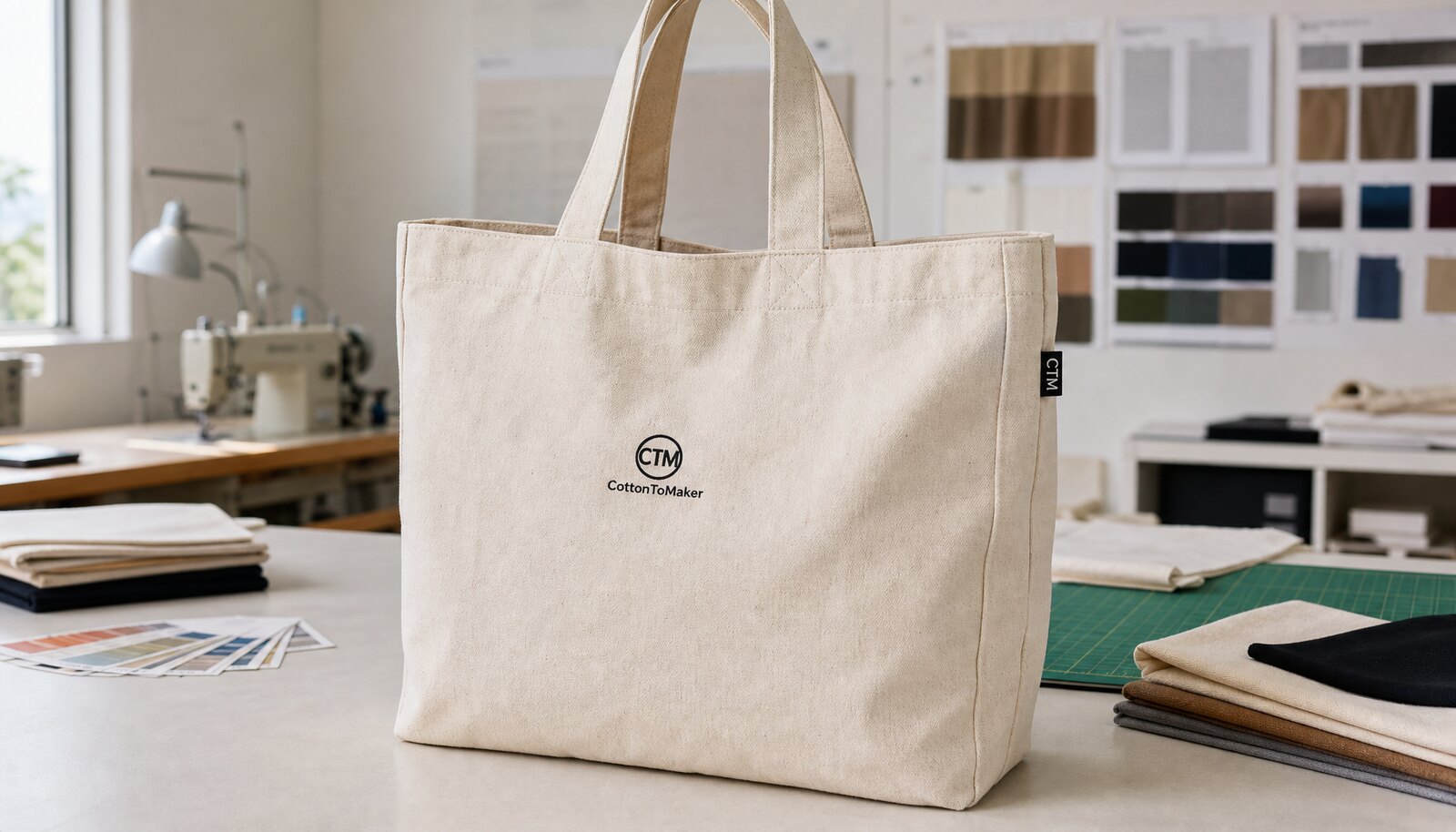
Start With the Launch Use Case, Not the Generic Tote
Large canvas grocery bags only work for apparel brands when the brief is clear. A retail launch bag is not the same as a free trade-show tote or a one-off promo item. It has to carry real weight, look clean on a shelf, and still feel like it belongs in the brand's product line. That means the first decision is not artwork. It is whether the bag is being sold as a margin item, used as an add-on at checkout, or bundled with apparel as a utility piece.
Once the use case is defined, the sourcing conversation gets easier. A bag sold in-store can justify heavier canvas, better stitching, and more careful packing because the buyer sees the item as part of the product range. A bag used only as a checkout bonus can often run lighter, with simpler decoration and less packaging. If the supplier is quoting before you define that difference, you will get inconsistent pricing and weak apples-to-apples comparisons.
- Define the sales channel first: retail shelf, e-commerce insert, or checkout add-on.
- State the expected load class in plain terms, such as daily groceries or light apparel carry.
- Limit the first launch to the core colorways and one clear logo treatment.
Choose Canvas Weight Based on Hand Feel and Load
For most retail grocery-style totes, 10-12 oz canvas, roughly 340-410 GSM, is the practical starting point. It gives the bag enough body to stand up better in-store, supports cleaner screen printing, and feels more substantial in hand than lighter promotional cloth. If the bag needs to carry heavier items or support premium retail positioning, some buyers move up again, but the cost and sewing time will rise with the weight.
Lighter fabric can still be useful when the bag is treated as an entry-level add-on or when the target sell price is tight. The problem is that underweight canvas can distort the logo, wrinkle after folding, and telegraph cheapness even if the print is accurate. Pre-shrunk or washed canvas helps when you need a more stable finished size and a softer feel, but it also changes the hand and may add cost. The right answer is usually a physical swatch review, not a catalog assumption.
- Ask for the exact GSM or ounce weight, plus the supplier's tolerance range.
- Compare raw and washed samples if shrinkage or hand feel affects the retail presentation.
- Use the same fabric spec across the launch wave so color and print behavior stay consistent.
Build the Bag Structure for Grocery Carry
The structure matters as much as the fabric. A grocery-style bag should usually include a gusset so it can hold folded apparel, boxed goods, or a mixed retail basket without the sidewalls collapsing. Reinforced handle attachment points, a stable top hem, and even seam construction are the parts that keep the bag from becoming a short-life accessory. If the bag is oversized but lightly built, it will read as awkward rather than premium.
For many apparel brands, the cleanest spec is a simple open-top tote with reinforced shoulder-length handles and a bottom gusset sized to the way the bag will actually be used. Decorative extras sound attractive in an RFQ, but they often add sewing steps without improving retail utility. If the bag is destined for frequent use, focus the budget on the parts that carry force: handle anchoring, bottom seams, and the upper edge where buyers grab the bag most often.
- Keep the handle drop consistent across samples so the bag feels balanced in hand and on the shoulder.
- Use double stitching or equivalent reinforcement at the load points, not just at the decorative edge.
- Specify the finished dimensions after sewing, not only the cut size.
Select Print Method for Retail Shelf Life
Screen print is still the most practical option for many large canvas grocery bags for apparel brands retail launch buying guide programs because it holds up well, looks clean from a distance, and keeps setup manageable for a small number of colors. It is the right default when the logo is bold and the art has clear edges. Embroidery or woven labels can work for a more premium look, but they are usually better for smaller marks, not large artwork blocks. If the design has multiple colors or fine gradients, the supplier needs to prove it can reproduce the file without thickening the hand of the bag.
The biggest mistake is to treat the artwork like a digital file and ignore the fabric underneath. Canvas absorbs ink differently depending on weave, finish, and color. A white or natural bag may take a clean print well, while a dyed base can shift the color and make the artwork look dull. Ask for a strike-off or pre-production print on the actual fabric, not only on paper. If the supplier resists that step, it is a warning sign for mass-production consistency.
- Limit the first run to one to three print colors unless the margin can absorb more setup time and higher reject risk.
- Reject fine lines, small reversed text, and tiny logo detail unless the factory has already proven that resolution on canvas.
- Use a written approval for print placement, size, and color, not only a verbal go-ahead.
Use Supplier Route to Control Risk
The right sourcing route depends on what you are protecting: price, speed, or control. A direct factory gives the clearest line of sight on fabric, sewing, and print decisions, which is usually best for a retail launch where the bag must match the brand standard. A trading company can be useful when you need multiple product categories in one order, but it adds another layer between the buyer and the line that actually cuts and sews the bags. A local decorator or printer may be the fastest choice for small replenishment runs, but it is usually not the most efficient route for a full production launch.
For apparel brands, the practical risk is hidden substitution. A supplier may quote the right general bag but switch canvas texture, handle tape, thread quality, or packaging details to protect margin. That is why supplier evidence matters. Look for production photos from the actual line, clear material descriptions, and a sample that matches the quote line by line. If the supplier cannot explain where the canvas is sourced, how it is cut, and where the print is applied, the launch is too important for that quote to be trusted at face value.
- Use a direct factory when the bag is part of the retail assortment and spec stability matters.
- Use a local decorator only for emergency top-up orders or last-minute promotional needs.
- Treat any supplier that cannot show a sample workflow as a higher-risk option.
Turn the Quote Into a Comparison Sheet
A useful quote is not just a unit price. It should tell you how the supplier got there. Separate fabric cost, cutting and sewing, print setup, labels or hangtags, packaging, cartonization, and freight assumptions. If those elements are bundled together, you cannot tell whether one supplier is genuinely efficient or just masking a weak line item somewhere else. The same bag can be priced very differently depending on whether the quote assumes raw folding, retail polybagging, a printed carton, or a more expensive print process.
MOQ logic needs the same discipline. A supplier may offer a lower per-piece price at a higher quantity, but that only helps if the launch demand can justify the stock. For a first retail run, the better move is often a narrower spec with one core body color and one print version, then a second wave if sell-through proves the product. The hidden cost is not just surplus units. It is also dead inventory sitting in the wrong color or with the wrong label spec. Compare quotes across the same assumptions, or the cheapest quote will not stay cheapest.
- Request price breaks at at least three quantities so you can see the real MOQ logic.
- Ask whether setup charges are one-time or repeated across colors and print versions.
- Compare the same Incoterm on every offer before ranking suppliers.
Approve Samples Like a Buyer, Not a Viewer
A photo sample is not enough for a retail launch. You need a pre-production sample that reflects the actual fabric, thread, print, and finishing method, plus a sealed gold sample that becomes the reference for the order. The buyer should check more than appearance. Hand feel, seam smoothness, handle balance, smell from ink or finishing agents, and the way the bag folds are all part of the retail experience. If the sample looks good but the handle twists, the bag will still come back as a complaint item.
Build a pass-fail sheet and make the factory work to that sheet. Typical checks include finished size, handle symmetry, print registration, stitch cleanliness, label placement, and overall shape after folding. If the sample needs a correction, write down exactly what changes and who approved them. That paper trail matters because the final mass run often drifts when the sample feedback is vague. The goal is not to admire a sample. The goal is to lock the manufacturing standard before production starts.
- Measure the sample flat and loaded so you can see whether the gusset and body hold shape.
- Inspect print edges under good light for smearing, haloing, or color shift.
- Keep one sealed sample in-house as the comparison point for shipment inspection.
Packing and Retail Readiness
Packing is part of product quality, not an afterthought. Large canvas grocery bags often ship folded, but the fold format, inner protection, and carton marking all affect how the item reaches the buyer. If the bag is sold in a retail setting, a clean fold and a barcode or SKU label can matter as much as the stitching. If the bag is destined for a distribution center, the master carton count and outer label accuracy become more important than the shelf-facing presentation. Either way, sloppy packing creates avoidable receiving issues.
For a launch order, specify the packing format in the RFQ. If you want each bag in a polybag, say so. If you need a paper insert to preserve shape or a hangtag for retail display, state the format and size. These details drive labor, carton count, and freight weight. They also change how the bag feels on arrival. A bag that is cleanly packed and protected from abrasion will look more premium in-store than a bag that arrives scuffed or crushed, even if the bag itself is well made.
- State whether the bags need to be retail-ready, warehouse-ready, or both.
- Require clear carton labels with quantity, color, style code, and destination information.
- Protect printed surfaces from rubbing against seams, zippers, or rough carton interiors.
Plan Lead Time Around Real Production Risk
Lead time is not the same as sewing time. A realistic plan includes sample approval, fabric booking, print screen setup, cutting, sewing, finishing, packing, inspection, and transit. For a retail launch, the final buffer is what protects the launch date when one part of the process slips. If the buyer waits until production is finished to think about freight, the launch calendar becomes fragile. The better approach is to work backward from the retail arrival date and include a buffer for both quality review and shipping delay.
The main schedule risks are predictable: slow artwork approvals, color mismatch on first strike-off, fabric shrinkage after washing, carton or label delays, and peak-season transit congestion. A supplier that promises a very short timeline without asking detailed questions is usually assuming something will be simplified later. That may be fine for a sample order, but it is risky for a launch program. Put the timeline in writing with each milestone named, so the factory and the buyer are both looking at the same clock.
- Build time for sample approval before production release, even if the order is small.
- Add a shipping buffer when the launch date is tied to a store reset or seasonal drop.
- Separate production completion date from warehouse arrival date in your internal plan.
Compare Landed Cost Before Awarding the PO
The cleanest way to compare suppliers is to convert every offer into landed cost. That means more than the quoted bag price. Include the freight term, inland transport, packaging upcharges, import handling, duties, brokerage, and any expected rework or inspection cost. Two quotes that look close on paper can diverge quickly once the buyer normalizes them into the same destination cost. This is where procurement teams protect margin. A low unit price is not a good deal if it creates quality risk or unexpected freight exposure.
For a first retail launch, award should reflect both commercial and operational fit. A supplier that is slightly higher on unit price but stronger on sample control, packing discipline, and communication may be the lower-risk choice when the launch date is fixed. Treat the decision as a balance of landed cost, defect risk, and schedule reliability. That is the right frame for apparel brands launching a bag that needs to look intentional, not incidental.
- Normalize all quotes to the same destination and packing assumption before comparing them.
- Use a simple scorecard for cost, sample quality, lead time, and response speed.
- Do not award on price alone if the bag is part of a retail assortment that customers will inspect closely.
Specification comparison for buyers
| Spec decision | Recommended option | When it fits | Buyer risk to check |
|---|---|---|---|
| Fabric weight | 10-12 oz / 340-410 GSM cotton canvas | Retail launch bags that need a more structured hand and repeat grocery use | Underweight cloth can look soft, wrinkle heavily, and fail load expectations |
| Bag structure | Gusseted body with reinforced handle points and a turned or bound top edge | When the bag will carry boxed goods, folded apparel, or heavier daily shopping | Weak corners and single-needle seams often show up after a short sell-through period |
| Print method | 1-3 color screen print for large logos; woven label or embroidery for smaller premium marks | When the brand mark needs to stay clean and legible on shelf | Fine detail can fill in, crack, or feel too heavy if the art and ink system are mismatched |
| Supplier route | Direct factory for core production; local decorator only for urgent replenishment | When the launch date and spec control matter more than lowest headline quote | Trading layers can hide fabric substitutions and slow issue resolution |
| MOQ strategy | One core spec with limited colorways and one print version per launch wave | When sell-through is still being tested and inventory risk must stay contained | Too many variants fragment stock and raise setup charges across the order |
| Sampling route | Pre-production sample plus sealed gold sample | When color, handle feel, print placement, and construction all need physical approval | Photo approvals miss shrinkage, stitch quality, and print hand feel |
| Packing route | Individual polybag or fold insert, then labeled master cartons with count marks | When bags go to retail DCs or store replenishment programs | Loose packing increases scuffing, count errors, and carton damage |
| Lead time route | Factory production plan with a 10-15 day buffer before launch date | When the retail calendar is fixed and transit delays cannot move the sell window | Ocean freight, color approvals, and pre-shipment checks can each add delay |
| Landed-cost route | Compare EXW, FOB, and delivered cost on one sheet | When procurement needs a true supplier comparison | A low piece price can disappear after packaging, inland freight, rework, and duty |
Buyer checklist before sampling
- Confirm bag size, gusset depth, handle drop, and target canvas weight before requesting price.
- Provide vector artwork, Pantone references, logo placement, and maximum print colors in the RFQ.
- State whether the bag is a retail sellable item, a giveaway, or a store-use utility bag, because that changes the spec.
- Define packing format, barcode needs, carton marks, and whether folded retail presentation matters.
- Set the target MOQ, launch date, destination port or warehouse, and preferred Incoterm.
- Request a pre-production sample, a sealed gold sample, and a written approval trail for any changes.
Factory quote questions to send
- What canvas weight, weave type, and weight tolerance are you quoting for this bag?
- What is the unit price at multiple quantities, and what changes between those quantity breaks?
- Which setup charges are separate, including print screens, embroidery digitizing, labels, and packaging?
- What sample charge applies, and is it credited back against the production order?
- What is the production lead time after sample approval, and what is the transit estimate by shipment mode?
- What carton size, carton count, and packing method will you use for this order?
- What quality documents can you provide, such as inspection photos, measurement reports, or pre-shipment checks?
- What Incoterm is assumed in the quote, and what costs are excluded from the headline price?
Quality-control points to confirm
- Fabric weight should match the agreed spec within the supplier's stated tolerance, not just a visual hand check.
- Bag dimensions should be measured after finishing, including body width, height, and gusset, against the approved sample.
- Handle length, handle symmetry, and attachment placement should be checked on every size and colorway.
- Seams should be even, secure at stress points, and free of skipped stitches, loose threads, and puckering.
- Print placement should stay within the approved registration window, with no smearing, pinholes, or color bleed.
- Top load areas should be evaluated with an internal use test, especially if the bag will carry heavier grocery items.
- Packaging count should be verified carton by carton, with labels, barcodes, and inner folds aligned to the retail plan.
- The final shipment should be compared against the sealed gold sample before release.