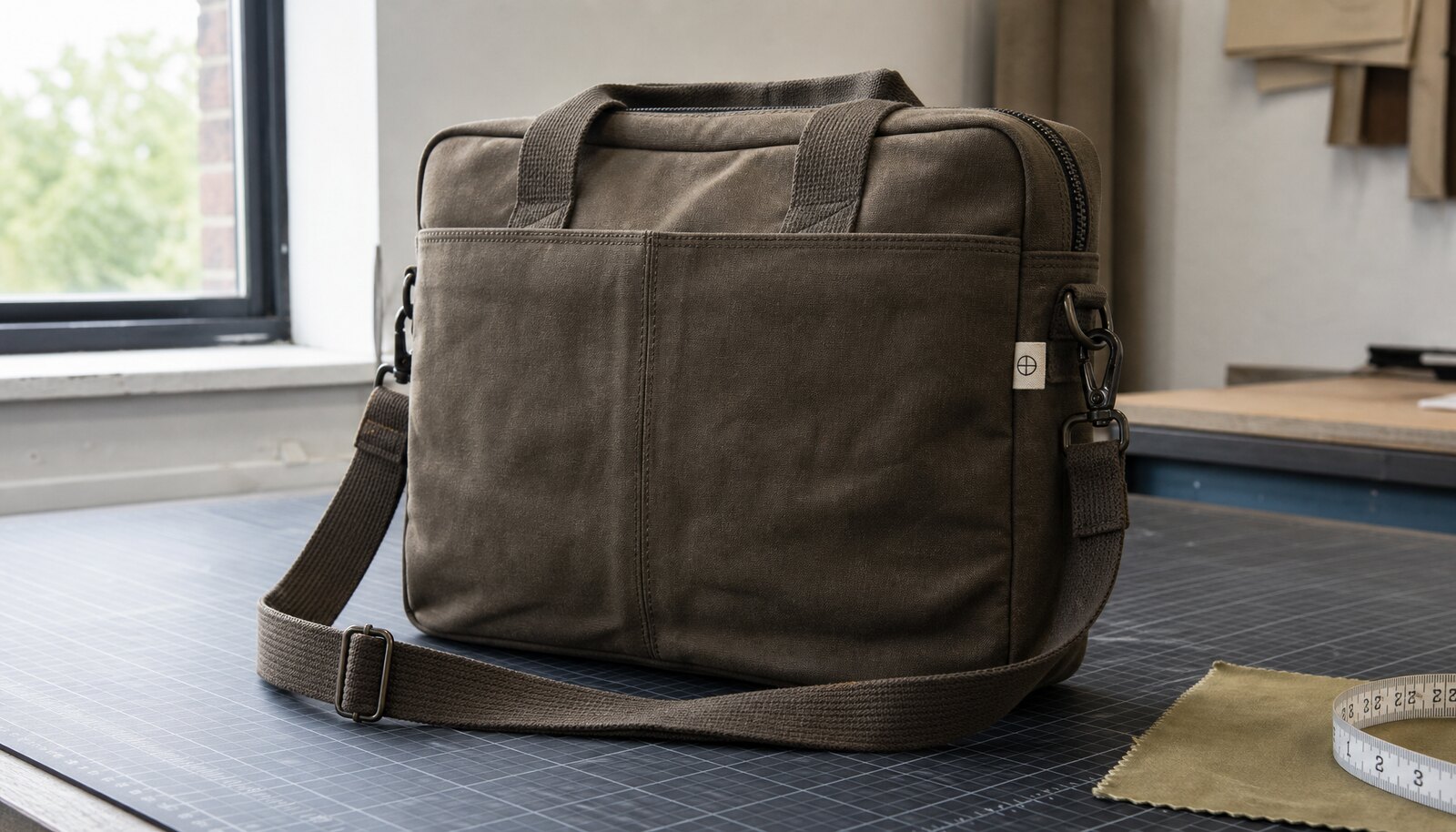
What a launch bag has to do
Laptop messenger bags for brand launches are usually not bought as a pure utility item. They are carrying a product story, event material, or a retail impression, so the bag has to fit a laptop, look deliberate in photos, and survive being handed out, stacked, and shipped. A weak spec shows up fast: the bag hangs awkwardly, the print looks cheap, or the structure collapses before it reaches the customer.
The RFQ should define the bag as a launch asset, not just a tote alternative. State the intended use, whether the bag is for gifting, retail resale, staff onboarding, or event distribution, then attach the device size it must fit. A supplier can only price correctly when the functional target is clear, especially if the bag needs padding, internal pockets, or a cleaner retail finish.
- Define the largest laptop size that must fit, plus charger, notebook, and insert card clearance.
- State whether the bag needs to stand upright, lie flat, or keep a structured silhouette on shelf.
- Separate launch-use bags from daily commuter bags, because the spec and price logic are different.
Choosing the canvas build
For canvas messenger bags, the body fabric usually lands in the 280 to 420 GSM range, or roughly 8 to 14 oz depending on how the mill describes it. Around 280 to 320 GSM gives a lighter bag that is easier to fold and cheaper to ship. Around 340 to 390 GSM is the safer retail band for a launch bag because it gives better body, cleaner print definition, and less sag at the strap points. Above 400 GSM, the bag feels more premium and structured, but sewing becomes slower and freight weight rises.
Do not treat GSM alone as the whole spec. Weave tightness, finish, lining, foam, and reinforcement matter just as much. A 12 oz canvas with a good lining and proper strap anchoring can outperform a heavier but loose weave. If the launch needs a more polished look, add a light interfacing or a 2 to 4 mm foam layer in the laptop compartment rather than overbuying on the outer canvas only.
- Use 280 to 320 GSM for light gifting or very price-sensitive launch kits.
- Use 340 to 390 GSM for retail-ready bags that need shape and better print presentation.
- Ask for shrinkage, shade stability, and edge fray behavior if the bag will be washed or handled heavily.
Print and branding that survive production
The decoration method should follow the artwork and the order size, not the other way around. For one-color logos and clean brand marks, screen print is usually the most controllable route at volume. For a premium launch bag, embroidery or a woven label works well if the logo has enough detail space and the buyer wants texture. Full-color transfer can work for short runs, but it needs tighter control on press temperature, adhesion, and wash resistance. Small text, thin lines, and gradients are the first things to fail when the wrong method is chosen.
Insist on the actual placement and artwork scale before production starts. A paper proof is not enough. The sample should show the logo on real canvas with the intended color, print area, and edge clearance. If the bag uses dark canvas, ask how the printer will handle underbase coverage. If the bag uses a side label or woven badge, confirm stitching path and visibility after folding and packing.
- Use screen print for simple logos with stable repeat volume and clear edge definition.
- Use embroidery only when the logo is large enough to carry stitch detail cleanly.
- Approve the print on actual canvas, not on paper, and lock the placement before bulk cutting.
Sourcing route and MOQ logic
The best sourcing route depends on how fixed the launch date is and how much control the buyer needs. A direct factory is usually the right choice when you care about fabric control, seam structure, and repeatability. A trading company can help when the launch includes mixed products and multiple packing requirements, but you need to see exactly which factory is doing the work. A stock blank route is the fastest path when the design can stay simple and only the brand mark changes.
MOQ should be broken into practical pieces, not just one headline number. Ask whether the minimum applies per color, per logo, or per size. A supplier may quote a low total MOQ and still require a much higher threshold for each artwork or canvas color. That is where many launch budgets get strained, because the buyer only sees the first page of the quote and not the real production trigger.
- Direct factory: best for spec control and repeat orders, with higher clarity on quality ownership.
- Trading company: best when you need one basket quote across multiple SKUs, but margin must be transparent.
- Stock blank plus local branding: best for pilot launches, but fabric and finish choices are usually limited.
What a serious factory quote includes
A useful quote is more than a unit price. It should identify the style code, dimensions, canvas weight, lining, foam, zipper type, strap webbing, logo method, packing format, sample fee, and production lead time. If a supplier gives only one lump sum without material details, the buyer cannot compare it with another factory on equal terms. The quote should also state the incoterm, export assumption, and whether cartons, insert cards, or barcode labels are included.
For brand launches, quote structure matters because the cheapest body cost often carries the highest risk. A low number can hide a weaker zipper, thin webbing, extra logo setup, or a bag that only works if the customer accepts a loose shape. Break out each cost driver, then compare two or three routes on the same basis. A clean comparison often shows that a slightly higher body price lowers the total landed cost once the right packing and fewer rejects are counted.
- Request a body cost, branding cost, accessory cost, and packing cost split.
- Ask for sample fee, setup fee, and any repeat-run savings on the same style.
- Make the factory state whether freight, customs documents, and carton marks are included or excluded.
Sample approval without surprises
The first sample should prove fit, proportion, and finish, not just shape. Put an actual laptop in the sample, along with a charger and notebook, and see whether the zipper closes without forcing the front panel. Check strap comfort with weight in the bag, not empty. A messenger bag that looks good on the table but twists on the shoulder is a production miss, not a styling issue.
The pre-production sample needs to match the final fabric and final trim set. If the factory swaps the canvas, zipper brand, webbing width, or logo method after sample approval, the sample is no longer valid as a control point. Require a revised sample or a signed deviation note whenever a material changes. That is the cleanest way to stop spec drift before bulk sewing starts.
- Test fit with the real laptop sizes that will be sold or gifted into the program.
- Check zipper travel, strap drop, pocket dimensions, and side seam alignment under load.
- Reject a sample if the final canvas weight, print method, or trim set changes without approval.
QC thresholds by component
Laptop messenger bags fail in predictable places: strap anchors, zipper lines, print edges, and corners. For a launch order, define the failure boundaries before inspection begins. Stitch skips, weak bar-tacks, crooked logos, and loose lining ends are easy to spot if the buyer gives the factory a clear standard. If your QC team uses AQL, separate appearance defects from function defects so the inspection report reflects both visual and structural risk.
Functional testing matters more than cosmetic perfection once the order is in volume. A bag can pass a quick visual scan and still fail when loaded with a 2 to 4 kg test weight, folded for carton packing, or opened repeatedly at the zipper ends. A launch item needs more than surface quality. It needs a stable fit, clean opening action, and a reinforcement pattern that will survive transit and merchandising handling.
- Use a stitch and reinforcement standard for strap anchors and stress corners.
- Set print alignment tolerance and color acceptance before the first bulk lot runs.
- Run a load-and-close test with the intended laptop size, not with an empty shell.
Packing and retail readiness
Packing influences both damage rate and shelf presentation. A messenger bag that is folded too sharply may keep a permanent crease across the front panel or the logo area. One that is packed too loosely will shift inside the carton and arrive with crushed corners. For launch bags, the most workable format is usually a flat fold with a tissue layer or insert card, then a polybag and a carton count that matches the retail plan.
The carton spec should be part of the quote, not an afterthought. Master carton dimensions affect freight, and freight affects margin. Ask for carton size, gross weight, net weight, and carton marks before you confirm production. If the launch is going into retail or distribution centers, make sure the SKU label, barcode, and country-of-origin marking are placed where the warehouse team expects them. Poor packing is a common reason a good bag gets downgraded at receiving.
- Avoid hard folds across the logo panel unless the material has been tested for crease recovery.
- Confirm whether the bag ships with tissue, insert card, silica gel, or inner polybag.
- Ask for carton count, carton dimensions, and label location before bulk packing starts.
Lead time and landed-cost planning
A realistic schedule has more than one clock. Sample development can take 5 to 10 days if materials are standard and the artwork is ready. New fabric sourcing, custom trims, or repeated sample rounds can push that longer. After PP approval and deposit, production for a straightforward canvas messenger bag often sits in the 30 to 45 day range, with transit added on top. If the launch depends on a fixed event date, build a buffer for print correction, packing approval, and export booking.
Landed cost changes quickly when the spec gets tighter. Thicker canvas, branded zipper pulls, padded panels, and premium packing all add cost, but the biggest swing often comes from the sourcing route itself. A direct factory can be the best value if the buyer is willing to manage details. A stock blank route can look cheaper until branding and logistics are added. The right comparison is not the unit price alone. It is the final cost per sellable bag at the date it lands.
- Add buffer time for new artwork, custom webbing, and any washed or coated canvas finish.
- Compare EXW, FOB, and delivered cost on the same quote basis.
- Count rework risk and packing damage when comparing low-price and high-control suppliers.
Specification comparison for buyers
| Spec decision | Recommended option | When it fits | Buyer risk to check |
|---|---|---|---|
| Direct factory with in-house sewing and print | Best for 300 to 2,000 pcs when you need one clear spec owner | You want tighter control on canvas GSM, strap build, and logo placement | Confirm they do not outsource print or hardware without telling you |
| Direct factory with outsourced branding | Use only if the sewing factory has a stable print subcontractor | The body spec is standard but the logo method is the main variable | Color match, print registration, and schedule risk can shift outside the factory |
| Trading company or sourcing agent | Useful for multi-SKU launch kits and cross-category purchasing | You need one contact across bags, inserts, and packaging parts | Hidden markup and factory swaps can make quote comparisons unreliable |
| Stock blank bag plus local branding | Good for rush launches or small pilot drops | The body design can stay generic and only the logo changes | Hand feel, color consistency, and decoration quality may be weaker |
| Domestic decorator or fulfillment partner | Best for very small runs and very short deadlines | You need fast turnaround inside one market and accept higher unit cost | Limited canvas choices and less control over cut-and-sew details |
| Regional supplier near the destination market | Useful when freight time and import friction matter more than lowest ex-works cost | The launch date is fixed and customs delay is a real risk | Fewer fabric options and smaller capacity can reduce repeatability |
| Large export factory with higher MOQ | Best for repeat launches and retail distribution | You need steady quality, stronger QA, and deeper trim sourcing | Minimums are usually higher and communication can be slower |
| Small workshop with low MOQ | Good for pilot launches, influencer kits, or market tests | You want to validate size, logo, and finish before scaling | Batch-to-batch variation is more likely on dimensions and stitching |
Buyer checklist before sampling
- State the laptop size to be fitted, not just the bag size on paper.
- Define canvas weight in GSM or ounce weight, plus whether the fabric is raw, washed, or coated.
- Choose the logo method before quoting: screen print, embroidery, woven label, patch, or debossed detail.
- Specify strap width, strap drop, and reinforcement at the anchor points.
- Decide whether the bag needs padding, lining, a laptop sleeve, or a rigid base insert.
- Confirm MOQ by color, by artwork, and by size before comparing suppliers.
- Ask for a pre-production sample made with the final fabric and final trim set.
- Set the packing format: individual polybag, tissue, insert card, carton count, and carton mark rules.
- Ask for lead time split by sample stage, production, and export transit assumption.
- Ask which QC standard will be used for appearance and function, and what tolerance limits apply.
Factory quote questions to send
- What is the actual canvas specification, including GSM, weave type, and finish?
- Is this quote from a direct factory or from a trading company, and which steps are done in-house?
- Which branding method are you pricing, and does the quote include setup, screen, digitizing, or mold cost if any?
- What is the MOQ by color, by logo artwork, and by order type?
- Please split the quote into bag body, lining, foam, zipper, webbing, logo application, and packing.
- What are the exact dimensions, tolerance range, and laptop fit target used for the quote?
- What sample stages are included, and what is the sample fee for each stage?
- What is the standard production lead time after PP approval and deposit?
- What packing details are included, such as polybag, insert card, carton count, and carton size?
- Which QC standard do you use for seam strength, print alignment, and final inspection?
Quality-control points to confirm
- Canvas weight matches the approved spec within a practical production tolerance and does not feel thin or underfilled.
- Logo placement, size, and color stay within the approved artwork and do not drift across the front panel or side label.
- Strap anchors use reinforced stitching, typically box-x or bar-tack, with no loose thread or skipped stitches.
- Zipper runs smoothly across the full track and does not snag on the lining or the flap edge.
- Laptop compartment dimensions fit the declared device size without forcing the zipper or distorting the bag body.
- Seam allowance and stitch density remain consistent across both sides, gussets, and stress points.
- Padding, if specified, stays even and does not bunch at the corners or collapse after compression.
- Carton pack count, carton size, and master marks match the packing list and do not crush the bag structure.