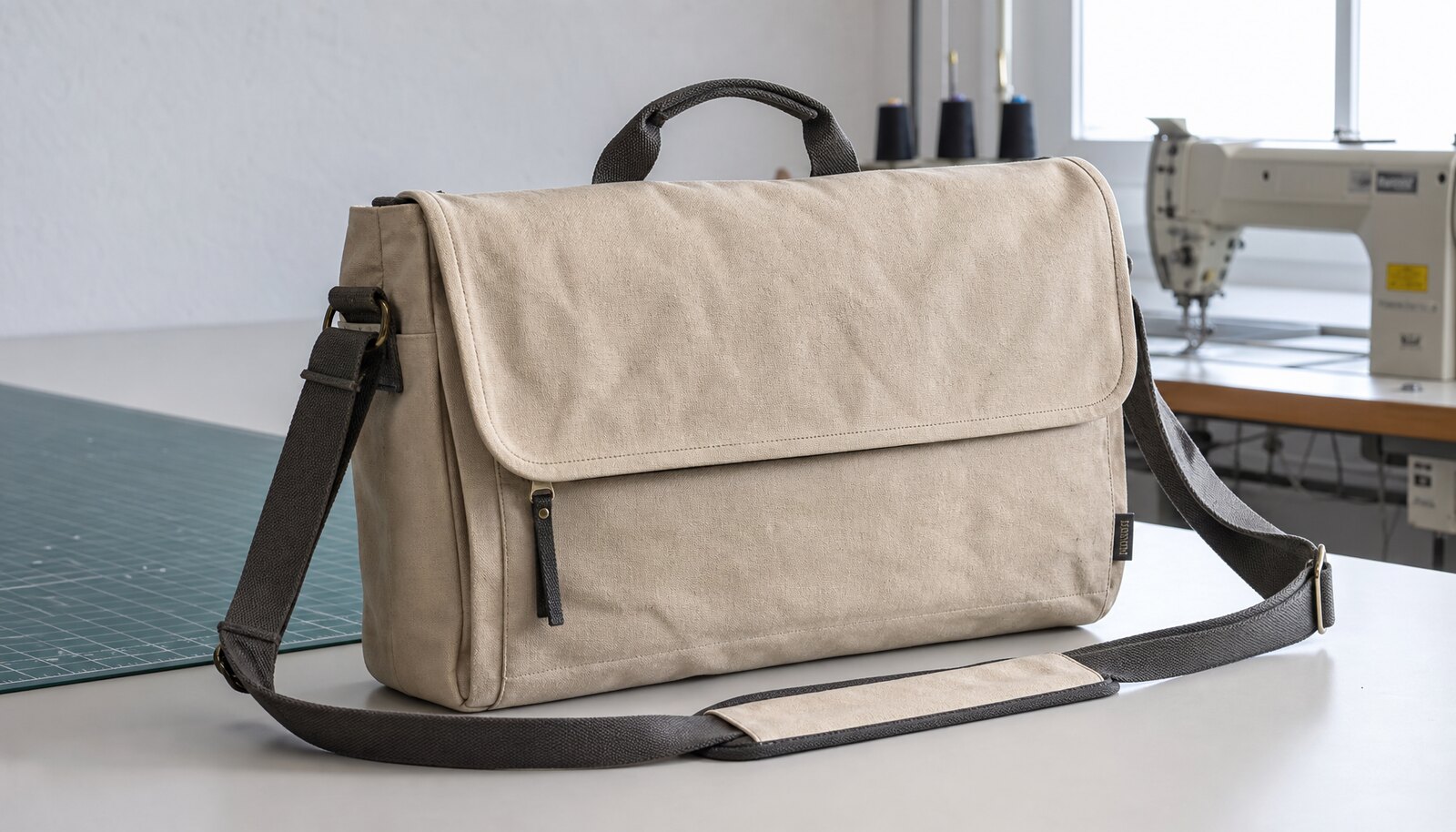
Start With the Laptop and Carry Profile
The first buying mistake with laptop messenger bags is starting from a style image instead of the device and use case. A 13-inch ultrabook, a 14-inch work laptop with a sleeve, and a 15.6-inch corporate notebook do not need the same internal clearances, padding, or strap load. If the buyer does not define the actual device dimensions, suppliers will quote to the generic screen size and the bag may arrive too tight at the corners or too loose to feel secure. The result is usually not a visible defect, but a return problem that shows up after the first field use.
The carry profile matters just as much as the device. Some programs need a slim bag that slides under a desk chair and into overhead storage, while others need extra document volume, a water bottle pocket, or a separate charger sleeve. If the bag is going into retail, the customer will judge shape and hand feel on the shelf. If it is going into a corporate program, the priority is often practical load, comfort, and print visibility. Define the real behavior before you price the bag, or every quote will be optimized for the wrong target.
- Measure the laptop, charger, notebook, and any sleeve that will be carried inside the bag.
- State whether the bag needs a structured body, a soft collapsible body, or a stand-up base.
- Clarify whether the target user carries the bag by hand, shoulder, or crossbody for long periods.
Choose Canvas Weight, Lining, and Reinforcement
Canvas weight is one of the biggest levers in both price and performance. For everyday laptop messenger bags, 12 oz to 14 oz canvas, roughly 340 to 400 gsm, is usually the practical middle ground. It gives enough body for print quality and shelf appeal without making the bag unnecessarily heavy. For premium retail or heavier computer loads, 16 oz canvas, around 450 gsm, can make sense, but the bag will feel stiffer, cost more to ship, and often need stronger accessories to match the heavier body.
Do not specify canvas alone and assume the rest will follow. The lining, padding, and reinforcement are what keep the bag usable after a few months of commuting. A basic build might use 210D polyester lining with a 3 mm EVA or foam sleeve. A more premium build may use cotton twill lining, a firm bottom board, and bar tacks at every strap anchor. If the bag has a flap or front pocket, the seam allowance and edge finishing matter because those areas take repeated stress when the bag is opened and closed every day.
- Use 12-14 oz canvas for launch programs, general office use, and tighter freight targets.
- Use 16 oz canvas when shelf presence and shape retention matter more than unit weight.
- Require reinforcement at strap ends, handle joins, and laptop sleeve corners regardless of canvas weight.
Match Decoration Method to Margin and Reorder Plan
The decoration method should follow the margin model, not just the artwork. Screen print is still the most practical choice for most canvas laptop messenger bags because it is cost-efficient, repeatable, and easy to compare across suppliers. It works best when the logo has one to three colors and the placement is flat enough for clean registration. If the brand artwork has tiny type, tonal gradients, or many colors, the buyer should expect either a simplification or a more expensive process. A quote that says 'print included' is not useful unless the supplier names the method, color count, and setup assumptions.
Embroidery and woven patches are usually better when the bag is meant to look more premium or when the buyer wants a more durable mark than surface ink. The tradeoff is cost, production time, and artwork simplification. Small text can disappear in stitching, and thin canvas can pucker around dense embroidery if the backing is not controlled. Side labels, sewn badges, and subtle woven tabs are often the most stable route for conservative branding. Pick the method that fits the product positioning and the reorder pattern, because the cheapest decoration on paper is often the most expensive option after rejects, touch-ups, and customer complaints.
- Use screen print for simple logos, campaign graphics, and stable repeat orders.
- Use embroidery or woven patches for premium positioning and lower cracking risk.
- Ask for the exact logo size in millimeters, not just a yes or no on decoration.
Build an RFQ That Produces Comparable Quotes
A useful RFQ for laptop messenger bags should read like a production brief, not a marketing request. Suppliers need the target size, canvas weight, lining, padding, closure style, print method, accessory spec, and pack-out. If the request is loose, every factory fills the gaps differently and the quotes become impossible to compare. One supplier may price a 12 oz bag with generic zipper tape and no internal padding, while another prices a 16 oz bag with a branded zipper and bottom board. That spread looks like a price gap, but it is really a spec gap.
The quote should break out the parts that move cost. Ask for base bag price, decoration setup, sample charge, carton spec, and any optional upgrades as separate lines. That makes it easier to see what changes if you move from 1-color print to 2-color print, or from basic lining to padded laptop sleeve. It also exposes the supplier that hides setup fees in the unit cost. When a buyer compares quotes, the goal is not to find the lowest number in isolation. The goal is to identify the lowest total cost for the spec that will survive use, transit, and retail handling.
- Request a quote line for fabric, lining, padding, zipper, handle, strap, print, label, and carton.
- Ask each supplier to note what is included and what is optional so the assumptions are visible.
- Keep the artwork file, dimension sheet, and packaging spec attached to the RFQ.
Compare Supplier Routes Before You Compare Prices
Not every sourcing route gives the same control. A direct bag factory with in-house decoration usually gives the cleanest control over pattern, stitching, logo placement, and schedule. That is the best route when the bag needs repeated reorders or when the buyer wants to lock a stable spec. A trading company or consolidator can be useful when the order is multi-category or when the buyer wants one shipment from several product lines, but the buyer should verify who actually owns the sample standard and production QC. If that is unclear, responsibility gets diluted fast when the order needs correction.
Stock programs and semi-custom bag routes can be practical for speed, but they are only suitable when the laptop size and interior layout are already close to the target market. They reduce lead time and MOQ pressure, yet they also limit control over the body shape, pocket count, and accessory quality. For retail, that can hurt repeatability. For a corporate giveaway, it may be enough. The right sourcing route depends on whether the buyer is optimizing for speed, margin, or spec control. A lower quote is not useful if it comes from a route that cannot hold the same standard on reorder.
- Use direct factory sourcing when fit, repeatability, and QC ownership matter most.
- Use a trading route only when the buyer needs consolidation or internal sourcing support.
- Use stock-body customization only when time and MOQ are the dominant constraints.
Sample Approval Should Test Fit, Not Just Appearance
Laptop messenger bag samples often look right before they are actually ready for production. The buyer needs to evaluate fit, opening angle, closure tension, strap comfort, and pocket usability with the real device or a proper dummy. A neat sample that is too shallow at the corners or too stiff at the flap is still a failed sample. The same applies to the laptop sleeve: if the sleeve is too tight, the user will fight the zipper every day; if it is too loose, the laptop will slide and the bag will feel cheap even when the fabric is good.
Treat the sample as a production control document. Mark the exact dimensions, material, logo position, and packaging condition that were approved, then make the factory confirm those points in writing before mass production. If the sample has a limitation, such as a non-standard lining color or a temporary zipper substitute, write that down too. Many production disputes are simply sample drift problems. The finished sample should not just be attractive. It should be a measurable reference that can survive a shipment without interpretation.
- Fit test with the actual laptop, charger, notebook, and accessories that users will carry.
- Check opening angle and zipper path with the bag both empty and lightly loaded.
- Sign off on a measured sample sheet that includes dimensions, materials, and logo placement.
Quality Control Needs Clear Failure Thresholds
The most common defects in laptop messenger bags are not dramatic; they are practical. Loose stitching at the strap anchor, a zipper that tracks unevenly, a flap that sits crooked, or print that cracks when the bag is folded can all create returns without looking like a major production failure. A good QC plan focuses on those points. Bar tacks should be clean and dense at stress areas, the laptop compartment should hold shape, and the bag should close without forcing the hardware. If the design uses piping, binding, or edge tape, those areas need extra scrutiny because they often hide skipped stitches and uneven tension.
AQL or pass-fail language helps only when the defect definitions are specific. The buyer should distinguish cosmetic flaws from functional failures. A small thread tail may be acceptable if it trims cleanly, but a misaligned zipper or a seam that opens under load is not. Print must be checked after folding and light abrasion, not just when the bag is flat on a table. For retail programs, the outer appearance on the shelf matters, but for procurement, the bigger cost is usually the defect that passes inspection and fails in the field. QC should catch the latter.
- Set separate rules for critical, major, and minor defects before inspection starts.
- Test the zipper, strap, and closure under light load, not only on an empty bag.
- Reject inconsistent logo placement, weak bar tacks, open seams, and unstable print cure.
Packing and Carton Choices Affect Damage Rates
Packing is part of product design for messenger bags because the bag shape can collapse or distort if it is packed badly. A folded canvas laptop bag with no insert may arrive with deep creases that are hard to recover, especially on premium retail orders. If the bag has a structured body or padded sleeve, it often needs a simple internal support such as paper, board, or air-filled material to preserve the profile. The buyer should not accept 'standard packing' as a meaningful answer. Standard for one factory may mean loose folding in a polybag; standard for another may mean folded with tissue and carton separators.
Cartonization also changes the landed cost. More bags per carton lowers carton count but can increase crush risk, while fewer bags per carton can protect shape but raise shipping volume. The right balance depends on whether the bag is going by sea, air, or courier, and whether the final destination is a warehouse or a retail fulfillment center. If the buyer only discusses unit cost, the shipping and damage cost can erase the savings. Ask for the carton size, gross weight, and packing method before you compare offers, because two quotes with the same unit price can land very differently.
- Specify whether the bag must be folded, stuffed, or laid flat in the carton.
- Ask for carton dimensions and gross weight to estimate freight before PO release.
- Use inserts or separators when the bag has a structured body, a flap, or a premium finish.
Lead Time and Reorders Need a Real Schedule, Not a Promise
A realistic lead time for laptop messenger bags depends on sample approval, fabric availability, decoration method, and carton prep. The buyer should separate sampling from mass production and ask the factory to quote both. A bag with custom canvas color, printed logo, and special packaging will take longer than a stock body with a sewn label. If the factory says yes to every request without naming the critical path, the schedule risk is probably hidden in the communication rather than eliminated. That usually shows up when artwork approval or trim sourcing is delayed and the shipment date slides with no clear owner.
Reorders deserve a different conversation than the first order. Once the pattern, decoration plate, and packaging are locked, repeat production should be faster and more stable, but only if the factory has retained the approved materials and specs. If the buyer is planning a seasonal replenishment, the quote should include the conditions that keep the reorder clean: same fabric mill, same zipper spec, same print setup, and same carton pack. That is how you avoid a surprise where the first order succeeds and the second order changes material or fit because the supplier treated it as a new project.
- Request separate sample lead time, pre-production lead time, and mass production lead time.
- Ask what items are held in stock for reorders and what must be resourced again.
- Get the factory to state the last approval step that starts production, such as artwork sign-off or deposit receipt.
Landed Cost Should Include the Choices You Made Up Front
The lowest factory quote is not always the lowest landed cost for laptop messenger bags. Canvas weight, padding, zipper quality, print method, packing, and carton volume all change what finally reaches the warehouse. A 14 oz bag with simple print may look cheaper on the worksheet than a 16 oz bag with a woven label, but if the lighter option creates returns or damages more easily, the real cost can be higher. Buyers should compare landed cost on the same spec basis, not just compare one supplier's quote against another's assumption. That means evaluating the same bag size, the same decoration method, the same packing, and the same shipment mode.
The best procurement habit is to price the spec that will actually be sold, not the one that looks easiest to buy. If retail positioning calls for a premium hand feel, the cost of a heavier canvas and better zipper may be justified. If the order is for a corporate campaign, a simpler body and clearer logo placement may make more sense. The value comes from matching the build to the channel. Once that match is defined, you can negotiate the cost drivers intelligently instead of chasing a unit price that does not reflect the real product.
- Compare quotes on the same canvas weight, same logo method, same packing, and same shipment terms.
- Treat freight, carton volume, and defect risk as part of the cost, not afterthoughts.
- Use the first order to set a stable spec that can be repeated without re-engineering.
Specification comparison for buyers
| Spec decision | Recommended option | When it fits | Buyer risk to check |
|---|---|---|---|
| Direct factory with in-house screen print | Best for a 1-3 color logo on 12-14 oz canvas with repeat orders | When the brand wants control over print placement, cure, and lead time | Check ink coverage, registration on seams, and whether setup cost is separated from unit price |
| Direct factory with embroidery or woven patch | Best for premium corporate gifts or retail programs that need a more durable logo | When the artwork is simple and the buyer wants a lower risk of cracking than flat ink | Check stitch density, patch edge finishing, and whether the needle holes weaken lighter canvas |
| Trading company bundling bag, print, and packaging | Best when the order mixes sizes, colors, or destinations and the buyer wants one PO | When internal sourcing time matters more than factory transparency | Check margin opacity, who actually owns QC, and whether samples match the named factory spec |
| Stock body with custom logo | Best for low MOQ launches, events, or urgent replenishment | When speed matters more than exact fit or material customization | Check whether stock size fits the target laptop and whether the fabric weight is strong enough for retail returns |
| 14 oz canvas with padded laptop sleeve | Best for everyday commuting bags for 13-14 inch laptops | When the buyer needs a balance of structure, price, and manageable shipping weight | Check seam strength at the sleeve, zipper alignment, and whether the foam thickness is consistent |
| 16 oz canvas with full lining and bottom board | Best for 15.6 inch bags, heavier loads, or premium private label programs | When the bag must feel sturdy in hand and hold shape on shelf | Check total bag weight, carton cost, and whether the extra structure changes the quoted freight rate |
| YKK or equivalent branded zipper and metal pull | Best for high-use bags with low return tolerance | When the bag will see daily opening and closing in the field | Check zipper tape color match, pull strength, and smooth operation across the full opening |
| Sewn woven label or side flag instead of large print | Best for buyers who want a cleaner look or a more conservative brand profile | When the target customer prefers subtle branding or the logo has many colors | Check label placement, stitch security, and whether the factory can keep the label size consistent across runs |
Buyer checklist before sampling
- Confirm the target laptop size with an actual device measurement, not just the screen size name.
- Specify canvas weight, lining type, padding thickness, and any bottom reinforcement before requesting quotes.
- Define logo method, logo size, print colors, and exact placement on the bag body or flap.
- State whether the bag must stand upright, carry documents, or fit additional chargers and accessories.
- Set the MOQ by color and by artwork version so suppliers do not quote different assumptions.
- Ask for sample approval on pre-production fabric, print proof, and a finished size sample.
- Require carton pack count, carton dimensions, and gross weight in the quote.
- Agree on inspection standard, defect limits, and rework responsibility before mass production starts.
Factory quote questions to send
- What canvas weight do you quote, and what tolerance do you allow on GSM or ounce weight?
- Is the laptop sleeve padded, and what is the padding thickness and material?
- What print method do you recommend for our logo, and how many colors are included in the quote?
- What is the MOQ per color, per size, and per logo version?
- What are the sample charge, sample lead time, and proof approval steps?
- Which zipper, slider, webbing, and hardware specification do you use by default?
- What is the production lead time at MOQ, and how does it change at a larger reorder quantity?
- How is the bag packed per polybag and per carton, and what are the carton dimensions and gross weight?
- What inspection standard do you use, and what defects trigger repair, replacement, or rejection?
- Can you send a dieline, measurement sheet, and pre-production artwork proof before we approve mass production?
Quality-control points to confirm
- Check the approved sample against the bulk order for bag dimensions, pocket count, and logo placement.
- Verify the laptop compartment fits the actual device and still closes without forcing the zipper or flap.
- Inspect strap anchors, handle joins, and flap corners for bar tacks, skipped stitches, loose threads, and seam puckering.
- Run the zipper through repeated open-close cycles and confirm smooth travel, full closure, and no tooth misalignment.
- Compare the bulk canvas color and texture against the approved swatch or lab dip and watch for lot-to-lot shade drift.
- Test the print or patch for cracking, peeling, loose edges, or poor cure after folding and light abrasion.
- Confirm the lining, internal pocket size, and foam thickness match the signed-off sample, not just the written spec.
- Check carton count, bag folding method, desiccant or insert use if needed, and outer carton marks before shipment.