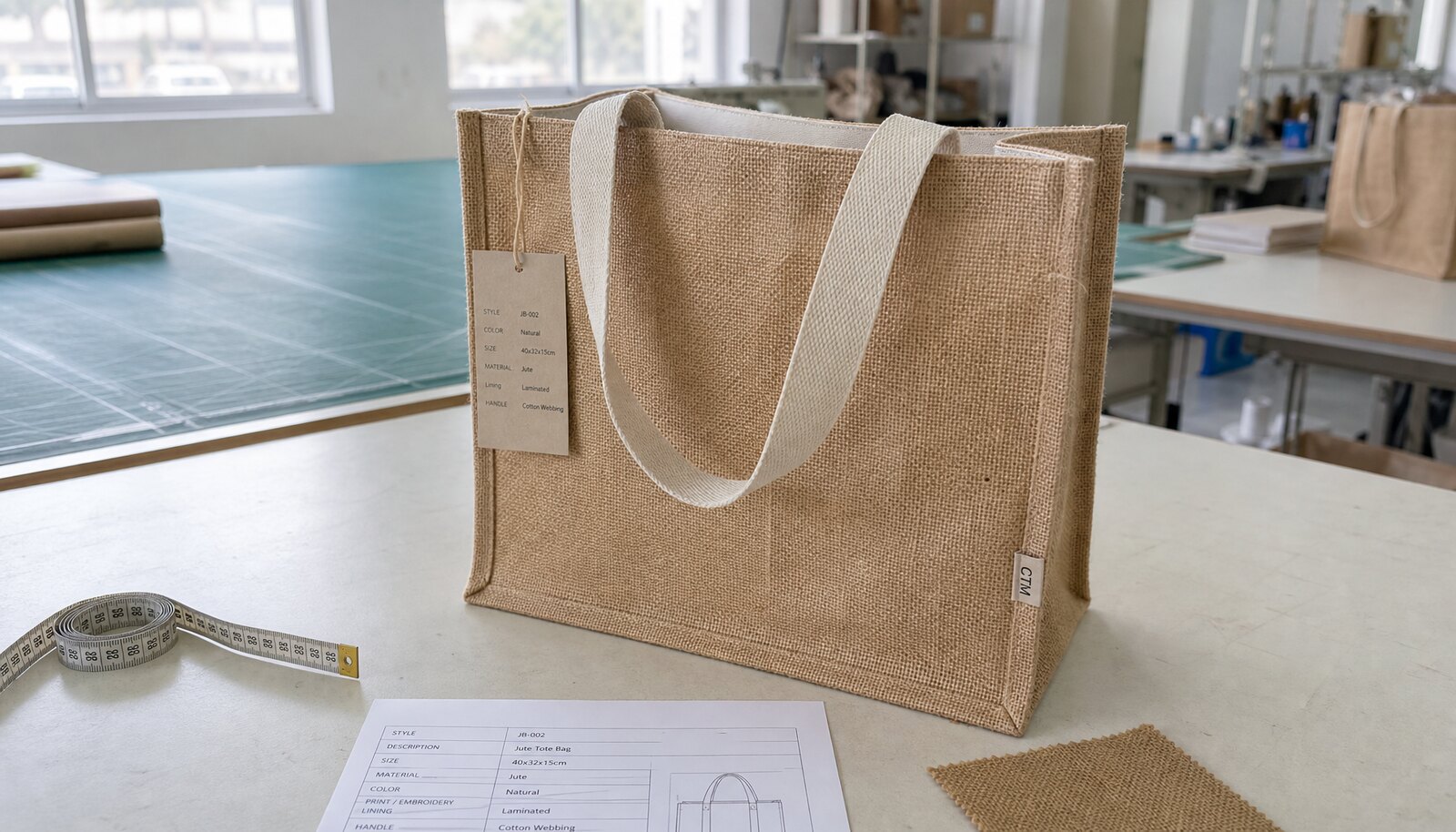
Why laminated jute tote bag quotes vary so much
Buyers often think they are comparing the same laminated jute tote bag, but suppliers may be quoting different fabric weights, different lamination films, different handle constructions, and different packing standards. That is why two quotes can look close on paper and still produce very different bags in hand.
The safest way to buy is to write the spec around the finished bag, not just the material name. A supplier can quote faster when you define size, GSM, lamination side, print method, handle type, closure style, insert requirements, and packing format in one RFQ.
- Ask for finished dimensions, not just nominal bag size.
- Separate body spec, handle spec, print spec, and packing spec.
- Require the supplier to state what is included and excluded in the quote.
Choose the right jute weight and lamination structure
For many wholesale tote programs, 320-400 GSM jute is a practical range. Lighter material can work for promo use, but it may show more weave variation and feel less stable when the bag is loaded. Heavier fabric improves structure, but it can raise unit cost and make folding less compact.
Lamination changes how the bag behaves in use. Inner lamination is common when you want moisture resistance, easier wipe-down cleaning, and a cleaner interior finish. Ask whether the film is PP or PE, whether it is full-surface or partial, and whether the edges are folded, bound, or stitched through the laminate. That matters for odor, stiffness, and seam durability.
- Use 320-350 GSM for lighter retail and event carry bags.
- Use 360-400 GSM when the bag needs more body and better shelf presentation.
- Confirm whether lamination is PP, PE, or another film and how it affects odor and stiffness.
- Ask whether the lamination is inside, outside, or double-sided.
- Request a sample bend test if the bag must fold repeatedly in retail use.
Print method matters more on jute than on smooth fabric
Jute has a coarse surface, so not every decoration method gives the same result. For simple logos with one or two solid colors, screen print is usually the most predictable option. For fine lines, gradients, or complex artwork, heat transfer or another decoration method may be better, but you should confirm how it holds on textured fibers.
A buyer should not approve artwork before checking print registration on an actual sample. Ask the factory to show the logo location, print size, color reference, and a close-up photo of the edges. A good print on jute should stay readable without flooding the weave or leaving broken letters in the low-density areas of the fabric.
- Screen print: best for bold logos, solid fills, and repeat orders.
- Heat transfer: useful for detail, but test durability, edge lift, and hand feel.
- Embroidery: premium look, but verify needle penetration, backing, and distortion on laminated material.
- Ask for a strike-off or pre-production sample before bulk print approval.
Use MOQ logic instead of guessing at the first quote
MOQ for laminated jute tote bags is usually driven by fabric booking, print setup, and whether the supplier needs separate tooling for size, handle type, or closure style. A one-color logo may support a lower MOQ than a multi-color print, but a zipper closure, base board, or special handle can push the minimum up quickly.
Do not ask for only one total MOQ number if your order might split by size or print version. Request MOQ by style, color count, and packaging format. That helps you see where the real cost jump happens and whether one design variation is better than two small ones. It also helps with quote comparison because a low unit price can hide a higher MOQ or higher setup cost.
- MOQ often changes with print colors, handle type, base insert, and closure style.
- One style with multiple artwork versions can cost more than one version with a larger run.
- Ask whether the supplier can combine sizes or colors in one production run.
- Request a price ladder at several quantity breakpoints if the order may grow.
What a useful sample approval should actually check
A sample is not just for approving the look. It is your best chance to catch production issues before they become a bulk claim. Measure the sample, check the handle drop, inspect seam symmetry, and test the bag with a realistic load. If the bag is laminated, check whether the finish cracks, whitens, or peels at the fold lines.
When a supplier sends a photo sample, ask for one front view, one side view, one interior view, and one close-up of the logo area. If the sample includes a side label, that should be placed exactly where the production version will be. Keep the sample as a signed reference so later disputes are easier to resolve.
- Compare sample size against your spec sheet with a ruler, not visually.
- Check the lamination edge, corner shape, and handle attachment points.
- Approve print color against the real bag surface, not only against a digital artwork file.
- Test the sample with the heaviest realistic load you expect in use.
- Record any acceptable variation in writing before mass production starts.
Packing, carton loading, and transit protection
Packing affects both cost and product condition. Laminated jute bags can hold shape better than plain jute, but they still need controlled packing to avoid creases, dust, and squashed handles. The quote should say whether each bag is folded flat, stuffed, polybagged, or packed with tissue.
For distributor and retail programs, carton count is not a small detail. A lower carton count can improve appearance and reduce deformation, while a higher carton count may cut freight cost. Ask the supplier to quote the packing method together with the estimated carton size, net weight, gross weight, and pallet pattern if applicable. If you are shipping long distances, ask how they protect against compression and moisture during transit.
- Confirm whether each bag is individually polybagged or bulk packed.
- Ask for carton dimensions and estimated gross weight per carton.
- If the bag has a board insert, verify how it is positioned for shipping.
- Ask whether cartons are edge-reinforced or strapped for export handling.
- Check whether palletization changes the carton count or outer dimensions.
What should be on the factory quote
A clean quote should let you compare suppliers line by line. If one factory gives a single lump price and another splits out body cost, print cost, handle upgrade, sample cost, and packing cost, the comparison is not fair. Ask each supplier to quote the same data set so you can identify hidden differences before order placement.
Your quote should also show lead time by stage. Sample lead time, material booking, production time, and final inspection should be clear enough that your procurement team can plan launch dates and delivery windows. If the supplier cannot separate these steps, expect more uncertainty later. Ask for the trade term, payment term, and any destination charges so the landed cost is clear before you approve the order.
- Finished size and tolerance
- Jute GSM and lamination type
- Print method, colors, and artwork format
- Handle material, length, reinforcement, and closure style
- Packing details, carton data, and pallet plan
- Sample cost, tooling cost, production lead time, and Incoterms
Supplier verification buyers should still request
A strong product quote is not enough if the supplier cannot support your market or shipping terms. Ask whether the factory has export experience for your destination, what documents they can provide, and whether they have handled the required packing marks, customs paperwork, or product testing reports before. If your buying policy requires it, request audit status, factory identification, and the name of the actual production site quoted on the order.
Also confirm compliance documents before payment. Depending on your market, you may need material declarations, social compliance documents, test reports, or country-specific labeling information. If the supplier cannot provide these up front, your price may not be comparable with a more prepared factory. Use this step to check whether the supplier understands your Incoterm, payment schedule, and document timing.
- Ask for export market experience relevant to your destination.
- Request available compliance documents before order placement.
- Confirm whether the quoted factory is the production site or a trading company.
- Check that payment terms and Incoterms match your internal procurement policy.
- Ask who is responsible for document issuance and revision fees.
Specification comparison for buyers
| Spec decision | Recommended option | When it fits | Buyer risk to check |
|---|---|---|---|
| Jute fabric weight | 320-400 GSM | Retail totes, trade show bags, and reusable shopping bags that need a natural look and moderate structure | Too light can feel flimsy and distort in transit; too heavy can stiffen the bag and raise cost |
| Lamination structure | Inner PP or PE lamination | When moisture resistance, wipe-clean use, or a smoother interior matters | Check odor, stiffness, folding cracks, and whether lamination weakens seam sewing or edge binding |
| Print method | Screen print for 1-2 solid colors; heat transfer for fine detail | Simple logos, clean brand marks, and repeat orders | Ink cracking, poor registration on coarse weave, and color shift on textured jute |
| Handle construction | Cotton webbing or reinforced jute handles with bar-tacks | For heavier loads and better retail presentation | Ask for handle width, drop length, stitch count, and pull-test expectation |
| Closure option | Open top, zipper top, or button/loop closure | Open top for retail carry; zipper or closure for gift sets and premium programs | Extra closures increase cost, lead time, and defect risk at the attachment points |
| Insert and base | Optional cardboard base or removable insert | When bags must stand upright or hold boxed goods | Without an insert, check sagging, corner collapse, and visible base distortion after loading |
Buyer checklist before sampling
- Confirm finished bag size in internal and external dimensions, not just a nominal size.
- Specify jute GSM, weave density, and whether lamination is on the inside, outside, or both sides.
- State print method, artwork file format, Pantone targets, print area, and the number of logo colors.
- Define handle material, handle length, handle drop, stitch pattern, and reinforcement points.
- Request sample photos of seams, corners, lamination edges, and logo placement before mass production.
- Set carton quantity, inner pack count, polybag use, desiccant requirement, and master carton labeling.
- Ask for lead time split between sample making, material booking, production, inspection, and dispatch.
- Request the supplier's quote to separate unit price, tooling or plate cost, sample cost, packing cost, and freight terms.
- Ask which compliance documents are available, such as material declarations, test reports, or export paperwork, if your market requires them.
- Confirm payment terms and Incoterms early so the quotation is comparable across suppliers.
Factory quote questions to send
- What GSM jute fabric and what lamination type are you quoting for the bag body?
- Is the quoted print price based on screen print, heat transfer, embroidery, or another method, and how many colors are included?
- What is the MOQ by size, print color count, handle type, and closure type?
- Does the quote include sample making, plate or screen charges, carton packing, and inner packing, or are these separate?
- What finished size, seam allowance, handle drop length, and base width are you using for the quote?
- What is your standard carton pack count, carton size, net weight, and gross weight estimate?
- What tolerance do you use for finished size, print position, and handle placement?
- What QC checks do you perform before shipment, and can you share an inspection photo set or report sample?
- What compliance documents can you provide for the destination market, and what are the document lead times?
- Which Incoterms and payment terms are you quoting, and what charges are excluded from the unit price?
Quality-control points to confirm
- Measure finished size, handle drop, base width, and seam allowance against the approved spec sheet.
- Check jute GSM, weave consistency, and whether the lamination is smooth, evenly bonded, and free of peeling at folds.
- Inspect print sharpness, color match, registration, edge bleed, and rub resistance after a light dry rub and damp rub test.
- Pull test the handles and inspect bar-tacks, stitch density, loose threads, and reinforcement at stress points.
- Check corner structure, base board fit if used, zipper alignment if applicable, and whether the bag stands properly when loaded.
- Verify odor, stain, lint, and dust levels before packing, especially on laminated interiors.
- Confirm carton count, inner packing, barcode or label placement, and carton compression resistance so cartons do not crush during export handling.
- Check that folded bags recover shape without permanent creases, seam opening, or laminate whitening.
- Set an acceptable defect limit in advance for size variation, print misalignment, and visible stains or scuffs.
- Review master carton marks, lot traceability, and pallet pattern if the shipment is palletized.