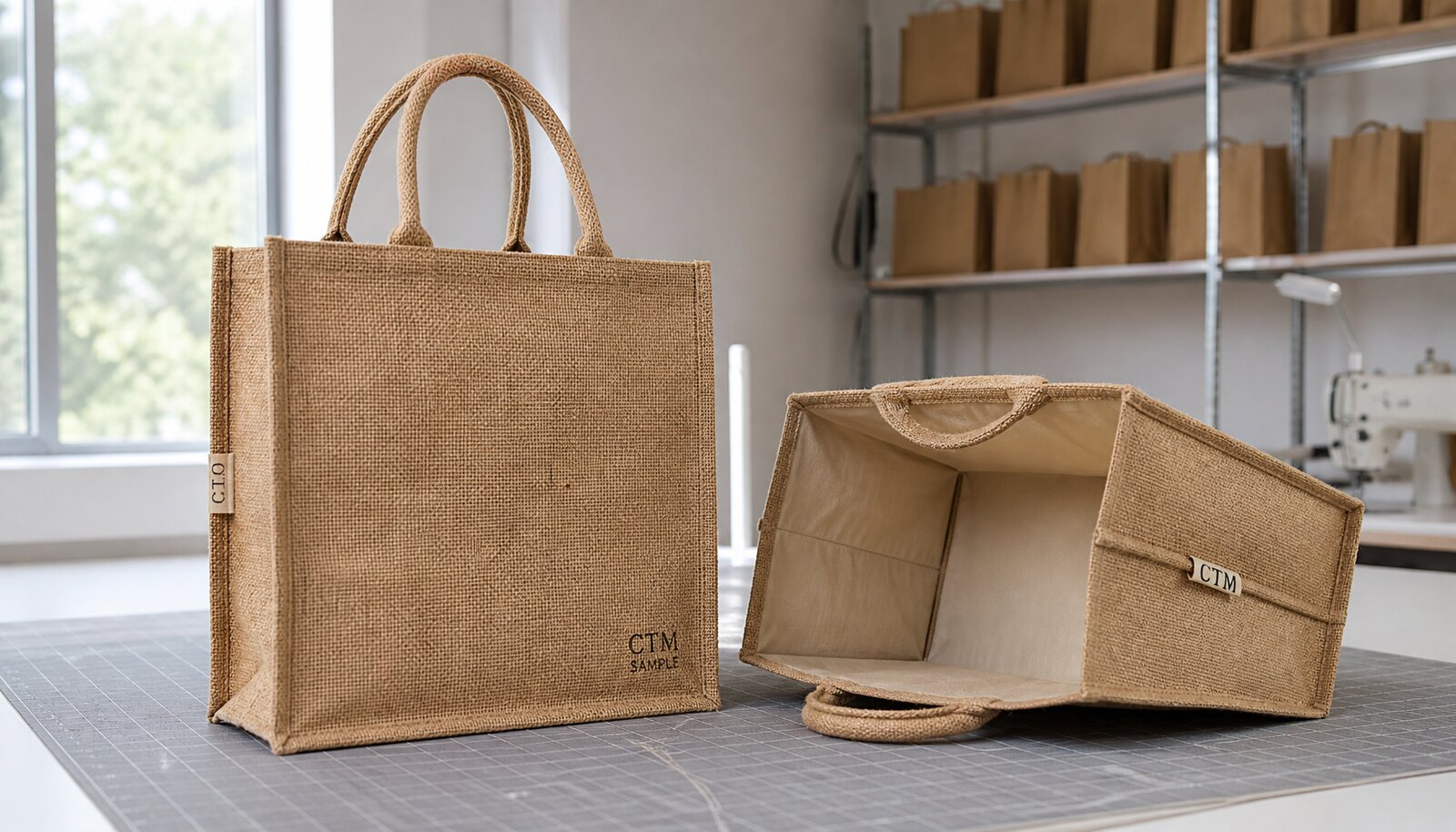
Why laminated jute bags are a different buying problem
Laminated jute bags are not just regular jute bags with a surface finish. The laminate changes how the cloth cuts, folds, prints, and holds shape, which means a supplier can quote a low bag price and still miss the real job. Once you add the inner film, the bag becomes stiffer, more moisture resistant, and often better for premium retail, wine, grocery, or gift programs. That is useful, but it also changes the failure points. Cracking at folds, weak handle roots, and poor print adhesion are all common when the bag was priced only as sewing labor plus fabric.
For procurement teams, the right question is not whether the bag looks good in a sample photo. The question is whether the factory can repeat the same structure at volume and ship it without crush damage, smell, or print rub. Laminated jute is usually a better fit than plain burlap when the buyer wants a more polished presentation and easier wipe-clean use. It is a poor fit when the program needs high flexibility, very soft drape, or very sharp photographic printing. Before you compare quotes, define the use case in plain terms and let the supplier price the construction, not just the name of the product.
- Best fit: premium retail packaging, bottle carry, gift programs, and reusable shopping bags with a structured look
- Weak fit: soft promotional bags, photo-heavy graphics, or programs that need frequent folding into a small storage space
- Buying risk: a visually similar sample can hide very different film thickness, fabric GSM, and reinforcement quality
Choose the right laminate and base jute weight
Most laminated jute bags start with a woven jute base and an inner PE lamination. That is the standard because it gives the bag more body, helps the interior resist moisture, and makes the inside easier to clean than raw jute. The tradeoff is stiffness. Too thin a cloth and the weave telegraphs through, the body collapses at the corners, and the bag can look tired before it ever reaches the shelf. Too heavy a cloth and the bag becomes expensive, harder to sew, and bulkier in carton packing. For many retail programs, a raw cloth weight around 260 to 320 gsm is a practical starting point, then adjusted by size and load expectation.
Buyers should separate raw cloth weight from finished bag weight. A supplier may quote a finished bag weight after lamination, which can make the cloth look heavier than it really is. Ask for the pre-laminate GSM, the laminate type, and whether the film covers the full inner panel or only the functional area. If the bag carries bottles or dense products, a heavier cloth and stronger handles are worth the extra cost. If it is a display or gift bag with lighter fill, you can often save money by using a moderate cloth weight and a cleaner internal finish rather than overbuilding the fabric.
- For lighter retail use, start around the mid-200 gsm range and validate carry strength with a filled sample
- For bottle or hard-good carry, step up fabric weight and reinforce the handle roots before you lock the quote
- Do not approve from a raw fabric swatch alone; test the folded, sewn, laminated bag as a finished unit
Construction details that move the quote
Two laminated jute bags can look the same on a product page and still land at very different costs. Size, gusset depth, top edge finish, handle length, reinforcement patches, and stitch density all affect labor and material use. A slightly larger gusset can change carton packing and freight efficiency. A cleaner top hem can improve shelf appeal but adds sewing time. Handles are especially important because buyers often focus on the logo and overlook the root construction. If the handles are too short, the bag carries awkwardly. If they are too narrow or poorly anchored, the bag fails under load even when the rest of the bag looks fine.
When you request pricing, give the factory a dimensioned drawing, not a phrase like medium tote or wine bag. Specify the finished width, height, gusset, handle drop, seam allowance, and where reinforcement is required. If the bag needs a base board, corner box, zipper, Velcro, or internal lining, state it up front. These details do not just affect price; they affect production order and lead time. Factories can cut and sew a simple laminated jute bag quickly, but every added structural piece creates another decision point on the line. The quote should reflect that reality instead of hiding it.
- Give finished size, gusset depth, handle drop, and seam allowance in the RFQ
- State whether a base board, zipper, or internal pocket is required before the first sample
- Ask the factory to confirm the exact reinforcement method at the handle root and top edge
Print and branding that survive the laminate
Printing on laminated jute is more forgiving than printing on raw burlap, but it still has limits. Screen print is usually the most practical option for a bold logo, a short brand line, or a simple one-color retail mark. It is easier to control on textured material and usually keeps the unit cost reasonable. Larger solid areas, tiny text, or multi-color art can start to show registration issues, uneven edges, or rub marks, especially if the supplier is not controlling ink cure and drying time carefully. If the brand wants a premium look, a sewn label or woven side label can give cleaner branding than trying to force too much detail into the print.
The best print decision depends on how the bag will be handled after delivery. If the bag will sit in a store, be folded into cartons, and be opened by customers many times, a durable, restrained print is usually safer than a complicated artwork treatment. If the buyer wants both sides printed, confirm whether the factory prints before or after final sewing and how they protect the opposite panel from ghosting or transfer. For expensive retail programs, request a print strike-off on the same laminated cloth, not on paper, and rub it under light pressure before approval. The print should look acceptable after handling, not just straight off the press.
- Use bold shapes and readable fonts rather than thin lines or tiny reversed text
- Approve the exact ink color on the actual laminated cloth, not only on a digital proof
- If brand detail matters more than large artwork, consider a sewn label or woven side label
MOQ and quote logic: what really changes the number
MOQ on laminated jute bags is usually driven by setup, not just sewing hours. The factory needs to cut cloth, manage lamination batches, prepare print screens, and pack the order in a way that protects the bags in transit. Once you add multiple sizes, multiple print colors, or several handle options, the minimums rise because the factory is splitting its line time and material planning. Traders sometimes quote a lower MOQ because they are combining orders across customers, but that can create less control over shade, print registration, and stock timing. For a repeat program, a direct factory quote with clear line items is easier to compare than a bundled number with missing detail.
The lowest quote is often missing something that will show up later as a surprise. The usual gaps are sample charges, print screen charges, handle upgrade costs, thicker carton cost, and packing changes for export. When the quote includes only the bag body, the landed unit cost is not real. Compare quotes only after you have the same dimensions, the same laminate thickness, the same handle construction, the same pack count, and the same sample scope. If one supplier prices a simpler bag and another prices a reinforced bag, the difference is not a real market gap. It is an apples-to-oranges quote.
- MOQ rises with additional sizes, print colors, and custom handle or closure choices
- Line items to compare: fabric weight, lamination, print setup, handles, packing, and sampling
- A lower unit price is not useful if the supplier has omitted reinforcements or export packing
Supplier evidence worth asking for
A reliable laminated jute supplier should be able to show more than a stock product photo. Ask for photos of a similar bag from the same production line, a close-up of the seam construction, and a sample of the actual lamination or cloth roll used for your order. If the supplier claims in-house control, that should be visible in the sample process. You want to see cutting, stitching, print setup, and packing evidence, not just a sales sheet. A factory that truly handles the process can usually speak clearly about where the laminate is applied, how the bag is folded, and how the print is protected during transit.
For imported programs, supplier evidence should also support the commercial side of the quote. That means a clear pro forma invoice, confirmed carton count, lead time after sample approval, and a realistic answer on whether the quoted MOQ applies per size or per combined order. If the supplier cannot explain what happens when you change handle material or increase the gusset, the quote is too loose. You do not need a long company presentation. You need evidence that the factory has controlled this bag construction before and can repeat it without treating your order like a first experiment.
- Request photos of a real similar run, including close-ups of seams and handle reinforcement
- Ask for the exact cloth swatch or laminate reference used on the sample
- Confirm whether print, cutting, sewing, and packing are in-house or subcontracted
Sample approval and QC thresholds
For laminated jute bags, sample control should happen in stages. Start with a prototype or pre-production sample to confirm the structure, then lock a gold sample after any changes are made. The gold sample should be signed off by the buyer and stored by the factory as the production reference. If the product has a visible logo, the sample must show the final print placement, not a generic position. If the bag has a structural requirement, such as a reinforced handle or a specific gusset depth, measure it and record it. The goal is not to create a bureaucracy. The goal is to prevent the classic problem where the factory says the bulk run is within tolerance but the bag does not match what the buyer expected.
A usable QC standard for this category should cover dimensions, print, stitching, laminate condition, smell, and packing. Do not accept vague statements like good quality or export standard without a defined defect list. For visible retail bags, buyers usually want tighter control on logo placement and outer appearance than they would for a plain utility bag. If a bag is intended for store shelves, the acceptable range for wrinkles, stains, and print rub should be much stricter than for a generic promotional carrier. The factory should know the defect threshold before production starts, not after the buyer opens the first carton.
- Lock a signed gold sample before bulk production starts
- Measure finished size, handle drop, and print placement on the sample
- Set defect rules for stains, odor, print rub, seam skip, and laminate cracking
Packing that prevents creases, moisture, and carton claims
Packing matters more with laminated jute than many buyers expect because the material holds folds and can show crush marks if it is packed badly. Flat packing usually makes sense, but the fold direction should be controlled so the front panel does not pick up a permanent crease across the logo. If the bags are going by sea, keep moisture in mind. A simple polybag, a moisture barrier where appropriate, and a sensible carton fill level will reduce the chance of odor, staining, or mold claims on arrival. The packing plan should be part of the quote, not an afterthought.
Carton count affects both freight and warehouse efficiency. Too many bags in one carton increases crush risk and makes carton handling harder. Too few bags raises carton cost and freight volume. The supplier should recommend a carton size that protects the bag structure without over-compressing the stack. If the product is a premium retail item, ask for carton marks, size labels, and country of origin placement to be included in the packing spec. That avoids relabeling work at destination and helps the warehouse receive the order without sorting errors.
- Use a flat pack only if the fold line will not damage the logo area
- Keep carton fill moderate so the bag body does not get crushed in transit
- Confirm polybag, desiccant, carton marks, and label placement before bulk packing starts
Lead time and landed-cost comparison
Lead time on laminated jute bags is not just sewing time. It starts with material availability, then lamination, then cutting, printing, stitching, packing, and inspection. A small print change can add time if the factory has to remake screens or wait for approval. Seasonal congestion can also slow things down, especially when the same factory is running holiday gifts, grocery bags, and retail packaging at once. For a first order, add a buffer for sample revisions and carton approvals. A rushed schedule usually leads to shortcuts in drying, packing, or inspection, and those shortcuts are exactly where laminated jute bags show problems later.
When you compare landed cost, compare route, not only bag price. A direct factory quote may look slower to respond, but it often gives clearer control over process and fewer surprises after order placement. A trader may be useful when the buyer needs a mixed basket of products or a smaller trial order, but the margin can be hidden in the middle. Local finishing can help with short lead times, but the base bag quality may already be locked before you get involved. Build the landed cost from the actual bag, the packing, the inland movement, the shipping mode, and the expected inspection effort. That is the number that matters to procurement.
- Buffer time for sample approval, print screen setup, and pre-shipment inspection
- Compare direct factory, trader, and local finishing on the same spec sheet
- Include packing, freight, and any relabeling work in the landed cost view
RFQ questions that remove ambiguity
A strong RFQ for laminated jute bags should force the factory to answer in measurable terms. Start with the bag size, use case, laminate type, raw cloth weight, handle spec, print artwork, and pack count. Then ask for the MOQ, lead time after sample approval, and what changes if you add a second colorway or a different handle. If you want a clean quote, do not let the supplier answer with a broad range and a sales pitch. Ask for the assumption behind each number. A good factory can usually tell you what drives the cost and what part of the design is the biggest risk to the schedule.
The RFQ should also reveal whether the supplier understands buyer control points. A factory that can explain sample stages, defect limits, and export packing is usually safer than one that only talks about unit price. Use the first quote round to eliminate ambiguity, not to negotiate blindly. If one supplier is vague on laminate thickness, seam reinforcement, or carton packing, that quote should stay low on your shortlist. Clarity at this stage saves time later because laminated jute bags are easy to make look acceptable in a photo and much harder to recover once the bulk run has started.
- Ask the factory to state every assumption behind the unit price
- Require the supplier to confirm the exact spec that is included and excluded
- Use the RFQ to test whether the supplier can explain sample approval, packing, and lead time clearly
Specification comparison for buyers
| Spec decision | Recommended option | When it fits | Buyer risk to check |
|---|---|---|---|
| Inner laminate type | Matte PE lamination on the inside with a folded sample test | Retail, gift, and grocery programs that need wipe-clean handling | Thin film can crack at the fold line or gusset, so do not approve from a flat swatch alone |
| Base jute fabric weight | Around 260 to 320 gsm for most retail bags, heavier for bottle carriers | When the bag must hold shape and survive repeated carry | Finished weight can hide weak raw cloth, so confirm the pre-laminate GSM and weave count |
| Handle build | Cotton webbing or reinforced jute handles with box-X stitching | When the buyer expects real carry strength and a cleaner hand feel | Loose handle stitching causes returns, and jute rope can feel rough on the hand under load |
| Reinforcement at stress points | Extra bar tack or patch reinforcement at handle roots and top edge | Medium to heavy load programs, especially bottle or gift packs | A pretty sample can still fail at the handle root if reinforcement is not specified and measured |
| Print method | Simple one or two color screen print on the laminated face | When the logo is bold, the artwork is low detail, and unit cost matters | Fine text, gradients, or large solid areas can rub or misregister on textured jute |
| Supplier route | Direct factory with in-house cutting, lamination, sewing, and printing | Recurring programs that need tighter control over lead time and quality | Traders can hide subcontracting, which makes issue resolution slower and sample control weaker |
| Packing format | Flat packed, counted, and cartonized with moisture protection | Ocean freight, warehouse receiving, and seasonal stock builds | Overstuffed cartons crease bags, and weak carton specs create crush damage in transit |
| Sample approval route | Pre-production sample plus sealed gold sample | Any new size, new print, or new factory | Approving a loose preproduction sample without a locked reference usually leads to batch variation |
Buyer checklist before sampling
- Finished size with tolerance, including gusset depth and handle drop
- Jute cloth GSM before lamination and finished bag weight
- Laminate type, thickness, and whether it is full inner coverage or partial
- Handle material, width, length, and stitch pattern
- Print artwork, color count, and whether the logo sits on the laminated side
- Carton pack count, carton size, and any polybag or desiccant requirement
- Sample stages, approval method, and who signs off the gold sample
- Defect limits for seams, print rub, stains, odor, and dimension variation
- Incoterm, lead time after sample approval, and shipping mode
- Country of origin marking, carton marking, and any retailer label requirement
Factory quote questions to send
- What is the raw jute GSM before lamination and the finished bag weight after lamination and sewing?
- Is the laminate matte or gloss, what is the thickness, and is it applied across the full inner surface?
- Where is the bag printed, how many colors are included, and how many screens or setup charges apply?
- What is the MOQ by size, print color, and handle style, and does MOQ change if the order has multiple colorways?
- Can you provide a pre-production sample, a size-checked gold sample, and photos of the first production batch?
- What are your standard seam allowance, handle reinforcement method, and load guidance for this bag?
- How are the bags packed per carton, and what carton dimensions do you recommend for export?
- What is the standard production lead time after sample approval, excluding ocean freight or air freight?
- What inspection standard do you use, and what defect levels trigger rework or rejection?
- Can you share photos or videos of a similar laminated jute bag run from cutting through packing?
Quality-control points to confirm
- Check finished dimensions against the approved sample, including gusset depth and handle drop
- Inspect the laminate for cracking, wrinkles, peel issues, and exposed adhesive at folds
- Rub-test the print on the laminated face to confirm no visible smudge or color transfer
- Pull-test handle seams and reinforcement points on a meaningful sample of bags
- Inspect top edge binding, stitch density, and symmetry from left to right
- Verify that no bag has strong odor, oil spots, loose glue, or visible dirt from production
- Count carton contents, confirm carton markings, and check moisture protection before shipment
- Confirm that the gold sample matches the bulk run on fabric shade, print placement, and hand feel