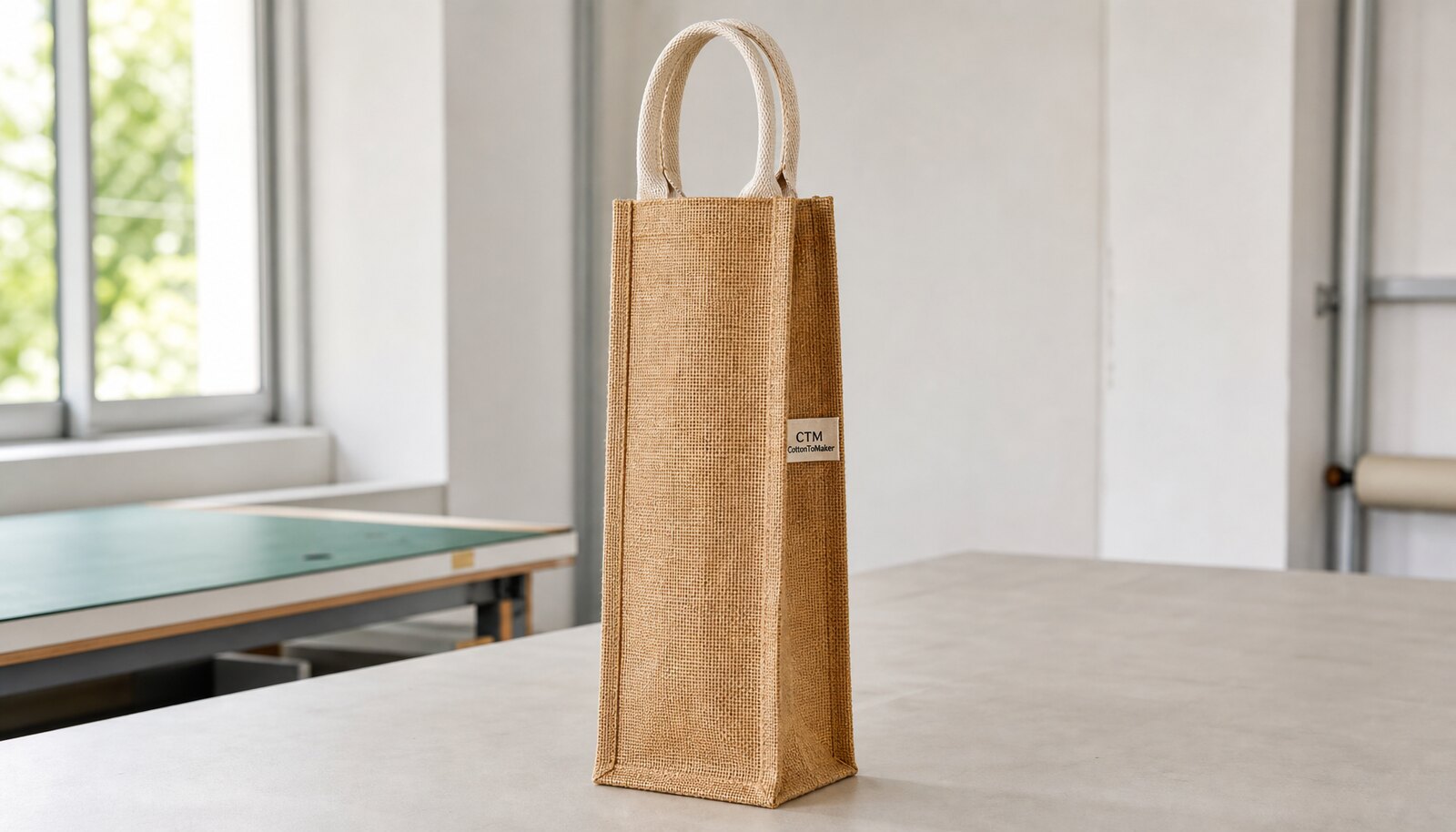
Why tasting-room buyers need a real compliance checklist, not a generic tote spec
Jute wine bottle bags for vineyard tasting rooms sit in a commercial gray area that makes sourcing harder than it looks. They are part retail display, part gift packaging, part transport protection, and part brand extension. A tasting room customer sees the bag at close range, carries it across a counter or parking lot, and often keeps it as a reusable item. Procurement has to balance all of those uses at once.
That is why a loose spec sheet usually fails. If the buyer only says “natural jute bottle bag with logo,” the supplier has to guess at bottle size, fabric weight, handle strength, print method, and packing format. The quote may look attractive, but the factory is filling in blanks that should have been controlled by the buyer. Later, the problems show up as poor fit, wrinkled presentation, weak handles, or cartons that arrive already damaged.
A compliance checklist gives the procurement team a better way to buy. It turns the discussion from opinion to evidence. The supplier can still propose alternatives, but the buyer has a clear list of points that must be shown, measured, or documented before approval. For vineyard and winery tasting-room programs, this reduces the risk of overpaying for vague quality claims or accepting a bag that does not match the brand environment.
- Use the checklist to control the quote, sample, production, and receiving stages.
- Tie every order to one approved spec version.
- Separate visual brand requirements from functional packaging requirements so they are not confused in the RFQ.
Start with the bottle, because fit drives nearly every other decision
The first question is not how the logo should look. It is what bottle the bag must carry. A 750 ml Bordeaux bottle, a rounder Burgundy shape, and a taller sparkling or Riesling bottle all create different fit challenges. The shoulder position changes how the bag hangs; the base diameter determines whether the side seam carries weight; and the cap height decides how much opening or headroom is needed above the bottle.
Procurement teams should measure a real bottle sample. Record the widest diameter, base diameter, shoulder width, body height, and total height including the closure or neck foil. If the tasting room sells more than one wine format, do not guess that a single bag will work for all of them. A bag designed for a wide Burgundy bottle may look loose on a slimmer bottle, while a tighter sleeve for a standard Bordeaux bottle may scrape seams or strain the bottom panel on a larger format.
If the bag needs to support add-ons such as a neck tag, tasting card, or gift tissue, include those dimensions in the spec. This is especially important for winery retail programs that want the bottle bag to act as a premium presentation item. The supplier should quote against finished internal dimensions, not just a generic bottle capacity, so the buyer can compare offers on the same basis.
- Measure one actual bottle from the line, not a catalog image.
- Include cap height and any neck accessory in the fit allowance.
- Decide early whether the bag must support upright shelf display or only carry-out use.
Fabric weight, weave density, and surface finish are the biggest cost drivers
Jute is a natural fiber, so the buying conversation needs more detail than “natural jute.” Fabric weight, weave density, yarn thickness, and finishing control all affect appearance, strength, and price. For tasting room bottle bags, many programs start in the 250-320 GSM range for standard use and move to 320-380 GSM when the buyer wants stronger shape retention, a more premium feel, or a bag that can handle repeat use without looking soft or collapsed.
The weave matters just as much as the GSM number. A cleaner, more consistent weave usually prints better and looks more retail-ready. If the weave is too open or irregular, logos can disappear into the texture, and the bottle silhouette may show through in a way that looks unfinished. Buyers should ask the supplier to state both GSM and weave construction, then provide photos of the actual fabric roll or cut panel. That gives the procurement team something concrete to compare across quotes.
If the order is for a premium tasting room or winery gift counter, ask whether the supplier can control slub variation, surface shedding, and odor from storage. Natural jute will never look like coated synthetic fabric, and buyers should not expect that. But the bag should still look clean, dry, and consistent enough to sit beside premium wine bottles without seeming like a promo giveaway.
- Require GSM plus weave description in the RFQ.
- Ask for fabric roll photos or a cut panel sample before sample approval.
- Treat severe odor, dampness, or visible contamination as a rejection risk, not a styling issue.
Choose the supplier route that matches your buying risk and internal workload
The supplier type changes the commercial risk. A direct factory usually gives the clearest view of construction, sewing methods, and packing discipline. That route is often best when you need stable reorders, custom dimensions, or a repeatable quality standard across multiple tasting rooms. The factory may still need support on artwork, labeling, or export documentation, but the production line is easier to audit.
A trading company can be useful when the buyer needs combined sourcing, smaller mixed-category orders, or one contact point for several SKUs. The tradeoff is visibility. The trader may quote confidently, but procurement still needs to know the real factory name, who owns QC decisions, and whether sample approval actually reaches the bulk line. Without that clarity, the buyer is comparing marketing language, not manufacturing capability.
Specialized bag workshops often do best on construction details. They are more likely to understand handle reinforcement, seam finishing, and bottle-fit behavior. They can be the right choice when the bag needs to feel more like a retail product than a simple carrier. The buyer’s job is to match the route to the risk. If the order is simple and promotional, a broad supplier may be sufficient. If the bag is a recurring retail item for tasting rooms, visibility into the actual factory matters more than a small price difference.
- Ask every non-factory supplier to name the actual production site.
- Verify who can reject a lot when the bulk output differs from the approved sample.
- Prefer routes that can show both sample and bulk evidence, not only sales presentations.
Comparison table: how supplier route changes price, lead time, and compliance ownership
A comparison table is most useful when it helps the buyer decide where the risk sits. For jute bottle bags, the route affects not only unit price but also who owns compliance paperwork, how quickly revisions move, and whether the supplier can actually enforce the approved construction. The best option is not always the cheapest on paper; it is the one that keeps the order predictable once production starts.
Use the table as a commercial filter before the RFQ is issued. If one supplier only works on a higher MOQ but includes documentation and stronger packing control, that may be better value than a lower-price route that leaves the buyer to solve problems after shipment.
- Compare landed cost, not only ex-works price.
- Ask which party owns each compliance document and each QC checkpoint.
- Record whether lead time includes sample approval, material sourcing, and packing.
Print method and branding limits: where suppliers often hide extra cost
Most vineyard tasting rooms are best served by a simple, readable logo treatment. One-color screen printing is often the cleanest approach because it balances cost, durability, and appearance on textured jute. It also keeps the bag visually calm enough to work as a premium wine accessory rather than an overworked promotional item. For many buyers, that is the right commercial compromise.
Problems begin when artwork is designed for a smooth digital screen but sent to a rough natural fiber surface without adjustment. Thin lines, tiny text, gradients, and tightly spaced serif fonts can all lose clarity on jute. The supplier may respond by recommending a different print method, but procurement should treat that as a design and cost decision, not a default upgrade. Some artwork should simply be simplified.
Ask the supplier to review artwork before sample approval and confirm the maximum print area, print position in millimeters, and any registration limits. Also ask about rub resistance and cure method if the bag will be handled frequently. The buyer does not need a chemistry lecture, but it does need enough information to judge whether the print will stay readable after normal retail handling. If the supplier cannot explain how the artwork will hold up on rough fiber, that is a warning sign.
- Limit small text and hairline strokes on rough jute.
- Get print setup fees separated from unit price so reorders are easier to compare.
- Lock print position from the top edge and side seam in millimeters, not by eye.
MOQ and SKU planning: keep the first order simple enough to control
MOQ is not just a number; it is a reflection of how the order is built. A factory may quote a low MOQ for the bag body but apply separate minimums for print colors, handle types, carton marks, or packing format. Once the buyer adds multiple bottle sizes, seasonal artwork, and special retail packing, the order becomes a set of separate production decisions, each with its own setup burden. That is why the quoted MOQ can move quickly if the spec is not disciplined.
For a first tasting-room program, the simplest launch is usually one bottle size, one fabric weight, one print method, and one pack style. That keeps the sample, inspection, and reorder path clear. If the bag performs well at the counter, the buyer can add variations later: a second bottle format, a holiday message, or a different handle color. This staged approach is usually easier to defend internally than launching a broad SKU family before demand is proven.
Procurement teams should also ask whether the MOQ changes between pilot run and repeat order. Some suppliers can support a lower first-order minimum because they expect a follow-up order once the design is fixed. Others quote a minimum that remains unchanged regardless of repeat business. Knowing that difference helps the buyer avoid inventory overhang and makes budget forecasts more realistic.
- Ask for MOQ by size, print color, and packing style.
- Keep the first run to one approved spec if possible.
- Separate pilot pricing from repeat pricing in the quote comparison.
Sample approval should test fit, handling, and shelf appearance together
A proper sample is more than a logo reference. For jute wine bottle bags, the pre-production sample should use final fabric, final handle material, final sewing method, final print position, and the intended carton style. A loose sample or fabric swatch may help with color and texture, but it does not prove the bag will carry a bottle cleanly, recover shape after packing, or hold up at the handle anchor.
The best sample review is practical. Put the real bottle into the bag. Lift it several times. Place it upright on the counter and inspect how it stands. Look at the seam line, the handle symmetry, and whether the print remains readable from the distance a tasting-room shopper would normally see it. If the bag is meant to feel premium, the sample has to look premium under real use, not only in a close-up photo.
If revisions are needed, ask for specific corrections. “Improve quality” is not a useful instruction. “Increase finished width by 10 mm,” “move the print down 8 mm,” or “use a stronger back-tack at the handle root” are useful instructions. Procurement works best when the sample approval note tells the factory exactly what is approved and exactly what must change before the next round.
- Approve against the actual bottle, not only a dummy insert.
- Test the sample after light creasing and repacking to simulate warehouse handling.
- Keep one signed master sample tied to the approved spec version.
Supplier compliance documents: what to ask for and when to ask for it
The compliance conversation should be specific to the market and the retail channel. For jute bag programs, the buyer usually needs documentation on material content, origin, and any restricted-substance obligations that apply to the destination market or retailer. Broad promises are not enough. Procurement should ask for actual document names, document dates, and the version that will travel with the order or be kept on file.
Useful documents often include a material composition or fiber-content statement, a country-of-origin declaration, a restricted-substance statement where relevant, a packing list format, and carton-mark confirmation. If the item will be sold through a retailer with onboarding requirements, that retailer may also require supplier registration details, social compliance information, or packaging declarations. The buyer should collect those requirements before the PO is issued, not after production has started.
The point is not to demand paperwork for its own sake. The point is to avoid a situation where the factory can make the bag but cannot support the downstream receiving process. Tasting room programs often feel small, but they still move through warehouses, retail systems, and regional distribution teams. A supplier that can provide clean records early is usually easier to manage at scale.
- Ask for the exact document type, not a vague “certificate.”
- Check that document names match the supplier legal entity and the factory actually quoted.
- Align compliance needs with the destination market and any retailer onboarding rules.
QC thresholds that help the buyer separate normal natural variation from real defects
Natural jute always has variation. The procurement problem is not variation itself; it is uncontrolled variation. Buyers need a defect matrix that tells the factory what counts as acceptable, what needs rework, and what should be rejected. Without that matrix, one inspector may pass a batch that another buyer would reject, and the shipment can become a dispute after arrival.
A practical QC plan for bottle bags should focus on defects that affect function and shelf image. Critical defects include wrong bottle fit, broken handles, mold or damp odor, missing print when print is required, and carton collapse. Major defects include stitch skips, handle misalignment, print shift outside tolerance, and seam fraying beyond the approved range. Minor defects include small natural-fiber slubs and slight surface variation that do not change use or readability.
The inspection should also be stage-based. Incoming fabric should be checked for shade consistency and moisture. In-process sewing should be checked for stitch density and handle placement. Print should be checked for registration and rub. Packing should be checked for count, handle protection, and carton integrity. This is more useful than a single final inspection because it catches the problem before the whole batch is built incorrectly.
- Define critical, major, and minor defects before production begins.
- Set dimension tolerances for width, height, gusset, and handle length.
- Inspect cartons and packing recovery, not just loose bags.
Specification comparison for buyers
| Supplier option | What to verify | Commercial advantage | Buyer risk to control |
|---|---|---|---|
| Direct sewing factory | jute roll photos, lamination sample, odor-control process, handle pull evidence, and pre-shipment carton condition photos | Better sample-to-bulk control and faster production feedback | May be weaker on export paperwork or branded packing unless checked early |
| Trading company | Factory name, production photos, trim-source proof, and who owns QC decisions | Can coordinate small mixed orders and extra services | Markup can hide real factory capability and slow defect decisions |
| Specialized bag workshop | handle stitching, side gusset, lamination edge control, inner seam cover, and fiber shedding tolerance | More practical for detailed construction, trims, and repeat programs | Capacity may be limited during peak seasons |
| Low-price general supplier | laminated or unlaminated jute, cotton-jute blend, inner coating, odor control, yarn thickness, and color shade variation | Useful for simple promotional runs with loose specs | Material downgrades, weak packing, and vague inspection scope can erase savings |
| Retail-ready supplier | airing time, moisture absorber, carton liner, bundle wrap, odor separation, and warehouse ventilation before loading | Can handle labels, SKU separation, carton marks, and receiving rules | Higher unit cost must be compared against reduced warehouse work |
| Compliance-focused supplier | Fabric records, labeling review, test plan, and production traceability | Safer for retail programs and repeat brand orders | Documentation claims need evidence, not only sales language |
| Local sample room plus bulk factory | Signed sample, bulk factory handoff, first-piece photos, and deviation owner | Good for complex branding before large production | Sample room quality may not match bulk line unless handoff is controlled |
Buyer checklist before sampling
- Measure a real bottle sample, including widest diameter, shoulder shape, cap height, and whether any neck tag or seal must fit inside the bag.
- Specify the finished internal dimensions and the acceptable dimension tolerance; do not rely on a vague "fits 750 ml bottle" description.
- State fabric GSM, weave appearance, and whether a jute-only body or jute blend is acceptable; ask the supplier to name the actual construction.
- Define handle material, handle width, handle length, and reinforcement method at the stitch points; ask for the stitch pattern used at the root.
- Confirm whether the bag must stand upright on shelf, be reused for carry-out, or serve mainly as a premium gift presentation item.
- Request a pre-production sample using final fabric, final handle, final print method, and final carton format before bulk approval.
- Ask the supplier to quote MOQ separately for size, print color, and packing format; one global MOQ is not enough for procurement comparison.
- Collect compliance documents before PO release: material composition or fiber content statement, restricted-substance statement if applicable to your market, country-of-origin details, and carton mark confirmation.
- Require a carton specification that lists master carton dimensions, gross weight, inner pack quantity, and whether individual poly bags or dust protection are included.
- Set an inspection plan with pass/fail thresholds for dimensions, stitch quality, print registration, handle security, odor, shade variation, and carton damage.
Factory quote questions to send
- What is the exact fabric GSM, weave density, and any blend ratio for the quoted jute body?
- Is the handle cotton webbing, jute webbing, or another material, and how is the handle root reinforced?
- What is the MOQ by size, print color count, and packing format, not only the total order quantity?
- What setup charges apply for screen printing, artwork separation, plates, or new packaging artwork?
- Can you quote both flat-packed and retail-ready packed options with carton dimensions and gross weight?
- What is your pre-production sample lead time, and what is the revision lead time if artwork or sizing changes?
- Which compliance documents can you provide with the quote, with the sample, and with the final shipment?
- What are your standard dimension tolerances for bag width, height, gusset, and handle length?
- How do you control print rub resistance, jute fiber shedding, and stitch security on the handle anchor?
- What is your realistic production lead time after sample approval, and what events usually extend it?
Quality-control points to confirm
- Use a defect matrix with severity levels: critical, major, and minor; define who can authorize a rework versus a reject.
- Critical defects should include wrong bottle fit, broken handle, missing print, mold or damp odor, and carton collapse; any one of these should block shipment until corrected.
- Major defects should include stitch skips, handle misalignment, print shift outside tolerance, visible seam fraying beyond the approved range, and obvious shade mismatch within a carton.
- Minor defects should include small jute slubs, slight natural fiber variation, and light print texture variation that does not affect readability or function.
- Set a measurable dimension tolerance for width, height, and gusset; many buyers use a practical band rather than a zero-deviation standard because natural fiber materials vary.
- Require handle pull security to be checked on a sample basis, especially at the stitch root and stitch bar-tack; the handle should not loosen, tear, or distort during normal carrying.
- Inspect print quality at two distances: close-up for ink coverage and a normal retail distance for logo readability; rough jute can hide weak artwork.
- Check thread trimming and back-tack consistency so loose ends do not create a premium-retail appearance issue.
- Confirm that odor is normal for natural jute and not musty, chemical, oily, or damp from storage; abnormal odor is a storage or finishing red flag.
- Review carton condition after packing and after stack pressure; corners, handles, and printed faces should not be crushed, curled, or stained.