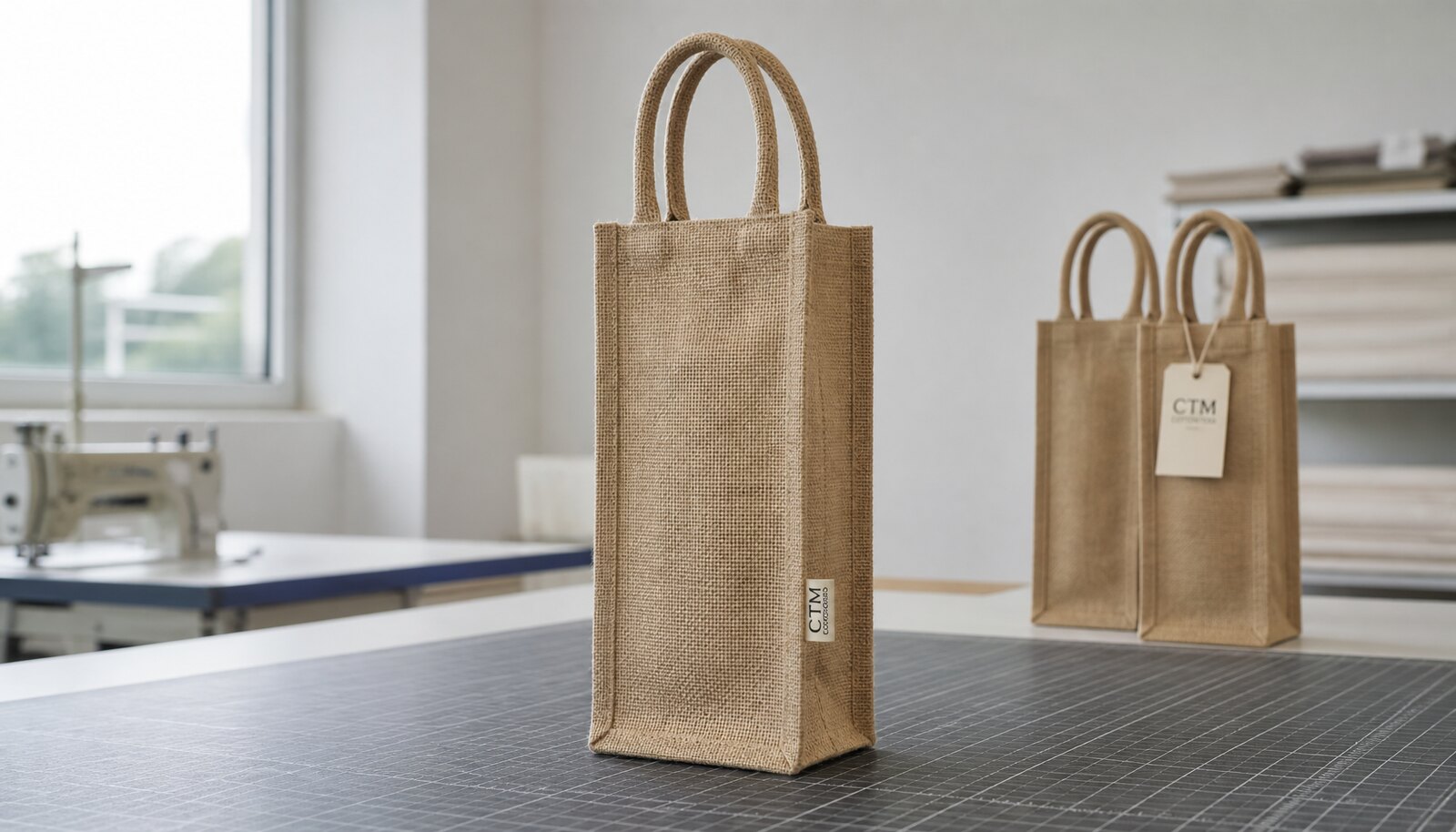
Why hotels buy jute wine bags in the first place
For hotels, jute wine bags are not just packaging. They are part of the guest experience when a bottle is used for welcome amenities, anniversary turn-down gifts, VIP room drops, banquet takeaway, club member rewards, or retail-style resale in a lobby shop. The bag has to look clean at first touch, survive housekeeping or banquet handling, and still fit the bottle without forcing the seams or making the product look improvised. A good program makes the bottle feel intentional, not last-minute.
The procurement challenge is usually not finding a supplier. It is defining a version that works across real hotel touchpoints. A room-service team wants fast packing and predictable size. Brand teams want a clear logo and a natural premium look. Procurement wants repeatable pricing with stable specifications across reorders. Those goals align only when the product definition is specific enough to control fabric weight, print method, fit, and packing from the start.
That is why jute wine bags for hotels should be treated as a small packaging project, not a simple accessory purchase. The bag affects perceived value, labor time, damage risk, and how the gift is received. Even a modest bag can look premium if the weave, stitch quality, and print are controlled. The reverse is also true: a poorly specified bag can make a good bottle presentation look cheap.
Buyer lens: a hotel bag must work at the front desk, in the back-of-house, and in the guest room. If it only looks good in the photo, it is not yet ready for procurement.
- Best-fit uses: welcome bottle, minibar add-on, banquet takeaway, member gift, seasonal promotion.
- Avoid overspecifying features the guest will not see, such as heavy lining or complex closure hardware, unless the bag will be reused often.
- Treat the bag as a brand touchpoint with handling requirements, not as disposable decoration.
Start with the bottle, not the bag
The most common sourcing mistake is building the bag around a marketing image instead of the actual bottle. A standard 750 ml bottle, a champagne bottle, and a short olive oil or spirit bottle all need different height, gusset, and neck clearance. If the bottle sits too high, the top edge looks awkward and the logo gets crowded. If the bottle sits too low, the bag loses structure and the bottom can sag. The bottle dimension sheet should be attached to the RFQ, not described loosely in an email.
For hotel programs, a single-bottle sleeve usually works best, but the finish must match the bottle profile. A gusseted base gives the bag standing stability for minibar counters and banquet trays. A reinforced top edge helps when housekeeping or concierge staff carry the bag one-handed. If the bottle has a wide shoulder or a foil neck wrap, leave extra room at the neck so the packaging does not tear when the bottle is inserted and removed repeatedly.
One useful procurement habit is to decide whether the bag should fit the exact bottle with a snug presentation or allow a slightly forgiving fit for multiple bottle suppliers. A snug fit creates a cleaner visual effect but raises the risk of fit problems when the beverage vendor changes. A forgiving fit is safer for chain programs with more than one bottle source, but it can make a lightweight bag look loose and less premium. The right answer depends on whether the hotel controls the bottle SKU or buys it from several sources.
If you expect bottle variation, ask the supplier to show internal clearances on the drawing, not just the external bag size. That makes it easier to judge whether the bag will work with the largest bottle in the program and still remain presentable with the standard bottle.
- Give the supplier bottle height, shoulder width, base diameter, and any closure detail that changes the silhouette.
- If one bag must fit multiple bottle types, build around the largest bottle and accept a slightly looser fit on the smaller one.
- Ask for a bottle-in-bag photo during sampling, not just a flat lay or empty bag picture.
Pick the fabric weight for the job
When suppliers say 'natural jute', that description is too broad to control quality. Jute for hotel wine bags should be specified by GSM and by the feel of the weave. In practice, 280-340 GSM covers most hospitality uses: it gives enough body for a bottle gift, keeps the unit cost in range, and still folds neatly in warehouse cartons. Move up to 350-400 GSM when the bag is expected to feel more premium, be reused often, or carry a heavier bottle with a more structured look.
The right fabric is not only about strength. It affects print clarity, wrinkle behavior, and how much fiber sheds during packing. A very open weave can look rustic but may make small logos hard to read. A tighter weave improves graphics and guest perception, but can also raise cost and reduce the handmade character that some brands want. For hotels, the practical test is simple: the bag should stand upright with the bottle inside, the print should read at arm's length, and the surface should not look patchy under lobby lighting.
For buyers, the important distinction is between a bag that is technically usable and one that is commercially acceptable to a guest-facing team. A bag that feels flimsy in the hand may still technically hold a bottle, but it can fail the brand test. A bag that is overly thick may look premium, but it can increase freight, storage volume, and carton pressure. A procurement spec should therefore include both a measured GSM and a visual expectation tied to the use case.
If you are comparing two suppliers, ask them to quote the same GSM band and the same weave type. Otherwise, one supplier may quietly reduce thickness to win on price while still describing the product as 'hotel quality'.
A useful rule is to compare the bag on three dimensions: structure, print performance, and handling. Structure tells you whether the bag stands or droops. Print performance tells you whether the artwork stays legible. Handling tells you whether staff can pack it quickly without fraying, shedding, or snagging.
- Use 280-340 GSM for standard gifts and volume programs.
- Use 350-400 GSM for premium rooms, special events, or repeated reuse.
- Avoid specifying only 'heavy jute' without a measured GSM range.
- If you can, ask for fabric swatches or a photo under daylight and indoor light before final approval.
Branding choices that hold up on coarse fabric
Logo decoration is where hotel buyers often overcomplicate the design. Jute is a textured substrate, so very fine text, narrow lines, and shaded artwork can disappear into the weave. For most hotel orders, a one-color screen print is the best balance of cost, legibility, and repeatability. It keeps the quote simple, makes reorders easier, and works well when the bag is intended as a clean branded gift rather than a fashion item. If the property wants a more elevated finish, a woven label or stitched patch can sit better on the fabric and feel more durable over time.
The most important design task is not the print technique; it is artwork simplification. A crest, skyline, or monogram that looks elegant in a PDF may fail on jute unless the thin lines are widened and the smallest text is removed. Ask the supplier to give a print proof on the real material, then review the edge clarity, alignment, and ink coverage. This is especially important for hotels because the bag is often seen under warm ambient lighting, not just in a bright studio.
Print placement should also serve the packing process. A centered face print is easier to stack and read when the bags are folded flat. A low or side placement can look stylish but may be more vulnerable to crease lines and carton pressure. If the hotel wants the bag to be used by multiple departments, choose a placement that survives storage as well as guest-facing display. In procurement terms, the best artwork position is the one that remains consistent after transport and handling, not just the one that photographs well.
For luxury properties, consider a mixed approach: screen print for the main logo plus a woven label or small side tag for tactile detail. That combination often gives a better cost-to-perception balance than overcomplicating the main print. The goal is a clean, durable brand signal, not a crowded decorative package.
- Screen print: best for one-color logos and repeat orders.
- Woven label or stitched patch: better for premium hotel programs with stronger brand standards.
- Avoid tiny reverse text unless the supplier proves it on a real sample.
- Ask for the maximum printable line thickness and smallest readable font size on the actual jute surface.
What changes the quote more than buyers expect
Two bags that look similar in photos can price very differently. The main drivers are fabric weight, bag size, decoration method, lining, reinforcement, and packing format. A small change such as adding a cotton lining or moving from open top to drawstring can shift labor time enough to move the unit price. The same is true for print complexity: a one-color logo on one panel is easy to price, while a multi-position print, woven label, and individual gift packing create more handling and more room for error.
Procurement teams should ask for quote line items, but the deeper reason is not just comparison. Line items show which parts of the order are truly driving cost and which parts are being bundled as a margin cushion. That matters when you compare direct factories, converters, and trading companies. A direct factory may price fabric and sewing more transparently, while an intermediary may offer convenience but hide the source cost of the body, print, and packing. Clear structure makes supplier negotiation more productive because you can see where a change in spec actually affects cost.
A good RFQ also asks for price breaks that reflect hotel buying behavior. Many properties test a design with one opening or one event first, then reorder if the item works. Ask for pricing at 500, 1,000, and 3,000 pieces, and if you expect chain rollout, ask at 5,000 or 10,000 too. This reveals whether the supplier has real efficiency at scale or only a decent sample-room price. The per-unit drop should be understandable; if it is not, ask what process step changes at each volume tier.
A low quote is not automatically a good quote. If the supplier is cheap because the bag is thinner, the print setup is simplified, or carton protection is minimal, the hotel may pay the difference later in returns, visual defects, or labor to re-sort the shipment. For procurement, the right number is the delivered usable-bag cost, not the factory sticker price.
When comparing offers, ask the supplier to explain exactly what makes the price move: fabric thickness, sewing time, print setup, or packing labor. That conversation often reveals whether the quote is stable or only attractive because it is vague.
- Require separate pricing for sample, print plate or setup, body, lining, and packing.
- Ask for tiered unit pricing at realistic volumes such as 500, 1,000, and 3,000 pcs.
- If the quote is unusually low, expect either thinner fabric, simpler packing, or less inspection time.
- Ask for the price impact of a second print position before you decide whether it is worth adding.
Supplier route matters as much as the bag spec
For hotels and hospitality groups, the supplier route affects control, speed, and risk. A direct factory is usually the best choice when the bag will repeat across properties and the spec is stable. It gives you a better chance of holding the GSM, stitching, and print method steady across reorders. A trading company or sourcing agent makes more sense when the hotel is buying several items at once, or when the team needs one contact to manage mixed packaging programs across multiple factories. A local decorator can be useful for last-mile speed, but only if they can prove where the base bag comes from and how the final decoration is controlled.
The practical question is not 'which supplier is best' but 'which supplier can prove the spec with the least hidden variation'. Ask who owns the fabric control, who applies the branding, and who packs the cartons. If those steps are split across multiple sites, the risk rises unless each handoff has a written standard. For hotel programs, a simpler supply chain is usually safer because the bag is a guest-facing item, not just a commodity pack-out piece.
When vetting a direct factory, do not stop at the claim of 'in-house production'. Ask for specific evidence: production photos of cutting and sewing, details of their inspection process, and a view of their packing line with carton marks. Ask whether they have handled jute or burlap before, because coarse woven materials behave differently from smooth cotton. A factory that mainly makes soft textile bags may still be capable, but the stitch settings, needle choice, and print control need to be proven on jute rather than assumed.
For trading companies, the key procurement question is transparency. Who is the actual producer? Can the intermediary state the factory name after award? Can they coordinate a third-party inspection? Can they show prior QC records for the same product type? If the answers are vague, you may still get a workable order, but you have less leverage if quality slips or a deadline moves.
For hotel buyers, a good sourcing route is the one that gives enough control for a repeatable guest-facing product without creating more administration than the team can manage.
- Direct factory: best for repeat orders and tighter control of fabric and stitching.
- Trading company: useful for mixed-category orders or when internal procurement time is limited.
- Local decorator: useful for rush jobs, but only if the base bag quality is already proven.
- Ask whether the same line handles both sampling and bulk, because a different line can mean different stitching behavior.
How to vet a supplier before you request samples
A sample request is too late to discover whether the supplier is actually set up for the job. Before shortlisting, ask for three things: relevant product photos, a production explanation, and a clear answer on who controls quality. Photos should show real seams, print detail, carton packing, and at least one completed bag with a bottle inside if possible. A polished catalog image is not enough. You want to see whether the supplier understands the practical requirements of hotel gifting and not just generic packaging.
Factory capability should be judged by signals that are hard to fake. A credible supplier can tell you what needle, stitch density, and seam reinforcement they use for coarse jute. They can describe how they cure or dry the print. They can explain how they prevent moisture staining in packing. They can state whether they have a routine final inspection or rely only on in-line checks. These are not exotic questions. They are the basic signals that the factory knows how to manage a guest-facing order.
If possible, ask for a short factory audit checklist even if you are not visiting in person. Good signals include separate areas for fabric storage, cutting, sewing, printing, packing, and finished goods staging. Better signals include labeled WIP areas, lot traceability, and a clear nonconforming goods zone. If the supplier cannot explain where rejected pieces go, that is a warning sign about process discipline.
Compliance questions should also be practical, not decorative. For a hotel purchase, it is useful to ask whether the supplier can support document requests such as a business license, export paperwork, or a basic material declaration if required by your internal policy. If the hotel is in a market with specific chemical or labeling rules, ask for those requirements before the sample stage so the supplier does not build the wrong version. Even when no formal certification is required, the supplier should be able to state what ink, adhesive, or lining material they use and whether anything is food-contact adjacent or purely decorative.
The easiest supplier mistakes to catch early are vague statements and overpromises. If the answer to every question is 'yes, no problem' without details, the supplier has not yet shown operational control.
- Ask for real photos of sewing, printing, and packing, not just finished product images.
- Request an explanation of stitch type, seam reinforcement, and print curing method.
- Check whether the supplier can identify and isolate nonconforming goods during production.
- If the hotel has brand or market compliance rules, send them before sample approval, not after.
Sampling and approval should match the final use
A sample is useful only if it mirrors the final production path. For hotel wine bags, the pre-production sample should match the final GSM, print method, seam finish, closure method, and packing style. If the approved sample is hand-finished in one way and the bulk order is sewn differently, the result will drift even if the dimensions look right on paper. The sample should also be tested with the actual bottle family, not a generic mock bottle that is only close enough to pass a photo review.
The approval process should include appearance and handling. Look at logo centering, print edge sharpness, seam straightness, and how the bag opens after folding. Then test insertion and removal of the bottle several times. If the bag is part of a hotel amenity program, the team should also check whether it stands straight in a tray, sits cleanly in a drawer, and stores flat without warping. Small quality defects become obvious when staff handle the item ten or twenty times before the guest sees it.
It helps to define what 'approved' means in writing. A clear approval note should name the bottle model used for fit, the approved print artwork version, the exact bag dimensions, the carton pack count, and the date of sign-off. If the supplier later says the bulk differs slightly because 'the sample was only a reference,' you can point to the approved spec rather than relying on memory. That avoids arguments during inspection and rework.
For hotels with multiple properties, approval should also include a tolerance strategy. For example, if one bottle vendor changes the glass shape slightly, is the hotel willing to accept a slightly looser fit? Or should the bag be redesigned? Agreeing on that boundary early saves time when the next reorder is needed.
The sample stage is also the right time to check whether the bag feels appropriate next to the rest of the guest experience. A rustic weave might fit a winery resort, while a very clean woven label and tighter finish may suit an urban luxury hotel. The product should match the brand environment, not just the bottle.
- Approve a final sample, not a generic reference sample.
- Test with the exact bottle size and closure style.
- Record the approved print placement in writing and on photos.
- Keep one sealed golden sample for each reorder and lot comparison.
Packaging and warehouse handling can ruin a good bag
Packaging choices matter more than many buyers expect. Jute wrinkles, absorbs moisture, and can pick up dust during handling. If the cartons are overfilled, the top edge crushes and the bag arrives with permanent bends. If the bags are packed too loosely, they rub against each other and the print loses sharpness at the edges. For hotel supply chains, bulk packing with clean separators is usually enough unless the bag is being sold in a gift shop or displayed directly to guests, in which case individual polybags or tissue wrap may be worth the extra cost.
Tell the supplier how the product will move after landing. A hotel warehouse may want cartons that stack on standard pallets with clear carton marks, quantity labels, and size codes. A retail outlet may need barcode labels and cleaner individual packing. A banquet team may prefer smaller inner packs that can be carried easily from storage to event setup. The inner pack count should match the actual delivery workflow, not just what fits best in the export carton.
Ask the factory to define damage limits for transport and packing. For example, a receiving rule could reject cartons with wet marks, crushed corners, broken straps, or obvious compression damage. Inside the carton, the bags should not show deep fold lines across the printed area or frayed edges caused by over-tight packing. These are practical signs that the packing specification is wrong even if the product itself was sewn correctly.
Moisture control is worth mentioning explicitly. If the shipping route includes humid storage, port dwell time, or a rainy receiving season, include a simple desiccant or dry-pack instruction. Jute does not need exotic protection, but it should not arrive smelling damp or showing water marks. For guest-facing items, even a minor shipping odor can make the product feel lower grade than it really is.
Good packing saves labor later; bad packing shifts the problem from the factory to the hotel back room. In procurement terms, the cheapest carton is not always the lowest total cost if it creates sorting, ironing, or repacking work at reception.
- Use carton marks that show size, color, quantity, and PO number.
- Do not overpack cartons if the bag has a structured gusset or printed face.
- Add moisture control if the shipping route includes humid storage or long port dwell time.
- Reject cartons that arrive crushed enough to deform the bag shape.
Lead time, reorder risk, and landed cost
Lead time is rarely just production time. For jute wine bags, the schedule includes artwork approval, sample making, bulk weaving or cutting, printing, stitching, packing, and export consolidation. If the hotel has a fixed event date, that full chain matters more than the nominal sewing time. A straightforward one-color program may move quickly, but any new artwork, woven label, or special packing step can add days. Procurement should treat the sample as a schedule checkpoint, not a formality.
Reorder risk is another reason to keep the spec tight. If the hotel gets a good result but does not save the final artwork version, approved bag dimensions, and carton format, the next purchase can drift even from the same supplier. That creates inconsistent guest presentation across properties or across seasons. A stable reorder file should include fabric GSM, exact measurements, print artwork, approved sample photo, carton count, and any packing notes. Without that package, the next buyer may be forced to rediscover the specification from scratch.
Landed cost also needs to be viewed as more than ex-factory price. Freight mode, carton density, packing style, and rework risk can change the final cost per usable bag. A bag that is slightly more expensive but stacks better and arrives with less damage can be cheaper on a landed basis than a lighter spec that requires more inspection or has higher rejection at receiving. For hotel buyers, the right comparison is the cost of acceptable bags delivered to the property, not the factory quote alone.
If you need a practical comparison method, calculate three numbers: ex-works price, landed-in-warehouse price, and received-acceptable price. The last number is the most honest. It includes freight, handling, carton damage, and any allowance for reject replacement. That is the number procurement should use when deciding whether to move to a premium fabric or a more durable branding method.
For chain buyers, consider repeatability a cost factor. A bag that can be reordered with the same results six months later is often more valuable than a marginally cheaper item that requires re-specifying every time.
- Build the timeline backward from the guest-facing date, not the PO date.
- Compare landed cost including freight, packing, and any expected inspection loss.
- Reorders are easier when the approved spec sheet includes GSM, dimensions, print artwork, and carton format.
- Keep a digital reorder pack so the next team member can buy the same item without guessing.
Specification comparison for buyers
| Spec decision | Recommended option | When it fits | Buyer risk to check | Cost / durability tradeoff |
|---|---|---|---|---|
| Fabric weight | 280-340 GSM jute for standard bottle gifting; 350-400 GSM for premium or heavier bottles | Use 280-340 GSM for room gifts, banquet takeaway, and seasonal promotions where cost and neat appearance matter more than long reuse | Too-light jute can look thin, show uneven weave, or deform after packing and handling | Lower GSM usually reduces unit price and freight weight, but can raise reject risk if the bag collapses or looks patchy under lighting |
| Bag structure | Single-bottle sleeve with gusseted base and reinforced top edge | Works for 750 ml wine bottles, olive oil gifts, sparkling beverages, and similar tall items that need a stable upright shape | Flat bags without a gusset can twist, print poorly on fold lines, and feel less premium in-room | A gusset adds sewing steps and a little cost, but improves standing stability and reduces bottle stress at the bottom corners |
| Lining | Unlined for dry gifting, nonwoven or cotton lining for better hand feel, lamination only when spill protection is needed | Choose lining when the hotel wants a cleaner interior, smoother bottle insertion, or less fiber shedding | Over-laminated bags can feel stiff, trap odor, and raise cost without improving guest presentation | Unlined is cheapest and lightest; lining improves perceived quality but adds labor and can complicate recycling or disposal |
| Branding method | 1-color screen print for most hotel programs; woven label or stitched patch for a more durable premium look | Screen print fits logos with clear shapes and repeat orders; labels suit higher-end properties and long reuse | Fine text, gradients, and thin outlines can blur on coarse jute if artwork is not simplified first | Screen print has the lowest setup cost; labels and patches add cost but can improve brand perception and abrasion resistance |
| Closure | Open top with reinforced neck or jute tie cord; drawstring only when the bag is reused as a keepsake pouch | Open-top is best for fast room-service packing and low unit cost | Drawstrings can tangle, slow packing, and create inconsistent bottle height control if the bottle is not standardized | Open top is the fastest and cheapest; drawstrings add labor and part cost, but may improve perceived gift value |
| Supplier route | Direct factory for repeat programs; converter or trading company only when you need mixed products, faster sourcing, or lower admin load | Direct factory suits volume, stable specs, and custom control; intermediaries help when the hotel is buying many items in one shipment | Trading layers can hide the true material source and make it harder to control GSM, print ink, and carton packing | Direct factory usually gives better visibility on true manufacturing cost; trading companies may be faster but can add margin and reduce transparency |
| Packing format | Bulk-packed with separators or tissue insert; individual polybag only for retail resale or upscale gift presentation | Bulk packing reduces carton volume for hotel supply chains and warehouse handling | Loose packing can scuff print, pick up fiber dust, or arrive bent if cartons are overfilled | Bulk packing lowers packing cost and freight volume; retail-style individual packing improves appearance but raises labor and material cost |
| MOQ logic | Base MOQ around 500-1,000 pcs for stock-size customization; 2,000-5,000 pcs for full custom shape and multi-step decoration | Use lower MOQ for pilot openings or seasonal campaigns; higher MOQ when multiple properties will reuse the same spec | Very low MOQ often means stock bodies, higher decoration charges, or less control over size consistency | Lower MOQ helps pilot programs but usually costs more per unit; higher MOQ lowers price but increases inventory exposure |
Buyer checklist before sampling
- Set the bottle size first: standard 750 ml, champagne, or a short gourmet bottle changes the gusset, height, and neck room.
- Define the hotel use case: guest welcome, minibar, event gifting, resale, or housekeeping kit changes the finish level and pack method.
- Lock the fabric spec in GSM and weave feel, not just the word 'jute'.
- Approve a simple artwork file that works on coarse fabric and avoid thin text or tiny reverse type.
- Require a pre-production sample with the final print placement, stitching, closure method, and the actual bottle inserted.
- State the carton pack count, inner protection, and labeling format before quote finalization.
- Ask for separate pricing for bag body, branding, sample, packing, and any lining or insert.
- Confirm the lead time for sample, bulk, and rework in writing.
- Ask whether the quoted fabric is natural jute, blended jute, or jute-look fabric, because appearance and abrasion resistance can differ materially.
- Request photos of the factory’s stitching, printing, and carton-packing lines before shortlisting, not after price negotiation.
Factory quote questions to send
- What is the exact fabric specification you are quoting, including GSM range, weave density, and whether it is 100% jute or a blended material?
- Is the quoted price based on a stock size or a custom pattern, and what exact finished dimensions are included after sewing tolerance?
- Which branding method is included, what is the print area, how many colors are priced, and what setup or plate fees apply?
- Are handle, closure, lining, reinforcement, or internal dust protection included, or priced as add-ons?
- What is the MOQ for the quoted spec, and how does the unit price change at 500, 1,000, 3,000, and 5,000 pcs?
- What sample type will you provide before bulk: reference sample, sales sample, or pre-production sample made on the actual line?
- Is the sample charge refundable after order confirmation, and are courier charges included or separate?
- How are the bags packed for shipment, what is the carton size, what is the gross weight, and how many pcs per carton?
- Which carton marks will you use for hotel receiving: PO number, item code, size, color, and case count?
- What lead time applies to artwork approval, sample production, bulk production, and export-ready packing?
Quality-control points to confirm
- Measure finished size on at least 5 pieces per lot. For hotel bottle bags, keep a practical tolerance of about ±5 mm on width and gusset depth and about ±7 mm on height unless the bottle fit is unusually tight. Anything beyond that can affect insertion and presentation consistency.
- Check stitch quality on side seams, base corners, and top reinforcement. For a typical hotel wine bag, a useful acceptance rule is no open seam, no split corner, no skipped stitch line, and no more than 2 loose thread tails longer than 5 mm per bag.
- Inspect stitch density visually and by count. A practical target for visible seams is roughly 8-10 stitches per 25 mm on standard construction; avoid sections where density drops sharply or the seam waviness becomes obvious.
- Rub-test the print after curing. The logo should not transfer onto white cloth after 10 firm dry rubs, and there should be no visible cracking, flaking, or edge lift on normal handling.
- Check the print placement against the approved sample with a simple ruler or print guide. A centered logo that drifts by more than 5 mm on a face panel can look inconsistent across a hotel batch.
- Look for defect classes and define them before ordering: critical defects include wrong size, open seam, major print misregistration, wrong artwork, and contamination; major defects include significant stain, broken closure, or bent top edge that does not recover; minor defects include small thread ends or slight weave variation.
- Set a practical AQL or at least a clear visual standard with the factory. If you do not use a formal inspection plan, agree on a receiving rule such as zero critical defects, no more than a small percentage of major defects, and all cartons counted against the PO.
- Check odor, dust, and fiber shedding, especially for guest-facing orders. Bags should not smell strongly of dye, glue, or mildew when opened; any pungent odor is a rejectable issue for in-room presentation.
- Confirm carton packing is not over-compressed. A good rule is that the top of the bags should recover flat after unpacking, with no permanent fold line at the logo area and no crushed gussets.
- Inspect carton condition on arrival: no torn corners, no wet cartons, no crushed edges, and no evidence of pallet compression that has deformed the product inside.