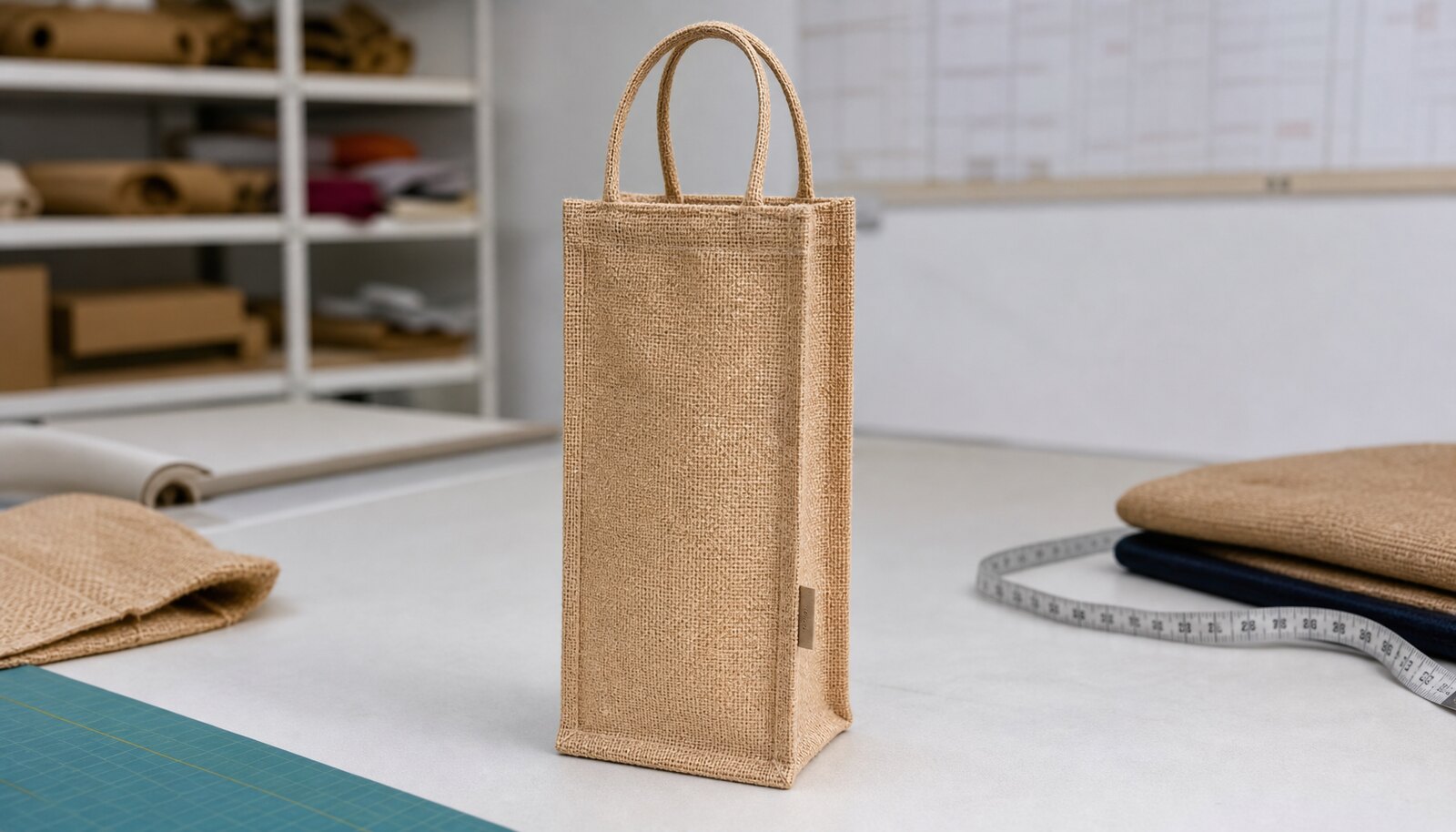
What Buyers Are Really Buying
A jute wine bag for events is not just a carry pouch. It has to present well on a table, survive handling by guests and staff, and move through packing and freight without arriving crushed or misshapen. If the buyer is sourcing for weddings, tastings, brand launches, hotel gifting, or distributor programs, the bag is part packaging and part branded merchandise. That means the spec has to work in three places at once: the shelf, the hand, and the carton.
The common mistake is to treat this as a simple decoration order. In practice, the failures show up in weak handle stitching, a body that is too thin to stand upright, logo ink that sinks into rough jute, and cartons that collapse before the event date. A good sourcing brief starts with the bottle size, the event use, and the expected handling route, then translates that into a bag structure the factory can repeat without improvising.
- Define whether the bag is for one bottle, a set with accessories, or a premium presentation piece.
- Write down whether the bottle will be room temperature, chilled, or packed with a gift insert.
- Treat presentation, durability, and packing efficiency as separate requirements, not one vague idea of quality.
Choose The Right Bag Construction
For a standard 750 ml bottle, most event buyers start with a gusseted jute body around 14 x 39 cm to 15 x 40 cm, then adjust for bottle shape and whether the neck needs extra height. A flat sleeve can look neat, but a gusseted body sits better on a table and is easier to pack. As a starting point, 280-320 gsm natural jute is the practical range for standard event use. Go lighter only if the bag is decorative and short-lived; go heavier if the bag must feel substantial, stand upright, or support repeated handling.
Construction choices matter more than many buyers expect. A reinforced top hem improves structure and helps the bag keep its shape after printing. Cotton rope or jute webbing handles are safer than thin tape when the bag is intended to be carried at events. If the bottle may be chilled, raw jute can absorb condensation and leave damp marks, so the buyer should decide early whether a light liner, a secondary sleeve, or a dry-use spec is acceptable.
- Use 280-320 gsm for standard one-bottle event bags; move higher only for premium feel or stronger structure.
- Prefer a gusseted body if the bag must stand on a table or carry a heavier bottle shape.
- Choose reinforced handles and top hems before you optimize decoration.
Branding That Holds Up In Use
The surface of raw jute is not friendly to tiny detail. That is why simple logos, large type, and short event copy usually outperform busy artwork. For volume orders, 1-2 color screen print is still the cleanest and most repeatable method. It gives a sharper commercial look than a crowded full-color transfer on rough cloth, and it is easier for the factory to hold consistent from sample to bulk. If the buyer wants a premium finish with long wear, a sewn woven label on the side seam is often better than pushing too much detail directly onto the fabric.
The print method should match the artwork, not the other way around. If the logo uses fine lines, gradients, or small legal text, either enlarge the design or move the detail into a woven label. Ask the supplier what line thickness they can hold on the actual jute base, because artwork that looks fine on a screen can fill in once it is printed on textured fiber. For event programs, a clean logo with controlled placement usually looks more expensive than an overworked graphic.
- Use screen print for simple logos and repeatable event orders.
- Use a sewn woven label when you want a cleaner premium finish and better durability.
- Do not approve small type or thin lines without a physical print sample on the actual cloth.
How MOQ And Price Actually Move
MOQ is not a single number; it changes with the amount of factory setup required. A blank standard bag usually has the lowest threshold because the factory can cut from existing patterns and run the line with minimal changeover. Add a custom size, a new handle color, a laminated lining, or multi-color print, and the order becomes less efficient to run. That is where buyers often see a jump in minimum quantity or a step-up in unit price. The real question is not whether the MOQ is high, but which part of the spec is forcing it up.
A useful quote should separate the cost drivers. Bag body, handle, lining, print method, setup fee, sample fee, inner packing, and carton packing should each be visible. If the supplier sends one all-in price with no breakdown, comparison becomes unreliable because you cannot tell whether the cheap quote removed the liner, used a lighter cloth, or excluded setup. For quote comparison, ask for at least three quantity tiers so you can see where the pricing curve flattens and whether it makes sense to move volume up or down.
- Request price tiers at multiple quantities, not only one target MOQ.
- Separate setup charges from recurring unit cost so the comparison is real.
- Watch for hidden changes in GSM, packing, or handle material when a quote looks unusually low.
Compare Sourcing Routes Before Unit Price
The right supplier route depends on how much control you need. A direct factory is usually the best route when the bag spec is fixed, the artwork is stable, and you want to control sample approval, printing, and packing in one chain. A trading company can be useful if you need one contact for multiple product types or if the project is small and speed matters more than cost. A local decorator or assembler may help when the bags are already in-market stock and you only need a fast logo run. None of these routes is automatically better; they solve different buying problems.
The mistake is to compare only the listed unit price. A trader quote can hide extra margin but still save time if they manage consolidation, artwork follow-up, and export documents. A direct factory can be cheaper but still cost more in the end if they need multiple art revisions, outsource printing, or miss the event date. Compare the route, not just the number. Ask who owns the cloth, who cuts the panels, who prints, and who packs the cartons before you decide which quote is actually usable.
- Use a direct factory when you need repeatable specs and tighter process control.
- Use a trader when the project is mixed, rushed, or too small to justify multiple supplier follow-ups.
- Use a local decorator when the base bag is standard and the last-mile turnaround matters more than absolute cost.
QC Thresholds That Prevent Rework
Quality control on jute wine bags starts with measurements, not opinions. Check the finished size, gusset depth, handle length, and print placement against the signed sample. A bag can look acceptable on a table and still fail in bulk if the body is narrow, the bottle neck sits too high, or the handle attachment is off-center. For first orders, measure a sample set from multiple cartons instead of inspecting only the top carton. That tells you whether the run is stable or whether the sewing line drifted after the first batch.
After size control, move to use control. A filled bottle should sit in the bag without seam opening, handle stretch, or twisting at the base. The print should stay legible under normal handling, and the cloth should not shed enough loose fiber to contaminate gift packaging. Odor matters too; a strong chemical smell, mildew note, or oily residue is a warning sign that the cloth, ink, or storage condition is wrong. QC is not about over-policing the factory. It is about stopping a bad batch before it reaches the event or the retail shelf.
- Hold logo placement within a small, written tolerance instead of accepting visual judgment only.
- Run a short load test with a filled bottle to confirm seam and handle strength.
- Reject bulk samples that show odor, glue marks, heavy fraying, or obvious print drift.
Sample Approval And Signoff
Never approve a jute wine bag from a digital mockup alone. A screen image cannot show how rough the cloth feels, whether the print sinks into the weave, or how the handle and top hem behave when the bag is folded and opened. The right workflow is simple: confirm artwork, approve the material and structure, review the pre-production sample, then lock one signed golden sample as the production reference. That sample should stay with both buyer and supplier so there is no argument when bulk arrives.
Keep the approval trail tight. If the buyer changes the logo size, shifts the print position, or swaps handle material after sample signoff, the factory may need a new sample and a new production clock. That is normal, but it must be visible in the schedule. For event work, the approval process is often what protects the deadline, because the sewing itself is usually faster than artwork corrections or repeated sample loops. Good sample discipline prevents the usual problem where everyone agrees the bag looked fine in email but nobody can prove which version was approved.
- Approve a physical sample before mass production starts.
- Keep one signed golden sample with the PO reference and artwork version noted on it.
- Treat any change after signoff as a new revision, not a casual adjustment.
Packing For Events And Retail
Packing is part of the product on event orders. Jute bags are bulky, and if they are packed too tightly they arrive creased, flattened, or dirty at the edges. Flat bulk packing is usually the best route for importers and distributors, but the carton count should be chosen so the bags stay compressed enough for freight efficiency without crushing the seams. If the destination is humid or the voyage is long, add moisture protection and keep the cartons off the floor in storage. Jute can hold scent and absorb humidity faster than buyers expect.
Event distribution also changes the packing logic. If the bags are being handed out on site, the count per inner bundle should match how staff will move and issue them. Mixed-color cartons may look efficient on paper but often slow counting and create errors at the venue. For retail or wholesale, one size and one artwork per carton is cleaner. If the buyer needs shelf-ready units, specify barcode labels, carton marks, and any inner bundle requirement before the order starts, because late packing changes are a common cause of delay.
- Use flat bulk packing unless the program truly needs individual presentation packing.
- Keep one size and one artwork per carton whenever possible.
- Add moisture control for humid destinations or long ocean transit.
Lead Time, Landed Cost, And RFQ Questions
For event goods, lead time risk usually starts with the artwork, not the sewing line. A factory can only start clean production after the print file, sample, carton marks, and packing details are frozen. If you are comparing suppliers across different countries or fulfillment routes, put the same incoterm on every quote so the landed-cost math stays honest. EXW, FOB, and delivered quotes are not interchangeable. A cheap ex-factory quote can become expensive once you add inland freight, export docs, ocean freight, duty, and destination handling. The buyer should compare the full landed path, not the first number on the page.
A quote-ready RFQ for jute wine bags should force the supplier to be specific. Ask for material, GSM, dimensions, handle material, print method, MOQ by artwork version, sample cost, packing count, lead time after sample approval, and carton details. If a supplier cannot answer those questions cleanly, the project will probably have the same lack of discipline in production. The cleanest buying process is simple: lock the spec, approve the sample, compare route and landed cost, then release production against a written schedule.
- Compare all quotes on the same incoterm and packing spec.
- Include setup fees, freight, duty, and local handling in the landed-cost view.
- Use a date-based production schedule so event deadlines are visible from day one.
Specification comparison for buyers
| Spec decision | Recommended option | When it fits | Buyer risk to check |
|---|---|---|---|
| Sourcing route | Direct factory with in-house sewing and print | Repeat orders, custom logo, and tighter control on sample approval | Verify the factory is not quietly subcontracting print or packing, or you lose control of lead time and QC |
| Fabric weight | 280-320 gsm natural jute for standard event use | Most single-bottle event giveaways and brand activations | Thin cloth looks flat and can distort at the handle stitch; ask whether the quoted GSM is base cloth or laminated weight |
| Body structure | Gusseted body with reinforced top hem | Bordeaux or Burgundy bottles that need a cleaner presentation and easier packing | A shallow body can twist the bottle neck or make the top look collapsed in transit |
| Branding method | 1-2 color screen print or sewn woven label | Simple logos, event names, and repeatable branded runs | Fine text can fill in on raw jute and small logos can shift if the print area is not controlled |
| Handle choice | Cotton rope or jute webbing with bar-tack reinforcement | When the bag will be carried by guests, staff, or retail buyers | Thin handles and weak stitch reinforcement fail first under load, especially if the bottle has a heavy base |
| Closure style | Open top with reinforced fold or simple drawstring | Fast event packing and giveaway use where speed matters more than luxury finish | Open tops must still hold the bottle neck securely; a loose top can look unfinished at the event |
| Packing route | Flat bulk pack with clear carton counts | Importers and distributors who need fast counting and lower freight cost | Overpacked cartons crush seams and create creases that are hard to remove before the event |
| Lead-time route | Stock base bag plus custom print | Shorter event timelines and repeat programs with stable artwork | A full custom size, new color, or multi-step finish can add more time than the sewing itself |
Buyer checklist before sampling
- Confirm the bottle size, neck height, and whether the bag must fit a chilled bottle or a room-temperature gift bottle.
- Lock the base spec: fabric weight, gusset depth, handle material, and whether you need a lining or reinforced top hem.
- Choose the branding method before asking for prices so the factory can quote the real production route, not a placeholder.
- Request tiered pricing at multiple quantities and separate any setup, plate, or sample charges from the unit price.
- Approve a physical sample or pre-production sample before mass production starts.
- Define packing by carton count, inner bundle size, and whether mixed SKUs are allowed.
- Set measurement tolerances and print placement tolerance in writing.
- Ask for a date-based production schedule, not only a lead-time estimate in days.
- Compare quotes on the same incoterm and the same packing specification.
- Keep one signed golden sample and one approved artwork file with version control.
Factory quote questions to send
- What is the exact bag size, gusset depth, handle material, and base jute GSM, and is that GSM for the raw cloth or the finished laminated material?
- Is the printing, sewing, and packing done in one facility or subcontracted, and which step creates the longest delay?
- What is the MOQ for the blank bag, for the printed bag, and for each extra print color or artwork version?
- Please break out any setup fee, screen charge, plate charge, sample fee, and carton or inner packing cost separately.
- What print method are you pricing, and what logo size or line thickness do you recommend for this jute surface?
- What measurement tolerances do you hold for bag width, height, gusset, handle length, and logo placement?
- What is the standard production lead time after sample approval and deposit, and what can extend it?
- What carton count, inner bundle count, and moisture protection do you include for export packing?
Quality-control points to confirm
- Finished dimensions must match the approved sample within the agreed tolerance, especially width, height, and gusset depth.
- Handle attachment must show no skipped stitches, loose threads, or pulled bar-tacks at the stress points.
- Logo placement must stay within the approved position and size, with no obvious ink bleed, fading, or color shift.
- The bag should hold a filled bottle without seam opening, base distortion, or handle stretch during a short load test.
- The cloth surface should be clean, with no oil marks, glue stains, mildew smell, or excess loose fiber.
- Carton counts must match the packing list, and mixed colors or mixed artworks should be packed only if the PO allows it.
- Desiccant or moisture control should be used when shipping into humid destinations or when the route is long sea freight.
- The production lot must match the signed golden sample on fabric feel, print sharpness, and overall structure.