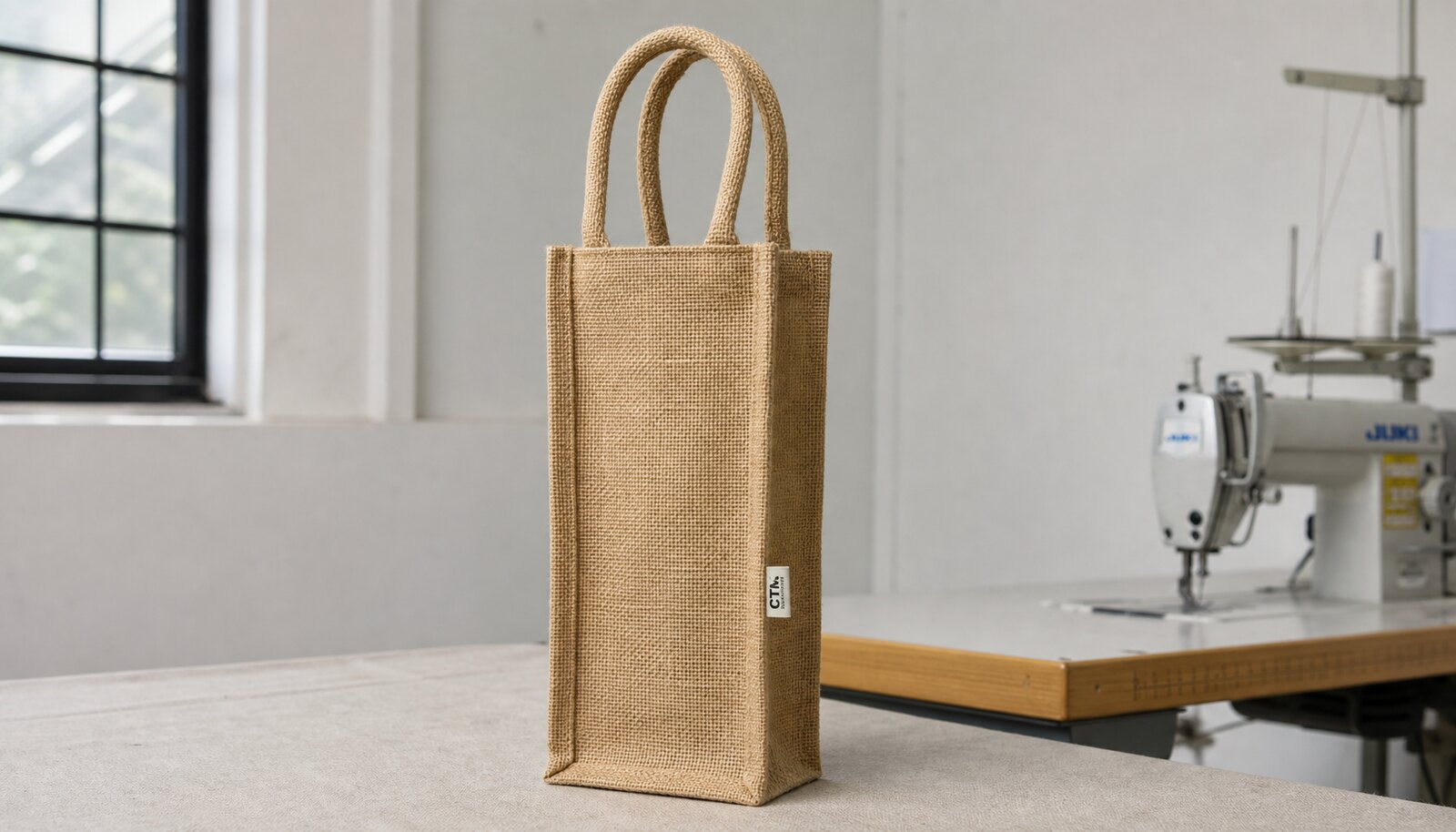
What A Corporate Gift Buyer Needs From A Jute Wine Bag
Jute wine bags for corporate gifts are not bought just for decoration. They have to fit a real bottle, survive handling through packing and transit, and still look acceptable when a client opens the gift. The common failure is choosing a bag that photographs well in a sample but sags, scratches the label, or looks uneven once a bottle is inserted. For procurement teams, the right starting point is not the logo. It is the bottle profile, the presentation target, and the distribution path. A bag for in-office handover can tolerate a different finish than a bag that will move through a distributor network or retail shelf.
For most programs, a single-bottle format is the easiest to standardize because it keeps the shape stable and the quote structure simpler. That does not mean the build should be generic. Jute weight, handle reinforcement, print area, and pack method all change how the bag feels in hand. If the gift is meant to sit beside premium wine, the bag should look intentional rather than rustic by default. Buyers usually get better results when they describe the occasion, the bottle type, and the target presentation level before they discuss price.
- Define the bottle first, then size the bag around it.
- Treat presentation and transit as separate requirements.
- Keep the format simple if the order needs repeatability across regions.
Start With Bottle Fit, Then Lock The Fabric Build
Bottle fit is where many first orders go wrong. A standard 750 ml bottle is not enough information on its own because shoulder width, label height, and neck length vary enough to affect the final bag dimensions. A practical starting point for a single-bottle jute wine bag is around 120 x 90 x 360 mm, but that should be treated as a reference, not a universal size. Tall labels, punted bases, or decorative closures can all push the dimensions upward. Buyers should measure the actual product that will go inside the bag and send those dimensions to every supplier, not just the nominal bottle size.
For the fabric build, a common corporate-gift spec sits around 320-360 gsm natural jute cloth. That gives a decent balance of body, structure, and cost. If the bag needs a cleaner interior or better protection against scuffing, add a 120 gsm cotton lining or a light inner lamination around 0.08-0.12 mm, depending on the presentation target. Heavier fabric and reinforcement can make the bag feel more premium, but they also raise unit cost and can make folding bulkier in master cartons. The right choice depends on whether the buyer wants a rustic look, a refined gift look, or a bag that has to travel farther before handover.
The most useful material questions are not about whether the bag is jute. They are about how much structure the bag needs, how stiff it should stand, and whether the bottle will ever be handled while still in the bag. If the bottle is inserted at the warehouse and moved again later, the body needs more support than a display-only carrier. If the bottle is packed at the last minute and handed over immediately, the bag can stay simpler and lighter.
- Measure the actual bottle, including cap, shoulder, label height, and base shape.
- Use 320-360 gsm as a practical baseline for most gift programs.
- Add lining or lamination only when the extra structure solves a real handling problem.
Branding That Survives The Jute Weave
Printing on jute looks simple until the artwork hits the weave. Fine lines, tiny text, and soft gradients can disappear into the texture or break up along the fiber pattern. For most corporate gift programs, 1-2 color screen print is the safest starting point because it gives strong contrast and repeatability. If the brand artwork is more detailed, a woven label or stitched patch often looks cleaner than forcing the entire logo onto rough natural jute. This is especially true when the bag is meant to carry a premium bottle and sit in a client-facing environment.
The practical rule is to design for the material instead of forcing the material to behave like coated paper or polyester. Keep line weight thick enough to hold, simplify small copy, and avoid tight registration on multi-color logos unless the supplier has proven control. Embroidery can work on thicker jute panels or side labels, but it may pucker if the base fabric is too loose. Heat transfer is useful for short runs or complex artwork, yet it is usually the least forgiving option on textured jute if the bag will travel, bend, or stack tightly in cartons.
- Use screen print for simple logos and repeat orders.
- Use a woven label or stitched patch when the logo needs a cleaner premium finish.
- Keep small text and thin lines out of the artwork unless you have an approved production sample.
What Actually Drives The Quote
A useful quote for jute wine bags should split the cost by body material, lining or lamination, handle reinforcement, print method, packing, and any setup charges. If the supplier gives only one unit price, the buyer cannot see which part of the build is expensive and which part is flexible. The real cost drivers are usually the ones that affect labor and setup: more print colors, stitched labels, custom carton artwork, internal dividers, and low-volume order splits across many colors or SKUs. Requesting prices at 500, 1,000, and 3,000 pieces often reveals whether the supplier is pricing a real production run or a small custom order with hidden overhead.
Buyers should also compare quote basis, not just the number on the page. An EXW quote from a factory and a CIF quote from a trading company are not directly comparable unless freight, export handling, and packaging are normalized. Ask whether the quote includes screens or plates, sample charges, carton counts, and any overrun tolerance. The cheapest quote can become the most expensive one if it excludes packing or assumes a lower fabric weight than the PO expects. For a corporate gift program, the safest approach is to compare on the same spec sheet, the same incoterm, and the same packing method.
- Separate body cost, trim cost, print cost, and packing cost.
- Compare the same incoterm across all suppliers.
- Make setup charges visible before you approve the artwork.
Compare Sourcing Routes Before You Compare Unit Price
The supplier route changes the economics as much as the spec does. A factory-direct source is usually the best fit for repeat programs, custom sizes, and strict QC because the sewing and printing team can control the build from start to finish. A trading company can be useful when the buyer needs multiple product types in one shipment or wants a lower coordination burden, but the buyer should confirm which factory is actually making the bags. A stock seller may look cheaper on day one, yet the customization ceiling is low and the final presentation is often generic.
For smaller or time-sensitive corporate gift orders, a hybrid route sometimes works better than a pure custom build. The buyer can select a stock body shape and add limited branding, then reserve full custom sizing for the next cycle. That keeps the first order manageable while still protecting the brand. The main risk is inconsistency between the stock sample and the final bulk order. If the supplier is using a standard shell with custom print only, the buyer should insist on photos of the exact production line and a physical sample that reflects the final stitch pattern, handle length, and carton pack.
- Use factory-direct when repeatability and artwork control matter most.
- Use a trader only when they can prove the actual factory and spec control.
- Use stock routes cautiously because customization is limited and shape consistency can vary.
Sample Approval Is The Cheapest Place To Find Problems
A photo approval is not enough for a jute wine bag. The material has enough body variation, seam tension, and print texture that a flat image can hide real production issues. Buyers should approve a physical pre-production sample with the actual bottle inserted. That one test reveals the real fit, top clearance, handle feel, and whether the logo sits where the eye expects it to sit. If the bag is for a fixed event, the approved sample should be kept as the golden reference in the factory file and in the buyer's internal record.
The sample should be judged like a shipping unit, not a design mockup. Check the hem, the handle anchoring, the print coverage on the woven surface, and the way the bag stands upright with the bottle inside. If the supplier proposes a different lining or print method for mass production, stop and ask for a revised sample. It is a common mistake to approve a cleaner lab sample and then receive a bulk order that uses a weaker material or a simplified closure. The sample has to reflect the exact bulk construction, otherwise the approval is not useful.
- Insert the real bottle or a true equivalent during sample review.
- Retain a sealed golden sample for production comparison.
- Reject any sample that changes material, lining, or print method after approval.
QC Thresholds Buyers Should Put In The PO
Quality control for jute wine bags does not need to be complicated, but it does need to be specific. The PO should define finished dimensions, allowed tolerance, print placement, seam quality, and carton pack count. A practical dimension tolerance for a handmade or semi-handmade jute bag is usually around plus or minus 5 mm on width and height, with the handle drop controlled closely enough that the bottle still sits comfortably in the bag. Print placement should be centered to the approved artwork, but the buyer should allow for the natural texture of jute rather than expecting machine-perfect alignment like coated board.
The most common visible defects are loose threads, weak bar-tacks, skewed handles, and print that is too light to read from normal viewing distance. Buyers should also require a simple load test and a short carry test using a filled bottle or a weight equivalent to the heaviest bottle in the program. If the bag is going to move through retail or distributor channels, add carton-level checks for count accuracy, artwork accuracy, and outer carton condition. If one carton arrives with the correct bags but the wrong labeling, the receiving team still pays the price.
- Specify dimension tolerance, print placement, and carton count in the PO.
- Use a real bottle or realistic weight for load testing.
- Reject weak handle anchors, visible seam distortion, and unreadable print.
Packing Choices That Change Presentation And Damage Rates
Packing is part of the product for a corporate gift. A bare jute bag can be acceptable in some programs, but many buyers need a cleaner presentation and less abrasion during transit. Tissue wrap, a simple polybag, or a paper sleeve can protect the surface and reduce jute dust. If the order is going to retailers or distributors, the master carton should use dividers or a layout that prevents the bottles from rubbing against each other. For gift sets, the difference between a bag that looks premium and one that looks careless is often the inner packing, not the bag itself.
The buyer should also think about how the goods will be received on the other end. Carton count, barcode placement, and easy-to-read outer marks save time at intake. If the order needs shelf-ready distribution, a carton that is too heavy or packed too tightly can slow down handling. If the bags are packed with a bottle inside at origin, the supplier needs to use a secure divider or insert so the bottle does not press into the side seam during transit. That packing decision can be more important than adding one more print color because it directly affects damage rates and receiving speed.
- Choose packing based on destination, not just unit cost.
- Use dividers or inserts when bottles are packed before shipment.
- Keep carton markings simple and readable for warehouse intake.
Lead Time, Artwork, And Schedule Risk
For a common custom build, a realistic planning window is often 5-10 days for sampling, 15-25 days for bulk production after sample approval, and extra time if the order uses embroidery, complex packing, or multiple print colors. Those numbers are not promises; they are planning references. The real schedule risk usually comes from the steps that look small at the beginning: artwork revision, screen approval, carton proofing, or a late change to the bottle size. If the event date is fixed, buyers should work backward and leave a buffer rather than building the plan around the factory's fastest case.
Lead time also depends on whether the supplier already has the correct jute cloth in stock. If the material needs to be woven, dyed, or matched to a particular texture, the start date moves. That is why repeated programs are easier to manage than one-off orders. For land-sea planning, the buyer should decide early whether the quote needs EXW, FOB, CIF, or delivered terms, because freight and export handling can change both the cash flow and the true landed cost. The fastest-looking supplier is not useful if their packing method creates inspection delays or if their missing paperwork holds the shipment at origin.
- Build time around sample approval, not around the first artwork file.
- Allow buffer for print proofing and carton artwork changes.
- Normalize freight terms before comparing lead time or landed cost.
How To Write The RFQ So Suppliers Quote The Same Thing
A good RFQ does not need to be long, but it does need to remove ambiguity. Start with the bottle dimensions, the target bag size, the required jute GSM, the print method, and the expected quantity by color and by ship date. Add the packing requirement, the quote basis, and whether the supplier must include sample and carton charges. If the buyer wants a premium gift look, say so directly. If the order is cost-driven and needs a lean build, say that too. Suppliers quote much better when they know whether the program is selling the bag, handing it out at an event, or sending it through a distributor chain.
The best RFQs also ask for evidence, not just a line item. Request a similar sample photo, a production-floor photo, and a confirmation of which steps are in-house. Ask the supplier to quote the same specification at multiple volumes so the buyer can see where the price curve changes. That helps procurement teams decide whether to split the order, simplify the print, or raise the order size to hit a better tier. A clean RFQ prevents quote drift, and quote drift is one of the most common hidden costs in custom jute packaging.
- Send bottle dimensions, target size, GSM, print method, quantity, and delivery term.
- Request pricing at more than one quantity break.
- Ask for production evidence, not only product photos.
Specification comparison for buyers
| Spec decision | Recommended option | When it fits | Buyer risk to check |
|---|---|---|---|
| Supplier route | Factory-direct with in-house sewing and printing | Repeat programs, artwork changes, and tighter QC | Verify who actually makes the bags; subcontracted printing can slip lead time and color consistency |
| Body material | 320-360 gsm natural jute with optional 120 gsm cotton lining | Premium corporate gifts and better bottle support | Too-light fabric looks limp; too-heavy fabric increases cost and makes folding bulky |
| Bag size | Around 120 x 90 x 360 mm for a standard 750 ml bottle | Most Bordeaux-style bottles and upright gifting | Test your tallest label and widest shoulder; neck clearance fails are common |
| Branding method | 1-2 color screen print or a sewn woven label | Simple logos on textured jute with repeat orders | Fine text and gradients can fill in or lose clarity on the weave |
| Closure and finish | Open top with reinforced handle anchors and optional tie or flap | Fast packing and clean presentation | Weak top hem or poor bar-tacks cause handle pullout |
| MOQ logic | 500-1,000 pcs per style and color for a custom run | Standard corporate campaigns and cost control | Very low MOQ often means stock shape, limited print, or higher unit cost |
| Packing route | Individual tissue or polybag plus divider carton | Gift-ready distribution and abrasion control | Overpacking increases cost; underpacking causes scuffing and fiber dust |
| Sample route | Physical pre-production sample plus retained golden sample | Any order with a fixed event date or strict brand color | Photo approval hides dimension and handle feel problems |
Buyer checklist before sampling
- Final bottle type, bottle height, and widest diameter
- Whether the bag is for one bottle, a set, or mixed bottle sizes
- Target body GSM and whether a liner or lamination is required
- Logo file format, print colors, and minimum text size
- Preferred finish, including handle type, closure, and label placement
- Packing requirement, including tissue, polybag, insert card, and carton count
- Required quote basis, such as EXW, FOB, or CIF
- Target sample approval date and final ship date
- Who signs off on the golden sample and artwork proof
- Any retail, gift, or distributor labeling needed on the carton
Factory quote questions to send
- What exact jute GSM, lining, and reinforcement are included in your quotation?
- What is the MOQ per style, per color, and per print method?
- What setup charges apply for screens, labels, cartons, or packaging changes?
- Can you quote the same specification at 500, 1,000, and 3,000 pieces?
- Which steps are done in-house, and which steps are outsourced?
- Can you share one similar sample photo and one production-line photo for reference?
- What lead time do you need after sample approval, and what can delay it?
- What tolerance do you follow for dimensions, print placement, and seam quality?
- What packing method and carton count are included in the unit price?
- Do you apply overrun, short-ship, or replacement terms on bulk orders?
Quality-control points to confirm
- Finished dimensions match the approved sample within the agreed tolerance, especially height, width, gusset, and handle drop.
- The bottle fits fully into the bag without forcing the neck, crushing the label, or leaving the bag too short at the top.
- Handle anchors have tight bar-tacks or reinforced stitching, with no loose threads, skipped stitches, or seam puckering.
- Print placement is centered and aligned to the approved artwork, with no bleeding, ghosting, or visibly weak ink coverage.
- The fabric surface has no major stains, oil marks, broken weave, or excessive fiber shedding that transfers to adjacent cartons.
- The bag holds a filled bottle in a static load test and a short carry test without strap failure or seam opening.
- Closure details, if any, work as intended and do not shift the bottle during handling or carton movement.
- Carton marking, pack count, and inner packaging match the PO and do not create confusion at receiving.