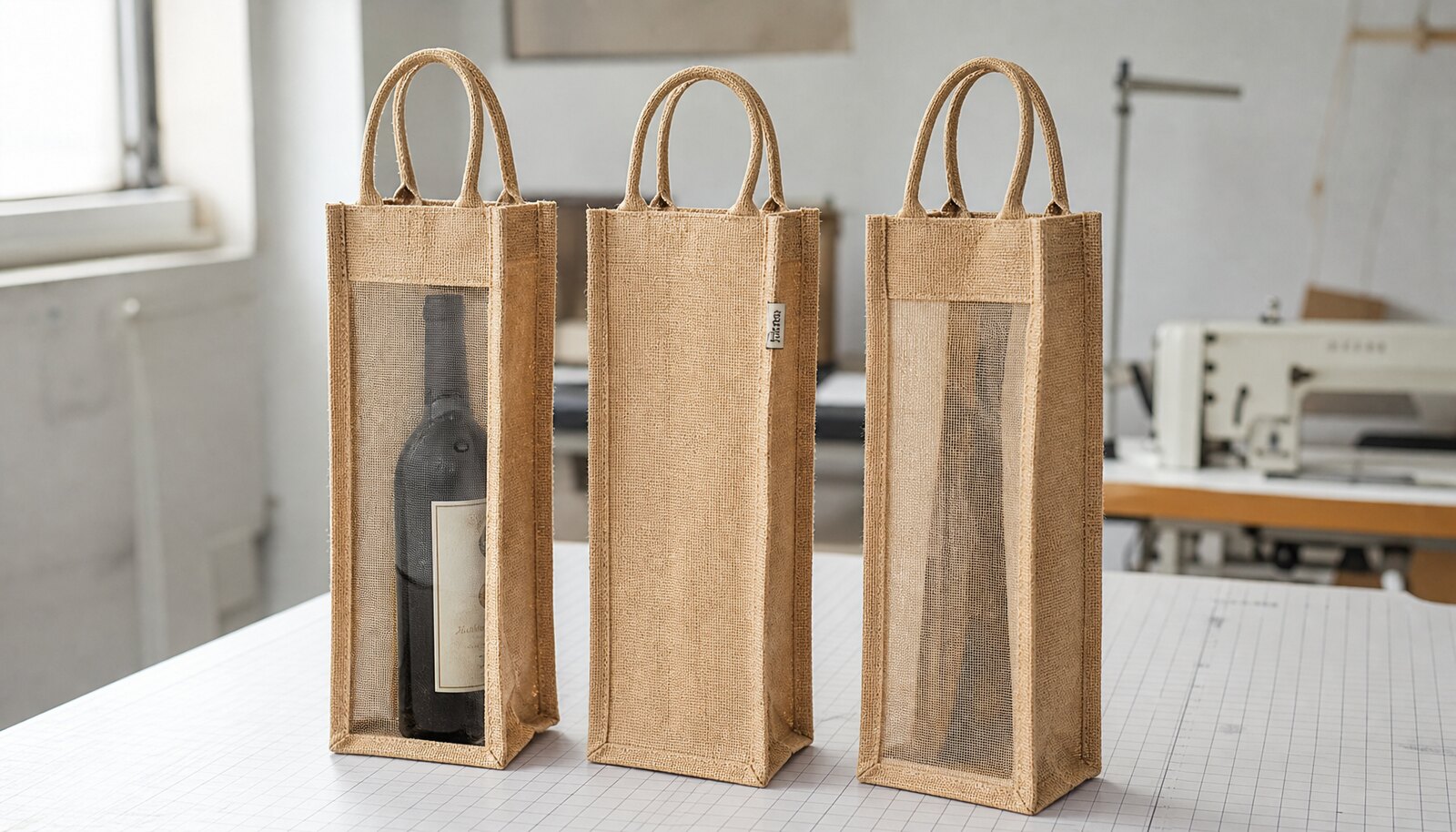
Why Jute Wine Bags Fit Brand Launches
Jute wine bags work well for brand launches because they solve two jobs at once: they carry a bottle safely and they signal a natural, gift-ready brand position without pushing the cost into hard-goods territory. For procurement teams, that matters because the bag often sits in a launch kit, retail display, PR mailer, or gifting program where the packaging must look deliberate but still remain price-controlled. A simple jute construction can do that if the fit is right and the print is clean.
The buying problem is not the bag category itself. It is choosing a build that matches the bottle, the brand position, and the order size without creating avoidable waste. A launch order usually needs a more polished finish than a generic promo bag, but not the complexity of a rigid gift box. That is why the specifications on fabric weight, print method, handle reinforcement, and inner packing matter more here than a marketing description ever will.
- Use jute wine bags when the bottle is part of a launch kit, PR drop, hospitality gift, or retail bundle.
- Avoid overbuilding the bag if the brief is a short-life promotion and the bottle will not be reused.
- Treat the bag as a branding surface and a protective carrier, not as a decorative afterthought.
Start With Bottle Fit, Not Artwork
The right spec starts with the actual bottle, not a generic wine size. Standard 750 ml bottles vary enough in shoulder shape, base diameter, and neck height that a bag can look fine on paper and still fail in hand. For a launch program, ask the factory to build around the bottle you will actually pack, whether that is a Bordeaux profile, a wider Burgundy style, or a heavier sparkling bottle. Internal width, height, and gusset should be stated as usable dimensions, not only overall cut size, because the usable space is what determines whether the bottle slides in cleanly and stands upright.
If the bag must fit inserts, tags, or a divider, state that up front. A bottle carrier with a printed hang tag, tissue wrap, or small insert needs extra allowance in the body and sometimes at the top opening. Many quotes fail at this point because the supplier prices the bag as a simple empty sleeve while the buyer later expects it to accept a heavier, dressed bottle. The result is a bag that fits only after force, which is not acceptable for retail launch work.
- Provide a real bottle sample or exact bottle drawing with base diameter, shoulder width, and total height.
- State whether the bag must hold one bottle only or also fit a divider, card, or gift insert.
- Fix the opening style early: open top, drawstring top, flap, or sewn closure all change the fit.
Choose Construction That Matches the Launch
For most launch programs, natural jute around 280 to 340 GSM is the practical middle ground. It gives enough body for a standing wine bag without making the item look flimsy, and it still accepts basic branding well. If the bag needs a more premium retail feel, especially for a bottle that will be sold at shelf or included in a gift set, move to a heavier fabric or a lined construction. A laminated or reinforced build can reduce fiber shedding and improve shape retention, but it also changes the hand feel and can add bulk in shipping, so it should be chosen for a reason rather than by default.
Handles and bottom reinforcement are the other points where the spec either works or fails in use. A jute rope handle can suit a rustic presentation, but cotton webbing or a reinforced tape handle is often more comfortable for a full bottle. Bottom boards, side gussets, and bar-tacks at the handle joins matter because the bag may be picked up repeatedly during launch events or retail handling. If the bottle is heavy or chilled, reinforce the stress points and request a carry test on the sample rather than relying on a visual approval.
- 280 to 340 GSM is usually enough for a standard one-bottle promotional bag.
- Heavier or lined builds make sense when the bag must feel premium, reusable, or retail-ready.
- Reinforce handle joins and the bottom seam if the bottle is heavy, chilled, or packed for event use.
Print and Decoration Can Make or Break Yield
On jute, the print method matters more than many buyers expect. Screen print is usually the most workable option for launch orders because it is cost-efficient, repeatable, and compatible with rough fiber surfaces. It performs best with bold logos, one or two colors, and clear type that does not depend on tiny strokes. Fine gradients, micro text, and hairline detail can disappear into the weave, so if the creative needs that level of precision, the bag surface may need a smoother panel, a coated area, or a sewn-on patch instead.
Premium decoration should be chosen for brand effect, not because it sounds better on a quote sheet. A woven label, embossed patch, or sewn trim can give the product a stronger retail identity than direct print on rough jute, especially when the launch sits in a premium gifting program. But every added decoration adds a point of risk: placement drift, weak attachment, longer lead time, or a higher reject rate. Lock the artwork size, the placement reference, and the acceptable color shift before sample approval, then test the printed sample with a light rub and handling cycle.
- Use screen print for bold brand marks and simple launch messaging.
- Use a patch, woven label, or embossed detail if the logo needs a more premium look.
- Do not send fine artwork to rough jute unless the factory confirms it can hold the detail.
MOQ Logic and What Really Drives Unit Cost
MOQ for jute wine bags is usually set by process efficiency rather than by a random factory policy. The plant has to cut fabric in workable runs, prepare print screens or plates, and pack cartons in a consistent batch size. A stock-size bag with one-color screen print typically supports a lower MOQ because the factory can run it with less setup. Custom dimensions, extra colors, lining, or decorative trims usually push MOQ upward because they introduce more cutting waste, more sewing steps, or separate sourcing for the trim itself.
A clean quote should show what is driving the cost, not just the final unit number. Ask for the base bag cost, print setup, sample charge, carton charge, and any extra cost for a lining, rope handle, woven label, or special packing. When quotes are not split, buyers cannot tell whether a lower unit price is real or simply hiding setup costs in a vague total. That becomes a problem at replenishment stage, when the factory expects the same price but the buyer later adds a color change or a new carton spec.
- Stock size plus one-color print usually gives the best balance of MOQ and cost.
- Custom size, multi-color print, and premium trim are the fastest ways to raise MOQ.
- Separate the quote into bag cost, setup, sample fee, packing, and export carton cost.
Sample Approval Needs a Physical Test, Not a Photo
A launch bag should not move to bulk production on the strength of a PDF mockup or a front-view photo alone. The approval path should include a size sample, a print strike-off if needed, and a pre-production sample built from the final fabric and trims. The sample has to be tested with the actual bottle, because a jute bag that looks correct when empty can fail once a heavier bottle pulls the seams open or shifts the center of gravity. For retail buyers, this is where many avoidable problems are caught before the first full carton is sewn and packed.
Use the sample to set clear acceptance criteria. The bottle should slide in without force, the opening should sit straight, the print should be centered, and the seam lines should be tidy under normal lighting. If the bag includes a patch or label, its placement should match the signed sample rather than a loose verbal expectation. Keep one signed sample as the master reference and make the factory retain one as well. That reduces argument when the bulk arrives and someone starts comparing it to a newer file version instead of the approved physical sample.
- Approve a real pre-production sample built with final fabric and final trims.
- Test the sample with the actual bottle weight, not only with a lightweight substitute.
- Keep a signed master sample at both buyer and factory sides.
Packing and Carton Design Affect Damage Rate
Packing is not a clerical detail on a jute wine bag order. Flat packing, carton size, and moisture protection affect the appearance of the bag when it lands, especially if the shipment is ocean freight. Jute can pick up wrinkles, dust, and edge distortion when it is packed badly. For launch programs, the bag should arrive with enough shape retention that the retailer or fulfillment team can pack bottles without rework. If the product will go direct to store or into a gift set, the packing spec should preserve speed at the final handling stage, not just reduce freight volume.
The carton spec also affects landed cost. Overly large cartons increase volumetric weight, while overstuffed cartons crush handles and distort the front panel. Ask the supplier to state carton dimensions, count per carton, net and gross weight, and whether a polybag, tissue, or paper insert is used. If there is a moisture risk, a simple inner protection layer and desiccant can be more useful than a premium-looking but fragile outer pack. The correct answer depends on the route, but the pack should always match the delivery channel instead of the factory's convenience.
- Use flat packing unless the launch presentation requires a pre-shaped bag.
- Keep carton dimensions tight enough to protect the bag but not so large that freight cost spikes.
- If the route is sea freight, add moisture protection that matches the season and transit time.
Lead Time Risk Comes From Artwork, Trims, and Seasonality
For jute wine bags, the published lead time is only the starting point. A realistic project plan separates sample time from bulk time and then adds risk buffers for artwork revisions, handle sourcing, carton changes, and inspection feedback. A sample may be ready in a week if the bag is simple and the factory has similar material in stock, but bulk production still depends on whether the print screens, trims, and packaging components are already aligned. When one of those items slips, the whole schedule moves even if sewing capacity is available.
Launch buyers should ask for a dated production plan with a clear approval gate. The factory should tell you when artwork is frozen, when the sample will be ready, when bulk cutting starts, and when the final carton pack is complete. Seasonal peaks matter too. If your launch lands near the holiday gifting window, the supplier may have the sewing line capacity but still be constrained by print, trim, or carton procurement. That is why schedule risk should be managed as a material and process problem, not just as a calendar problem.
- Expect sample time and bulk time to be separate milestones.
- Ask the factory to name the exact items that can delay the order.
- Build buffer into the schedule if the launch date is fixed and cannot move.
How to Compare Quotes and Avoid Cheap-Sounding Bags
Quote comparison only works when the suppliers are quoting the same spec. One factory may include a heavier GSM, better stitching, and tighter packing, while another is pricing a thinner fabric and simpler print. A launch buyer should compare dimensions, fabric weight, print method, handle type, packing count, and carton spec line by line. If those fields are not identical, the lower quote is not necessarily the better value. It may simply be a weaker product that will create a quality issue after approval or a surprise cost at repack stage.
A practical sourcing strategy is to separate the first launch from the replenishment plan. For the first drop, speed and approval control matter more than absolute lowest cost. For repeat orders, once the artwork and fit are proven, you can push the factory harder on efficiency and packaging. In some cases a direct factory is the right source for both stages. In others, a launch may run through a flexible supplier route while the follow-on replenishment moves to a lower-cost factory. The key is to keep the spec stable so the apples-to-apples comparison remains valid.
- Compare only like-for-like quotes with the same GSM, size, print method, and packing.
- Separate launch supply from replenishment if schedule pressure is high.
- Treat a suspiciously low quote as a spec gap until proven otherwise.
Claims, Compliance Language, and Seller Documentation
A brand launch often needs supporting language for packaging, retail pages, or distributor sheets. Keep that language precise. If the bag is jute, say jute and describe the exact construction rather than leaning on broad terms like natural or eco-friendly without the production detail behind them. If the bag uses a lining, laminate, patch, or mixed-fiber handle, state it clearly. Buyers and downstream teams need material truth, not slogan language, because the wrong description creates disputes at customs, on marketplace listings, or in retail compliance reviews.
The same discipline applies to supplier documentation. Ask for the commercial invoice format, carton marks, packing list, and any product composition statement the route requires. If your market needs additional labeling or packaging declarations, build that into the quote stage instead of trying to add it after approval. The cost of a late label change is usually not the label itself. It is the production stop, reprint, and schedule impact that follow. Good sourcing on launch bags is mostly about removing ambiguity before the order starts.
- Describe the bag with the actual materials and construction, not generic marketing language.
- Build labeling and documentation into the quote stage if the destination market requires it.
- Keep product claims aligned with the real build so retail and customs teams see the same spec.
Specification comparison for buyers
| Spec decision | Recommended option | When it fits | Buyer risk to check |
|---|---|---|---|
| Direct factory with in-house printing | Best for one controlled production source and clear accountability on fabric, printing, and packing | Launch orders of 1,000 to 10,000 bags where you need stable repeatability and one approval path | Confirm whether cutting, screen making, and final packing are all done in-house or subcontracted |
| Trading company or agent-led sourcing | Use only if you need access to multiple plants or a very low development workload | When your internal team is short on supplier management and the assortment may change by market | Verify which factory actually makes the bag and whether the quote includes the agent margin |
| Stock size with custom print | Lowest-risk route for first launch or seasonal promotion | When the bottle size is standard and the brand wants speed more than structural customization | Check whether stock bags are truly the same size across batches and whether the stock fabric shade is consistent |
| Custom size and construction | Best when the bottle has unusual diameter, a gift insert, or premium retail presentation | When the bag must fit specific bottle profiles or sit inside a hamper or mailer | Ask for a physical sample with the exact bottle, not only a flat spec sheet |
| One-color screen print | Most efficient for rough jute and launch budgets | When the artwork is bold, logo-led, and not dependent on fine gradients | Confirm screen count, color match tolerance, and print rub resistance on the actual fabric |
| Woven label, patch, or embossed trim | Choose for a more premium brand feel without relying on detailed printing on the weave | When the launch is retail-facing and the bag should feel reusable and collectible | Check attachment strength, label placement, and whether the trim adds lead time |
| Lined or laminated construction | Useful when you want cleaner interiors, less fiber shedding, or a sturdier retail feel | When the bag will be chilled, handled often, or packed with gift inserts | Make sure the lining does not create bulk that changes bottle fit or carton counts |
| Dual-source launch and replenishment plan | Separate first shipment from long-term supply if the launch date is fixed | When the first order must move fast but follow-on orders need lower unit cost | Lock the same measurements, artwork files, and packing spec so the replenishment quote stays comparable |
Buyer checklist before sampling
- Lock the exact bottle type, including diameter, shoulder shape, and whether the bag must fit a cork or screw-top finish.
- Define the bag size in internal usable dimensions, not only overall size, and state any target tolerance.
- Choose the fabric weight range, such as 280 to 340 GSM for standard builds or 350 GSM and above for a heavier premium feel.
- Specify the print method, number of colors, print area, and whether the logo can sit on a rough jute surface without fine details.
- Ask for a pre-production sample with the actual bottle inside before releasing bulk production.
- Confirm packing format, carton count, inner protection, and whether the bags ship flat or lightly stuffed.
- Request a quote split by bag price, print setup, sample fee, carton cost, and any special trim or lining cost.
- Get a dated production schedule with sample approval, bulk start, packing, and ready-to-ship milestones.
Factory quote questions to send
- What is the exact bag size, GSM, and construction you are quoting, and is that the same spec across all sizes of the order?
- Which printing method are you using, how many colors are included, and what is the setup charge for screens, plates, or dies?
- Is the quoted price based on a direct factory run or through a trading company, and which process is subcontracted if any?
- What is the MOQ by size and by print version, and how does the price change if we move from stock size to custom size?
- Can you show the actual carton pack count, carton dimensions, and gross weight estimate for shipment planning?
- What sample stages are included before bulk production, and what is the fee for a corrected sample if the first sample misses the spec?
- What is your standard lead time after sample approval, and what elements can extend it, such as handle sourcing or artwork revision?
- Which QC checks do you perform before shipment, and can you share a pre-shipment inspection photo set or report format?
Quality-control points to confirm
- Measure the internal width, height, and gusset against the approved sample and keep the variance within the agreed tolerance, typically tight enough that the bottle does not rattle or jam.
- Test the bag with the actual bottle weight and shape, including a short carry test and a standing test on a flat surface.
- Inspect stitching at handle joins, side seams, and bottom seams for skipped stitches, loose thread ends, and uneven seam allowance.
- Check print alignment, ink coverage, and edge sharpness under normal light and after a light rub test on the printed panel.
- Review the fabric surface for excessive fiber shedding, oil spots, color variation, or unwanted smell that signals poor storage or finishing.
- Confirm that labels, patches, or woven brand marks are fixed securely and sit in the correct position across the full batch.
- Verify carton markings, quantity per carton, and packing list accuracy so the order is easy to receive and count on arrival.
- Compare the bulk pre-shipment sample with the signed approval sample before authorizing final dispatch.