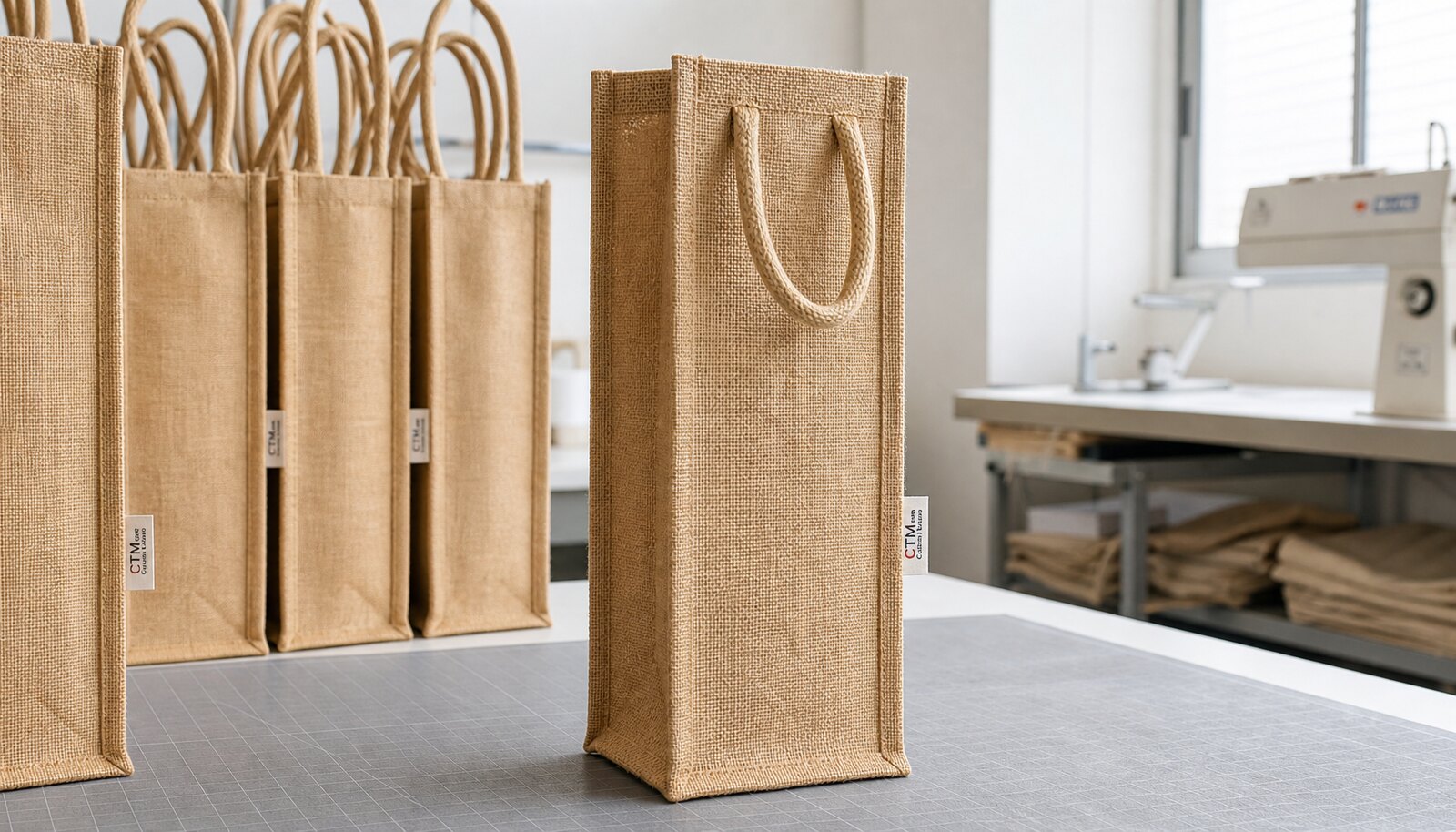
Why jute wine bags need tighter specs than they look
A jute wine bag is not just a sleeve for a bottle. Buyers are usually balancing presentation, bottle protection, freight efficiency, and a very narrow price target. The problem is that suppliers often quote different constructions under the same name. One quote may be for a thin, unlined promo bag; another may include heavier jute, cotton handles, and a lined interior. If you compare those numbers without standardizing the spec, the lowest price is usually the least useful offer.
For procurement teams, the first job is to define the bottle and the use case. A standard 750 ml wine bottle with a narrow shoulder sits differently from a wider Burgundy bottle or a taller sparkling bottle. That changes body width, gusset depth, and where the bottle neck exits the top. If you are buying for retail shelves or gifting sets, the bag also needs to look straight when hung or boxed, not just survive a short hand carry.
- Define the bottle profile first: standard, Bordeaux-style, Burgundy-style, sparkling, or specialty glass.
- Choose the user moment: retail gifting, promo giveaway, cellar accessory, or corporate gift pack.
- Separate appearance requirements from transport requirements so the supplier does not underbuild the bag.
The spec choices that drive quote differences
The largest cost driver is fabric weight. For jute wine bags, a practical range is about 14x14 oz or roughly 400-450 GSM for a premium retail feel. Lighter fabric can work for giveaways, but once a bottle is inserted, weak weave density becomes obvious in the side seams and print face. Heavier jute improves shape and shelf value, but it also raises material cost and can require stronger stitching and slower sewing.
Next is construction. Unlined bags are the cheapest and fastest to produce, but they expose the rough jute interior and can shed fibers. A cotton or PP laminated lining improves structure and bottle protection, though it adds material, labor, and sometimes odor or folding issues if the supplier rushes the lamination. Handles also matter more than buyers expect. Self-fabric jute handles are economical, but cotton webbing handles usually feel better in the hand and communicate a more retail-ready product.
- Use 400-450 GSM jute for most premium wine retail programs.
- Choose lining only if the bag must feel cleaner, hold shape, or protect the bottle label from abrasion.
- Request handle length in millimeters and attachment style, not just “strong handle.”
A practical comparison of sourcing routes
For jute wine bags, your supplier route changes more than just the price. A direct factory with jute sewing experience usually gives better control over fabric weight, stitch quality, and packing consistency. General gift suppliers can be fine for simple promo orders, but they often rely on outside workshops and may shift construction details after the order is placed. That creates risk when the buyer expects the same bag to be repeatable across seasons.
If the order is small and the artwork is simple, a trader may quote faster. But for recurring programs, retail brands usually get a better outcome from the factory that can show material swatches, pre-production samples, and clear QC limits. The right route depends on whether the bag is a one-off event item or a product line that will be reordered.
- Direct factory: better for repeat orders, spec control, and packaging consistency.
- Trader or sourcing agent: useful for low-volume mixed-item programs, but verify material origin and build details.
- Specialist jute supplier: strongest option when print quality and handle strength are non-negotiable.
Comparison table: supplier options and what each one really means
The table below compares realistic sourcing routes for jute wine bags. Use it to standardize quotes before you compare numbers. If one supplier offers a lower price, make sure the offer still matches the same fabric, lining, handle, print, and packing scope.
Make suppliers separate base unit price, setup fee, sample fee, label or packing cost, and freight handover term. MOQ should be tied to real drivers such as fabric dye lot, print setup, trim sourcing, carton rules, or inspection depth.
- Write decisions in measurable language, not only descriptive wording.
- Ask for sample photos plus one physical approval sample for important orders.
- Keep quotation, sample approval, and inspection notes tied to the same spec version.
How MOQs work when you change print, lining, or size
MOQ logic on jute wine bags is rarely about one number. It is usually driven by fabric procurement, print setup, and sewing efficiency. If you choose a standard size and one-color print, the factory can spread setup costs over a larger run and keep the price stable. Add multiple sizes, different logos, or a lined interior, and the minimum order often rises because the workshop needs to cut separate patterns and schedule more labor stages.
A sensible RFQ should separate base bag MOQ from artwork MOQ and color MOQ. For example, a factory may accept 3,000 pcs for one size and one print, but require 5,000 pcs if you want mixed colors or a special woven label. Buyers should also ask whether the MOQ applies per SKU or per production batch. That distinction matters when planning regional distribution, because one large order can be split into several carton destinations if the supplier builds efficiently.
- Base MOQ changes with fabric color, lining, and handle material.
- Artwork complexity can increase setup charges even when MOQ stays the same.
- Mixed-size or mixed-print orders should be quoted with a clear run-by-run cost breakdown.
What a useful quote should include, line by line
A good quote for jute wine bags should not stop at a single unit price. It needs to show what the factory is actually including so you can compare like for like. At minimum, the offer should identify fabric GSM, size, print method, handle construction, lining, packing method, and lead time after sample approval. Without that detail, a low quote can hide thinner fabric, simplified stitching, or loose packing assumptions that later become claims.
Ask for quote data in a format you can paste into your internal comparison sheet: material cost, decoration cost, labor, packaging, and export carton cost if they are separated. If the supplier only gives one all-in number, request an itemized version for internal review. That is the easiest way to see whether the gap is in fabric, print setup, or the supplier’s margin.
- Quote should show finished size, jute GSM, lining, handles, and print method.
- Lead time should be stated from sample approval, not from payment receipt only.
- Packing scope should be clear: bulk pack, polybag, insert card, or retail-ready carton.
Sample approval is where most mistakes are prevented
For jute wine bags, sample approval should be treated as a production gate, not a formality. A sales sample can prove the idea, but it often differs from the final build in fabric lot, stitching density, or print finish. The pre-production sample should use the exact fabric weight, the final handle material, the actual print method, and the same packing spec that will be used in the shipment. Otherwise the sample tells you very little about the real order.
When reviewing the sample, do not limit the review to appearance. Insert the intended bottle and check the fit at the shoulder and neck. Look at how the top hem holds its shape and whether the bag stands straight on a table. A sample that looks attractive but collapses when loaded will disappoint retail buyers and create returns if the bottle has to be displayed in-store.
- Approve only a pre-production sample that matches final material and print.
- Test the actual bottle fit, not just a dummy insert of the same weight.
- Mark any acceptable variation in shade, stitch line, or logo position before mass production starts.
QC thresholds that matter in production
Jute bags fail in predictable ways: weak seams, crooked prints, loose handles, damp cartons, and inconsistent sizing. The right QC plan sets acceptance criteria before production starts. For finished dimensions, a tolerance of +/- 0.5 to 1 cm is usually workable for sewn jute bags, but the bag still needs to fit the target bottle without excessive slack. If the bottle moves too much inside the bag, the user experience drops even when the dimensions are technically within tolerance.
Handle strength deserves special attention because wine bottles are heavy and the load sits lower than on a normal tote. Ask the factory what stitch pattern is used at the handle base, whether bar-tacks are applied, and whether a pull test is performed on a loaded sample. Print quality should also be reviewed under normal indoor light. On jute, a print can look acceptable in photos but still bleed or break at the weave when inspected closely.
- Require straight seams, secure handle attachment, and no loose yarns at visible edges.
- Use loaded fit checks for the actual bottle weight and shape.
- Reject cartons with moisture, odor, or contamination that can transfer to the product.
Packing, cartonization, and freight cost control
Packing decisions change both damage rate and landed cost. Flat-packed jute wine bags are usually the best freight option because they reduce carton volume, but they must be folded consistently so the bag opens cleanly after unpacking. If the bag is retail-facing, some buyers prefer individual polybags or simple inserts to keep the product clean and presentable. That adds labor and plastic cost, so it should be built into the quote rather than treated as an afterthought.
Carton count also matters for warehouse receiving. Export cartons should carry clear marks, net and gross weight, and the agreed quantity per carton. If the supplier mixes carton counts or leaves the counts unspecified, distributors often face reconciliation problems at the destination warehouse. For larger orders, ask for a palletization plan if your destination country uses pallet receiving as standard practice.
- Flat pack for freight efficiency; retail pack only when the channel requires it.
- Fix carton count and gross weight in the PO to avoid receiving disputes.
- Include master carton marks and any barcode or SKU label requirement in the RFQ.
Land cost comparison: where the extra money usually goes
The landed cost of jute wine bags is shaped by more than factory price. Fabric weight, lining, print method, and packing style all affect freight volume and handling cost. A thicker jute bag may raise the unit price, but it can reduce damage, return risk, and retail complaints. That is why the cheapest quote often becomes the most expensive after freight, inspection, and rework are added.
When comparing offers, calculate the full landed picture: ex-works price, inland move to port, export carton cost, freight by volume, duty if applicable, and destination handling. If one supplier quotes a lower unit price but uses oversized cartons or slower production, the total delivered cost may be higher. For brand buyers, that difference can erase margin on a seasonal promotion.
- Compare by landed cost, not just ex-works unit price.
- Watch carton size and packing density because they affect freight chargeable volume.
- A cheaper bag with weak stitching can cost more through claims and replacement stock.
Specification comparison for buyers
| Spec decision | Recommended option | When it fits | Buyer risk to check |
|---|---|---|---|
| Jute fabric weight | 14x14 oz or about 400-450 GSM with tight weave | Standard retail wine gifting where appearance and stiffness matter | Lightweight jute can distort after stitching and print may look uneven on loose weave |
| Inner lining | Unlined for low-cost promo; laminated PP or cotton lining for premium use | Unlined for short campaigns, lined for premium wine retail and long shelf life | Unlined bags can shed fibers and reduce bottle protection; lining changes cost and lead time |
| Closure style | Open top with hem or top flap with tuck-in insert | Open top for giveaways, flap for retail presentation and dust control | Loose top opening can let bottles shift during transport if bottle neck is short |
| Handle construction | Self-fabric jute handles or cotton webbing handles stitched through top hem | Self-fabric for cost control, cotton webbing for hand comfort and higher perceived value | Thin handles cut into the hand; weak bar-tacks fail when bottle weight sits unevenly |
| Print method | 1-color screen print or heat transfer for small artwork; woven label for premium branding | Simple logos, short runs, or brands that want a cleaner finish | Overly detailed art may blur on jute; heat methods can crack if the bag is rough packed |
| MOQ route | Factory-direct custom run from 3,000-10,000 pcs depending on print and lining | Most private label and distributor orders | Low MOQ often means higher unit cost, fewer size choices, or shared materials |
| Sample stage | Pre-production sample with final fabric, handles, print, and packing marked approved | Any order with retail packaging, color matching, or gift launch timing | Sales samples often use better workmanship than bulk; approve the exact production build |
| Packing method | Flat-packed with bulk cartons and carton marks, or polybag + master carton for retail | Flat-pack for freight efficiency; individual polybag when retail presentation requires it | Poor folding can crease the body and deform the print; wrong carton count causes receiving disputes |
| Supplier route | Direct factory with jute sewing experience over general gift supplier | When consistency, testing, and repeat orders matter | General traders may understate fabric weight, miss reinforcement details, or swap materials after PO |
Buyer checklist before sampling
- State bottle size range in the RFQ: standard 750 ml Bordeaux, Burgundy, or wider 1 L specialty bottles change bag width and gusset requirements.
- Specify finished dimensions, jute GSM, lining type, handle length, and whether the bottle should stand upright or sit low inside the bag.
- Send print artwork in vector format and define one-color, two-color, or woven label branding before quoting.
- Require a pre-production sample that matches final fabric, stitching, print, and packing, not a sales sample.
- Ask suppliers to quote with carton count, inner packing, gross weight, and lead time from sample approval, not from PO date only.
- Compare quotes on the same terms: fabric weight, handle type, lining, print method, and packaging scope.
- Set QC limits for stitch density, handle pull strength, print alignment, odor, stains, and dimensional tolerance.
- Confirm whether cartons are master-packed for export or retail-ready for shelf display.
Factory quote questions to send
- What exact jute GSM and weave construction are you quoting, and can you show a fabric swatch or spec sheet?
- Is the quoted price based on unlined, lined, or laminated construction, and what changes if we add a cotton label or insert flap?
- Which print method is included, how many colors, and what is the setup charge or screen charge per design?
- What is the MOQ by color and by artwork version, and can you combine sizes or print variations in one production run?
- What is included in the sample stage: sales sample, pre-production sample, or full production sample with final packaging?
- How are handles attached, what stitch pattern is used, and what pull-test standard do you apply before shipment?
- How many bags go into each carton, what is the carton size, and can you quote with export packing marks?
- What is the lead time after sample approval, and what parts of the schedule are at risk if artwork or packaging changes?
- What inspection standard do you follow for appearance and measurements, and can you share defect criteria before production?
Quality-control points to confirm
- Finished size tolerance should stay within +/- 0.5 to 1 cm for width and height, with gusset depth matched to the bottle profile.
- Jute weave should be even, without loose threads, broken yarns, oil spots, or hard creases that damage print quality.
- Handles must be securely bar-tacked or box-stitched; tug resistance should be reviewed with a loaded bottle or equivalent weight test.
- Print registration should be centered and readable, with no excessive ink bleed into the weave and no cracking after light rub testing.
- Top hem, side seams, and base seams should be straight and reinforced at stress points; open seams are not acceptable for export cartons.
- Odor and contamination control matters on jute; reject strong mold smell, damp cartons, or visible dust that transfers to the product.
- Carton counts must match the packing list exactly; mixed counts create warehouse receiving delays and claim disputes.
- Retail-facing units need clean folding, consistent insert placement, and no exposed glue or loose fibers on the visible side.