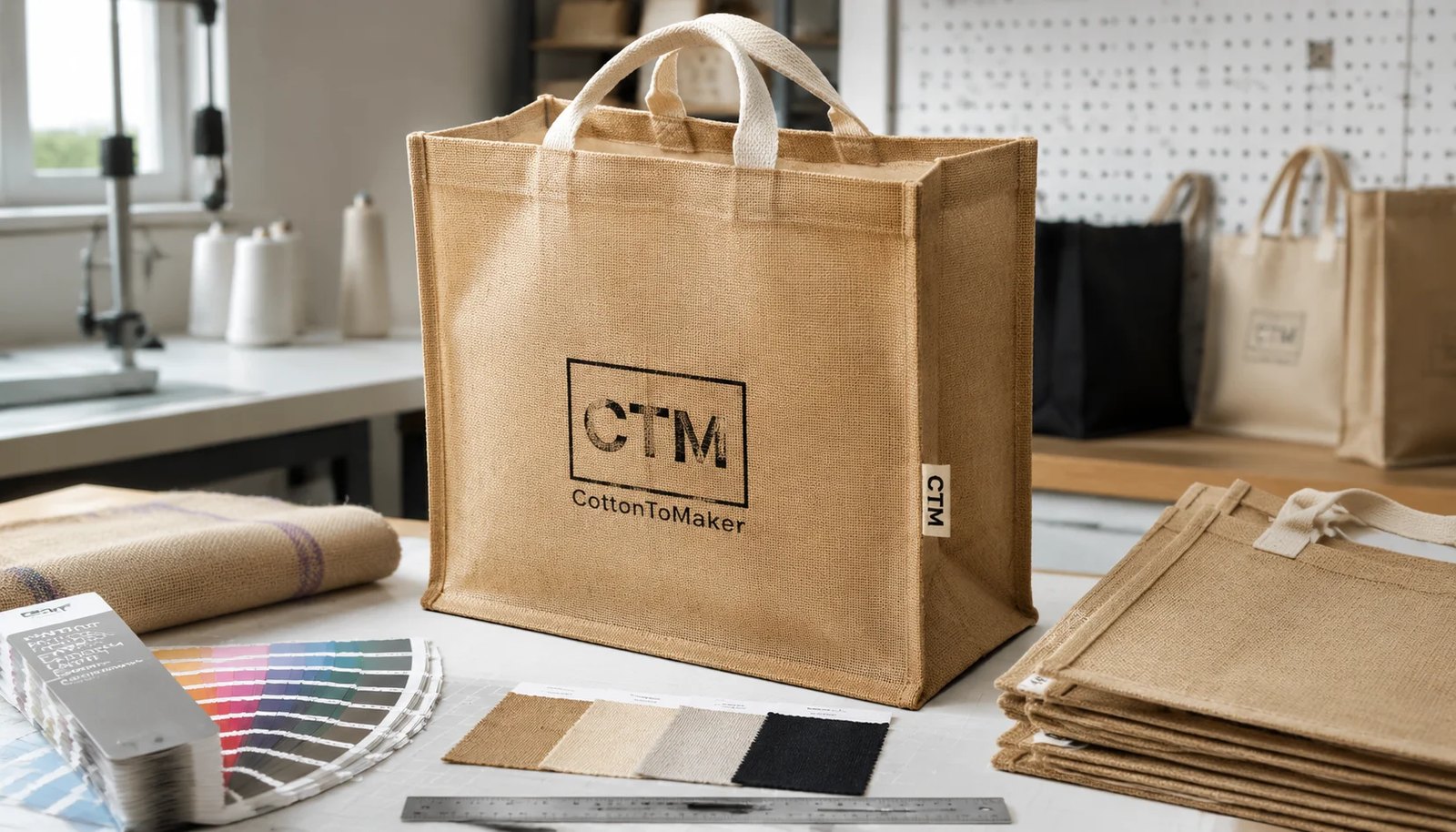
Why Proofing Is Different on Jute
Jute tote bags look simple in a product photo, but print proofing them is less forgiving than proofing canvas or non-woven bags. Natural jute has a coarse yarn, uneven surface, and visible color variation. A clean logo in a PDF can become broken, fuzzy, or darker than expected once ink lands on the woven panel. For natural grocers, the problem is bigger because the bag often carries a brand promise around organic food, reuse, and low-waste shopping. A poor print makes the bag look cheap even when the base material is strong.
The proofing target should not be a perfect paper-like print. The target should be a commercially acceptable print that keeps the logo readable, color controlled enough for retail display, and durable enough for repeated grocery use. A strong proofing checklist gives the buyer objective acceptance points before bulk cutting and printing begin. It also prevents the common dispute where the factory says the result is normal for jute while the brand team expected a smooth cotton tote finish.
- Treat jute as a textured print surface, not a flat advertising panel.
- Approve print appearance from a physical sample under normal retail light.
- Set acceptance rules for logo readability, ink coverage, placement, and rub resistance.
- Use the proof stage to simplify artwork before production, not after the first failed sample.
Start With Bag Construction
Print quality starts with the bag specification. For grocery use, many buyers work around 13 to 15 oz jute, roughly 380 to 430 GSM, because it gives better body and load performance than very light promotional jute. Lighter jute can reduce unit cost and freight weight, but it may collapse on shelf, distort at the print panel, and show more open gaps between yarns. Heavier jute can look more substantial, yet it may increase carton volume and create fold marks when packed tightly.
The bag shape also affects the proof. A wide gusset tote stands better at checkout and works for bulky produce, boxed dry goods, and jars. A flat tote is cheaper and easier to pack, but it gives less retail usefulness. Handle length should match the selling use: short hand-carry handles for checkout bags, longer shoulder handles for farmers market or lifestyle retail. Reinforcement stitching is not cosmetic. A large cross-stitch or box stitch spreads load better than a small tack that tears under grocery weight.
- Common grocery body weight: 13 to 15 oz jute, about 380 to 430 GSM.
- Common handle option: cotton webbing for softer handfeel, jute webbing for a more natural look.
- Useful gusset range: wide enough for packaged groceries, not so wide that cartons become inefficient.
- Critical construction point: handle stitch box size, thread strength, and seam allowance.
Choose the Print Method Before Artwork Approval
Most natural grocery jute totes use screen printing because it handles solid logos and simple brand messages well. The ink deposit can be adjusted for jute texture, and setup cost is manageable for wholesale quantities. Heat transfer can hold finer details, but it may look less integrated with the natural fabric and can raise durability concerns if the bag is folded or rubbed heavily. Embroidery is possible for small logos or labels, but it is usually not the first choice for large front-panel grocery branding because thread can distort the jute panel and increase cost.
The print method should be fixed before the brand team approves artwork. A design prepared for smooth paper, web banners, or a cotton T-shirt may not survive on jute. Small registered trademark symbols, fine ingredient-style copy, thin leaf icons, and reversed white lines inside a dark block are frequent failure points. The factory should review the file and mark risky areas before making the proof, but the buyer should also build print limits into the RFQ.
- Screen print fits bold one to three color logos and store names.
- Avoid reversed text below practical readability size on coarse weave.
- Keep fine lines near or above about 1 mm where possible.
- Use larger spacing between letters when printing small words on jute.
- Do not judge artwork only from a digital mockup on a smooth beige background.
Control Color Without Overpromising
Pantone references are useful, but they do not guarantee identical output on natural jute. The base fabric color affects every ink color, especially white, cream, yellow, green, and light brown. A pale green that looks fresh on paper may look muddy on darker jute. White ink may need a heavier deposit to look solid, but heavy ink can crack or feel stiff. For natural grocers, earthy colors often work well, but they still need proofing because low-contrast logos can disappear in store lighting.
The practical solution is a physical strike-off or pre-production sample using the real material. The buyer should approve color under consistent lighting and keep the approved sample sealed for final inspection comparison. Instead of demanding impossible exact color matching, define an acceptable commercial range and identify which parts of the logo matter most. A brand mark may need tighter control than a secondary slogan or small campaign line.
- Provide Pantone codes for every print color, including white or off-white.
- Request ink drawdown or strike-off on jute, not only on paper.
- Approve contrast from normal viewing distance, not only close inspection.
- Keep one approved sample at the buyer office and one at the factory.
- Define whether slight jute shade variation is acceptable across cartons.
Use MOQ Logic That Matches Production Reality
MOQ for jute tote bags is not just a number of pieces. It is tied to jute roll availability, cutting efficiency, print setup, color count, handle material, packing labor, and carton allocation. A factory may quote an attractive MOQ for one logo and one size, then change the economics when the buyer splits the order into ten regional store logos. Every logo version may need separate screens, proofing, setup time, and carton labeling. That can make a small regional split more expensive than the buyer expected.
For natural grocers and distributors, the best RFQ separates total program volume from version quantity. If the total order is 5,000 pieces but split across five store groups, the factory needs to price five print setups and may require a minimum per design. Buyers should decide early whether all stores can use one master logo, whether regional names are necessary, and whether a hangtag can carry variable information instead of changing the bag print.
- Quote total quantity and quantity per artwork version.
- List all sizes, handle colors, print colors, and packing versions.
- Ask whether screen charges are included, waived, or billed separately.
- Consider using one common bag print with variable carton labels or hangtags.
- Avoid approving many small versions before seeing the true setup cost.
Make the Proof Sample Production-Accurate
A useful proof sample should be close to bulk production, not a beautiful one-off made from whatever material is on the sample-room shelf. The sample should use the agreed jute weight, final handle material, final print method, final logo size, and a realistic packing fold. If lamination is part of the order, the sample must include it because lamination changes stiffness, odor, folding behavior, and print feel. If the order uses cotton handles, do not approve a jute-handle sample and assume the final look will be similar.
The sample approval sheet should record measurable points. Finished size, gusset width, handle length, print width, print height, distance from top edge, and distance from side seams should be written down. Photos are helpful, but measurements prevent confusion when bulk pieces vary. The buyer should also review the bag loaded with typical grocery weight. A tote that looks fine empty may twist, sag, or pull at the handle stitches once filled with canned goods and glass jars.
- Sample must match bulk fabric, print method, handle material, and lamination.
- Measure print position from top edge and side seam.
- Load-test the sample with realistic grocery weight before approval.
- Review the sample after 24 hours for ink drying, odor, and surface tack.
- Seal and label the approved sample with date, artwork version, and factory reference.
Set Print Acceptance Criteria
Print inspection on jute needs clear tolerances because the material naturally creates small irregularities. Some broken ink along high yarns may be normal. Missing letters, unreadable slogans, heavy smearing, major color shifts, and crooked placement are not normal. The buyer should define what counts as a major defect before production starts. This is especially important when the bag will be sold as a retail item rather than given away free.
A good standard separates normal jute character from true print failure. For example, slight texture show-through inside a large solid logo may be accepted if the logo is readable and consistent. Ink bleeding that changes letter shape should be rejected. Minor placement variation may be accepted within the agreed tolerance. A logo visibly slanted against the top seam should be rejected. These rules protect both sides because the factory knows the target and the buyer has a basis for final inspection.
- Reject blocked counters in letters such as a, e, o, and p when brand readability is affected.
- Reject ink smears, double images, large pinholes, and color contamination.
- Agree print placement tolerance before production, commonly measured in millimeters or centimeters.
- Accept minor texture show-through only when the logo remains clean at retail viewing distance.
- Use the sealed approved sample as the reference, not a fresh digital proof.
Plan Packing Before the Carton Is Designed
Packing can damage a good print if it is decided too late. Jute bags are often flat packed or half-folded to reduce carton volume. If the fold crosses a heavy printed logo, the ink may crease, crack, or transfer slightly under pressure. If laminated jute is compressed too tightly, corners can develop permanent fold marks. For natural grocery retail distribution, cartons may also need store allocation labels, barcode labels, or inner bundles counted by store pack.
The buyer should choose packing based on how the bags will be used on arrival. Bags sold at checkout need clean presentation and consistent folds. Bags distributed through a warehouse need carton strength, moisture protection, and clear labels. Bags used for events may need bundle counts that match store kits. Carton CBM matters because jute totes can be bulky, especially with wide gussets and stiff handles. A low unit price can lose advantage if the packing method creates poor container efficiency.
- Avoid folding directly through the main printed logo where possible.
- Specify pieces per polybag only if plastic use fits the grocer's sustainability policy.
- Use clean inner carton lining or tissue where dark ink faces another bag.
- Confirm carton size, gross weight, net weight, and CBM before purchase order approval.
- Match carton marks to store allocation, SKU, color, size, and purchase order number.
Build Lead Time Around Approvals
The calendar risk in jute tote production is usually not sewing time alone. Artwork review, screen making, material booking, sample production, sample shipping, buyer approval, bulk cutting, printing, drying, sewing, packing, inspection, and export booking all sit in sequence. A delay in proof approval can push the whole order into a congested production window. Peak seasons before Earth Day, summer farmers market campaigns, back-to-school, and holiday grocery promotions often reduce flexibility.
Procurement teams should treat proof approval as a dated milestone. If the retail launch date is fixed, work backward from the required warehouse arrival date and include time for final inspection and shipping. A realistic RFQ should ask the factory to separate sample lead time from bulk lead time. It should also state how many business days the buyer needs for internal approval, because brand, merchandising, compliance, and logistics teams may all need to review the sample.
- Separate artwork review time, sample production time, and bulk production time.
- Add buffer for physical sample transit and internal brand approval.
- Do not release bulk printing until artwork, color, position, and packing are locked.
- Plan final inspection before shipment, not after cartons are already loaded.
- For seasonal grocery campaigns, book capacity before final retail artwork becomes urgent.
Compare Quotes Beyond Unit Price
Two jute tote quotes can look similar and still represent different products. One quote may include 430 GSM jute, cotton handles, lamination, screen charges, pre-production sample, export carton, and final inspection support. Another may be based on lighter jute, substitute handles, no screen charge, and basic bulk packing. Without a quote comparison sheet, the lower price can create disputes after deposit because the buyer assumed details that were never included.
A useful quote should show bag size, material weight, lamination, handle specification, print method, number of colors, print size, MOQ per artwork, sample fee, screen fee, packing method, carton data, lead time, payment terms, and shipping terms. For landed-cost comparison, carton CBM and gross weight are not optional. Jute totes can occupy more space than expected, and freight cost per bag can change the best supplier decision.
- Compare material GSM and weave quality, not just finished bag dimensions.
- Separate product cost, sample cost, screen charge, packing cost, and inland handling where possible.
- Request carton dimensions and estimated CBM for freight comparison.
- Confirm Incoterms so FOB, EXW, CIF, and DDP quotes are not mixed together.
- Record excluded items such as hangtags, barcode labels, moisture bags, inspections, or extra samples.
Specification comparison for buyers
| Spec decision | Recommended option | When it fits | Buyer risk to check |
|---|---|---|---|
| Jute body weight | 13 to 15 oz jute, roughly 380 to 430 GSM, with even weave and minimal slubs on the print panel | Reusable grocery tote programs where the bag must carry produce, jars, boxed goods, and repeated in-store use | Very open weave or heavy slub yarn can break small logo details and make proof approval look better than bulk output |
| Print method on natural jute | Screen print with a slightly heavier ink deposit and artwork adjusted for coarse texture | One to three color logos, store slogans, loyalty program bags, and seasonal grocery campaigns | Fine lines below about 1 mm, small reversed text, and thin organic certification icons may fill in or disappear |
| Print color approach | Use Pantone references plus a physical ink drawdown or strike-off on actual jute | Brand teams that need close color control but understand natural fiber variation | Approving color from a PDF only is unreliable because jute base shade changes the final visible color |
| Handle construction | Cotton webbing or jute webbing reinforced with cross-stitching at stress points | Retail grocery baskets, farmer market kits, and natural product subscription bags | Handles that look acceptable in photos may fail if the stitch box is too small or thread tension cuts the webbing |
| Inside structure | Laminated jute or unlaminated jute selected by use case, odor tolerance, and sustainability claim | Laminated for easier standing shape and moisture resistance; unlaminated for a more natural handfeel | Lamination can affect recycling claims, bag odor, fold marks, and carton compression behavior |
| Proof sample type | Pre-production sample using actual bulk jute, final handle material, final print method, and final packing fold | Orders where the bag will be sold, gifted with purchase, or displayed at checkout | A salesman sample made from substitute fabric can hide bulk risks in print edge, shrinkage, shade, and handle stiffness |
| MOQ logic | Set MOQ by fabric lot, print setup, color count, and packing style instead of only by bag quantity | Importers combining multiple store logos, private labels, or regional campaigns | Splitting many small logo versions can multiply screen charges, sample fees, carton marks, and inspection workload |
| Packing format | Flat packed or half-folded with print protected by tissue or clean inner carton lining | Retail distribution where bags must arrive clean, scannable, and ready for store allocation | Deep folding across the logo can crack heavy ink, leave creases in lamination, and make checkout display messy |
Buyer checklist before sampling
- Define the bag use: sold retail item, giveaway, loyalty gift, delivery tote, or in-store merchandising bag.
- Specify jute weight in oz or GSM and require actual bulk material for the print proof.
- State finished size, gusset width, handle length, handle material, and reinforcement stitch pattern.
- Convert artwork to vector files and remove logo lines, text, or reversed details that cannot survive coarse jute texture.
- Provide Pantone references, but approve color from a physical strike-off on jute, not from a screen image.
- Approve print position with measured tolerance from top edge, side seam, and gusset fold.
- Test print rub resistance after drying, especially for dark ink on natural jute and heavy ink deposits.
- Review smell, fiber shedding, loose yarn, panel skew, and lamination bubbles during sample approval.
- Confirm carton quantity, folded size, carton marks, inner protection, and whether hangtags or barcode labels are applied.
- Lock the approved sample, artwork file name, packing method, and inspection checklist before deposit or bulk material cutting.
Factory quote questions to send
- What jute weight, weave density, and lamination option are included in the quoted price?
- Will the print proof be made on actual bulk jute or on available sample-room material?
- What is the minimum printable line width and minimum text height you recommend for this artwork on natural jute?
- Which print method is quoted, how many screens are required, and are screen charges included or listed separately?
- What color tolerance will you use for Pantone matching on natural jute, and can you provide a physical ink strike-off?
- What handle material, width, length, and reinforcement stitching are included in the base quote?
- What is the MOQ per logo, per print color, and per bag size if we split the order across store groups?
- What sample lead time, production lead time, and peak-season buffer should be planned after artwork approval?
- How will bags be packed to protect the printed face, and what is the estimated carton size, gross weight, and CBM?
- Which inspection standard will you accept for print defects, stains, broken stitches, size tolerance, odor, and carton labeling?
Quality-control points to confirm
- Finished bag size tolerance should normally be agreed before production, commonly around plus or minus 1 cm for soft jute bags unless the design requires tighter control.
- Print placement tolerance should be measured from fixed bag edges, not estimated by eye from the center of a flexible panel.
- Logo edges should remain readable from normal retail viewing distance, with no blocked letters, missing strokes, or heavy ink bleeding into the weave.
- Handle pull strength should be tested on production samples using a realistic grocery load, with special attention to stitch box size and thread breakage.
- Bulk jute shade should be checked carton by carton because natural lots can vary from pale straw to darker brown.
- Laminated bags should be inspected for bubbles, cracking at folds, strong odor, and delamination near seams.
- Cartons should be checked for correct store allocation marks, barcode labels, bag count, moisture protection, and clean inner packing.
- A sealed approved sample should be kept by both buyer and factory for comparison during inline and final inspection.