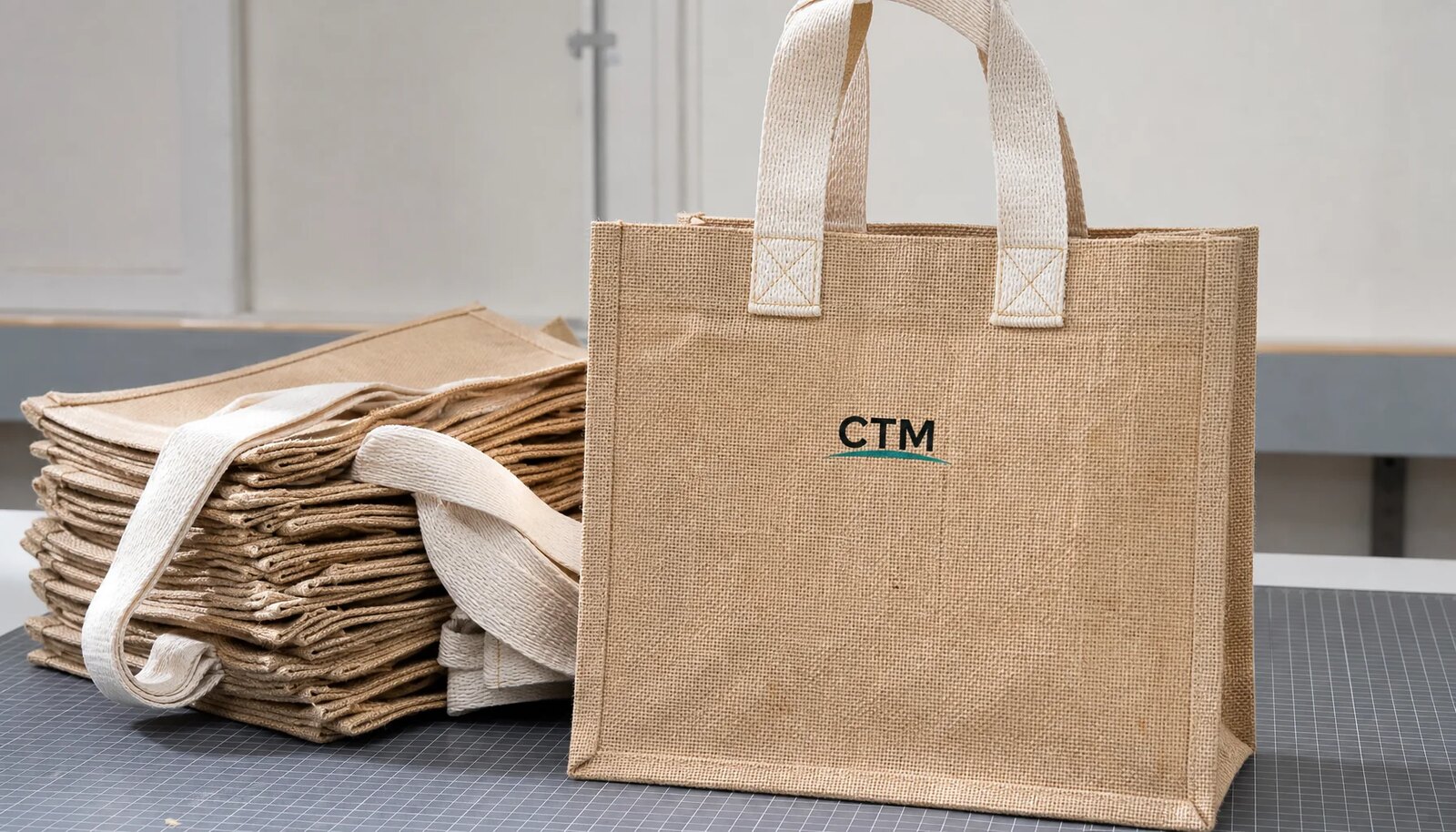
Start With The Event Job, Not A Generic Tote
A useful jute tote bags wholesale buying checklist for event planners starts with the work the bag has to do on site. A registration tote for a badge packet, agenda, notebook, and sponsor inserts is not the same product as a VIP gift bag, resale item, exhibitor handout, or prepacked fulfillment container. If the first supplier message only says "jute tote with logo," each bidder will fill in the missing details in a different way. One quote may assume thin natural jute, no gusset, and simple jute handles. Another may include lamination, a reinforced base, cotton webbing handles, two-side printing, and stronger export cartons. Those prices may sit in the same spreadsheet, but they are not prices for the same bag.
Define the event environment before discussing pennies per unit. Will the bags sit in neat stacks at registration, hang from chair backs, ship to a third-party kitting warehouse, or be handed out empty from a booth? Will attendees carry them for ten minutes, for a full conference day, or between venues? Will the contents include catalogs, glass bottles, folded apparel, boxed samples, tablets, or sharp-edged printed materials? These details shape finished size, gusset depth, handle drop, handle material, reinforcement, carton packing, and timeline buffer.
Procurement should turn those facts into a sourcing brief. Share the target quantity by version, required in-hand date, receiving location, expected filled weight, largest insert size, presentation standard, and sponsor approval process. If the tote is part of a paid sponsorship package, print placement and repeatability may matter more than a slightly lower base price. If it is a broad giveaway, stable supply, clean packing, and practical durability may carry more value than premium trims.
- Identify the role of the bag: registration kit, sponsor gift, VIP item, resale merchandise, booth giveaway, or fulfillment pack.
- List contents by size and weight, including rigid boxes, bottled products, catalogs, laptops, or sharp-edged inserts.
- State how the bags will be distributed: counter stack, chair placement, warehouse kitting, venue handout, or preloaded carton.
- Decide whether the tote must stand upright, fold flat, fit under a chair, or fit into an existing master carton.
- Share the event date, required in-hand date, receiving address, dock rules, appointment needs, and internal approval deadline.
Turn The Brief Into A Measurable Spec Sheet
A strong RFQ converts the event brief into production language. The core measurements are finished width, finished height, gusset depth, handle drop, and handle width. Finished dimensions matter because the cut panels are not the same as the completed bag after sewing, trimming, pressing, folding, and packing. If the tote must hold an A4 folder, US letter folder, legal-size packet, or boxed sponsor gift, provide the actual dimensions and say how the item should sit inside the bag. Words such as medium, large, heavy duty, or premium invite quote variation.
Write tolerance into the specification while there is still time to discuss it. Jute is a natural woven material, so small variation is normal, but buyers should decide what is acceptable before production. For many event tote programs, a finished-size tolerance around +/- 1 cm on critical dimensions is a practical request when the supplier confirms it can control that range. Less critical giveaways may accept wider tolerance. Tightly kitted programs may need stricter checks against the insert size. Handle drop deserves its own tolerance because a small change can decide whether the tote works on the shoulder or only as a hand-carry bag.
Do not let construction details disappear from short quotes. Ask whether the top edge is hemmed, folded, or bound; whether side seams are covered; whether the bottom is flat, boxed, or reinforced; whether the bag includes lamination or lining; and whether raw jute edges are visible inside. These choices affect shedding, presentation, durability, weight, and carton volume. A supplier can quote accurately only when the intended build is written down.
- Specify finished width, height, gusset depth, handle drop, handle width, and tolerance after sewing and pressing.
- Include largest insert dimensions and whether contents must sit flat without bending or protruding.
- Define top-edge finish, side seam treatment, bottom construction, internal binding, lining, lamination, and base reinforcement.
- Ask whether dimensions are measured with the bag flat, open, pressed, folded, or packed.
- Attach a simple annotated line drawing or marked-up reference photo so every supplier measures the same points.
Choose Jute Construction By Use And Load
Jute tote bags are not one commodity item. Natural unlaminated jute gives the textured look many event buyers want, but it can shed fibers, vary in weave, and create a rougher print surface. Laminated jute adds structure, helps the bag stand upright, and usually gives the interior a cleaner feel. It also changes flexibility and may crease or crack if folded too aggressively. Lined jute or jute-cotton blend bags feel more finished and can reduce interior roughness, but they add material, labor, bulk, and freight volume.
Fabric weight needs careful comparison because suppliers may use ounces, GSM, or local shorthand. Many event buyers start evaluating around a 10 oz to 12 oz equivalent for general conference totes, then move lighter or heavier depending on contents, desired structure, and budget. That range is a starting point, not a rule. A paper-insert giveaway may work with less. A kit with catalogs, bottles, or boxed products may need heavier fabric, lamination, stronger handle reinforcement, or a base insert. Ask for a swatch or pre-production sample instead of relying only on a weight number.
Handles deserve procurement attention. Cotton webbing handles are often more comfortable, easier to stitch consistently, and better suited for heavier event kits. Jute handles keep a natural look, but they can feel rougher, twist more easily, and fray if the cut ends are not finished well. The best test is simple: load the sample with the expected contents, carry it the way an attendee will, then inspect the stress points for pulling, distortion, or discomfort.
- Use natural unlaminated jute when texture, cost control, and a classic reusable-bag look are the main priorities.
- Use laminated jute when structure, cleaner interior finish, or upright display matters at registration or sponsor tables.
- Use lined or blended construction when the tote is a premium gift or retail-style item and freight volume is acceptable.
- Request fabric weight, weave description, and a close-up swatch reference before treating two quotes as equivalent.
- Match handle drop and width to carry style: hand carry, elbow carry, or shoulder carry.
Set Artwork Limits Before Final Pricing
Decoration is where many jute tote programs become risky. The woven surface can soften edges, break fine strokes, reduce opacity, and make small sponsor text harder to read than it appears on a digital proof. Bold logos, solid shapes, and limited color counts usually reproduce more reliably than gradients, photographic art, tiny copy, halftones, or dense QR codes. Before approving the design, ask the supplier to review the artwork at actual print size and identify details that may fail on the chosen material.
Screen printing is common for wholesale jute tote bags because it suits bold event logos and one- or two-color sponsor marks. The quote should state the print method, number of colors, screen or setup charges, maximum print area, print side, and whether color matching is included. If the order has several sponsor versions, clarify whether each logo requires a separate screen, separate MOQ, separate packing run, or separate carton label. Two-side printing also adds handling and alignment control, so it can affect lead time.
Color expectations should stay realistic. Natural jute is not a coated white substrate, so ink may look warmer, duller, or more textured than it looks on screen. Pantone references help communication, but the approved strike-off or pre-production sample is the better production reference. For fine artwork, ask about minimum line thickness, minimum text height, and whether the supplier recommends simplifying the mark. As a practical starting point, avoid lines below about 1 mm and very small reversed-out text unless the exact artwork has been tested on the selected surface.
- Send vector artwork and identify the exact artwork version, print size, placement, side, and color references.
- Ask the supplier to flag thin lines, small text, gradients, halftones, QR codes, and tight sponsor lockups before quoting final price.
- Confirm screen charges, color-match charges, maximum print area, one-side or two-side printing, and whether reorders use the same screens.
- Approve a strike-off or PP sample when sponsor brand standards are strict or multiple colors must register cleanly.
- Measure logo placement from the top edge, side seams, and gusset fold, not only by visual centering.
Compare MOQ And Version Rules Honestly
MOQ is not only a sales preference. It reflects setup time, fabric procurement, cutting efficiency, print screens, sewing flow, inspection, and packing labor. A low unit price at 5,000 pieces may be real, but it does not help an event that needs 850 usable bags and has no future use for leftovers. A lower-MOQ supplier may charge more per piece while still reducing obsolete inventory, storage cost, and sponsor-version risk. Compare the total program economics at the quantity the event actually needs.
Ask what the MOQ applies to. Some suppliers set MOQ by total order quantity. Others apply it by bag size, body color, handle color, print version, packing method, or sponsor logo. An order for 2,000 pieces can become four 500-piece production lots if each event track has a different logo or carton label. That changes price, timing, and inspection complexity. Put version counts in the RFQ so the issue is visible before artwork approval.
Clarify overage, shortage, and sample quantities. Custom textile orders can involve small quantity variation because of waste, inspection pulls, print setup pieces, or rejected units. For event programs, a shortage is often more damaging than a small overrun, so the PO should state whether exact quantity is required, whether extra units are acceptable, and how they will be invoiced. If the event repeats annually, separate first-order costs from reorder costs because screens, artwork setup, and sample development may not repeat.
- Ask whether MOQ is per order, per size, per body color, per handle color, per artwork, per packing version, or per delivery destination.
- Quote the actual event quantity and the next price break so procurement can judge whether extra stock makes sense.
- Separate first-order setup charges from repeat-order pricing for recurring conferences or annual programs.
- Confirm whether the supplier allows quantity overage or shortage and how it is invoiced.
- Include extra units for internal samples, sponsor approval, press kits, inspection pulls, and emergency replacements.
Build A Quote Sheet That Shows Landed Cost
A useful supplier quote shows more than a per-bag price. At minimum, it should identify finished dimensions, fabric construction, material weight, handle type, reinforcement, print method, color count, sample cost, setup charges, packing quantity, carton dimensions, lead time, Incoterm, named port or delivery point, and payment terms. Without those details, buyers cannot compare bids fairly. Missing information tends to become a price change, schedule delay, or quality dispute later.
Separate product cost from one-time charges and logistics costs. Product cost usually covers the bag body, handles, sewing, decoration, standard trimming, and ordinary export carton. One-time costs may include pre-production samples, screens, plates, artwork adjustment, color matching, woven labels, hangtags, custom carton marks, or packing development. Logistics costs may include inland pickup, export handling, ocean or air freight, duty, customs brokerage, palletization, delivery appointment fees, liftgate fees, venue receiving charges, or final-mile delivery.
Jute totes are often light but bulky, so freight may be charged by dimensional weight or volume instead of actual weight, especially for courier and air shipments. Carton dimensions, units per carton, gross weight, net weight, and total carton count are not administrative leftovers; they drive landed cost and receiving workload. If the supplier cannot confirm exact carton data during quoting, ask for a best estimate and require final data before mass packing and freight booking.
- Require every bidder to quote against the same spec sheet, artwork, quantity by version, packing method, and delivery term.
- Ask for unit price, sample fee, screen charges, label charges, carton upgrades, and special packing as separate lines.
- Confirm Incoterm and named place: EXW factory, FOB port, CIF port, DAP warehouse, DDP destination, or another agreed term.
- Request carton dimensions, units per carton, gross weight, net weight, total carton count, and pallet option before approving freight.
- Compare landed cost per usable bag, not only the lowest quoted unit price.
Approve Samples As Production Controls
Samples should be treated as production controls, not mood-board pieces. Start by measuring finished width, height, gusset depth, handle drop, and handle width. Then inspect handle attachment, seam straightness, top-edge finish, internal raw edges, bottom construction, odor, shedding, and overall hand feel. Fill the sample with the real event contents or a realistic weight substitute. A tote that looks clean while empty may sag, twist, or strain at the handles once packed.
Print approval needs the same discipline. Check logo size, distance from top and side edges, ink opacity, edge sharpness, small detail legibility, and whether the natural jute color shifts the perceived brand color. Rub the print after curing to check for obvious transfer or scuffing. For multi-color artwork, inspect registration and whether color edges drift on the woven surface. If a sponsor will reject visible inconsistency, attach the approved strike-off to the PO record.
Document exactly what the sample represents. A sales sample may use available stock fabric and approximate printing. A strike-off may only confirm print quality on a material swatch. A true pre-production sample should match the intended fabric, dimensions, handles, seam finish, print, packing, and label. The PO should say which sample controls bulk production. Keep one approved reference sample sealed or clearly labeled for incoming inspection, warehouse receiving, and dispute resolution.
- Measure the sample after sewing, pressing, and packing, not from the cutting pattern alone.
- Test the bag with actual contents or a realistic filled weight before approving bulk production.
- Photograph approved print placement with measurement marks visible and keep the approved artwork proof in the same file.
- Confirm whether the sample is a sales sample, strike-off, development sample, or true pre-production sample.
- Keep an approved reference sample for the receiving team and any third-party inspector.
Write QC Criteria The Factory Can Use
Quality control should be defined before production starts. For jute tote bags, inspection usually centers on size consistency, handle strength, seam security, print quality, cleanliness, odor, packing accuracy, and carton labeling. The buyer does not need a complicated system, but the factory should know what will be checked, when it will be checked, and what happens if goods fail. A written checklist gives everyone a steadier reference than scattered email comments.
In-process checks catch problems while they can still be corrected. At fabric receipt, the factory can check weight, color tone, weave, moisture exposure, stains, and strong odor. During cutting, it can confirm panel size and fabric direction. During sewing, it can check handle placement, box-stitch reinforcement, stitch density, seam straightness, loose threads, and raw edges. During printing, it can check placement, curing, ink coverage, color, registration, and rub resistance. During packing, it can confirm units per carton, carton condition, carton marks, moisture protection, and version separation.
Set defect definitions that match the event standard. Major defects may include wrong artwork, wrong size beyond tolerance, weak or loose handles, severe stains, mold, strong odor, incorrect sponsor packing, missing labels, or cartons that cannot protect the goods. Minor defects may include small loose threads, slight natural weave variation, or small slubs within the agreed appearance standard. If using third-party inspection, provide the inspector with the approved sample, spec sheet, artwork proof, carton label requirements, and packing list before the visit.
- Check dimensions, fabric, handle reinforcement, seam security, print placement, print quality, cleanliness, odor, and carton labeling.
- Define major defects before production: wrong artwork, unusable size, weak handles, severe stains, mold, strong odor, or mixed sponsor versions.
- Define acceptable natural variation, such as minor slubs or weave irregularities that do not affect presentation or use.
- Ask for inline photos at fabric cutting, handle stitching, first print approval, and first packed carton.
- Use the approved sample and signed spec as the inspection reference, not informal email comments.
Plan Packing, Cartons, And Receiving
Packing affects both product appearance and event operations. Jute bags can be crushed, scuffed, stained, wrinkled, or exposed to moisture if cartons are weak, overfilled, underfilled, or stacked poorly. A bag that looks acceptable in a factory photo may arrive with distorted handles or dirty edges if packing is loose. For front-of-house giveaways, presentation matters because attendees, sponsors, and brand teams see the product immediately.
Ask how bags will be folded, nested, bundled, or individually packed. Many buyers want to reduce plastic, but the goods still need protection from dust, moisture, carton rub, and warehouse handling. Options may include bulk inner liners, paper bands, recyclable wraps, or carton-only packing with stronger cartons. The right choice depends on transit route, storage time, humidity risk, and how polished the tote must look at distribution.
Design warehouse receiving into the order. Cartons may need labels by PO number, event name, SKU, sponsor version, event day, venue zone, destination, or fulfillment kit. Carton quantity should support handling as well as freight. A carton of 100 bags may be efficient for shipping but awkward if the fulfillment team packs inserts in batches of 25. Confirm carton dimensions and gross weight so receiving teams can move cartons safely and count units quickly.
- Confirm carton dimensions, units per carton, gross weight, net weight, carton count, and whether pallets are available.
- Specify carton labels with PO number, event name, SKU, sponsor version, quantity, destination, and carton sequence if needed.
- Ask whether cartons are single-wall or double-wall and whether they are suitable for the transit route and stacking plan.
- Match inner bundle quantities to warehouse kitting or venue distribution workflow.
- Choose moisture and scuff protection based on freight mode, storage conditions, and presentation standard.
Protect The Timeline From Approval And Freight Risk
The biggest schedule risk is often not sewing time. Artwork changes, sponsor sign-off, sample transit, payment release, carton label revisions, inspection scheduling, export booking, customs clearance, and final delivery appointments can all consume days before the bags reach the warehouse or venue. Build the schedule backward from the required in-hand date, not the public event opening date. The in-hand date should include time for receiving, counting, kitting, damage review, and emergency fixes.
Ask the supplier to identify the critical path. It may be fabric procurement, lamination, handle material, print screen preparation, sewing capacity, drying or curing time, inspection scheduling, or vessel booking. If the event date is tight, consider whether a split shipment makes sense: a smaller air shipment to cover immediate needs and the main order by sea or truck. Price that option early because bulky totes can be expensive by air even when they are not heavy.
Control approvals through one buyer-side owner. Someone must approve artwork, print size, pre-production sample, color, carton marks, packing method, delivery address, and final shipping documents. If several sponsors are involved, collect their approvals in a structured sequence instead of sending the supplier a stream of changing comments. The cleanest schedule is usually the one where the factory receives complete, signed instructions before bulk work begins.
- Work backward from the required in-hand date and include receiving, counting, kitting, inspection, and emergency buffer.
- Reserve time for artwork review, sample production, sample transit, revisions, production, final inspection, freight, customs, and final delivery.
- Assign one internal owner for artwork approval and one for logistics approval.
- Confirm the supplier's critical path and ask which step is most likely to delay production.
- Approve carton marks, packing list format, commercial documents, and delivery instructions before goods leave the factory.
Specification comparison for buyers
| Spec decision | Recommended option | When it fits | Buyer risk to check |
|---|---|---|---|
| Natural unlaminated jute | Classic woven appearance with a tactile surface and softer structure | Eco-themed giveaways, light registration inserts, simple one-color logos | Confirm fabric weight, shedding, odor, weave variation, exposed raw edges, and whether small logo details remain legible |
| Laminated jute body | Stiffer body with cleaner interior surface and better shape retention | Sponsor kits, front-desk displays, bags that must stand upright, heavier insert packs | Confirm laminate type, lamination uniformity, fold cracking, stiffness, recyclability claims, and print compatibility |
| Jute-cotton blend or lined jute | Softer hand feel and a more controlled interior finish | Premium attendee gifts, VIP packs, retail-style conference merchandise | Verify actual composition, lining seam quality, color consistency, added cost, and higher carton volume |
| 10 oz to 12 oz equivalent body fabric | Practical starting range for many event totes carrying paper inserts | Registration bags, conference handouts, sponsor kits without very heavy products | Do not rely on ounces alone; request swatch, GSM or supplier standard, and filled-weight testing |
| Cotton webbing handles | More comfortable carry and consistent reinforcement stitching | Bags carrying catalogs, notebooks, drinkware, boxed samples, or shoulder-use totes | Check handle width, drop length, colorfastness, box stitch size, stitch density, and pull strength under expected load |
| Jute handles | Material continuity and a natural look | Light giveaways where appearance is more important than long carry comfort | Check rough grip feel, cut-end fraying, handle twisting, and reinforcement at stress points |
| Screen print decoration | Cost-effective for bold artwork, limited colors, and repeat sponsor marks | Most one- or two-color event logos on natural or laminated jute | Confirm maximum print area, screen charges, ink curing, edge sharpness, registration tolerance, and rub resistance |
| Patch, woven label, or hangtag branding | Cleaner branding on rough weave with a more retail detail | VIP gifting, premium sponsor merchandise, brands avoiding large ink areas | Confirm attachment method, needle marks, label placement tolerance, colorfastness, and whether attachment distorts the bag |
| Direct factory program | Better control of custom size, material, print, packing, inspection, and repeat orders | Planned programs with enough lead time and meaningful volume | Confirm whether the supplier controls sewing, printing, and QC directly or only coordinates subcontractors |
Buyer checklist before sampling
- Define the event use case first: registration kit, sponsor gift, VIP bag, retail merchandise, exhibitor handout, or fulfillment packaging.
- List the exact contents the bag must carry, including largest insert dimensions, estimated filled weight, and any rigid, sharp-edged, bottled, or boxed items.
- Specify finished bag width, height, gusset depth, handle drop, handle width, top-edge finish, bottom construction, and acceptable finished-size tolerance.
- Use finished measurement tolerances such as +/- 1 cm for critical dimensions or +/- 2 cm for less critical giveaway programs, adjusted to the supplier's process.
- State jute construction clearly: natural unlaminated, laminated, lined, blended, cotton-webbing handle, jute handle, base-reinforced, or another agreed build.
- Use one fabric reference across suppliers, such as 10 oz, 12 oz, GSM equivalent, or an approved swatch, and require the quoted material to be identified in writing.
- Define print method, print size, ink colors, Pantone references if needed, one-side or two-side placement, and the exact artwork version quoted.
- Ask whether small text, thin lines below about 1 mm, gradients, halftones, QR codes, or fine sponsor marks are suitable for the chosen jute surface.
- Request sample photos showing weave, handle attachment, seam structure, binding, print edge quality, carton packing, and carton labels, not only a front beauty shot.
- Require a pre-production sample or approved strike-off for custom print, custom size, strict sponsor branding, or any order where rejection would affect an event date.
Factory quote questions to send
- What exact jute fabric weight, weave type, lamination or lining status, and construction are you quoting, and what finished-size tolerance do you allow in bulk?
- Are the bags natural, laminated, lined, blended, or reinforced, and what material change would affect stiffness, odor, shedding, print quality, or carton volume?
- What are the finished dimensions, gusset depth, handle drop, handle width, top hem, bottom seam, and handle reinforcement pattern included in the quote?
- Are the handles cotton webbing, jute, or blended material, and what stitch pattern, stitch density, box-stitch size, and load-point reinforcement will be used?
- Which print method will you use for this artwork, how many colors are included, what ink type is used, and what setup, screen, plate, or color-match charges apply?
- Can you review our artwork at actual print size and flag any small text, thin lines, gradients, QR codes, dense sponsor locks, or placement risks on the jute surface?
- What is your MOQ by bag size, fabric color, handle type, print version, and packing version, and does MOQ change if the same base bag carries multiple sponsor logos?
- Can you provide a true pre-production sample, and what will it match exactly: size, fabric, handle, print color, print position, seam finish, packing, and carton label?
- How many business days are required for artwork review, sampling, revision, bulk production, inspection, export documents, booking, and dispatch after final approval?
- What in-process inspections do you perform for fabric receipt, cutting, sewing, handle stitching, printing, curing, trimming, odor, moisture exposure, and packing?
Quality-control points to confirm
- Finished width, height, gusset, handle drop, and handle width measured after sewing and pressing, within the written tolerance agreed on the PO.
- Fabric weight, weave appearance, stiffness, lining or laminate, color tone, and hand feel checked against the approved pre-production sample or sealed swatch.
- Handle stitching secure at both ends, with agreed box stitch or reinforcement, no skipped stitches, loose threads, pulled seams, twisted handles, or weak stress points.
- Side seams, bottom seam, top hem, binding, piping, and internal finish clean enough for the intended presentation standard and free from exposed sharp or loose edges.
- Print placement centered within the approved artwork window, with consistent distance from top edge, side seam, and gusset fold according to the signed proof.
- Ink color, coverage, edge sharpness, curing, rub resistance, opacity, and registration checked against the approved strike-off or pre-production sample.
- No severe slubs, broken fibers, oil marks, stains, water marks, mold, strong odor, excessive lint, exposed raw edges, or fraying that would affect use or presentation.
- Bag opens properly, stands or folds as specified, and carries the planned event contents without obvious distortion, seam strain, or handle discomfort.
- Cartons packed to the approved quantity, with correct SKU or sponsor labeling, clean closure, moisture control if needed, and no crushing or over-compression.
- Packing list, carton marks, PO number, event name, carton count, delivery address, and receiving instructions match the buyer's shipment requirements before dispatch.