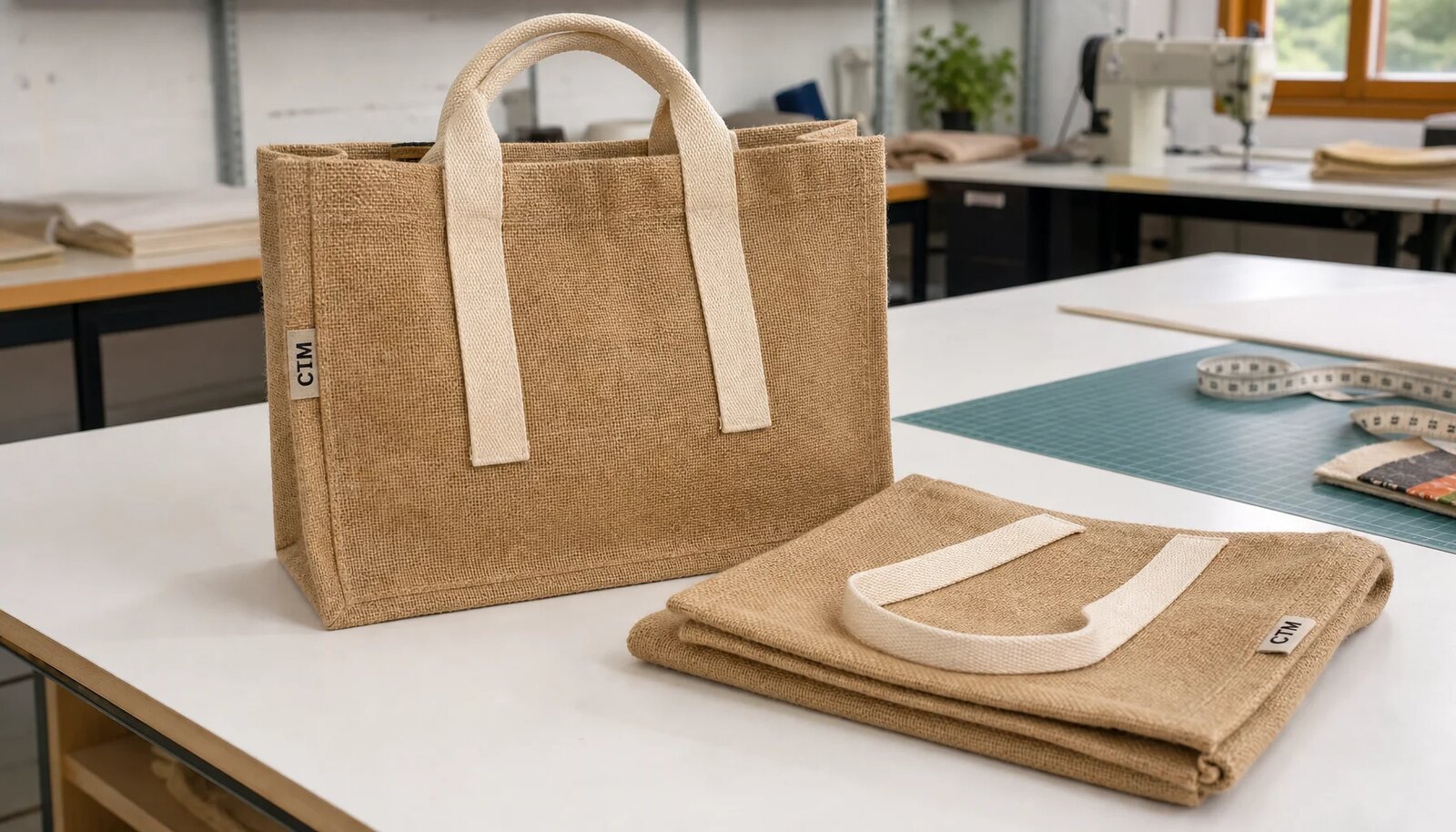
Start With the Bag's Job, Not the Logo
The cleanest wholesale spec starts with the bag's job. Many apparel teams open with artwork, ask for a quote on a jute tote, and hope the supplier fills in the blanks. That usually produces a weak RFQ. A retail carry bag for folded denim is not the same product as an ecommerce insert, a gift-with-purchase bag, or an event giveaway. Each one carries different expectations for size, weight, print durability, and presentation.
For procurement, the fastest way to avoid back-and-forth is to define the actual use case and the heaviest realistic load. Do not use an average purchase basket if the bag will sometimes carry a hoodie, trousers, and a boxed accessory together. If the bag is sold at checkout, it should still feel presentable after 20 to 30 minutes of customer use. If it sits in a warehouse and gets inserted later, the bag needs to pack flat and survive handling without scuffing or odor issues.
A usable RFQ should include finished width, height, gusset depth, handle drop, opening width, closure requirement, print position, label position, and pack format. State whether the tote must stand upright, fold flat, hang from a display hook, or fit inside an apparel mailer. That lets suppliers quote the same product instead of guessing at a generic tote.
- Define the use case as retail carry, gift-with-purchase, event giveaway, ecommerce insert, or reusable customer tote.
- Use the heaviest realistic apparel bundle as the load reference and write that load into the spec.
- State whether the tote must stand upright, fold flat, hang on display, or ship inside another carton.
- Give suppliers one complete RFQ package: dimensions, GSM, handle build, branding, packing, and delivery terms.
Translate Brand Positioning Into a Real Jute Spec
Eco apparel brands often choose jute because it signals natural texture, reuse, and a lower-gloss retail presentation. That does not mean every natural-looking bag works commercially. Raw jute can shed fibers, show shade variation, and carry an earthy odor. Those traits may fit a rustic or artisan label. They may feel wrong for a minimal premium brand that sells pale garments, clean typography, and a tight visual system.
Set the material language carefully. If the bag includes cotton handles, a lining, lamination, a zipper, a PVC window, or coated decoration, the product is no longer just a plain jute tote. Procurement should align the spec with marketing before the PO is placed so the retailer description, hangtag copy, and compliance file all describe the same construction. If the brand wants to claim natural or sustainable material use, ask for the composition in writing and avoid broad claims the supplier cannot support.
Natural shade control matters more than many teams expect. Jute is not a uniform beige cloth. Batches can vary from lighter straw tones to darker brown tones, and print contrast changes with them. Approve a shade band using physical samples, not only screen photos. If the tote will touch light-colored apparel or sit in a back room, ask for a rub, odor, and storage check because a technically acceptable bag can still be a poor customer experience if it smells damp or sheds too much fiber.
- Write material composition clearly, including body fabric, handles, lining, lamination, labels, and closures.
- Approve a natural shade range with physical samples instead of expecting perfect color uniformity.
- Align procurement specs with marketing claims before artwork, hangtags, or retailer copy are finalized.
- Check odor, moisture, and fiber transfer if the tote will touch apparel or sit in warehouse storage.
Choose GSM, Handles, and Reinforcement by Channel
Construction determines whether the bag feels deliberate or disposable. A lightweight promo tote may use roughly 280 to 320 GSM jute and minimal reinforcement. That can work for a handout or short campaign. It will usually feel thin for paid retail use. A structured apparel tote often needs 350 to 450 GSM, especially when the bag has a wide gusset or larger front panel. Higher GSM improves body and visual weight, but it does not replace proper stitching or handle anchoring.
Lining and lamination should have a reason. A laminated inner face can improve structure and help with moisture resistance, but it changes the hand feel and can complicate the brand story. A fabric lining can make the tote feel more finished and protect garments from raw fibers, but it adds labor and cost. An unlined raw jute tote is often the right answer for eco apparel brands if the seams are secure and the buyer accepts the natural texture. Do not approve a coating just because a supplier says it is standard.
Handles deserve their own line item in the quote. Cotton webbing is usually the most comfortable option for apparel retail because it sits better in the hand and on the shoulder. A 30 to 38 mm web handle is common for a clean retail look. Narrow handles can cut into the hand when the bag is loaded. Jute rope looks rustic but can feel abrasive and is harder to secure consistently. For repeat-use programs, specify handle material, width, total length, drop length, and attachment stitch pattern, then verify the build with a load test.
- Use 280 to 320 GSM for lighter promotional programs and 350 to 450 GSM for more structured retail totes.
- Specify lining or lamination only when it supports the use case, moisture requirement, or garment-contact requirement.
- Define handle material, width, drop, attachment stitch, and color as separate quote fields.
- Require reinforcement at handle anchors, top hem, side seams, and bottom stress points for repeat-use programs.
Compare Sourcing Routes Before You Compare Unit Price
The lowest unit price is not always the lowest-risk route. A direct factory is usually the right fit when the buyer needs custom dimensions, repeatable construction, and tighter control over sewing and print placement. A trading company can be useful when the order includes bags plus trims or other accessories, but the buyer needs transparency about where production actually happens. A stock blank program with local overprint can be the fastest route for launches and event programs, but it gives limited control over GSM, handle length, shade, and reinforcement.
The supplier model affects communication and accountability. If sewing happens in one place, printing in another, and packing in a third, the schedule depends on handoffs. That can work if the supplier manages it well and discloses it clearly. It becomes a risk when the buyer assumes full-package production and later learns that decoration was outsourced without a final inspection before packing. Ask who owns the golden sample, who approves bulk print, and who is responsible if the final bag fails inspection because of a subcontracted step.
Documentation expectations should match the route. A direct factory should be able to provide production photos, packing-room photos, sample records, and confirmation of the processes it controls. A trader should identify the actual manufacturer and explain the QC plan. A regional converter should disclose whether imported blanks come from consistent sources and whether those blanks are the same batch used for the sample. For eco apparel brands selling to retailers, the best supplier is the one that can repeat the approved spec and provide the paper trail your buyer, merch team, or retailer will ask for.
- Use a direct factory for custom repeat programs where construction control is important.
- Use a trading company when consolidation matters, but ask for factory disclosure and QC responsibility.
- Use stock blanks for speed only after confirming GSM, handle build, odor, and shade consistency.
- Treat undisclosed outsourcing as a schedule and quality risk, especially for printing and packing.
Normalize Every Quote With a Line-by-Line Cost Template
Jute tote quotes are hard to compare when suppliers include different assumptions. One supplier may price 350 GSM raw jute with cotton web handles, a one-color screen print, individual polybags, and export cartons. Another may price 300 GSM, shorter handles, no reinforcement, and loose bulk pack. Both can be described as a natural jute tote bag. Procurement should send a line-by-line cost template so each supplier confirms the same body fabric, handle, print, label, packing, carton, sample, and freight assumptions.
A useful quote separates body material, handle material, sewing, decoration setup, decoration run charge, labels or trims, packing materials, master cartons, testing, documentation, and export handling. Ask suppliers to identify what is included in the unit price and what is a separate charge. Print screens, artwork revisions, barcode labels, insert cards, carton marks, and special packing all move the number. For small orders, setup charges can matter more than unit price. For larger orders, carton cube and freight efficiency can change the winner even when the FOB price looks higher.
Use the same incoterm and quantity breaks for all suppliers. Ask for pricing at realistic volumes such as 500, 1,000, 3,000, and 5,000 pieces if those are possible order levels. Require the same pack method for each quote because carton volume affects landed cost. If one quote is EXW and another is FOB, convert them before comparison. If one supplier quotes by email without dimensions, GSM, or carton details, do not treat it as a final commercial offer.
- Create a quote template with separate fields for fabric, handles, sewing, print, labels, packing, cartons, and shipping terms.
- Ask for quantity breaks and confirm MOQ by size, body color, handle color, and artwork version.
- Compare suppliers using the same incoterm, carton count, carton dimensions, and pack format.
- Watch for hidden savings created by thinner fabric, shorter handles, fewer stitches, smaller print area, or loose bulk packing.
Set MOQ, Sampling, and Golden Sample Rules Early
MOQ should be tied to production reality, not treated as a vague supplier preference. Stock blank totes with simple overprint may be available in the low hundreds if inventory already exists. A custom size, custom handle color, custom lining, or nonstandard print usually raises the minimum because the factory must buy material, set up cutting, and manage separate production lots. Multiple body colors, handle colors, and artwork versions can multiply the real MOQ even when the total order looks healthy.
For brands running several seasonal graphics or store versions, ask for both total order MOQ and per-SKU minimums. A supplier may accept 3,000 pieces total but require 500 or 1,000 pieces per artwork. That matters before the design team finalizes the collection. Ask whether the supplier can gang print similar designs, combine handle colors, or use one body construction across several graphics to reduce complexity. Procurement can often protect cost by standardizing the build while allowing limited artwork variation.
Sampling should be staged and documented. A reference sample shows the supplier's existing workmanship. A construction sample confirms size, GSM, handle drop, seam structure, and hand feel. A pre-production sample confirms the actual artwork placement, print method, labels, trims, and packing. The golden sample is the signed physical standard used for bulk production and inspection. Do not rely only on photos for final approval. On jute, texture, odor, print absorption, and shade are hard to judge on screen.
- Ask for MOQ by total order, size, body color, handle color, and artwork version.
- Standardize bag construction where possible and vary only artwork or labels to reduce production complexity.
- Approve samples in stages: reference, construction, pre-production, and golden sample for custom orders.
- Keep signed physical golden samples with both buyer and supplier for reorder and inspection control.
Select Branding That Works on Real Jute Texture
Jute is not a smooth canvas. Its woven texture, natural slubs, and uneven surface affect print sharpness. Fine type, thin lines, gradients, and tiny icons may disappear or look broken after production. For most wholesale jute tote bags, a simple one-color screen print gives the best balance of cost, readability, and durability. It works well for logos, brand marks, and short campaign messages when the print panel is flat enough and the artwork has enough line weight.
Screen printing is not the only option. Heat transfer can support detailed artwork or smaller runs, but it should be tested for abrasion, folding, and edge lift. Embroidery can look premium, but dense stitches on coarse jute may pucker unless the panel is backed correctly. Woven labels, side tabs, and sewn patches are often a strong choice for eco apparel brands that want understated branding and longer wear life. A label also avoids covering a large natural jute area with ink, which may better match a restrained design language.
Artwork should be engineered for the material. Increase line thickness, avoid tiny reverse type, and keep the logo away from seams, folds, and gusset edges. Define the printable area and placement tolerance in millimeters. If the logo must be centered, specify whether it is centered to the front panel, the bag opening, or the visible area after folding. For multi-color prints, ask for a strike-off on the same GSM and texture because registration on jute is less forgiving than on smoother fabrics.
- Use screen print for simple logos, larger runs, and strong readability on flatter jute panels.
- Use woven labels, side tabs, or patches when premium feel and long wear are more important than large graphics.
- Avoid fine type, thin lines, gradients, and artwork placed too close to seams or folds.
- Approve a physical print strike-off on the same jute quality before bulk production starts.
Specify Packing for Retail Presentation and Freight Cube
Packing is a commercial choice, not an afterthought. A jute tote can arrive looking premium or cheap depending on how it is folded, stacked, protected, and carton-packed. Bulk flat packing is usually the most freight-efficient option and works well when bags are stored in a warehouse or inserted into apparel orders later. Nested packing may preserve shape better for structured totes. Individual polybags protect against dust and handling marks, but they add labor, material, and waste.
Decide whether the bag is retail-ready or warehouse-ready. A retail-ready tote may need a hangtag, barcode, insert card, belly band, or size label. A warehouse-ready tote may only need bulk pack with a carton label that supports receiving and inventory control. If totes are going to multiple stores, ask whether the supplier can pack by store allocation or SKU split. If the tote is part of a gift-with-purchase campaign, carton labels should identify the campaign name, artwork version, and quantity so distribution errors do not happen at the dock.
Carton specifications should be written before production starts. State the number of units per carton, carton dimensions, gross weight limit, shipping marks, label placement, and any pallet or forwarder requirements. Heavy cartons create handling damage. Oversized cartons increase freight cube and can collapse in transit. For ocean shipments or humid lanes, moisture protection may be needed. Jute can absorb moisture and retain odor, so packing areas and cartons should be dry. Ask whether cartons will include inner liners, desiccants, or other moisture control if the route justifies it.
- Choose bulk flat pack for freight efficiency and individual or belly-band packing only when presentation requires it.
- Define carton quantity, dimensions, gross weight, shipping marks, and barcode or store-allocation requirements.
- Keep fold lines away from key logo areas whenever possible and approve the fold method before bulk packing.
- Add moisture protection or stricter storage requirements when shipping through humid lanes or long ocean transit.
Write QC Thresholds Into the PO, Not After Inspection
Quality control for jute tote bags should be practical, measurable, and agreed before production. Natural fiber variation is expected. Functional failure is not. The PO should define critical, major, and minor defects. Critical defects may include contamination, mildew, unsafe sharp objects, or incorrect materials. Major defects usually include wrong dimensions, weak handle attachment, broken seams, missing labels, incorrect artwork, off-center print beyond tolerance, wrong packing, or carton quantity mismatch. Minor defects may include small thread ends, slight natural slubs, wrinkles, or acceptable shade variation within the approved range.
Set measurable tolerances. Finished dimensions might be allowed plus or minus 5 mm for smaller totes and plus or minus 10 mm for larger totes, but the exact tolerance should match the product. Print placement should have a stated tolerance, commonly 2 to 3 mm for centered logos when the construction allows it. Handle drop should be checked because a tote that looks fine on a table may not fit comfortably over the shoulder if the handle is short. Stitch pattern, thread color, reinforcement layout, and seam alignment should be compared against the golden sample.
Functional testing matters. A static load test should reflect the intended use, not an arbitrary number. If the bag is expected to carry 3 kg of apparel, test at 4.5 kg. If it is intended for 5 kg, test at 7.5 kg. Hold the load for a defined period and check for seam opening, handle tearing, distortion, and broken stitches. For decoration, add a rub check or fold check to see whether ink cracks, flakes, or transfers. For garment-contact programs, check for fiber shedding and odor, especially if the bags will be packed near apparel.
- Define critical, major, and minor defects before production starts.
- Set written tolerances for size, handle drop, print placement, shade range, and thread trimming.
- Use load testing, print rub checks, odor checks, and carton verification as part of final QC.
- Inspect against the signed golden sample, not against memory or digital artwork alone.
Confirm Documentation and Claim Support Before Public Marketing
Eco apparel brands often need more than a finished tote. Retailers, marketplaces, and internal compliance teams may ask for material composition, supplier information, restricted-substance expectations, country-of-origin details, and packaging information. If the tote is marketed as natural, reusable, plastic-free, recyclable, biodegradable, or sustainable, the buyer should confirm what evidence supports that language. Procurement should not wait until the product page or hangtag is ready to discover that the supplier can only provide a generic invoice description.
Ask suppliers for written material breakdowns and any available compliance documents early in the RFQ process. The exact documentation needed depends on your market, retailer requirements, and internal policy. A supplier may provide composition statements, certificates where applicable, audit documents, test reports, or declarations for specific requirements. Do not assume that every jute factory has the same file set. If a retailer requires a specific test or format, name it in the RFQ and ask whether the supplier can meet it before quoting.
Be precise with environmental language. A raw jute body with cotton handles and a paper belly band is different from a laminated jute bag with synthetic lining and plastic packaging. Both may be commercially valid, but they should not be described the same way. If the bag includes lamination, coatings, or mixed-material trims, the end-of-life story changes. For B2B buyers, the safest approach is to describe materials accurately and avoid claims that are broader than the evidence. That protects the brand from avoidable compliance and credibility problems.
- Request material composition and compliance documents during RFQ, not after production.
- Avoid broad sustainability claims unless the supplier can support them in writing and your team has reviewed the language.
- Document any lamination, lining, coating, plastic packaging, trims, or mixed-material components.
- Keep spec sheets, sample approvals, inspection reports, and material statements in the same procurement file.
Specification comparison for buyers
| Spec decision | Recommended option | When it fits | Buyer risk to check |
|---|---|---|---|
| Direct factory in a jute manufacturing cluster | Best for custom size, handle build, sewing, and print control | You have a written spec, repeat orders are likely, and the brand needs the same construction every season | Verify whether cutting, sewing, printing, and packing are all in-house; ask which steps are subcontracted |
| Trading company with a factory network | Useful when you need one commercial contact and consolidated export handling | You are buying bags plus other trims or accessories and want simplified coordination | Request factory identity, process ownership, and a line-by-line spec sheet so margin does not hide substitutions |
| Stock blank bag with local overprint | Fastest route for launches, events, and market tests | You need a short lead time and can accept limited size, GSM, and handle options | Hold a physical reference sample because stock blanks can change by lot, shade, or supplier |
| Regional converter using imported blanks | Good for lower MOQs and domestic decoration | You want local artwork approval, faster proofs, or simpler import management | Check imported blank consistency, odor, handle attachment, and whether blank stock is traceable |
| Full-package factory with in-house printing and packing | Best for one supplier, one schedule, and one QC owner | You want fewer handoffs and cleaner responsibility for export-ready cartons | Confirm that print, packing, and carton labeling are really done in-house and not shifted late in the process |
| Factory with outsourced specialty decoration | Useful for foil, embroidery patch, puff print, or other nonstandard finishes | Your artwork needs a decoration method the bag factory does not run internally | Build schedule buffer and approve a decorated pre-production sample before bulk starts |
| Pilot order with a backup supplier | Best for new brands, retailer trials, and first-season volume uncertainty | You are validating sell-through, customer reuse, or store feedback | The backup supplier must quote the same specification, not just the same style name |
| Audited sustainable specialist | Best when retailers need material, social, or compliance paperwork | You need written support for composition claims, restricted-substance expectations, or audit files | Do not rely on marketing language; request current documents and state which claims may be used |
| Custom retail tote with reinforced build | Best for premium apparel packaging and repeat-use customer carry | The bag is part of the customer experience and may be reused after purchase | Higher GSM alone is not enough; check handle attachment, base support, seam strength, and a load-test target |
Buyer checklist before sampling
- Define the end use: retail carry, gift-with-purchase, event giveaway, ecommerce insert, or reusable customer tote.
- State the intended load in kilograms and use the heaviest realistic apparel bundle as the test reference.
- Lock finished width, height, gusset depth, handle drop, opening width, and whether the bag must stand upright.
- Set the body material spec: jute, burlap, or hessian terminology, target GSM, and whether you need lining or lamination.
- Approve the natural shade range with a physical sample instead of expecting perfect color uniformity across batches.
- Define handle material, width, finished length, drop length, and attachment method before asking for pricing.
- Specify reinforcement points at the handle anchors, top hem, side seams, and bottom corners.
- Approve branding method, print color count, artwork size, placement tolerance, and any no-print zones near seams or folds.
- State MOQ by total order, size, body color, handle color, and artwork version so quotes are comparable.
- Require a reference sample, construction sample, pre-production sample, and signed golden sample for custom orders.
Factory quote questions to send
- What is the exact GSM range, and is the quote based on finished fabric weight or base fabric weight before decoration?
- What is the fiber composition of the body, handles, lining, labels, and any reinforcement material?
- What finished dimensions, gusset depth, and dimensional tolerance are included in the quote?
- What handle material, width, total length, and handle drop are included in the unit price?
- What stitch pattern is used at the handle anchor: straight stitch, bar-tack, box stitch, or X-box stitch?
- How many stitch rows are used at the top hem and side seams, and is there any reinforcement tape or backing inside the bag?
- What print method, color count, print area, setup charge, and ink limitation are included?
- Can you provide a strike-off or photo proof on the same GSM and texture we are quoting?
- What is the MOQ per size, per body color, per handle color, and per artwork version?
- What sample stages do you offer, how long does each stage take, and is the sample charge refundable against bulk?
Quality-control points to confirm
- Fabric weight matches the agreed GSM range and the approved shade band, with no holes, mildew, oil marks, or severe thin spots outside the reference sample.
- Finished width, height, and gusset depth stay within the written tolerance, commonly plus or minus 5 mm for smaller totes and plus or minus 10 mm for larger totes unless the buyer sets a tighter limit.
- Handle drop matches the approved sample and stays within the stated tolerance, commonly plus or minus 5 mm.
- Handle material, width, length, and color match the approved spec sheet and golden sample.
- Handle anchors use the agreed stitch pattern, with no skipped stitches, loose lock threads, broken yarns, or visible thread tails longer than the buyer allows.
- Top hem, side seams, and bottom corners remain secure and square when the bag is lightly loaded.
- Print placement stays within the agreed tolerance, often 2 to 3 mm for centered logos, with no major bleeding, ghosting, missing ink, or heavy cracking.
- Printed colors are checked against the approved reference while allowing realistic variation caused by natural jute texture and fiber tone.
- Labels, hangtags, barcodes, inserts, and care or composition statements match the PO and approved artwork files.
- Odor, moisture, and fiber shedding stay within acceptable limits, with no musty, chemical, or damp-storage smell.