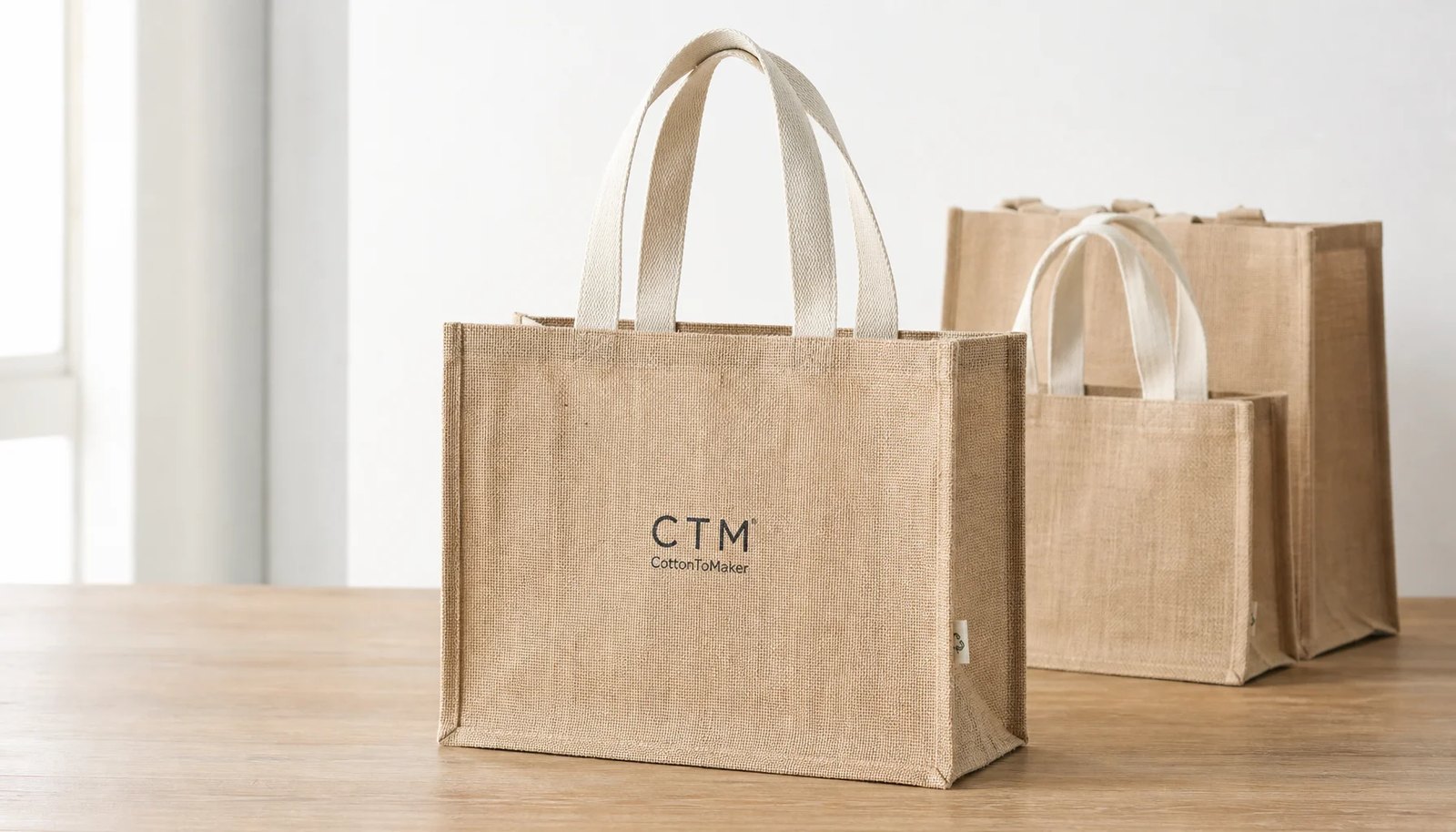
Start With the Campus Use Case
Jute tote bags for university bookstores sound simple until the buyer compares actual needs. A paid retail tote sitting beside sweatshirts needs cleaner sewing, a stable shape, a better front panel, and consistent logo placement. A one-day giveaway can be simpler. An orientation kit bag has another job altogether: it may be packed before arrival week with folders, bottles, apparel, maps, and printed materials, then stored by event date. In that case, gusset depth, handle strength, and carton organization matter more than a premium hangtag.
Most sourcing problems begin with a vague RFQ: “jute tote bag with logo.” Suppliers then make their own assumptions. One factory may quote 240 GSM unlaminated jute, narrow handles, and a flat body. Another may quote 300 GSM laminated jute, cotton webbing handles, and a box-bottom gusset. Both may look acceptable in email photos. They are not the same product, and they will not carry the same cost, carton volume, or load performance.
Write the program into the specification before asking for price. The best wholesale spec is the one that matches expected load, resale price, brand exposure, storage conditions, and delivery deadline. Heavier fabric may support a higher retail price, but it increases bulk. Lighter fabric may fit a promotion budget, but it may not survive textbook use. Splitting the requirement by campus program keeps quote comparison fair and prevents a supplier from winning on an assumption the buyer never intended.
- Retail merchandise tote: require cleaner front panels, consistent logo placement, UPC or hangtag readiness, and stronger cosmetic inspection.
- Checkout shopping bag: prioritize cost, replenishment speed, carton efficiency, one-color print, and practical handle comfort.
- Orientation or admissions kit: prioritize load capacity, wider gusset, reinforced handles, event labeling, and on-time delivery before distribution week.
- Alumni or donor gift: prioritize better fabric selection, lower odor, premium-looking handles, and tighter cosmetic defect limits.
- Conference or event giveaway: prioritize fast artwork approval, packing by venue or department, and a lead time that still allows inspection.
- Department program bag: control SKU complexity because each logo, color, destination, or label can create separate setup and packing work.
Write a Factory-Ready Specification
A strong buying checklist turns into a one-page technical sheet. That sheet should tell every supplier exactly what to quote: finished dimensions, jute GSM, lamination, handle material, handle drop, construction, print method, logo size, label requirements, packing method, carton marks, inspection requirements, and delivery terms. This is far more useful than asking for “best quality,” which can mean premium retail grade to one factory and low-cost promo grade to another.
Use finished dimensions after sewing. For example, write 40 cm width x 36 cm height x 15 cm gusset, measured before packing compression. Then define the body: flat, side-gusseted, box-bottom, or folded gusset. Handle drop should be stated separately from handle length. A 35-40 cm drop often works for shoulder carry, while a shorter drop may be enough for checkout bags. Webbing width belongs in the same line because a narrow handle can feel harsh when the bag is loaded with books.
Tolerances should be set before sampling, not debated after inspection. A practical baseline is ±1 cm for body width, height, and gusset; ±1.5 cm for handle drop; and a written logo-placement tolerance such as ±0.5 cm or ±1 cm depending on artwork and factory capability. Jute can shift during cutting, sewing, and printing, so tighter limits must be confirmed on real samples. If brand alignment is critical, make the acceptable range measurable.
- Use finished size, not cutting size, in all quote requests and purchase orders.
- Specify body construction, bottom style, side gusset, seam type, and whether reinforcement comes from stitching, folding, or lamination.
- Record handle material, handle width, handle drop, stitch pattern, thread color, and reinforcement method on the approved sample sheet.
- List logo size in centimeters and placement from fixed reference points such as top edge, side seam, or bottom fold.
- State tolerances for body dimensions, handle drop, print size, logo placement, and carton quantity before mass production.
- Attach a SKU matrix so suppliers can price each size, artwork, color, label, and destination without guessing.
Select Jute GSM and Fabric Grade
Fabric weight drives both performance and cost. For many university bookstore retail totes, 260-320 GSM is a practical range: enough body for books and merchandise without pushing carton volume too high. A 220-240 GSM bag can work for a light giveaway, but it may feel loose, show more weave gaps, and struggle with dense loads. A 340 GSM or heavier bag can look more structured and premium, yet it costs more, ships bulkier, and may fold less cleanly.
Do not buy by GSM alone. Two fabrics marked 280 GSM can behave differently because of weave density, yarn thickness, finishing, and fiber consistency. A tight 280 GSM cloth may print and carry better than a loose 320 GSM cloth with weak yarn clusters. Ask for swatches from the fabric source planned for production, then compare them under normal store lighting. Look closely at the logo panel, not just a corner. Slubs and coarse yarns can interrupt artwork.
Natural jute will never look like smooth cotton canvas. Small slubs, shade movement, and uneven yarn texture are part of the material. The QC standard should separate natural character from defects that reduce function or retail value. Holes, mildew, oil stains, heavy discoloration, weak yarn clusters, and large loose fibers in the print area should be rejected. If the front panel is the retail-facing side, ask the factory to sort cleaner panels for printing where practical.
- 220-240 GSM: consider only for light giveaways, very short-use events, or cost-sensitive promotional bags.
- 260-280 GSM: useful for entry retail totes, checkout bags, and moderate bookstore loads.
- 300-320 GSM: stronger choice for reusable bookstore totes with gussets and shoulder handles.
- 340 GSM and above: more premium and structured, but heavier to ship and bulkier to carton.
- Swatch rule: compare suppliers only after GSM, weave, lamination, and handle construction are matched.
- Defect rule: accept minor natural slubs, but reject holes, mildew, oil marks, severe shade mismatch, weak yarn clusters, and front-panel stains.
Choose Lamination Carefully
Inside PP lamination gives a jute tote more body, reduces fiber shedding, and adds limited moisture resistance. That can help on rainy campuses, in grocery-style bookstore purchases, or when bags carry bottles, snacks, or hard goods. Lamination can also help a tote stand better on a shelf. The tradeoff is real: added cost, a different handfeel, possible odor, crease risk, and more complicated sustainability messaging.
Unlaminated jute has a more natural feel and often fits a rustic bookstore story better. It may be easier to position as a natural-fiber product when the full construction supports that claim. But raw interiors shed more, absorb moisture faster, and collapse more when empty. If the bag will sit near apparel, check whether fibers transfer onto clothing. If it will be used for kits, test whether it holds shape while staff pack it.
Do not accept vague lamination language in the quote. Ask whether the lamination is inside only, clear or matte, how evenly it covers the interior, and how the factory controls odor and delamination. Review the folded sample, because problems often show at creases, corners, and gusset folds. If campus marketing wants to use words such as natural, reusable, eco, plastic-free, biodegradable, or compostable, verify that the actual material mix supports the claim. The word jute is not enough.
- Use lamination for better body, reduced shedding, light moisture resistance, grocery-style use, or display stability.
- Avoid lamination when the product story depends on an uncoated natural handfeel or reduced plastic content.
- Specify clear or matte interior finish and review odor, bubbling, peeling, and crease marks on a physical sample.
- Check whether lamination changes print performance, fold method, pieces per carton, lead time, and freight CBM.
- Align marketing language with the actual construction; laminated jute should not be described as plastic-free.
- Compare laminated and unlaminated quotes separately because material cost, performance, claims, and packing behavior differ.
Size the Bag for Real Bookstore Loads
Bookstore totes carry dense, awkward items. Two textbooks, a binder, a hoodie, and a drink bottle can stress the handles and bottom seams more than a typical promotional insert. Start with the merchandise, not a catalog size. Practical retail formats often sit near 38 x 35 x 12 cm or 40 x 36 x 15 cm, but the right answer depends on textbook formats, apparel mix, kit contents, display fixtures, and shipping constraints.
A flat tote may be fine for a light giveaway. For paid retail, orientation kits, and reusable shopping bags, side-gusseted or box-bottom construction is usually stronger and more useful. The gusset helps the bag accept rectangular items and reduces stress at the corners. Send the supplier a loading list or a photo of intended contents. If staff will pack kits before distribution, test whether the sample can be filled quickly without tearing seams or distorting the printed panel.
Handles deserve the same scrutiny as the body fabric. Cotton webbing is common because it is softer than jute rope and more comfortable under weight. A 2.5-4.0 cm webbing width usually feels better than narrow tape, and a 35-40 cm drop works for many shoulder-carry totes. For heavier loads, require box-cross stitching, bar tacks, or another approved reinforcement pattern. Dark dyed handles need color-transfer checks, especially after humid storage or long transit.
- Measure sample capacity using actual bookstore items or an equivalent weighted load, not empty-bag appearance.
- Use gusseted or box-bottom construction when the tote must hold books, apparel, folders, drinkware, or kits.
- State finished dimensions as width x height x gusset and confirm the measurement method with the inspector.
- Specify handle material, width, drop, color, thread, reinforcement pattern, and acceptable stitch quality.
- For shoulder carry, test comfort and clearance with the intended bag height and load.
- Check dyed handles for dry rub, damp rub where relevant, and color transfer after packed-contact simulation.
Adapt Artwork to Jute Texture
Screen printing is usually the most practical logo method for jute tote bags with one to three solid colors. It works well for bookstore names, simplified university marks, department logos, event graphics, sponsor marks, and bold type. The limitation is the fabric. Jute is coarse, uneven, and absorbent compared with cotton canvas. Fine lines, tiny legal text, gradients, and detailed crests may break, fill in, or print unevenly.
Heat transfer can reproduce more colors and finer detail, but it needs testing on the exact jute. Check adhesion, edge lift, surface texture, and handfeel. A transfer may sit on top of the fabric rather than blending into the natural surface, which may or may not fit the bookstore’s design direction. Embroidery can work for small marks, but it is usually less practical for large front graphics because it adds cost, weight, and distortion risk. Digital mockups help with layout only; they do not prove production quality.
The artwork file should be production-ready: vector format, Pantone or approved color targets, final print size, placement from fixed edges, and minimum line thickness. Keep important text away from seams, gussets, handle attachment zones, and bottom folds. Before mass production, approve a print strike-off or pre-production sample on the actual jute with final ink and curing. During inspection, judge against the retained sample while allowing normal jute texture. Reject missing letters, heavy bleeding, major color deviation, severe crooked placement, and poor curing.
- Use screen print for simple 1-3 color campus logos, bookstore names, and event artwork.
- Ask the factory to confirm minimum line thickness and spacing for the chosen jute fabric.
- Simplify crests, small type, gradients, and thin outlines before production screens are made.
- Set logo size and placement in centimeters from fixed bag reference points.
- Approve actual print on actual jute; do not release bulk production based only on a digital mockup.
- Test cured print for rub transfer, cracking, smearing, edge lift, registration, and color match.
Control MOQ, SKUs, and Quote Math
MOQ is shaped by fabric purchasing, cutting yield, handle preparation, print setup, production scheduling, packing labor, and export documentation. Many practical wholesale programs start around 500-1,000 pieces per size, artwork, and color, though some factories may accept less at a higher unit price. Ask for price breaks at 500, 1,000, 2,500, and 5,000 pieces when demand is not fixed. The breaks show where setup costs become more efficient.
University orders can become complicated fast. Admissions may want one logo, alumni another, athletics a third, and the bookstore floor may need UPC labels or hangtags. Each change can affect setup, packing, and inspection. Build an SKU matrix before final pricing. Include body size, jute GSM, lamination, fabric color, handle color, artwork, label, quantity, destination, and delivery date. Otherwise a “2,000-piece order” may actually be four 500-piece production lots.
Compare more than unit price. Ask suppliers to itemize screen charges, artwork setup, sample fees, courier fees, hangtag application, UPC labeling, individual polybags, stronger cartons, moisture protection, and inspection support. Request carton dimensions, gross weight, net weight, total carton count, and total CBM. A low FOB price can become expensive if cartons are bulky, weak, poorly labeled, or inefficient for bookstore receiving.
- Define each SKU by size, GSM, lamination, fabric color, handle color, logo version, label, packing method, and destination.
- Treat artwork changes, fabric color changes, handle color changes, and lamination changes as possible separate production lots.
- Request price breaks for 500, 1,000, 2,500, and 5,000 pieces when inventory planning is not fixed.
- Ask whether departments can share one base bag and split only the print run.
- Compare quotes using the same Incoterms, payment terms, sample assumptions, packing data, and inspection expectations.
- Separate bag cost from print setup, labels, hangtags, carton upgrades, moisture protection, courier fees, and freight data.
Approve Samples With Records
The pre-production sample should represent the final bag, not just the general idea. It should use the final jute GSM, lamination choice, handle material, handle drop, stitch pattern, print method, logo size, ink color, label placement, and packing fold. If the factory sends a sample made from stock fabric, mark it as a reference sample only. It can help with size and shape, but it should not release bulk production if final materials will differ.
Document sample approval with measurements and photos. Record width, height, gusset, handle drop, handle width, print size, logo placement, seam construction, handle reinforcement, lamination condition, and packed fold. Photograph the front, back, inside, bottom, side gussets, handle attachments, labels, and carton mockup if available. Load the bag with the expected contents or an agreed weight, then record whether seams, handles, or fabric distort.
Keep retained samples on both sides. The buyer, distributor, or procurement office should keep one approved sample, and the factory should keep one for production reference. Final inspection should compare mass production against those retained samples. For brand-sensitive university marks, marketing or licensing approval must happen before bulk printing. If artwork is risky, approve a print strike-off first, then the full pre-production sample.
- Measure body width, height, gusset, handle drop, handle width, print size, and logo position on the physical sample.
- Test the sample with real kit contents or an agreed static load and record test weight, duration, and failure criteria.
- Review odor, loose fibers, lamination peeling, crease marks, skipped stitches, seam straightness, and retail-facing front-panel quality.
- Confirm hangtag location, UPC sticker position, price-label area, and display fold if the bag will be sold in-store.
- Approve deviations in writing; do not rely on verbal sample comments or email photos alone.
- Retain one approved sample with the buyer and one at the factory for inspection comparison and dispute resolution.
Set Inspection and Defect Rules
Jute needs realistic QC rules because it is a natural fiber. Minor slubs, small shade differences, and slight texture breaks are normal. University bookstore totes are still customer-facing products, so the standard should reject anything that hurts function, safety, sellability, or brand presentation. Major defects normally include broken handles, open seams, wrong size, wrong artwork, heavy stains, mildew smell, large holes, severe print offset, and unusable cartons.
A load test should reflect actual use rather than an inflated marketing claim. If the tote is expected to carry textbooks and merchandise, define a reasonable test load and duration in the purchase order. Inspect handle stitching, side seams, bottom seams, gusset folds, and fabric distortion after the test. If orientation kits have known contents, test with the kit or an equivalent weight distribution. The goal is practical performance, not an unverifiable strength statement.
Print inspection should compare bulk bags against the approved sample. Normal texture breaks may pass on jute, but missing letters, unreadable text, heavy bleeding, poor curing, strong color mismatch, and crooked placement should not. Laminated bags need extra checks for odor, bubbling, peeling, and cracking at folds before shipment. Dyed handles should be checked for dry rub and damp rub where color-transfer risk is relevant. The inspection report should also verify carton marks, counts, SKU separation, receiving labels, moisture protection, and carton condition.
- Major defects: broken handles, open seams, wrong logo, wrong size, mildew odor, large holes, oil stains, severe print offset, and crushed or unusable cartons.
- Minor defects: small natural slubs, slight shade variation, minor loose fibers, and small print texture breaks within approved tolerance.
- Measurement checks: verify body, gusset, handle drop, print size, and logo placement against the PO and retained sample.
- Functional checks: test handle attachment, side seams, bottom seams, gusset stress points, and fabric distortion after loading.
- Print checks: inspect color, curing, rub transfer, registration, missing strokes, bleeding, cracking, and placement.
- Packing checks: verify carton count, carton strength, SKU separation, PO labels, UPC or hangtag accuracy, moisture control, and destination marks.
Pack for Receiving and Reorders
Packing affects landed cost, receiving labor, and retail presentation. Flat packing is common for jute totes, but too much compression can create deep creases, handle marks, distorted corners, and print abrasion. Retail merchandise totes may need fewer pieces per carton to preserve appearance. Event giveaways may tolerate tighter packing if bags can be reshaped before distribution. Decide this before final quote approval because carton count and CBM affect freight.
Every quote should include pieces per carton, carton dimensions, gross weight, net weight, total cartons, and total CBM. Direct importers need this data for freight and warehouse planning. Distributors need it for receiving schedules and storage. Carton weight should be practical for bookstore staff and campus receiving teams. If pallets, delivery appointments, routing labels, or receiving barcodes are required, include them in the packing instructions before production ends.
Retail labeling should not wait until the last week. Hangtags, UPC stickers, price labels, PO numbers, department codes, event names, and carton marks belong in the production file. For multi-destination campus programs, cartons should be separated by SKU and destination, with a packing list that matches the physical marks. Individual polybags may protect retail appearance, but they add cost, labor, and plastic. Use them only when needed. Moisture control is important for humid-season production, ocean routes, coastal storage, and warehouses without climate control.
- Require carton data in the quote: pieces per carton, carton size, gross weight, net weight, total cartons, and total CBM.
- Set a maximum carton weight that campus receiving or bookstore staff can handle safely and efficiently.
- Confirm fold method and packing compression with photos before shipment, especially for retail display totes.
- Use moisture protection when shipping in humid seasons, through ocean routes, or into non-climate-controlled storage.
- Mark cartons with SKU, quantity, PO number, destination, department, event name, and receiving barcode when required.
- Request final packing photos showing fold method, carton labels, SKU separation, and closed-carton condition before release.
Specification comparison for buyers
| Procurement decision | Recommended specification | Use when | Quote or QC risk to control |
|---|---|---|---|
| Campus program split | Create separate specs for retail merchandise, checkout shopping bags, orientation kits, alumni gifts, event giveaways, and department programs | Each use has different load, finish, labeling, packing, and delivery priorities | One supplier may quote a promo-grade bag while another quotes a retail-grade tote, making the cheaper price misleading |
| Jute fabric weight | 260-320 GSM for most bookstore retail totes; 220-240 GSM for light giveaways; 340+ GSM for premium structured bags | Balances strength, shelf appearance, material cost, carton volume, and freight CBM | GSM is only one factor; confirm weave tightness, yarn quality, lamination, odor, and print-panel quality |
| Finished size | State finished width x height x gusset after sewing, plus handle drop and measurement tolerances | Prevents confusion between cut size, flat panel size, catalog size, and usable finished capacity | A tote can meet width and height but still fail if the gusset is too shallow for textbooks, folders, or apparel bundles |
| Dimension tolerance | Use a starting point of ±1 cm for body/gusset, ±1.5 cm for handle drop, and written logo placement tolerance unless tighter limits are approved | Gives QC teams measurable inspection criteria before shipment | Without tolerances, size and logo-placement disputes become subjective after packing |
| Construction | Gusseted or box-bottom tote with reinforced side seams, bottom seams, and handle attachment | Best for textbooks, hoodies, notebooks, binders, water bottles, and mixed bookstore purchases | Flat totes are cheaper but put more stress on corners and usually feel less substantial for paid retail sale |
| Handle system | Cotton webbing or jute-cotton blend, 2.5-4.0 cm width, 35-40 cm shoulder drop, box-cross or bar-tack reinforcement | Improves comfort and reduces failures when students carry dense loads across campus | Thin handles, short drops, weak stitching, or dyed-handle color transfer can create complaints even when the body fabric passes |
| Lamination | Unlaminated for natural handfeel; inside PP lamination when body, moisture resistance, or reduced shedding is needed | Useful for rainy campuses, grocery-style purchases, drinkware, snacks, or shelf-display stability | Lamination affects claims and can introduce odor, creasing, bubbling, peeling, or higher carton volume |
| Logo method | Screen print for 1-3 solid colors; heat transfer only for multicolor detail after adhesion testing on jute | Works for bookstore names, simplified school marks, department logos, event graphics, and sponsor marks | Fine text, gradients, and detailed crests can break on coarse jute; approve a real strike-off, not only a digital mockup |
| MOQ structure | Quote 500, 1,000, 2,500, and 5,000 pcs per base spec where possible; treat each size, color, artwork, lamination, and packing style as a potential separate lot | Supports semester buys, alumni weekends, admissions kits, and department consolidation | A 2,000-piece order may price like four 500-piece lots if artwork, material, labels, or packing are split |
Buyer checklist before sampling
- Define the exact bookstore program: paid retail tote, checkout bag, orientation kit, admissions pack, alumni gift, donor bag, event giveaway, or department-branded merchandise.
- List the expected contents and realistic load: textbooks, binders, notebooks, apparel, drink bottles, boxed gifts, folders, laptops, or mixed point-of-sale items.
- Specify finished body size as width x height x gusset after sewing, not fabric cut size; state whether the base is box-bottom, folded gusset, side-gusseted, or flat.
- Set measurement tolerances before sampling, such as ±1 cm for body dimensions, ±1.5 cm for handle drop, and a written tolerance for logo placement and print size.
- Choose jute GSM by use case and request swatches for each quoted GSM; compare suppliers only when GSM, weave, lamination, and handle construction are aligned.
- State whether the bag is laminated or unlaminated; if laminated, specify inside PP lamination finish, odor expectations, crease tolerance, and any sustainability claim limits.
- Provide vector artwork, Pantone or brand color references, final print size in centimeters, logo placement from fixed edges, minimum line thickness, and printable-area limits away from seams and handles.
- Confirm handle material, color, width, drop, reinforcement stitch pattern, stitch color, and colorfastness expectations for dyed handles.
- Build an SKU matrix by size, GSM, lamination, fabric color, handle color, logo version, hangtag, UPC label, packing method, destination, and delivery date.
- Request a pre-production sample made with final fabric, final handle, final lamination, final print method, final ink or transfer, final stitch pattern, and intended packing fold.
Factory quote questions to send
- What exact jute GSM, weave description, fabric finish, and yarn quality are included, and can you send swatches from the same fabric source planned for production?
- Is the price based on laminated or unlaminated jute; if laminated, what PP film thickness or grade, finish, interior appearance, and odor-control process are included?
- What are the finished dimensions after sewing: width, height, gusset, handle drop, handle width, bottom construction, and printable panel size?
- What tolerances do you apply for body dimensions, gusset, handle drop, handle width, logo placement, print size, carton quantity, and carton weight?
- Which handle material, webbing width, color, stitch pattern, stitch count, and reinforcement method are included, and what load test can the attachment pass?
- Which print method is quoted, how many colors are included, what is the maximum print area, and what minimum line thickness and spacing do you recommend for this jute?
- Can you produce a print strike-off on the actual jute before the full pre-production sample, especially for small text, crests, or multi-color registration?
- Are screen charges, artwork setup, sample fee, courier fee, bank charges, hangtag application, UPC labeling, carton marks, and inspection support included or itemized separately?
- What MOQ applies per artwork, size, fabric color, handle color, lamination choice, hangtag, UPC label, and packing style?
- Can multiple department logos share one base bag production run, and how does the unit price change by artwork split and print setup?
Quality-control points to confirm
- Verify fabric weight against the approved range using an agreed GSM test method, supplier fabric report, retained swatch, or inspection cutting method before or during mass cutting.
- Check finished bag dimensions after sewing and before compression; common baseline tolerances are ±1 cm for body and gusset and ±1.5 cm for handle drop unless the PO states otherwise.
- Run an agreed static load test using the intended campus load or a stated weight; inspect handle stitching, side seams, bottom seams, gusset folds, and fabric distortion after the test.
- Classify defects consistently: broken handle, open seam, wrong logo, wrong size, mildew odor, large hole, heavy stain, and severe print offset should be treated as major defects.
- Separate normal jute character from defects; minor slubs and shade variation may be acceptable, but oil marks, mold, weak yarn clusters, holes, and heavy discoloration on the front panel should not be.
- Inspect handle attachments for box-cross stitching, bar tacks, skipped stitches, stitch density, thread breakage, and visible stress after loading.
- Check screen print or transfer against the approved sample for color, curing, placement, size, registration, missing strokes, bleeding, cracking, and rub transfer.
- Perform dry rub checks on printed areas and dyed handles; use damp rub checks when dark handles, humid shipping, or color-transfer risk is relevant.
- For laminated bags, check interior coverage, peeling, bubbling, strong odor, delamination at folds, cracking after packing, and excessive creasing on the retail-facing panel.
- Inspect packing for correct SKU separation, piece count, carton strength, moisture protection, folded shape, carton marks, PO labels, UPC or hangtag accuracy, and receiving destination data.