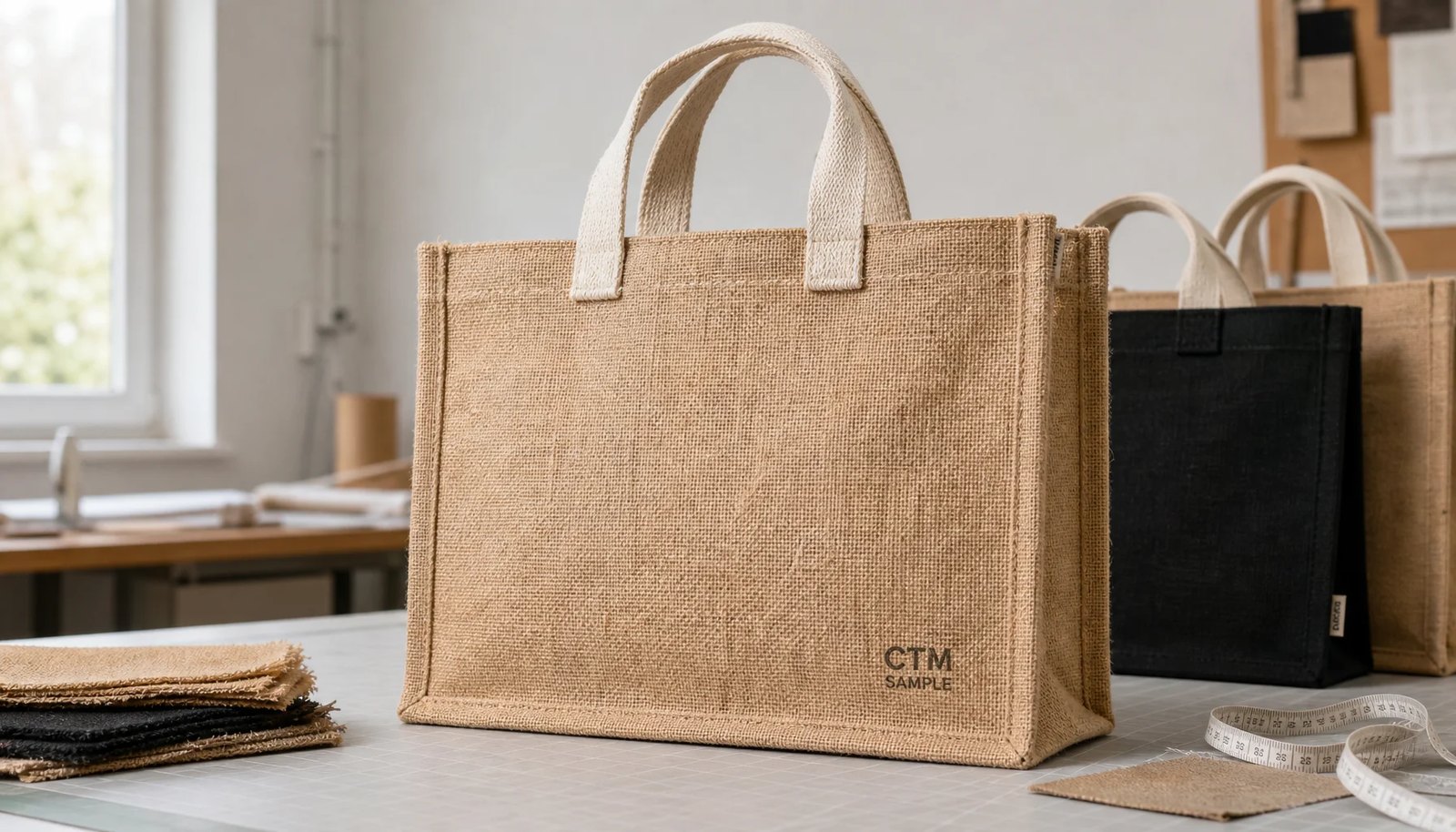
Why bookstore totes fail
University bookstore jute totes are not simple giveaway bags. A single purchase may include a hoodie, hardback textbook, notebooks, drink bottle, chargers, stationery, and small gifts. The tote must carry weight, sit neatly on shelf, show the campus logo clearly, and survive storage before peak retail windows such as move-in, homecoming, graduation, and holiday shopping.
Most failures come from under-specified construction rather than from jute as a material. Two suppliers can quote a natural jute tote at the same size while using different fabric weight, weave density, lamination, handle width, stitch reinforcement, and packing method. Product photos may look similar, but load performance can be very different.
For university bookstores, defects also carry brand risk. A torn handle, cracked mascot print, crooked crest, or musty carton reflects on the campus retailer and the licensed program. A clear durability checklist helps buyers compare quotes, approve samples, and inspect shipments using observable criteria instead of broad claims like premium quality or heavy duty.
- Define the bag’s duty level before asking for price.
- Treat handles, top hem, bottom seam, gussets, print, and packing as separate risk areas.
- Use buyer-defined load targets rather than assuming one universal strength standard.
- Approve physical samples because jute texture, shade, and stiffness vary by batch.
- Make inspection criteria specific enough for the factory and third-party inspector to apply consistently.
Start with use case and load
The RFQ should begin with the intended use. A light admissions giveaway, a one-day conference bag, and a premium alumni retail tote should not share the same specification. If the buyer sends only size, artwork, and target price, the supplier may choose a construction that meets the photo expectation but not the real bookstore load.
A practical approach is to set a working load target. Light programs may use 3-5 kg. Standard bookstore checkout totes often need 5-8 kg. Heavy textbook or premium reusable totes may be designed around 8-10 kg when bag size, gusset, handle width, and seam construction support it. These are procurement targets, not universal industry guarantees.
The test method should be written in the purchase specification. Static hanging shows whether handle anchoring is weak. Repeated lifting is useful because shoppers rarely carry a tote perfectly still. A short carry simulation can reveal top hem distortion and handle discomfort. The goal is not to create an overcomplicated laboratory program; it is to make pass or fail decisions repeatable.
- State expected contents, such as books, apparel, bottles, kits, or gift bundles.
- Define working load separately from maximum breaking load.
- Write the load weight, duration, sample quantity, and pass criteria.
- Include no handle tear-out, no seam opening, and no severe shape distortion in pass criteria.
- Agree whether tested pieces are replaced or counted as inspection consumption.
Specify jute, weave, and lamination
For durable university bookstore use, buyers commonly review jute in the 350-420 GSM range, sometimes described by suppliers as roughly 13-15 oz. GSM is easier to compare across quotes, but it still needs context. A looser weave can feel thick while fraying at seams. A tighter weave may print and stitch better even at a similar weight.
Lamination is a major specification choice. Laminated jute usually improves structure, moisture resistance, and shelf appearance. It can help totes stand upright and may give printing a more stable surface. The tradeoff is that sharp folding can create visible creases, and the hand feel is less soft than unlaminated jute.
Unlaminated jute gives a more natural textile feel and can suit moderate-duty programs when packing and storage are controlled. It may shed more fibers, absorb moisture more readily, and show less crisp logo edges. Neither option is automatically best; the right choice depends on retail positioning, load target, freight route, storage conditions, and logo complexity.
- Request GSM or oz grade with written tolerance.
- Clarify whether fabric weight includes PE lamination.
- Ask for weave density and hand-feel confirmation if comparing close quotes.
- Use laminated jute for structure, moisture resistance, and cleaner retail presentation.
- Use unlaminated jute when softer natural feel is more important than sharp structure.
- Approve acceptable shade variation, slub level, and weave irregularity before bulk cutting.
Engineer the handles
Handles should be treated as load-bearing components. Many weak jute totes fail at the handle attachment while the fabric panel remains intact. Cotton webbing handles are often comfortable and consistent for bookstore retail. A width of about 2.5-4 cm is common, with handle drop chosen for hand carry or shoulder carry.
Reinforcement matters more than a heavy-looking panel. The handle should be inserted securely into the top hem or attached with an approved reinforcement patch. Box stitch, cross stitch, or similar reinforcement helps distribute force. One straight stitch near the edge is usually not enough for repeated lifting with books.
A complete handle specification includes material, width, total length, handle drop, insertion depth, stitch pattern, placement tolerance, and color. If handles are dyed or matched to a campus color, rub checks are important because color transfer can mark light apparel, books, or tissue paper during packing.
- Specify handle material instead of accepting factory standard.
- Set handle width, total length, drop, and tolerance.
- Require reinforced stitching at every handle end.
- Check whether handles are sewn into the hem, onto the panel, or through patches.
- Inspect handle symmetry and distance from side seams.
- Load the sample and watch whether the top hem pulls out of shape.
Design gussets and seams for books
Bookstore contents are often rectangular and heavy, so gusset design affects both capacity and durability. An 8-12 cm gusset is common for practical retail totes, but the right depth depends on intended contents and shelf presentation. A narrow gusset may look tidy in a flat photo but fail to hold textbooks, folded apparel, or bundled orientation items neatly.
The bottom seam and gusset corners deserve close inspection. Books press into the base with hard edges, which can expose weak stitching, uneven seam allowance, or poor corner alignment. If the tote is positioned as a premium product or expected to carry heavy course materials, a bottom insert may improve user experience, but it must be quoted and sampled because it adds cost and packing considerations.
Dimensions should be measured after the bag is opened and squared, not while it is flattened unevenly. Procurement teams should specify height, width, gusset depth, and tolerance so suppliers do not save cost by reducing capacity while keeping the front panel visually similar.
- Match gusset depth to the largest expected contents.
- Inspect bottom seam and gusset corners during sample and bulk review.
- Consider a bottom insert for premium or heavy-use bookstore totes.
- Measure bags fully opened, with the bottom squared.
- Set dimensional tolerance, commonly around +/- 1 cm where feasible.
- Confirm that packing does not crush gusset shape before retail display.
Plan printing around jute texture
University bookstore totes often carry licensed names, crests, mascots, alumni marks, department logos, or event artwork. Jute texture affects print clarity. Large solid artwork usually works better than tiny reversed text, thin serif lettering, detailed crest lines, or tight multi-color registration.
Screen printing is often the practical option for one to three solid colors. Heat transfer can be considered for detailed artwork on some laminated jute surfaces, but adhesion and edge quality must be tested on the actual material. For very fine marks, a woven side label, cotton patch, or simplified artwork may be cleaner than direct printing on coarse jute.
Pantone references are useful, but ink on natural jute will not appear like ink on white coated paper. A strike-off should be approved on the actual production jute grade and lamination. For licensed merchandise, the final approval record should include artwork size, placement, color acceptability, opacity, curing, and rub resistance.
- Avoid fine lines and small text unless proven by strike-off.
- Request print testing on the actual production jute.
- Define logo size, placement from edges, and placement tolerance.
- Ask the factory to flag risky artwork before screens are made.
- Rub test cured prints with dry and slightly damp white cloth.
- Keep licensing or brand approval timelines inside the production schedule.
Approve samples in practical stages
A digital mockup cannot confirm jute durability. First orders, licensed programs, and premium retail totes should move through staged approval: blank construction sample, printed strike-off, and pre-production sample. Each stage answers a different question and reduces later disputes.
The blank sample confirms size, fabric, lamination, gusset, handle comfort, stitching, and structure. The strike-off confirms how the artwork behaves on the chosen jute. The pre-production sample locks the final construction before bulk cutting, printing, and sewing. If any of these stages change, the buyer should confirm whether price, lead time, or inspection criteria also change.
Documentation is important. Keep photos, measurements, written comments, dates, and one approved reference sample. If natural slub, slight shade variation, or textured print edges are acceptable, record that. If musty odor, crooked logo placement, sharp fold marks, or loose handle loops are not acceptable, record those too.
- Approve construction before bulk material commitment when possible.
- Approve the print strike-off before mass printing.
- Keep one approved sample with the buyer and one with the factory.
- Record accepted natural variation and rejected defects.
- Confirm packing method before mass packing starts.
- Recheck sample weight and handle construction if the supplier offers a lower price.
Run a focused pre-shipment inspection
A visual inspection alone is not enough for bookstore jute totes. Inspectors should open cartons from different shipment positions, fully open the bags, square the gussets, measure dimensions, review stitching, test print rub, and perform the agreed load check. The inspection should target the areas most likely to fail in campus use.
Pass/fail language should be objective. Instead of writing check handle strength, state the load, duration, method, and unacceptable results. Instead of writing logo must be good, define placement tolerance, edge clarity, ink coverage, and rub outcome. Clear criteria allow the buyer, factory, and inspector to make the same decision.
Sampling quantity should reflect order value and risk. A small giveaway order may need a lighter inspection plan. A large licensed bookstore order or premium retail tote should include more functional samples, especially for handle load and print rub checks. If testing damages samples, agree in advance how those pieces are handled commercially.
- Measure height, width, gusset, and handle drop against approved tolerance.
- Check stitch density, skipped stitches, loose thread, and secured ends.
- Load test handles using the buyer-defined target and duration.
- Repeat lift loaded samples to expose weak handle anchoring.
- Dry and damp rub printed areas after curing.
- Reject or hold shipments with musty odor, mildew marks, wet cartons, or severe deformation.
Compare suppliers beyond unit price
A lower unit price may reflect a real efficiency, but it may also remove durability. Cost drivers include jute grade, lamination, handle material, stitch reinforcement, gusset depth, print colors, artwork setup, labels, carton liners, packing style, order quantity, and carton volume. Procurement should compare the same specification before choosing a supplier.
MOQ and quantity breaks matter. A 500-piece order carries higher setup cost per bag than a 3,000-piece run because material purchasing, cutting, print setup, and packing preparation are spread across fewer units. Ask for consistent price breaks at realistic quantities so departments, alumni shops, athletics stores, and events teams can consolidate demand where practical.
Freight can change the landed cost. Jute totes are bulkier than many flat promotional bags. Over-compression may reduce carton volume but create creasing and deformation. Buyers should compare FOB or ex-factory price together with carton dimensions, pieces per carton, gross weight, CBM, inspection cost, labels, courier charges, and shipping mode.
- Request price breaks at 500, 1,000, 3,000, and 5,000 pieces.
- Ask what specification changes if the supplier lowers the price.
- Separate sample, screen, artwork, courier, label, and packing charges.
- Compare carton CBM and gross weight, not only unit cost.
- Confirm whether reinforced handle stitching is included.
- Use total landed cost for supplier comparison.
Build lead time around approvals and packing
Jute tote lead time is not only sewing time. The schedule may include sample making, artwork adjustment, strike-off approval, material purchasing, bulk cutting, printing, curing, stitching, trimming, inspection, packing, freight booking, customs, campus receiving, and internal distribution. Delays often come from late logo approval or a failed strike-off, not from the sewing line itself.
University retail calendars are fixed. Move-in, orientation, homecoming, graduation, admissions events, alumni weekends, and holiday campaigns leave little room for rework. Work backward from the in-store or event date and include inspection and freight buffer. If goods must arrive for an event, the RFQ should state the required delivery date and latest acceptable shipment release date.
Packing should be confirmed before production ends. Flat packing or gentle folding is usually safer for laminated jute than sharp compression. Cartons should be dry, lined when needed, and labeled for campus receiving. If distribution is split across bookstore locations, athletic shops, alumni centers, or departments, carton marks and allocation labels should be part of the packing instruction.
- Confirm when production lead time starts: deposit, artwork approval, sample approval, or material receipt.
- Reserve time for brand or licensing review of strike-offs.
- Schedule inspection before the vessel or courier cutoff becomes urgent.
- Request carton size, pieces per carton, gross weight, net weight, and CBM.
- Use carton liners or moisture barriers when route and season require them.
- Define store allocation labels and inner pack quantities before final packing.
Specification comparison for buyers
| Procurement choice | Typical specification range | Best fit | QC risk to control |
|---|---|---|---|
| Main jute fabric | 350-420 GSM, often quoted around 13-15 oz; confirm whether weight is before or after lamination | Reusable bookstore totes carrying apparel, books, bottles, stationery, and gift items | Low or loose GSM may sag, fray at seams, or distort under buyer-defined load targets |
| Lamination or lining | PE-laminated jute for structure and moisture resistance; unlaminated for softer natural hand feel; cotton lining for premium programs | Checkout bags, alumni retail totes, welcome kits, department gifts, and merchandise bundles | Lamination may crease if sharply folded; unlaminated jute can absorb odor or moisture in storage |
| Handle material | Cotton webbing or jute-cotton blend, commonly 2.5-4 cm wide; rope only for light-duty styles | Bookstore totes expected to be comfortable in hand and shoulder carry | Narrow handles or shallow anchoring can tear out before the fabric panel fails |
| Handle reinforcement | Box stitch, cross stitch, or approved reinforcement sewn into top hem; state insertion depth and stitch quality | Standard and heavy bookstore loads, especially textbooks or bundled course materials | Single-line stitching near the edge can open during repeated lifting |
| Gusset and bottom | 8-12 cm side/bottom gusset; optional bottom insert for premium or heavy loads | Retail display, orientation kits, rectangular books, hoodies, drinkware, and gift sets | Weak bottom seam and misaligned gussets reduce capacity and are common failure points |
| Logo decoration | Screen print for solid marks; heat transfer only after adhesion testing on actual jute; patch/label for fine detail | Licensed university logos, mascots, alumni marks, event artwork, and bookstore private label | Fine crest lines and small text may break or fill in on coarse jute texture |
| Dimensional tolerance | Common target: +/- 1 cm on height/width and +/- 0.5-1 cm on handle drop if factory agrees | Multi-store distribution, planograms, kit packing, and repeat reorder programs | Size variation affects capacity, carton count, shelf presentation, and customer perception |
| Packing method | Flat pack or gentle fold in lined master cartons; inner bundles or retail polybags if required | Ocean freight, campus receiving, stockroom storage, and retail merchandising | Over-compression, damp cartons, or sharp folds can cause odor, creasing, mildew, or distorted shape |
Buyer checklist before sampling
- Define the program type: retail checkout tote, orientation kit, conference bag, admissions giveaway, department order, alumni gift, or premium bookstore merchandise.
- Set a buyer-defined working load, such as 3-5 kg for light duty, 5-8 kg for standard bookstore use, or 8-10 kg for heavier textbook programs when construction supports it.
- Specify jute weight in GSM or oz with tolerance, and clarify whether quoted weight includes lamination.
- Confirm laminated, unlaminated, lined, or partially lined construction, including required hand feel, structure, and moisture resistance.
- State finished dimensions: height, width, gusset depth, handle width, total handle length, handle drop, and acceptable tolerance.
- Define handle material, insertion depth, reinforcement stitch pattern, thread finish, and placement symmetry before comparing quotes.
- Require a blank construction sample, print strike-off on actual production jute, and pre-production sample for first orders or licensed programs.
- Write the load test method, weight, duration, sample quantity, and pass criteria instead of asking generally for strong handles.
- Approve artwork size, placement tolerance, Pantone targets, minimum line thickness, and strike-off review process for university marks.
- Inspect dimensions, handle stitching, bottom seam, gusset corners, print adhesion, odor, carton condition, labels, and packing before shipment release.
Factory quote questions to send
- What exact jute GSM or oz grade is included, what tolerance applies, and is the stated weight before or after lamination?
- Can the same jute grade, weave density, lamination, and handle material used in the sample be reserved for bulk production?
- Is the bag laminated, unlaminated, cotton lined, or partially lined, and what film or lining specification is included?
- What handle material, width, total length, drop, insertion depth, stitch pattern, and reinforcement are included in the quoted unit price?
- What buyer-defined load test can you perform on this construction, at what weight, duration, and sample quantity, and what counts as failure?
- Which print method do you recommend for our artwork on this jute surface, and can you provide a strike-off on the actual production fabric?
- Which artwork details may need adjustment because of jute texture, such as fine crest lines, small text, thin borders, or multi-color registration?
- What are the MOQ and price breaks at 500, 1,000, 3,000, and 5,000 pieces for the same specification?
- Are sample charges, screen charges, artwork setup, courier fees, labels, carton liners, inspection support, and special packing included or separate?
- How many days are required for proto sample, strike-off, pre-production sample, bulk cutting, printing, curing, sewing, inspection, and packing?
Quality-control points to confirm
- Measure finished size after fully opening the bag, squaring the gusset, and smoothing the panels without stretching the jute.
- Verify ordered GSM or oz grade through material records, weight checks, or agreed factory documentation, including whether lamination is counted.
- Compare bulk jute shade, slub level, weave openness, lamination appearance, hand feel, and structure against the approved pre-production sample.
- Test handles using the agreed load, duration, and method; check for handle tear-out, top hem opening, seam slippage, or severe distortion.
- Inspect box stitches, cross stitches, top hem, gusset corners, bottom seam, skipped stitches, broken thread, loose loops, and trimming.
- Check handle width, handle drop, handle alignment, color, symmetry, and distance from side seams on both front and back panels.
- Rub printed areas with a dry white cloth and a slightly damp white cloth after curing to check transfer, flaking, or visible logo damage.
- Review print placement, registration, opacity, edge clarity, curing, ink coverage, and color appearance on the textured jute surface.
- Open cartons from different pallet or shipment positions to check moisture odor, mildew marks, crushed corners, sharp folds, and bag deformation.
- Confirm carton marks, barcodes, hangtags, warning labels if polybags are used, inner bundle quantities, and campus distribution labels.