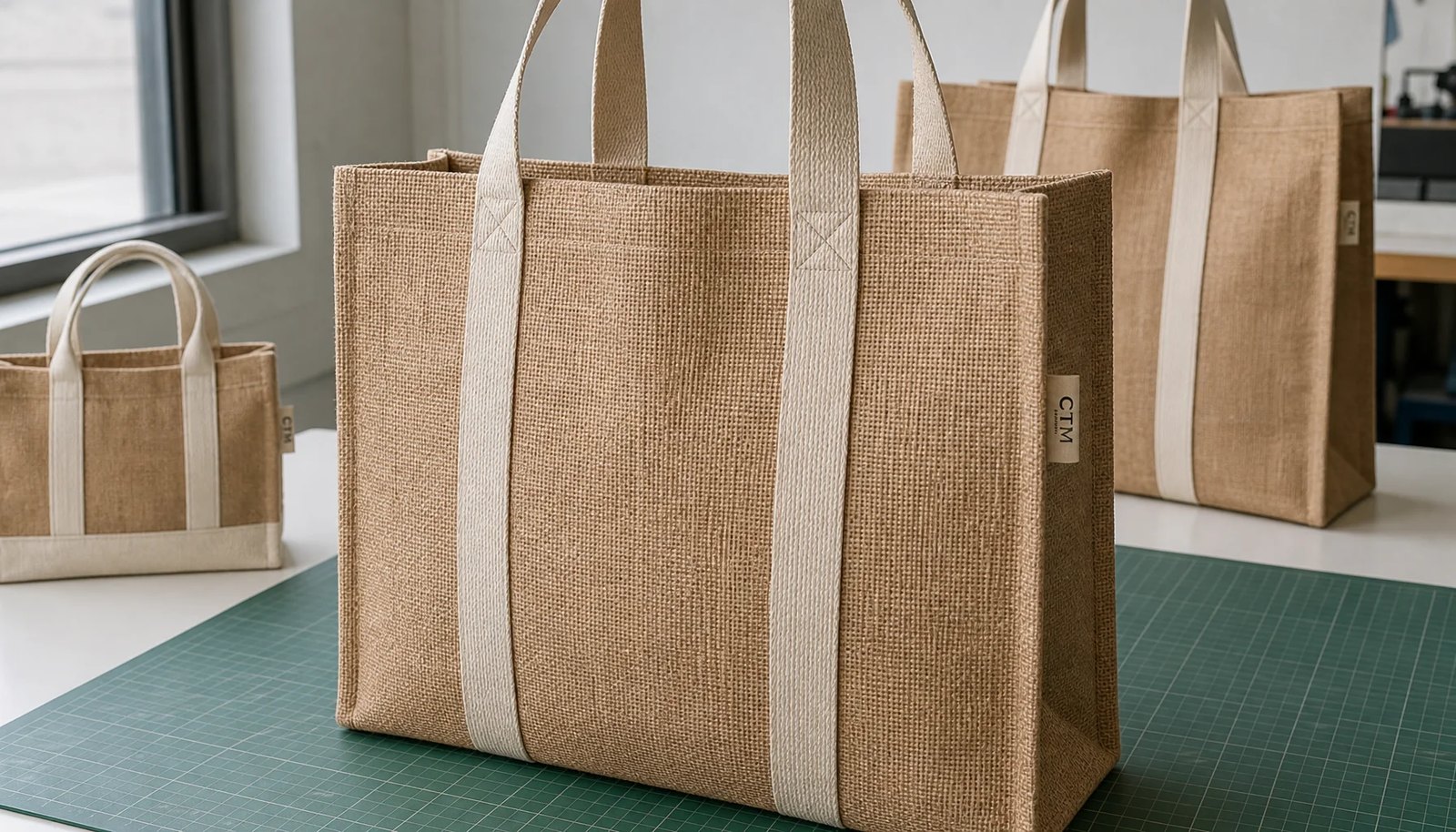
Start with the trade show job, not the tote
Jute tote bags for trade show exhibitors have to do more than look pleasant in a sample photo. At the event, they may carry booth literature, product sheets, retail samples, water bottles, sponsor inserts, or a full set of handouts collected across the hall. They also move through warehouses, event contractors, hotel storage rooms, booth setup, and attendee traffic. That path should shape the specification before anyone talks about logo size.
The proofing conversation becomes much easier when procurement names the real use case. A light brochure giveaway can use a different construction than a bag expected to hold catalogs and boxed samples. A sponsor-facing tote may need tighter print control than a general attendee handout. A distributor program with regional versions needs clearer version tracking than a single exhibitor order. These are buying details, not decoration details.
Jute adds another layer of reality. It is a coarse natural fiber, not a smooth white print surface. Yarn thickness varies, small slubs appear, and the base shade can move from pale straw to deeper tan between material lots. Ink can absorb unevenly, edges can break slightly, and some colors look warmer or duller than they do on coated paper. A digital layout can confirm spelling and composition, but it cannot prove how the printed mark will sit on woven jute.
For B2B buyers, the approved proof is also a commercial control. It should connect the supplier quote, artwork file, physical sample, purchase order, and inspection standard. If those documents disagree on GSM, handle drop, print size, placement, lining, or packing, the bulk order starts with an avoidable argument built into it.
- Define the expected contents before choosing GSM, gusset depth, handle width, and reinforcement.
- Treat the proof as a production reference, not only as a marketing preview.
- Approve the same bag construction that will be used for bulk production.
- Keep the quote, artwork, sample approval, and purchase order under the same revision date.
Freeze construction before artwork approval
The bag build controls the print area. Finished width, finished height, gusset depth, top hem, handle anchors, lining, lamination, and seam allowance all influence where a logo can sit cleanly. If the bag size or handle position changes after artwork approval, a logo that looked centered on the artboard may sit too low, drift toward a side seam, or crowd the handle stitching on the finished tote.
A practical sourcing range for many trade show jute totes is 250 to 350 GSM. Lighter jute may be suitable for high-volume literature bags where carton efficiency and cost matter. Heavier jute can give more structure for premium giveaways, heavier inserts, or retail-style presentation. Lining can make the interior neater and reduce loose-fiber contact with contents, but it adds cost, weight, packing volume, and sometimes lead time. Lamination or backing may change surface behavior, so it should be declared before proofing.
Handles deserve the same level of detail as the bag body. Cotton webbing handles are common because they feel comfortable and can be color coordinated, but they are not one fixed specification. Buyers should state width, drop, tape color, attachment style, stitch pattern, and reinforcement method. A 25 mm handle may work for a light handout tote; a 40 mm handle with box stitching or bar-tacks may be more appropriate when the bag will carry catalogs, bottles, or samples.
Procurement should avoid approving artwork on a loose or partial sample unless everyone understands what is missing. A print strike-off on a fabric panel is useful for color and edge quality, but it will not confirm handle relationship, seam distortion, gusset behavior, or final hanging balance. A sewn pre-production sample answers more questions because it shows the finished product as the attendee will use it.
- Put finished size, gusset, GSM, fabric shade, lining, lamination, handle width, handle drop, handle color, stitch pattern, print method, and packing method in the RFQ.
- Ask whether finished dimensions are measured flat, opened, or after packing recovery.
- State size tolerance in millimeters and ask the factory to confirm what it can hold.
- Do not release screens until the bag construction and print panel are fixed.
Design the artwork for woven jute
Jute rewards bold artwork. It is less friendly to fine serif type, hairline rules, tiny reversed text, gradients, halftones, photo effects, and dense sponsor blocks. The aim is not to force paper-level precision onto a textured fabric. The aim is to make the logo and message look intentional when printed over an uneven weave and viewed in a busy exhibition aisle.
For most exhibitor tote programs, one or two color screen printing is the most predictable route. Large logos, short booth messages, simple icons, strong sponsor marks, and bold URLs usually perform better than crowded layouts. If the bag must carry multiple sponsors, ask whether the smallest marks can be enlarged, simplified, moved to a hang tag, or printed on an insert card. That decision often protects brand legibility better than squeezing every detail onto the front panel.
Vector artwork should be the default. Fonts should be outlined, colors clearly named, and artboards matched to the intended print area. The approval file should call out print width, print height, location from top edge, location from centerline or side seam, and orientation relative to the handles. For a gusseted bag, also check whether the print sits on a panel that remains flat in use or crosses a fold line.
Pantone targets are useful, but they should not be treated as a promise that jute will match coated paper. The tan base color and matte fiber surface will influence the result. White may appear softer. Navy, green, and red may look warmer or less saturated. Black can show texture because raised yarns and open spaces interrupt the ink film. The physical proof is the practical color standard.
- Use bold logos, high contrast, and generous spacing.
- Ask for safe minimums for line thickness, reverse gaps, text height, and registration spacing before screen making.
- Avoid tight multi-color registration unless the supplier proves it on the same jute construction.
- Move dense legal copy, long web addresses, QR alternatives, or regional details to inserts, tags, or labels when the bag print would become unreadable.
Choose the proof type based on risk
A digital proof is useful, but it has a narrow job. It can confirm spelling, artwork version, scale, color names, and approximate placement. It cannot show the actual jute shade, ink absorption, edge breakup, rub resistance, handle relationship, or placement shift after sewing. For a repeat order using the same supplier, same construction, same print method, and same retained master sample, a digital proof may be enough to release production. For a first order, it is usually too thin a control.
A physical strike-off tests the print on jute. It helps buyers judge color direction, ink density, broken edges, line survival, and readability. A full pre-production sample goes further because it shows the sewn bag, handles, gusset, seams, lining, and print placement together. When the event date is fixed and the artwork is brand-sensitive, the full sample is often worth the extra time because it prevents separate print and sewing assumptions from colliding later.
The buyer should ask what the proof truly represents. Was it made from the same material lot planned for bulk? Was the same ink system used? Is the screen mesh the same? Will bulk be printed before or after sewing? Was the sample cured the same way? Will the packing method be the same? A good-looking sample is reassuring only if the production route can repeat it.
Written approval should name the approved sample, artwork revision, date, and any accepted deviations. If the buyer accepts a slightly textured edge or a warmer color because it is normal on jute, note that. If the buyer rejects a small text size or requests a placement change, document the corrected measurement. The more specific the approval, the less room there is for memory-based production decisions.
- Use digital proofs for spelling, layout, version, and broad scale checks.
- Use strike-offs for color, edge quality, ink density, detail survival, and rub checks.
- Use full pre-production samples for finished placement, handle relationship, construction, and pack-out review.
- Require the factory to retain an approved counter-sample for production and inspection comparison.
Make supplier quotes comparable
Jute tote quotes can look similar while describing different products. One factory may price 250 GSM unlined jute, basic cotton handles, a digital proof, and loose bulk packing. Another may include 320 GSM jute, lining, reinforced handles, a physical sample, stronger export cartons, inner liners, and clearer inspection steps. The unit price alone does not tell procurement whether the same bag is being quoted.
Every supplier should respond to the same controlled specification. The quote should separate base bag cost, print setup, screen or plate cost, sample fee, artwork revision fee, reproof charge, packing cost, export carton cost, labels, freight basis, inspection support, and trade terms. When those items are buried, a buyer may discover the real cost only after the sample round starts.
MOQ also needs detail. A headline MOQ may not cover multiple bag sizes, fabric colors, handle colors, print colors, artwork versions, carton labels, or delivery destinations. A bilingual layout, sponsor update, regional logo, or different handle color can require separate screens and separate production tracking. For distributor and multi-event programs, procurement should ask for MOQ by version rather than assuming all units can be pooled.
The quality of the supplier's questions is part of the evaluation. A capable factory will ask about print size, artwork detail, Pantone target, finished placement, packing plan, approval timing, and event deadline. A quote that accepts vague artwork and a vague bag description without questions may simply be moving risk into the sample stage.
- Compare quotes only after GSM, size, lining, handles, print method, proof scope, packing, and trade terms match.
- Separate one-time charges from unit price.
- Ask for MOQ by bag size, fabric color, handle color, print color count, artwork version, packing style, and destination.
- Confirm whether quote validity depends on fabric availability, seasonal capacity, exchange rate, or freight assumptions.
Inspect samples with measurements, not impressions
A pre-production sample should be reviewed with the purchase order, artwork approval, and ruler on the table. Start with finished width, finished height, gusset depth, handle drop, handle width, print width, and print height. Then measure placement from finished physical reference points. Top edge, side seam, centerline, bottom gusset, and handle anchor are more useful than the digital artboard once cutting and sewing have happened.
Print inspection should be practical and direct. Look for broken edges, pinholes, patchy absorption, heavy fill-in, poor registration, uneven density, fiber contamination, and visible weave interference. View the bag close up and at a normal aisle distance. Some surface texture is expected on jute. Unreadable sponsor names, filled-in letters, or a logo that looks damaged are different matters.
Construction inspection matters because the bag is a carrier, not a poster. Check handle stitching, top hem, side seams, bottom gusset, lining capture, corner strength, loose threads, raw edges, and distortion around the print panel. Load the sample with representative contents. If the handles twist, the seams pull, or the print panel creases sharply under normal use, the sample is telling you something useful before the order becomes expensive.
Packing should be tested on the sample too. Fold or nest the bag the way the factory plans to pack it. Check whether the logo receives a hard crease, whether handles press into the print, and whether adjacent surfaces pick up ink. If the order will sit in storage before the show, ask how the supplier controls moisture, carton strength, and recovery after unpacking.
- Record approved finished dimensions and placement in millimeters.
- Review color and readability under consistent light and typical indoor exhibition lighting.
- Rub the cured print lightly with a clean cloth to check transfer or smearing.
- Load the bag with realistic contents before approving handle strength and seam behavior.
Set QC tolerances before production starts
Inspection language should be specific enough for someone outside the approval meeting to use. Phrases such as good print, strong handles, and same as sample are helpful as intent, but weak as inspection standards. The purchase order or QC sheet should define the defects that matter most for printed jute totes.
Critical defects may include wrong artwork, wrong event version, severe print smearing, broken handles, mildew, foreign contamination, or unsafe construction. Major defects may include obvious placement error, unreadable text, open seams, incorrect size beyond tolerance, severe color mismatch from the approved sample, or missing carton labels. Minor defects may include small loose threads or slight natural fiber irregularities that do not affect use or overall appearance.
Dimensional tolerances need to be agreed with the factory before cutting begins. For sewn fabric bags, buyers and suppliers often discuss tolerances in millimeters because cutting, sewing, and natural fibers do not behave like rigid materials. The exact tolerance depends on bag size, construction, and the sensitivity of the artwork. A logo that nearly touches a handle anchor needs tighter placement control than a large centered mark with open space around it.
In-line inspection is useful for print-heavy orders. The first approved production pieces should be checked before the full run continues, especially when small text, two-color registration, or a strict placement target is involved. Final inspection should then confirm finished size, print quality, construction, packing, carton marks, and version separation against the approved sample and purchase order.
- Classify wrong artwork, wrong version, severe smear, handle failure, mildew, and severe contamination as high-priority defects.
- Set finished-size, print-size, and print-placement tolerances in millimeters.
- Measure print placement from finished bag reference points, not from the digital file alone.
- Require first-off print approval and final inspection photos separated by artwork version when the order has multiple event designs.
Control color, cure, and rub resistance
Color approval on jute should be grounded in the actual material. Pantone references help the factory aim, but natural fiber shade, weave density, and ink absorption affect the finished look. Buyers should expect some difference between a coated-paper swatch and the printed tote. The question is whether the printed color is acceptable on the approved jute, not whether the fiber can behave like paper.
Ink cure is a production risk that often hides until packing. Under-cured ink can smear, transfer to adjacent bags, mark carton liners, or scuff during handling. Too much ink can make a logo feel heavy and cause small gaps or letters to fill in. The factory should confirm its drying or curing process, the time required before packing, and whether the printed bags are stacked, hung, or otherwise handled during cure.
Rub resistance does not need to be overcomplicated, but it should be checked. A light cloth rub after curing can reveal transfer. Stacking several printed bags can show whether ink offsets onto the next bag. Folding through the print area can show whether a crease breaks the ink film. These checks are especially important when the schedule is tight and packing starts soon after printing.
If the supplier changes material lot between proof and bulk, ask how color and absorption will be controlled. A slightly different jute shade can change the apparent ink color. A different weave density can change edge clarity. For brand-sensitive orders, review first bulk pieces before the entire run is printed.
- Approve printed color on the actual jute, with Pantone treated as a target reference.
- Confirm cure or drying time before packing begins.
- Check for ink transfer between stacked, nested, or folded bags.
- Ask for first bulk print photos or retained samples when the material lot changes after proof approval.
Plan packing, moisture control, and carton labels
Packing is part of the product, especially for trade show orders. Jute can absorb moisture, hold creases, and pick up odor if storage conditions are poor. A bag that looked good at the factory can arrive wrinkled, musty, or scuffed if the carton plan is weak. Procurement should approve packing before bulk production, not after the totes are already finished.
Bulk nested packing can reduce sharp fold lines and may be efficient for high-volume orders. Controlled flat packing can work when carton dimensions and fold direction keep pressure away from the main print. Individual sleeves can protect against handling, but they add cost, labor, and packaging waste. Many B2B buyers choose bulk packing with an inner liner when it suits the freight route, warehouse handling, and sustainability requirements.
Moisture control deserves early attention. Ask whether inner liners, desiccants, carton strength, pallet wrapping, or route-specific handling steps are recommended for the season and freight mode. Ocean freight, humid storage, long warehouse dwell time, and event-contractor intake can all increase risk. The goal is not to add packaging automatically; it is to choose controls that match the route.
Carton information should be confirmed before freight booking. Pieces per carton, carton dimensions, gross weight, net weight, packing orientation, carton marks, and version labels all affect logistics. If the goods are going to an advanced warehouse or event contractor, labels may need PO number, booth name, event name, exhibitor name, destination, and shipment reference. For multi-version orders, clear carton marks prevent the wrong logo from reaching the wrong booth.
- Confirm nested, flat, sleeved, or bulk packing before sample approval.
- Keep fold lines and handle pressure away from the primary print area where possible.
- Use inner liners, desiccants, or moisture-resistant handling when the route and season justify them.
- Approve carton marks for PO, SKU, artwork version, quantity, destination, event name, and booth or warehouse reference.
Build the schedule backward from the event date
The safest lead time starts after written proof approval and receipt of all production inputs. Inquiry date and PO date can be misleading if artwork is still changing, sample transit is not included, carton labels are missing, or the deposit has not been received. Trade show delivery dates do not move easily, so procurement should build the calendar from the required arrival date backward.
Separate the schedule into steps: artwork review, proof preparation, sample transit, buyer review, correction round, bulk material preparation, printing, sewing or finishing, curing, final inspection, packing, export documents, freight booking, transit, warehouse intake, and delivery to the event channel. This makes hidden time visible. It also shows where a late marketing change will affect the real deadline.
Stakeholder approval should be assigned before sampling. Marketing may own logo color and layout. Sales may own booth message. Procurement may own cost and supplier terms. A distributor or event team may own delivery labels and routing. If these roles are unclear, the first physical proof can trigger a late redesign, new screens, and a revised production date.
A correction buffer is sensible for new jute tote programs. The first strike-off may show that a line is too thin, the color is too muted, the print sits too close to the handle, or the fabric shade needs review. Finding that before bulk production is normal. Finding it after the goods are printed, packed, or booked for freight is when the order becomes difficult to recover.
- Ask for sample lead time, sample transit time, buyer review time, bulk lead time, inspection time, and freight time as separate lines.
- Freeze artwork, construction, handle color, packing method, and carton marks before final sample approval.
- Add time for one correction round when brand color, small details, or multi-version artwork matters.
- Use confirmed carton data before booking freight, warehouse intake, or event-site delivery.
Specification comparison for buyers
| Spec decision | Recommended option | When it fits | Buyer risk to check |
|---|---|---|---|
| Production route | Direct jute bag factory with confirmed sewing, finishing, and print control | Repeat exhibitor programs, distributor orders, custom sizes, and orders where the approved proof must match bulk production | Confirm whether printing is in-house or subcontracted, who approves color, and whether subcontracting can change after sign-off |
| Proofing route | Physical strike-off or full pre-production sample on the same bag construction | First orders, strict brand standards, large quantities, multi-version campaigns, or fixed trade show delivery windows | Digital proofs do not show jute shade, ink absorption, edge breakup, rub resistance, or final placement after sewing |
| Print method | 1 to 2 color screen print with artwork simplified for coarse woven jute | Exhibitor logos, sponsor marks, short booth messages, QR alternatives, and high-volume giveaway programs | Fine gradients, small reverse text, thin serifs, tight registration, and dense sponsor lists often lose clarity on jute |
| Fabric build | 250 to 350 GSM natural jute, with lining or lamination only when required by the use case | Standard trade show totes carrying brochures, light samples, catalogs, inserts, or retail leaflets | Lighter fabric can distort under ink; heavier, lined, or laminated builds affect MOQ, carton volume, freight cost, and print behavior |
| Handle construction | Cotton webbing handles, commonly 25 to 40 mm wide, with X-box, box-stitch, or bar-tack reinforcement | Bags expected to carry catalogs, boxed samples, water bottles, giveaways, or multi-booth handouts | Ask for handle drop, tape width, stitch pattern, thread quality, and load expectation; weak handles create a functional failure even when the print is correct |
| Artwork approval | Locked vector artwork with Pantone targets, print size, placement dimensions, and minimum line/text rules | Procurement teams managing marketing approval, distributor clients, regional versions, or sponsor artwork | Verbal layout approval causes disputes; approval files should define measurable placement from finished bag reference points |
| MOQ structure | MOQ separated by bag size, fabric color, handle color, print color count, and artwork version | Regional campaigns, bilingual layouts, sponsor variants, staggered events, and split shipments | A single headline MOQ can hide separate screen charges, reproofing costs, version setup, carton labels, and inefficient split runs |
| Packing route | Bulk nested or controlled flat packing in export cartons, with inner liners or moisture protection when the route requires it | Ocean freight, warehouse intake, event-contractor delivery, distributor warehouses, and longer storage before the show | Jute absorbs moisture and can crease; carton density, fold direction, desiccants, liner bags, and storage time affect arrival condition |
| Schedule route | Bulk lead time starts after written sample approval and receipt of all production inputs | Event dates, advanced warehouse deadlines, booth shipment cutoffs, and retail-style launch windows | Late artwork revisions, slow proof approval, missing carton data, and delayed freight booking are often bigger risks than sewing time |
Buyer checklist before sampling
- Issue one controlled specification sheet before sampling: finished width and height, gusset depth, jute GSM, fabric color, lining or lamination status, handle material, handle width, handle drop, stitch pattern, print method, packing method, and destination.
- Use millimeters for print measurements: logo width and height, distance from top edge, distance from side seam or centerline, distance from bottom gusset if relevant, and relationship to handle anchors.
- State a realistic finished-size tolerance in the purchase order, commonly discussed as plus or minus 5 to 10 mm depending on bag size and construction, then ask the factory to confirm what it can hold.
- Approve artwork for jute, not for paper: ask the printer to identify unsafe line weights, small text, reverse gaps, gradients, halftones, and registration areas before screen making.
- For first-time or brand-sensitive orders, require a physical strike-off or full pre-production sample using the same jute build, print method, ink system, handle placement, and finishing process planned for bulk.
- Define the practical color standard as the approved physical sample, supported by Pantone references where needed, because natural jute warms, dulls, or darkens many printed colors compared with coated paper.
- Request a quote that separates base bag price, print setup, screen or plate cost, sample fee, artwork revision cost, packing, export cartons, labels, freight basis, and reproofing charges.
- Ask whether proof and bulk production will use the same jute lot; if not, require controls for fabric shade, weave density, stiffness, odor, moisture condition, and print absorption between lots.
- Reserve schedule time for at least one correction round if the first strike-off shows broken edges, color drift, text fill-in, placement error, fabric shade concern, or poor rub resistance.
- Confirm MOQ by bag size, fabric color, handle color, print color count, artwork version, packing method, and ship-to destination when the program includes multiple events or regions.
Factory quote questions to send
- What are the exact finished dimensions, gusset depth, jute GSM, fabric color, lining or lamination status, and expected tolerance on the finished bag?
- Is the jute natural, dyed, bleached, laminated, lined, or treated in a way that changes ink absorption, stiffness, odor, or surface texture?
- What print method do you recommend for this artwork, and what minimum line thickness, gap width, reverse space, and text height are safe on this weave?
- Will the proof be a digital proof, physical strike-off, sewn pre-production sample, or both strike-off and full sample? What is included in the quoted cost?
- Will the proof use the same material lot, ink system, screen mesh, curing process, handle placement, and packing method as bulk production? If not, what will differ?
- What is the MOQ per bag size, fabric color, handle color, print color count, artwork version, and packing style?
- What is included in the unit price, and what is charged separately for screens, setup, sampling, artwork revisions, reproofs, packing, export cartons, carton labels, inspections, and freight?
- What are the carton quantity, carton dimensions, gross weight, net weight, and packing orientation? Are bags nested, folded, flat packed, sleeved, or bulk packed with an inner liner?
- What lead time applies after written proof approval, and which steps are outside that clock, such as artwork correction, sample transit, buyer review, deposit receipt, fabric procurement, or freight booking?
- How do you measure print alignment on finished bags: from top edge, side seam, centerline, bottom gusset, handle anchor, or another reference point?
Quality-control points to confirm
- Finished bag dimensions measured after sewing and before packing: width, height, gusset depth, handle drop, print size, and tolerance against the approved sample and purchase order.
- Logo placement measured from finished physical points: top edge, side seam, centerline, bottom gusset, and handle anchors, not only from the digital artboard.
- Color reviewed against the approved physical sample under consistent light, with Pantone references treated as targets rather than guaranteed coated-paper matches on natural jute.
- Minimum text height, line thickness, reverse gaps, and registration spacing verified on the physical weave before screens are released for bulk production.
- Ink coverage checked for broken edges, pinholes, patchy absorption, heavy fill-in, uneven density, fiber contamination, and visible weave interference at normal viewing distance.
- Ink cure and rub resistance checked after drying so print does not smear, transfer to adjacent bags, mark carton liners, or scuff during handling.
- Handle strength inspected at X-box stitching, box stitching, bar-tacks, tape ends, and seam capture points, especially for bags intended to carry catalogs or product samples.
- Side seams, top hem, and bottom gusset checked for skipped stitches, loose threads, uneven folding, weak corners, raw edges, and distortion around the print panel.
- Handle length, handle symmetry, and handle placement measured on finished bags so the tote hangs evenly and does not twist when loaded.
- Fabric lot consistency reviewed for color, smell, stiffness, weave density, yarn slubs, broken fibers, stains, oil marks, mildew signs, and contamination between proof and production.